
The loss of high-value lyophilized material during reconstitution isn’t an inevitable research hazard; it’s a failure of methodological rigor. Guesswork has no place in the laboratory. Even a single instance of irreversible peptide aggregation can invalidate weeks of analytical data. Implementing a standardized peptide solubility testing protocol is the only way to ensure that every milligram of material is utilized with absolute precision.
You’ve likely experienced the frustration of inaccurate assay concentrations caused by incomplete dissolution or the sudden precipitation of a sequence mid-experiment. This article provides a systematic hierarchical approach to peptide solubilization, designed to maximize stability and ensure 100% transparency in your research solutions. We’ll preview the specific solvent hierarchy, beginning with the least invasive aqueous methods and progressing to specialized organic additives, to provide a clear roadmap for successful reconstitution without sacrificing molecular integrity.
Key Takeaways
- Perform a predictive sequence analysis to identify potential hydrophobic regions and determine the most appropriate initial solvent system.
- Utilize the “Aliquot Rule” within your peptide solubility testing protocol to preserve the bulk sample while identifying the optimal reconstitution parameters.
- Follow a rigorous solvent hierarchy that balances effective dissolution with the maintenance of biological activity and sample stability.
- Mitigate the risk of the “salting out” effect by meticulously managing the transition from sterile water to high-ionic strength buffers.
- Leverage independent HPLC and Mass Spectrometry reports to establish verifiable baseline metrics for purity and solubility before initiating laboratory procedures.
Theoretical Framework: Predictive Assessment of Peptide Solubility
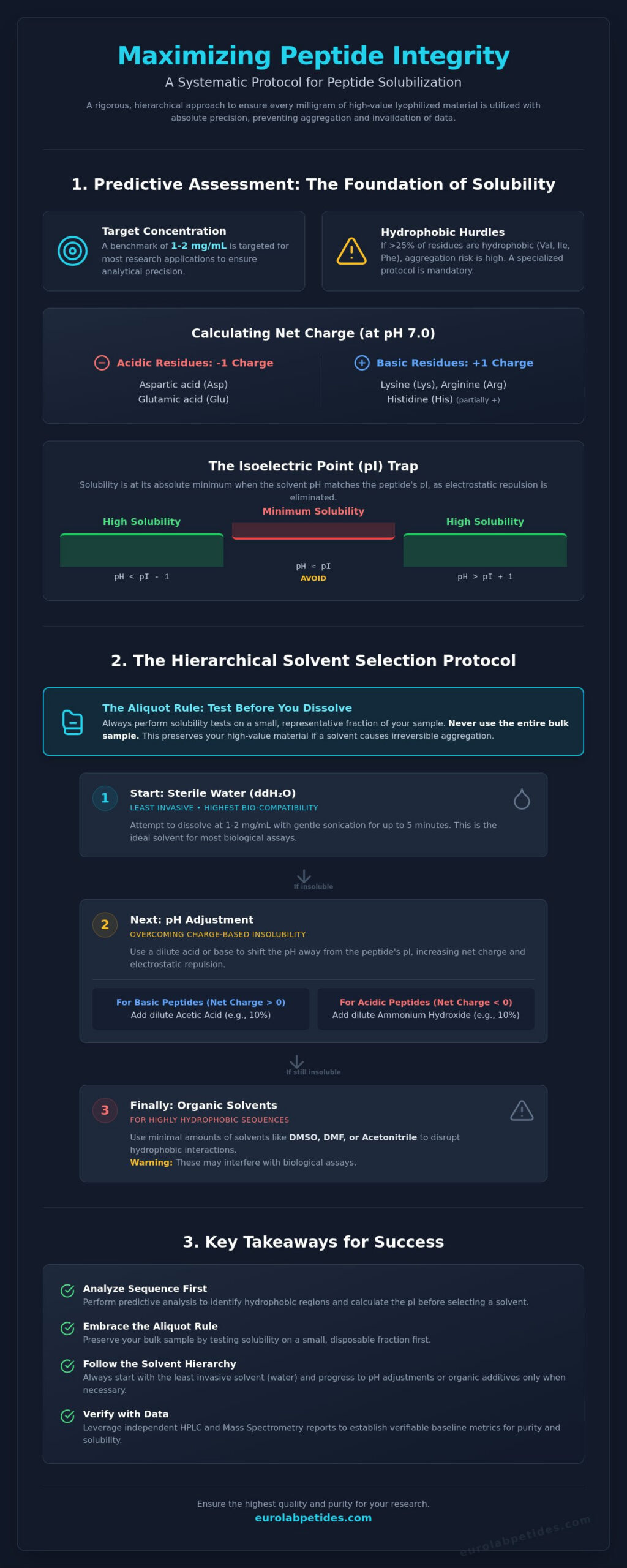
Peptide solubility is defined as the maximum concentration of a peptide that remains in a stable, clear solution without visual evidence of precipitation or aggregation. In analytical chemistry, this is a verifiable metric that dictates the feasibility of subsequent assays. For standard research applications, a concentration benchmark of 1-2 mg/mL is typically targeted to ensure analytical precision and avoid the effects of molecular crowding. Achieving this benchmark requires a rigorous Predictive Assessment of Peptide Solubility based on the specific primary sequence of the molecule.
The ratio of hydrophilic to hydrophobic residues dictates the initial success of the peptide solubility testing protocol. Primary sequences are analyzed for their polarity, where the presence of non-polar side chains increases the risk of sample degradation during reconstitution. Modifications like N-terminal acetylation or C-terminal amidation significantly alter the molecule’s polarity. These chemical modifications remove terminal charges, which often increases the overall hydrophobic character of the sequence. Such alterations necessitate a more aggressive solvent hierarchy to ensure the peptide doesn’t remain in a suspended, insoluble state.
Calculating Net Charge and Isoelectric Point
The net charge of a peptide is a primary predictor of its behavior in aqueous environments. Researchers must assign specific charge values to ionizable side chains at a neutral pH of 7.0. Acidic residues, such as Aspartic acid (Asp) and Glutamic acid (Glu), carry a -1 charge, while basic residues like Lysine (Lys) and Arginine (Arg) carry a +1 charge. Histidine (His) is considered partially positive at this pH. The summation of these charges determines the isoelectric point (pI), which is the specific pH where the peptide maintains no net electrical charge.
Solubility is consistently at its absolute minimum when the solvent pH matches the peptide’s pI. When the net charge is zero, electrostatic repulsion between molecules is eliminated, facilitating rapid aggregation. Standard laboratory procedures dictate avoiding pH environments within one unit of the calculated pI. If the peptide’s pI is 7.0, a buffer at pH 6.0 or 8.0 is required to maintain a stable solution.
The Influence of Secondary Structure on Dissolution
A peptide’s primary sequence doesn’t always provide a complete picture of its solubility profile. Beta-sheet forming sequences, characterized by high concentrations of residues like Valine (Val), Isoleucine (Ile), or Phenylalanine (Phe), often resist standard aqueous solvents. These “difficult” residues promote inter-chain hydrogen bonding. This results in the formation of stable, insoluble aggregates even when the overall charge suggests the peptide should be soluble.
Sequences containing poly-Val or poly-Ile clusters are particularly prone to this behavior. The secondary structural stability of these aggregates often overrides the influence of charged residues. Predicting solubility hurdles involves calculating the ratio of charged to uncharged residues. If more than 25% of the sequence consists of hydrophobic amino acids, a specialized peptide solubility testing protocol involving organic modifiers or pH adjustments is mandatory to disrupt these structural barriers.
The Hierarchical Solvent Selection Protocol
The systematic selection of solvents is a primary component of a rigorous peptide solubility testing protocol. Solvents are categorized by their degree of “invasiveness” relative to the intended biological assay. Minimal interference with downstream analytical precision is the objective. It’s essential to recognize that solvent choice isn’t just about dissolution; it’s about maintaining the peptide’s integrity for its specific application.
The “Aliquot Rule” is the fundamental prerequisite of this peptide solubility testing protocol. Solubility testing isn’t performed on the bulk lyophilized sample. Instead, a small representative fraction is utilized to determine the optimal solvent system. This prevents the irreversible loss of the entire batch if a specific solvent causes immediate aggregation. If the test aliquot fails to dissolve, the material hasn’t been wasted, and alternative methods can be explored safely.
Sterile, deionised, and degassed water (ddH2O) serves as the primary solvent of choice. Dissolution in water maintains the highest level of compatibility with most in-vitro models. If the peptide remains insoluble at the 1-2 mg/mL benchmark after five minutes of gentle sonication, the protocol dictates a transition to pH-adjusted or organic systems. Standardized procedures ensure that these transitions are documented and reproducible.
Step 1: Aqueous and Polar Systems
Initial attempts at solubilization involve sterile water or physiological buffers such as Phosphate-Buffered Saline (PBS) or Tris. The sequence’s net charge, as calculated in the theoretical framework, dictates specific adjustments. Basic peptides, which have a net charge greater than zero at pH 7.0, often require 0.1% Acetic Acid to facilitate dissolution. Conversely, acidic peptides with a net charge less than zero are treated with 0.1% Ammonium Hydroxide. These minor pH shifts provide sufficient electrostatic repulsion to overcome intermolecular forces. Researchers who utilize validated research peptides often find that these minor adjustments are sufficient for the majority of sequences.
Step 2: Organic Co-solvents and Additives
When aqueous systems fail to achieve the required concentration, organic co-solvents are introduced. Dimethyl Sulfoxide (DMSO) is utilized as a universal solvent for highly hydrophobic sequences. While effective, DMSO concentration must be strictly monitored to prevent cytotoxicity in biological assays. For applications involving HPLC analysis, Acetonitrile (ACN) or Dimethylformamide (DMF) are the preferred choices. In cases of extreme insolubility where secondary structures dominate, chaotropic agents such as 6M Guanidine-HCl or 8M Urea are employed to disrupt hydrogen bonding and facilitate complete reconstitution.
Step-by-Step Peptide Solubility Testing Procedure
Execution of a rigorous peptide solubility testing protocol begins with the mechanical consolidation of the lyophilized material. Centrifugation of the primary vial at 10,000 x g for a duration of 30 to 60 seconds is mandatory. This process ensures that the peptide powder is consolidated at the base of the vessel, preventing the loss of material that often adheres to the cap or sidewalls during transit. Once consolidated, a precise mass of 0.5 mg to 1.0 mg is transferred to a secondary, sterile microcentrifuge tube. This aliquot serves as the testing substrate, preserving the bulk of the research material from potential contamination or irreversible aggregation.
The transition from solid to solution is monitored through incremental addition. The primary solvent, determined by the hierarchical protocol, is added in 10-20 µL increments. After each addition, the vessel is inspected for clarity. This granular approach allows for the determination of the exact saturation point and prevents the over-dilution of the sample. Systematic documentation of the volume added vs. the mass of the peptide is required to establish the final concentration metrics.
Mechanical Aids to Dissolution
While vortexing is a standard laboratory practice, it must be applied with caution. Sequences containing sensitive disulfide bonds or those prone to mechanical denaturation require gentle agitation rather than high-speed vortexing. If the peptide remains insoluble after initial mixing, sonication is employed. The protocol specifies 3x 10-second bursts. It’s critical to perform this on ice to prevent thermal degradation, as sonication generates localized heat that can compromise peptide stability. Following dissolution, a final centrifugation step at 10,000 x g for 2 minutes is performed to identify any microscopic undissolved particulates that may interfere with analytical precision.
Monitoring Concentration and Clarity
Visual inspection is often insufficient for confirming a true solution. The “Tyndall Effect” test is utilized to distinguish between a genuine solution and a colloidal suspension. By passing a concentrated light source through the vessel, researchers can identify light scattering caused by suspended particles. If the solution is clear but concentration accuracy is paramount, UV-Vis spectroscopy at 280 nm (A280) is used to verify the actual concentration against the theoretical value. This is especially critical for peptides containing Tryptophan or Tyrosine residues. All final solubility limits and the specific solvent systems used must be recorded to ensure experimental replication and batch-to-batch consistency in subsequent research phases.
Troubleshooting Aggregation and Precipitation
The most frequent technical objection encountered during the execution of a peptide solubility testing protocol is the observation of immediate precipitation upon buffer addition. This phenomenon is typically categorized as the “salting out” effect. When a peptide is successfully dissolved in sterile water and then transitioned to a high-ionic strength buffer, such as PBS or Tris, the salt ions compete for available water molecules. This competition reduces the hydration shell surrounding the peptide, leading to rapid sedimentation. Understanding the chemical drivers of this transition is essential for maintaining analytical precision.
Differentiating between reversible precipitation and irreversible aggregation is a critical diagnostic step. Reversible precipitation involves the formation of non-covalent clusters that can be redispersed through solvent modification or pH adjustment. In contrast, irreversible aggregation often involves the formation of stable beta-sheet structures or covalent cross-linking, which permanently compromises the peptide’s molecular identity. The “Back-Titration” method is a proactive strategy used to mitigate these risks. In this procedure, the peptide is first dissolved at a high concentration in a strong, compatible solvent. This concentrated stock is then slowly titrated into the final assay buffer, ensuring the peptide remains in a monomeric state during the dilution process.
Recovering a Precipitated Sample
If a solution becomes turbid during reconstitution, a step-wise rescue protocol is initiated. DMSO is added in 5% volume increments until clarity is restored, provided the final concentration remains within the limits of the biological assay. If the peptide’s isoelectric point allows, the pH is adjusted by at least 1.0 unit to restore the electrostatic repulsion necessary for stability. Should these chemical interventions fail, lyophilization is employed as a last resort. This process allows for the total removal of the problematic solvent system, enabling a fresh reconstitution attempt using a revised solvent hierarchy.
Preventing Degradation During Testing
Thermal intervention is frequently suggested in less rigorous protocols, yet “gentle warming” represents a significant risk factor for sequences containing Cysteine (Cys) or Methionine (Met) residues. Heat accelerates oxidative pathways, leading to the formation of unwanted disulfide bridges or sulfoxides. To manage oxidation, all solvents are argon-purged to remove dissolved oxygen prior to use. For researchers requiring the highest standards of molecular integrity, utilizing high-purity research peptides from validated sources ensures that the starting material is free from pre-existing oxidative damage. While high pH may aid dissolution, it simultaneously increases the rate of deamidation in Asparagine-containing sequences.
Integration with EuroLab Quality Standards
The reliability of a peptide solubility testing protocol is inextricably linked to the quality of the starting material. EuroLab Peptides employs a multi-level quality control system designed to ensure that solubility profiles remain consistent across different production batches. Researchers are provided with direct access to HPLC chromatograms and Mass Spectrometry reports for every order. This level of transparency allows for the predictive identification of hydrophobic peaks or potential sequence-related hurdles before the lyophilized vial is breached in the laboratory. Relying on verifiable data rather than anecdotal evidence is the standard for serious professional inquiry.
Standardizing the transition from dry powder to stock solution requires a meticulous approach to characterization. When a peptide is characterized by a purity threshold of 98% or higher, its behavior in various solvent systems becomes highly predictable. This predictability is essential for maintaining the analytical precision required in high-stakes research environments. By leveraging external validation and third-party testing, researchers can proceed with the confidence that their solubility results are representative of the peptide’s true molecular character rather than a result of residual contaminants.
From Solubility to Storage
Successful reconstitution is only the first phase of sample management. Once a peptide is in solution, it enters a state of heightened vulnerability to degradation. Standard operating procedures dictate the flash-freezing of aliquots in liquid nitrogen to prevent cryoconcentration. This phenomenon occurs when solutes concentrate in the remaining liquid phase as the solvent freezes, often leading to irreversible aggregation. Repeated freeze-thaw cycles must be avoided; each cycle introduces thermal stress that can permanently alter the peptide’s solubility profile and biological activity. For detailed instructions on maintaining material integrity, researchers are encouraged to review the guide on storing lyophilized peptides.
Sourcing Verified Research Materials
Predictable dissolution is a function of chemical purity. EuroLab maintains a strict purity threshold of 98% or higher for all in-vitro research models. This benchmark is verified through independent third-party laboratory testing, a non-negotiable standard in the current 2026 regulatory environment. Peptides sourced from unverified suppliers often carry residual trifluoroacetic acid (TFA) or inorganic salts. These contaminants shift the local pH of the micro-environment, causing the peptide to deviate from its predicted solubility behavior. In a market where 11.81% of shipments were intercepted in early 2026 due to quality failures, sourcing from a reliable partner is essential for maintaining research continuity. To ensure the highest analytical precision, purchase high-purity research peptides for your next study and reference the EuroLab multi-level quality protocol for batch-specific characterization data.
Advancing Analytical Precision through Standardized Reconstitution
Adherence to a systematic peptide solubility testing protocol is the primary safeguard against the irreversible loss of high-value lyophilized materials. By prioritizing a hierarchical solvent selection and strictly enforcing the Aliquot Rule, researchers ensure that every milligram of material is utilized with maximum efficiency. Analytical precision isn’t achieved through trial and error; it’s the result of integrating predictive sequence analysis with verifiable batch-specific data. This methodical approach eliminates the uncertainty that often compromises the integrity of sensitive assays.
EuroLab Peptides supports these rigorous standards through a multi-level quality control protocol and independent 3rd party laboratory testing. Specialized European logistics are utilized to ensure research continuity by maintaining strict handling and delivery standards. Secure your laboratory’s success by utilizing materials characterized by absolute transparency and empirical validation. Order Research-Grade Peptides with Verified Purity Standards. Refining your reconstitution methodology ensures that your focus remains on the objective data that drive scientific advancement.
Frequently Asked Questions
How do I calculate the net charge of my peptide for solubility testing?
The net charge is determined by the summation of ionizable side chains at a neutral pH of 7.0. Assign a value of -1 to acidic residues like Aspartic acid (Asp) and Glutamic acid (Glu), and +1 to basic residues such as Lysine (Lys) and Arginine (Arg). Histidine (His) is assigned a partial charge of +0.5. This calculation is a prerequisite for any peptide solubility testing protocol as it dictates the initial choice between acidic or basic aqueous modifiers.
Can I use DMSO for all peptides if water fails?
DMSO is an effective universal solvent for hydrophobic sequences, but it shouldn’t be the default choice for every peptide. While it disrupts inter-chain hydrogen bonding, high concentrations can induce cytotoxicity in biological assays or interfere with specific spectroscopic measurements. It’s utilized as a secondary step in the solvent hierarchy only after aqueous systems have been exhausted and proven insufficient for complete dissolution.
What should I do if my peptide forms a gel instead of a solution?
Gelation indicates the formation of extensive hydrogen-bonded networks, typically associated with beta-sheet structures. You must immediately dilute the sample with a chaotropic agent, such as 8M Urea or 6M Guanidine-HCl, to disrupt these inter-chain interactions. Increasing the total solvent volume or shifting the pH away from the peptide’s isoelectric point can also help redisperse the material into a monomeric state.
Why does my peptide dissolve in water but precipitate in PBS?
This phenomenon is the result of the “salting out” effect, where high ionic strength buffers reduce the available hydration shell surrounding the peptide. The salts in PBS compete for water molecules, leading to the rapid sedimentation of the peptide. To mitigate this, you should dissolve the peptide in a minimal volume of sterile water or an organic modifier first, followed by a slow, controlled titration into the final PBS buffer.
Is it safe to sonicate peptides with disulfide bonds?
Sonication is safe provided that thermal degradation is strictly controlled during the process. The protocol requires 3x 10-second bursts while maintaining the vessel on ice to dissipate localized heat. Excessive temperatures generated by sonication can lead to the shuffling of disulfide bonds or accelerated oxidation of Cysteine residues, which permanently compromises the structural integrity of the molecule.
How long can I store a reconstituted peptide solution before it degrades?
Reconstituted solutions are inherently less stable than lyophilized powders and should be used within 24 to 48 hours when stored at 4°C. For extended storage, the solution must be flash-frozen in liquid nitrogen and kept at -20°C or -80°C. You must avoid repeated freeze-thaw cycles, as these transitions promote molecular aggregation and significantly reduce the long-term solubility limit of the material.
Does the presence of TFA salts affect peptide solubility?
Residual trifluoroacetic acid (TFA) salts significantly impact solubility by lowering the local pH of the micro-environment. Most synthetic peptides are provided as TFA salts, which may facilitate the dissolution of basic peptides but often cause the immediate precipitation of acidic sequences. Verifying the salt content through HPLC and Mass Spectrometry is a critical component of a rigorous peptide solubility testing protocol.
What is the recommended concentration for a master stock solution?
A master stock concentration of 1-2 mg/mL is recommended for standard analytical and biological research. This concentration range provides sufficient material for precise dilution while remaining below the saturation threshold where aggregation is likely to occur. For highly hydrophobic sequences, a lower concentration of 0.5 mg/mL may be necessary to ensure the peptide remains in a stable, clear solution over time.
