

In the expansive and often ambiguous domain of cognitive science, the term nootropics is frequently dissociated from its rigorous pharmacological origins. The proliferation of marketing hyperbole and anecdotal reports has created a challenging landscape for the researcher, where distinguishing between legitimate neurochemical agents and commercial supplements is a matter of critical scientific integrity. This lack of clarity obscures precise classification, confounds the understanding of specific mechanisms of action, and complicates the procurement of compounds suitable for stringent, reproducible research.
While this article maintains a strict focus on laboratory investigation, the findings from such research have fueled a growing consumer interest in cognitive wellness. Consequently, many of these natural compounds are now widely available as dietary supplements from specialized online retailers like E-Nutrient, which offers a broad range of vitamins and wellness products.
This review provides a necessary corrective, establishing a definitive, evidence-based framework for the study of cognitive enhancers. We will systematically dissect the scientific definition of a nootropic, present a logical classification of primary compound families, and elucidate the key biochemical pathways through which their effects are investigated. The objective is to equip the scientific professional with an uncompromising understanding of these agents, from their molecular basis to the methodologies required for their valid analysis in a controlled laboratory setting.
Key Takeaways
- Grasp the original five-point scientific criteria that define a classical nootropic, providing a foundational framework for compound selection and study design.
- Systematically classify cognitive-enhancing compounds by chemical structure and mechanism of action to precisely target specific neurochemical pathways in your research.
- Identify the validated in vitro and in vivo methodologies required to rigorously assess the cognitive effects and safety profiles of novel agents.
- Clearly differentiate the specific neurochemical and safety profiles of nootropics from classical CNS stimulants to avoid critical misinterpretations in research data.
Defining Nootropics: From Original Criteria to Modern Research
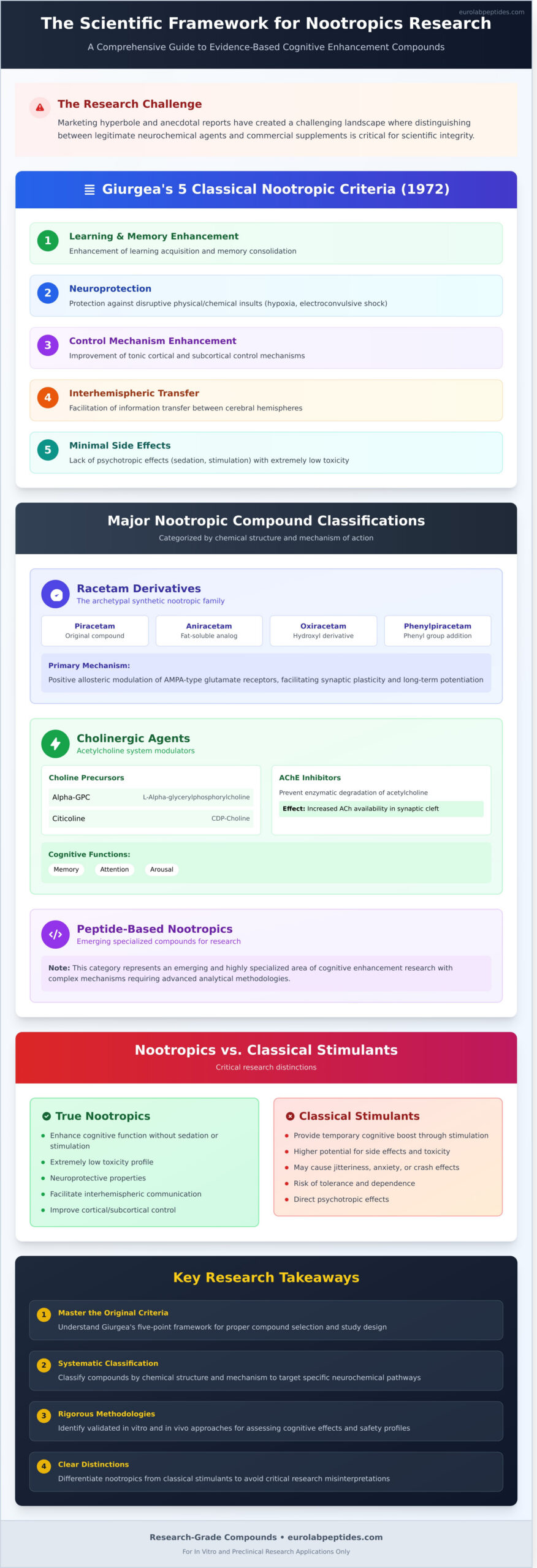
The term nootropics was first coined in 1972 by the Romanian psychologist and chemist Dr. Corneliu E. Giurgea. His definition was not a casual descriptor but a stringent set of criteria intended to classify a specific class of neuroprotective and cognitively enhancing compounds. This foundational framework, born from his work with Piracetam, remains the scientific benchmark against which potential cognitive enhancers are measured, distinguishing them from conventional psychotropic agents.
The Foundational Giurgea Criteria
To qualify as a classical nootropic under Giurgea’s highly specific model, a compound was required to meet five rigorous conditions. This framework established an exceptionally high threshold, prioritizing both demonstrable efficacy and an uncompromising safety profile. A true nootropic must exhibit:
- Enhancement of learning acquisition and memory consolidation.
- Protection of brain function against disruptive physical or chemical insults, such as hypoxia or electroconvulsive shock.
- Improvement of the efficacy of tonic cortical and subcortical control mechanisms.
- Facilitation of information transfer between the cerebral hemispheres.
- A distinct lack of common psychotropic effects (e.g., sedation, motor stimulation) and possess extremely low toxicity.
Modern Interpretations in a Research Context
The contemporary landscape has expanded significantly beyond Giurgea’s original definition. The term is now often used colloquially to encompass a broad array of substances, including stimulants and psychoactive compounds, frequently labeled ‘smart drugs’. For a detailed overview of this evolution and to understand what are nootropics in the modern lexicon, extensive resources are available. However, in a laboratory setting, this broad categorization is insufficient. Scientific investigation demands a focus on compounds with specific, measurable mechanisms of action and quantifiable effects on cognitive endpoints, regardless of their popular classification.
Regulatory Status and Its Impact on Research
The classification of these compounds—as prescription pharmaceuticals, dietary supplements, or research chemicals—has profound implications for their study. While pharmaceuticals undergo rigorous clinical trials and supplements are regulated for consumption, research chemicals are designated exclusively for in vitro and non-human in vivo laboratory investigation. For researchers, this distinction is critical. Sourcing from compliant suppliers that provide third-party verification via HPLC and Mass Spectrometry ensures the chemical integrity and purity requisite for generating valid, reproducible data.
Classification of Nootropic Compounds for Scientific Investigation
The systematic classification of nootropics is essential for structured scientific inquiry. Compounds are typically categorized based on their chemical structure and primary pharmacological mechanism of action. However, it is critical to recognize that many agents exhibit pleiotropic effects, potentially fitting into multiple classifications. The following overview delineates major classes of compounds frequently investigated in cognitive science, with the explicit understanding that all discussions pertain to their application in in-vitro and preclinical research models, not for human use.
Racetam Derivatives
The racetam family constitutes the archetypal class of synthetic nootropic compounds, with Piracetam being the original molecule from which the category is defined. Subsequent structural analogs, such as Aniracetam, Oxiracetam, and Phenylpiracetam, have been synthesized and are subjects of ongoing study. The primary investigated mechanism for this class involves the positive allosteric modulation of AMPA-type glutamate receptors, which is hypothesized to facilitate synaptic plasticity and long-term potentiation, key processes in learning and memory formation.
Cholinergic Agents
The cholinergic system, mediated by the neurotransmitter acetylcholine (ACh), is fundamentally linked to cognitive functions including memory, attention, and arousal. Compounds studied in this category aim to modulate this system. They are broadly divided into two groups: choline precursors, such as Alpha-GPC (L-Alpha-glycerylphosphorylcholine) and Citicoline (CDP-Choline), which provide the raw substrate for ACh synthesis, and acetylcholinesterase (AChE) inhibitors, which prevent the enzymatic degradation of ACh in the synaptic cleft, thereby increasing its availability.
Peptide-Based Nootropics
An emerging and highly specialized domain of neuropharmacological research involves peptide-based nootropics. These compounds are typically synthetic analogs of endogenous neuropeptides that regulate complex central nervous system functions. Key examples include Semax, derived from the adrenocorticotropic hormone (ACTH), and Selank, an analog of the immunomodulatory peptide tuftsin. Their investigation presents unique methodological challenges, including blood-brain barrier permeability and stability in biological systems, demanding stringent purity and sequence validation for reliable experimental outcomes.
Natural and Herbal Compounds
A significant body of research is dedicated to plant-derived substances and fungal compounds investigated for their potential cognitive effects. Prominent examples include extracts from Bacopa monnieri, Ginkgo biloba, and the fungus Hericium erinaceus (Lion’s Mane). A comprehensive scientific review of natural nootropics details many of these agents and their putative mechanisms. For rigorous and reproducible research, the use of standardized extracts with verified concentrations of active alkaloids, such as bacosides or ginkgolides, is an absolute prerequisite to control for variability between batches.
Investigated Mechanisms of Action in Cognitive Neuroscience
The elucidation of how putative cognitive enhancers exert their effects at a molecular level is a primary objective in contemporary neuroscience. Moving beyond phenomenological observation, current research focuses on identifying and characterizing the precise biochemical pathways through which these compounds operate. The investigation into the mechanisms of action for various nootropics is extensive, reflecting a broad chemical diversity and the important regulatory distinctions between nootropic drugs vs. dietary supplements. The following sections detail the principal systems and pathways under rigorous scientific scrutiny.
Modulation of Neurotransmitter Systems
A significant body of research is dedicated to understanding how nootropic compounds interact with key neurotransmitter systems. The primary focus areas include:
- Glutamatergic System: This excitatory pathway is fundamental to synaptic plasticity, learning, and memory. Investigations center on positive allosteric modulation of AMPA and NMDA receptors, which is hypothesized to facilitate long-term potentiation (LTP), a cellular correlate of memory formation.
- Cholinergic System: The role of acetylcholine in attention, learning, and memory consolidation is well-established. Research examines compounds that may increase acetylcholine synthesis, inhibit its degradation by acetylcholinesterase (AChE), or sensitize postsynaptic cholinergic receptors.
- Catecholaminergic Systems: Dopamine and norepinephrine are critically implicated in executive functions, motivation, and alertness. Studies explore mechanisms that influence the synthesis, release, and reuptake of these monoamines, thereby modulating signaling in prefrontal cortex circuits.
Enhancement of Cerebral Metabolism
Cognitive function is an energetically demanding process. Consequently, another major avenue of research investigates the enhancement of cerebral bioenergetics. Postulated mechanisms include the improvement of cerebral blood flow via vasodilation, which increases the delivery of critical substrates. Furthermore, studies assess the direct impact on cellular metabolism, such as increased glucose and oxygen uptake by neurons. This metabolic optimization is theorized to improve neuronal efficiency, enhance resilience against metabolic stress, and support sustained high-level cognitive processing.
Promotion of Neuroprotection and Neuroplasticity
Long-term cognitive integrity relies on the brain’s ability to adapt and resist damage. Neuroplasticity, the capacity of neural networks to reorganize, is essential for learning. Research in this domain evaluates the ability of certain compounds to upregulate the expression of critical neurotrophic factors, such as Brain-Derived Neurotrophic Factor (BDNF) and Nerve Growth Factor (NGF). Additionally, many compounds are screened for neuroprotective properties, including antioxidant activity to mitigate oxidative stress and anti-inflammatory actions to reduce cytotoxic neuroinflammation, thereby preserving neuronal structure and function.
Methodologies for Nootropic Research in a Laboratory Setting
The scientific validation of potential nootropics is a multi-stage process, demanding rigorous and systematic evaluation. To progress from a hypothetical molecule to a characterized research compound, investigators must employ a tiered approach that moves from the microscopic to the systemic. This progression ensures that observed effects are mechanistically understood and functionally relevant. All such investigations are predicated on the absolute purity of the test compound, as any contaminant introduces variables that can invalidate the entire body of research. These compounds are strictly intended for in-vitro research and laboratory experimentation only.
In-Vitro Models: Cellular and Receptor Assays
Initial screening is conducted at the cellular level to establish a baseline of biological activity. Neuronal cell cultures serve as the primary model to assess a compound’s direct effects on cell viability, proliferation, and morphology. Receptor binding assays are then employed to determine the molecule’s affinity and selectivity for specific neurotransmitter receptors (e.g., AMPA, NMDA, cholinergic). This phase also evaluates the compound’s neuroprotective capacity against induced stressors, such as glutamate excitotoxicity or oxidative damage.
In-Vivo Models: Behavioral Studies in Animals
Promising compounds advance to in-vivo testing, where behavioral paradigms in animal models correlate cellular effects with cognitive function. Standardized tests such as the Morris water maze assess spatial learning and memory, while the novel object recognition task evaluates recognition memory. Each model provides quantifiable data on specific cognitive domains. The integrity of these studies depends on the stringent control of confounding variables, including environment, diet, and stress, to isolate the compound’s specific neurological impact.
The Critical Role of Analytical Chemistry (HPLC & MS)
Underpinning all credible research is the analytical verification of the compound itself. The reproducibility of any experiment is impossible without a certifiably pure starting material. High-Performance Liquid Chromatography (HPLC) is utilized to separate, identify, and quantify each component in a sample, establishing its purity percentage. Subsequently, Mass Spectrometry (MS) provides unambiguous confirmation of the compound’s molecular identity by measuring its mass-to-charge ratio. For scientific research, a purity of 99% or greater is the uncompromising standard; anything less risks compromising the data. View our commitment to multi-level quality control.
Nootropics vs. Classical Stimulants: A Key Research Distinction
A frequent confounding variable in cognitive enhancement research is the conflation of true nootropic agents with classical central nervous system (CNS) stimulants. This distinction is not merely semantic; it is a fundamental pharmacological and methodological division that is critical for the design of valid scientific experiments and the accurate interpretation of results. Understanding the divergent pathways through which these compounds exert their effects is paramount for any serious inquiry into cognitive modulation.
Divergent Mechanisms of Action
Classical stimulants, such as amphetamines or methylphenidate, function primarily as potent catecholamine releasing agents or reuptake inhibitors. Their mechanism induces a state of ‘forced output’ from dopaminergic and noradrenergic systems, leading to acute increases in arousal and focus. In stark contrast, many compounds investigated as nootropics exhibit more nuanced modulatory effects, such as allosteric modulation of AMPA receptors, influencing acetylcholine receptor sensitivity, or optimizing cerebral glucose utilization. This approach supports neuronal efficiency rather than compelling maximal, often unsustainable, neuronal firing.
Metabolic Cost and Neurotoxicity
The aggressive neurochemical activity elicited by stimulants imposes a significant metabolic demand on neurons. This can elevate oxidative stress and, with chronic or high-dose administration, carries a quantifiable risk of excitotoxicity and receptor downregulation. This pharmacological profile is diametrically opposed to the classical definition of a nootropic, which stipulates a neuroprotective or exceptionally low toxicity profile. This difference is a critical variable in any longitudinal study assessing long-term cognitive health and neuronal integrity.
Defining Research Endpoints
The distinct pharmacological profiles of these two classes dictate their appropriate research applications. The choice of compound must align precisely with the hypothesis being tested.
- Classical Stimulants: Validated tools for investigating acute states of wakefulness, vigilance, and task-oriented attention in models of fatigue or attention-deficit disorders.
- Nootropics: Investigated for their potential roles in more complex processes such as learning, memory consolidation, synaptic plasticity, and long-term neuro-resilience against age-related cognitive decline.
Therefore, the rigorous segregation of these compound classes is essential for methodological validity. Researchers investigating subtle cognitive processes require agents with well-characterized, specific mechanisms of action. For such precise scientific inquiry, ensuring the uncompromising purity and identity of the selected compounds is the foundational prerequisite. You can review our stringent quality assurance protocols for research-grade peptides and chemicals at eurolabpeptides.com.
Advancing Cognitive Research with Precision and Integrity
The scientific investigation of nootropics is a discipline defined by methodological precision. As this review has established, a clear distinction from classical stimulants and a comprehensive understanding of their complex neurochemical mechanisms are fundamental to producing valid, reproducible inquiry. Ultimately, the efficacy and integrity of such research are contingent upon the chemical purity of the compounds under examination, as unverified substances introduce variables that can compromise or entirely invalidate critical data.
For researchers demanding uncompromising standards, Eurolab Peptides provides EU-manufactured reference materials for advanced cognitive studies. Each batch is subjected to stringent analysis, including HPLC and Mass Spectrometry, with a guaranteed 99%+ purity that is independently verified by third-party laboratories. This commitment to transparent, verifiable quality ensures your study is built upon a foundation of absolute chemical certainty. Examine high-purity compounds for cognitive function research and propel your investigations forward with the highest degree of scientific confidence.
Frequently Asked Questions
What is the difference between a nootropic and a research peptide?
The distinction is based on chemical classification and intended function. A nootropic is defined by its functional effect: the enhancement of cognitive processes. This category includes diverse chemical structures. Conversely, a research peptide is defined by its structure as a short chain of amino acids. While some peptides may exhibit nootropic properties, the two categories are not interchangeable. One describes a molecule’s function, while the other describes its fundamental biochemical composition and structure.
Why is third-party laboratory testing essential for nootropic compounds?
Third-party laboratory testing provides objective, unbiased verification of a compound’s identity, purity, and concentration. This process is non-negotiable for ensuring research integrity. Without independent analysis via methods like HPLC and Mass Spectrometry, a researcher cannot rule out the presence of impurities or incorrect dosages, which would invalidate experimental outcomes. It transforms a quality claim into a verifiable, scientific metric essential for reproducible studies on nootropics.
What are the primary challenges in conducting valid nootropic research?
The principal challenges in nootropic research involve controlling for confounding variables and overcoming the subjectivity of cognitive measurement. The pronounced placebo effect in cognitive studies necessitates stringent double-blind, placebo-controlled designs. Furthermore, isolating a compound’s effects from factors like diet, sleep, and baseline cognitive function requires large sample sizes and rigorous statistical analysis. Quantifying subtle cognitive improvements objectively, beyond self-reported assessments, remains a significant methodological hurdle.
In a research context, are natural compounds superior to synthetic ones?
In a research context, a compound’s origin is secondary to its purity, stability, and verifiable structure. A synthetic compound can be chemically identical to its natural counterpart, often with the advantage of higher purity and the absence of contaminants found in botanical extracts. For valid and reproducible scientific inquiry, consistency is paramount. Synthetically derived compounds provide a standardized purity, typically exceeding 99%, which is essential for accurate dosing and the elimination of experimental variables.
How has the scientific definition of ‘nootropic’ evolved over time?
The term ‘nootropic’ was originally coined by Dr. Corneliu E. Giurgea with a strict set of criteria. A true nootropic must enhance memory and learning, protect the brain from physical or chemical injury, possess few side effects, and lack the pharmacology of typical psychotropic drugs. While the popular definition has broadened to include many stimulants and cognitive enhancers, the original, rigorous scientific definition remains the benchmark for academic research and pharmacological classification.
What is the significance of lyophilization for storing research nootropics?
Lyophilization, or freeze-drying, is a superior method for preserving the long-term stability and integrity of sensitive research compounds. By removing water under low pressure, this process prevents chemical degradation, such as hydrolysis, which can compromise a compound’s purity and efficacy over time. For the researcher, a lyophilized product ensures a longer shelf-life and allows for precise reconstitution in a chosen solvent, which is critical for maintaining dosage accuracy in experimental protocols.
