
In scientific research, the integrity of an experiment is predicated on the verifiable purity of its constituent reagents. An uncharacterized impurity, even in trace amounts, can introduce confounding variables, invalidating months of work and squandering valuable grant funding. This fundamental risk underscores the researcher’s critical need for an objective, quantitative method of quality assurance that moves beyond supplier claims and into the realm of empirical data. The definitive solution to this challenge lies in analytical chemistry, and understanding the importance of HPLC in peptide analysis is the first step toward achieving methodological rigor and experimental reproducibility.
This guide is designed for the discerning researcher. It deconstructs the principles of High-Performance Liquid Chromatography (HPLC), providing a systematic framework for interpreting chromatogram data and equipping you with the technical literacy to critically evaluate any supplier’s Certificate of Analysis. The objective is to empower you to safeguard your research, validate product quality with absolute certainty, and proceed with unwavering confidence in the integrity of your compounds. By mastering this gold-standard technique, you ensure your results are built on a foundation of uncompromising purity.
Key Takeaways
- Understand the critical importance of HPLC in peptide analysis by learning how common synthesis-related impurities can compromise experimental data integrity.
- Deconstruct the analytical workflow of High-Performance Liquid Chromatography to grasp how a peptide sample is precisely separated and quantified.
- Learn to interpret an HPLC chromatogram, enabling you to visually verify the purity percentage and identify contaminants from the graphical output.
- Differentiate the roles of HPLC and Mass Spectrometry to see why both techniques are required for definitive peptide characterization.
Why Purity is Non-Negotiable in Peptide Research
In the context of biochemical research, peptide purity is not a qualitative descriptor but a critical quantitative variable. It is defined as the percentage of a sample that consists of the correct, full-length peptide sequence. An unverified or low-purity peptide introduces uncontrolled variables into an experimental design, directly compromising the integrity and validity of the resulting data. For any serious scientific inquiry, ensuring high purity is a foundational requirement for reproducible and defensible outcomes.
The presence of unknown contaminants can lead to misleading results, off-target effects, or a complete failure to replicate findings, wasting valuable time and resources. This reality underscores the profound importance of HPLC in peptide analysis for mitigating the risks of experimental irreproducibility and ensuring that observed effects are attributable solely to the target molecule.
The Challenge of Synthetic Peptides: Sources of Impurity
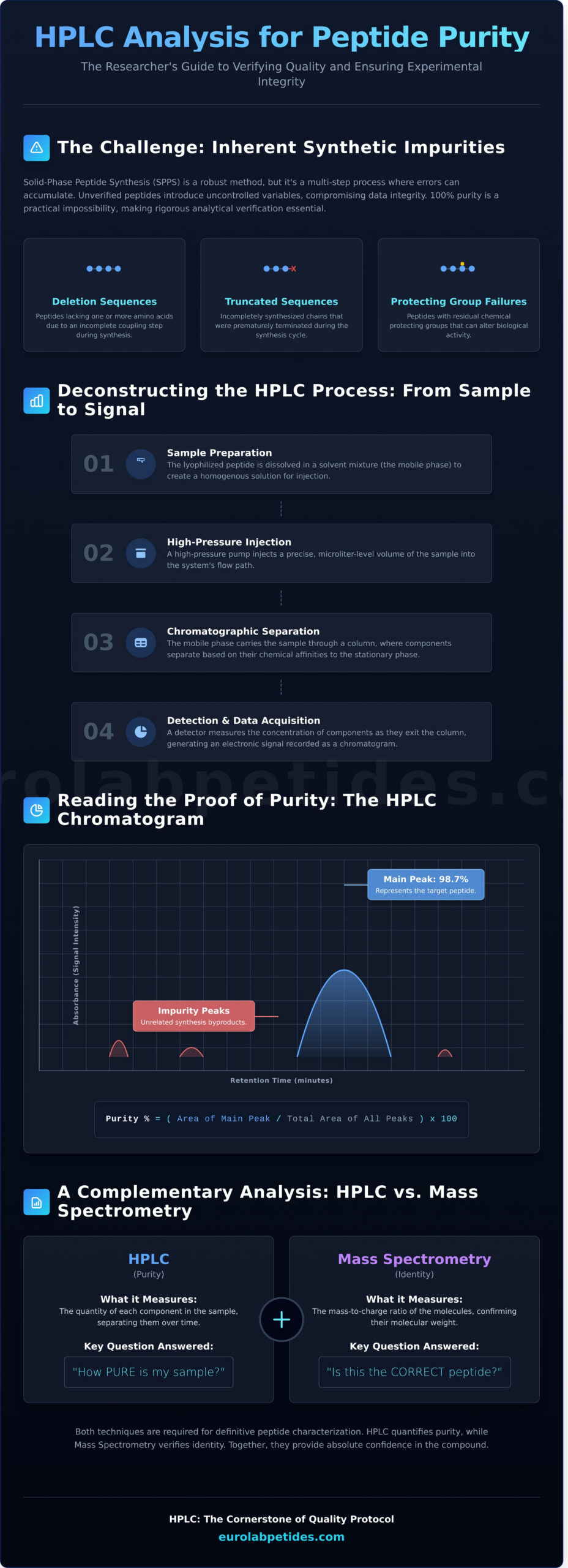
The predominant method for peptide production, Solid-Phase Peptide Synthesis (SPPS), is a complex, multi-step process where errors can accumulate. Even under the most stringent laboratory protocols, the generation of impurities is an inherent challenge. These impurities typically include:
- Deletion Sequences: Peptides lacking one or more amino acids from the target sequence due to an incomplete coupling step.
- Truncated Sequences: Incompletely synthesized peptide chains that were prematurely terminated during the synthesis cycle.
- Protecting Group Failures: Peptides with residual chemical protecting groups that can significantly alter biological activity and receptor binding affinity.
Beyond these sequence-related errors, residual reagents, solvents, and salts from the synthesis and purification process can also contaminate the final lyophilized product. Consequently, 100% purity is a practical impossibility, making rigorous analytical verification essential.
Establishing the Gold Standard: HPLC for Purity Assessment
To address the challenge of peptide heterogeneity, the scientific community relies on a definitive analytical standard. This is where High-performance liquid chromatography (HPLC) becomes indispensable as the industry’s gold standard for purity assessment. In contrast to less precise historical methods, its superior separatory power allows for the distinct resolution and quantification of the target peptide from even closely related impurities.
The importance of HPLC in peptide analysis lies in its ability to provide objective, reproducible data. The resulting chromatogram offers a clear quantitative profile of a sample’s components, transforming the abstract concept of “purity” into a verifiable metric. This analytical rigor is the bedrock upon which reliable and impactful research is built, providing the objective data researchers need to proceed with absolute confidence.
Deconstructing the HPLC Process: From Sample to Signal
High-Performance Liquid Chromatography is not a singular action but a meticulously orchestrated sequence of events designed to separate, identify, and quantify each component within a complex mixture. The precision of this multi-stage process underscores the importance of HPLC in peptide analysis, where even minor impurities can invalidate research outcomes. The analytical journey from a prepared sample to a final data signal follows a standardized and reproducible pathway executed in four critical stages:
- Sample Preparation: The peptide sample is first dissolved in a solvent mixture known as the mobile phase.
- High-Pressure Injection: A high-pressure pump injects a precise, microliter-level volume of this sample into the system’s flow path.
- Chromatographic Separation: The mobile phase carries the sample through a column packed with a stationary phase, where individual components separate based on their unique chemical affinities.
- Detection and Data Acquisition: As separated components exit (elute from) the column at different times, a detector measures their concentration and generates an electronic signal, which is recorded as a chromatogram.
Key Components of a Modern HPLC System
A modern HPLC system is comprised of several integrated modules. A high-pressure pump delivers the mobile phase from a solvent reservoir at a precise flow rate. An injector introduces a calibrated volume of the peptide sample into the flow path. The analytical column, packed with the stationary phase, is where separation occurs. Finally, a detector (e.g., UV-Vis) quantifies the components as they elute, converting chemical presence into a measurable electronic signal.
The Principle of Reversed-Phase Chromatography (RP-HPLC)
Reversed-Phase HPLC (RP-HPLC) is the predominant mode for peptide assessment, utilizing a nonpolar stationary phase (e.g., C18-bonded silica) and a polar mobile phase (e.g., a water/acetonitrile gradient). This configuration is foundational to modern peptide analysis by HPLC, as it effectively resolves molecules based on their hydrophobicity. Peptides with greater hydrophobic character interact more strongly with the stationary phase, resulting in longer retention times and later elution from the column.
This principle of differential retention allows for the high-resolution separation of a target peptide from closely related impurities, such as deletion sequences or incompletely deprotected fragments. The resulting chromatogram provides a quantitative purity profile, which is a direct reflection of the importance of HPLC in peptide analysis for ensuring product integrity and experimental validity.
How to Interpret an HPLC Chromatogram: Reading the Proof of Purity
The definitive output of a High-Performance Liquid Chromatography run is the chromatogram-a graphical representation that serves as the unassailable evidence of a peptide’s purity. This plot provides a quantitative visual assessment of the sample’s composition. Understanding this graphical output is fundamental to appreciating the importance of HPLC in peptide analysis for verifying product integrity.
In a properly executed analysis, the chromatogram will display one dominant peak, representing the target peptide, and potentially several much smaller peaks, which correspond to impurities.
Figure 1: An exemplary HPLC chromatogram. The large peak at approximately 10.5 minutes represents the target peptide, while the minor peaks indicate trace impurities.
Anatomy of a Chromatogram: Peaks, Retention Time, and Area
Each component of the chromatogram provides critical data. The primary elements are:
- Retention Time (X-axis): Measured in minutes, this indicates the time required for a specific compound to elute from the HPLC column after injection. Each unique compound will have a characteristic retention time under identical conditions.
- Detector Response (Y-axis): Typically measured in absorbance units (mAU), this axis quantifies the signal intensity detected as a compound passes through. This signal forms the “peak.”
- Peak Area: This is the integrated area under a peak. It is directly proportional to the concentration of the compound that generated the peak, providing the basis for quantitative analysis.
Calculating Purity: The ‘Area Percent’ Method
Purity is determined using the ‘area percent’ method, a standard calculation in analytical chemistry. The formula is a direct ratio: (Area of the main peptide peak / Total area of all peaks) x 100%. This calculation yields the purity percentage, which is the paramount metric for quality assurance.
A report claiming 99%+ purity, the uncompromising standard at EuroLab Peptides, will be substantiated by a chromatogram where the main peak’s area constitutes over 99% of the total integrated area. This visual proof is the cornerstone of our commitment to quality. It must be noted that this method operates on the assumption that all eluting compounds exhibit a similar response factor at the detection wavelength-a generally accepted convention for peptide-related impurities.
HPLC vs. Mass Spectrometry (MS): A Complementary Analysis
In the rigorous environment of scientific research, analytical techniques are not competitors but essential partners. High-Performance Liquid Chromatography (HPLC) and Mass Spectrometry (MS) are not interchangeable methods for peptide verification; they are synergistic techniques that, when used in tandem, provide a complete and unambiguous profile of a synthesized product. One method addresses purity and quantity, while the other confirms molecular identity. Understanding this distinction highlights the critical importance of HPLC in peptide analysis as part of a larger quality assurance framework.
The two techniques answer fundamentally different, yet equally vital, questions:
- High-Performance Liquid Chromatography (HPLC): Primarily answers, “How much of each component is present?” Its function is quantitative, determining the sample’s purity by separating its constituents.
- Mass Spectrometry (MS): Primarily answers, “What is this component?” Its function is qualitative, determining the precise molecular weight to confirm the compound’s identity.
HPLC for Quantification: The Purity Question
The core strength of HPLC lies in its unparalleled quantitative accuracy. The method separates a peptide mixture under high pressure, allowing each component to elute at a distinct time. The resulting chromatogram displays peaks whose areas correspond to the relative abundance of each substance. This process yields the definitive purity value-for example, >99%-that researchers depend on. However, HPLC alone does not inherently confirm the molecular identity of the primary peak; it only quantifies its proportion relative to impurities.
MS for Identification: The Identity Question
Mass Spectrometry provides the definitive structural confirmation that HPLC cannot. By measuring the mass-to-charge ratio (m/z) of ionized molecules, MS determines the molecular weight of a compound with exceptional precision. When the main peak isolated by HPLC is subjected to MS analysis, the resulting data must match the calculated theoretical mass of the target peptide. This verification is non-negotiable for confirming that the correct amino acid sequence was successfully synthesized.
Why Comprehensive Validation Requires Both HPLC and MS
True analytical integrity is achieved only when both methods are deployed. HPLC confirms that a sample is pure, and MS confirms that the pure substance is the correct one. A supplier providing a Certificate of Analysis with both HPLC and MS data demonstrates an uncompromising commitment to multi-level quality control. This two-pronged validation strategy eliminates the risk of using a product that is high in purity but incorrect in identity. This dual approach underscores the true importance of HPLC in peptide analysis, ensuring both purity and identity are verified to the highest European standards. For research that demands absolute certainty, this level of scrutiny is not optional; it is the benchmark for reliability. You can review our stringent testing protocols for every batch at eurolabpeptides.com.
HPLC as the Cornerstone of EuroLab Peptides’ Quality Protocol
At EuroLab Peptides, our uncompromising commitment to a minimum 99% purity level is not a marketing claim; it is a verifiable metric derived from a stringent quality assurance protocol. High-Performance Liquid Chromatography (HPLC) is the central pillar of this system, providing the quantitative data necessary to validate every product we offer. Every single batch of synthesized peptide is subjected to this rigorous analytical testing, with the resulting chromatogram forming the empirical basis for the Certificate of Analysis (CoA) that accompanies each vial. This methodological rigor underscores the critical importance of HPLC in peptide analysis for ensuring the integrity and reproducibility required for sensitive research applications.
From Synthesis to Verification: Our Testing Workflow
Our quality control is an integrated, multi-stage process designed for maximum assurance. The analytical workflow includes:
- Post-Synthesis Analysis: Immediately following synthesis, HPLC is utilized to assess the crude product and guide the purification process.
- Post-Lyophilization Verification: After purification and lyophilization, each final batch undergoes comprehensive HPLC analysis to quantify its purity and identify any potential impurities, such as truncated or deletion sequences.
- Identity Confirmation: This purity data is then supplemented with Mass Spectrometry (MS) to confirm the precise molecular weight, thereby verifying the correct amino acid sequence.
To guarantee absolute objectivity and data integrity, this dual analysis is conducted by independent, third-party laboratories, eliminating any possibility of internal bias.
Transparency in Action: Your Certificate of Analysis
We believe that researchers deserve complete and unredacted access to quality data. For this reason, the CoA provided with your specific product lot includes the raw HPLC chromatogram and MS analysis. This radical transparency empowers you to independently review the evidence of purity and identity, ensuring absolute confidence in the materials used for your experiments. The importance of HPLC in peptide analysis is fully realized when the data is made directly available to the end-user, transforming a simple purchase into a trusted scientific partnership. This commitment to verifiable quality is standard across our entire catalog. View our range of third-party tested research peptides.
The Definitive Role of HPLC in Ensuring Research Integrity
In the rigorous landscape of scientific inquiry, peptide purity is not a variable but an absolute prerequisite for generating reproducible and valid data. Therefore, a comprehensive understanding of the importance of HPLC in peptide analysis is indispensable for any researcher. This definitive method quantifies purity with unparalleled precision, separating target peptides from synthetic impurities and providing unambiguous, visual proof of quality through its chromatogram. This analytical mastery empowers researchers to validate the integrity of their materials before critical experimentation begins.
At EuroLab Peptides, this analytical rigor is the cornerstone of our quality protocol. We provide researchers with peptides of guaranteed 99%+ purity, a metric confirmed through stringent, independent third-party laboratory testing for every batch. Every product is accompanied by a comprehensive Certificate of Analysis, featuring both HPLC and MS data for complete transparency and accountability. We invite you to explore our catalog of research peptides, each verified by HPLC and MS analysis.
Proceed with your research, confident in the absolute integrity of your materials.
Frequently Asked Questions About HPLC and Peptide Purity
What is a typical purity level for research-grade peptides?
For research applications where data integrity is paramount, a purity level of ≥98% is the established standard. At EuroLab Peptides, our stringent synthesis and purification protocols ensure a minimum purity of 99% for all catalog products. This high degree of purity is critical for obtaining reproducible experimental results and minimizing the risk of confounding variables introduced by synthesis-related impurities. Purity is meticulously verified and quantified for every batch via HPLC analysis.
How does retention time help in identifying a peptide?
Retention time (RT) is the specific duration required for a peptide to travel through the HPLC column and reach the detector under a defined set of analytical conditions. This value is highly reproducible and serves as a characteristic signature for a specific molecule. By comparing the retention time of a sample to that of a validated reference standard, one can confirm the identity of the target peptide with a high degree of confidence, distinguishing it from other components within the sample matrix.
Can HPLC analysis degrade the peptide sample?
High-Performance Liquid Chromatography is fundamentally a non-destructive analytical technique. The mobile phase compositions and column chemistries used in standard peptide analysis, particularly RP-HPLC, are selected to separate molecules based on their physicochemical properties without inducing chemical degradation. The peptide remains structurally intact throughout the analysis, and if necessary, the fractions corresponding to specific peaks can be collected for subsequent analytical procedures or use, assuming sufficient quantity was injected.
What does it mean if there are multiple small peaks on a chromatogram?
On an HPLC chromatogram, the largest peak represents the target peptide of the correct sequence and structure. Any additional, smaller peaks indicate the presence of impurities. These can include deletion sequences, incompletely deprotected peptides, or other byproducts from the solid-phase synthesis process. The relative area of these impurity peaks compared to the main peak is calculated to determine the final purity percentage, demonstrating the critical importance of HPLC in peptide analysis for quality control.
Why is Reversed-Phase HPLC (RP-HPLC) preferred for peptide analysis?
Reversed-Phase HPLC (RP-HPLC) is the industry standard for peptide analysis due to its exceptional resolving power for these molecules. This technique separates compounds based on their relative hydrophobicity. Since peptides are composed of amino acids with diverse side-chain properties, they exhibit a wide range of hydrophobic characters, allowing for effective separation. The use of a non-polar stationary phase and a polar mobile phase provides high-resolution chromatograms essential for accurate purity assessment.
How can I request the HPLC data for a specific batch I purchase?
Transparency is a core component of our quality assurance protocol. The comprehensive Certificate of Analysis (CoA), which includes the high-resolution HPLC chromatogram and Mass Spectrometry data, is available for every batch we produce. This documentation is readily accessible on the corresponding product page on our website. Should you require data for a specific lot number not immediately visible, our technical support team can provide it upon request, ensuring full traceability and data validation for your research.
Does EuroLab Peptides perform both HPLC and Mass Spectrometry on all products?
Yes, every batch of every peptide synthesized by EuroLab Peptides undergoes a stringent, dual-verification process. High-Performance Liquid Chromatography (HPLC) is employed to precisely quantify the purity of the final product, ensuring it meets or exceeds our 99%+ standard. Concurrently, Mass Spectrometry (MS) is utilized to verify the molecular weight, confirming that the correct amino acid sequence has been successfully synthesized. This uncompromising two-method approach guarantees both the purity and identity of our products.
