

Navigating the landscape of novel research peptides requires an uncompromising commitment to empirical data, a standard frequently unmet by the proliferation of anecdotal reports and consumer-focused content. This informational challenge is particularly acute when investigating compounds such as the kpv peptide, where potent biological activity demands rigorous scientific scrutiny, not speculation. For the dedicated researcher, the signal-to-noise ratio is unacceptably low, creating significant hurdles in experimental design and the sourcing of verifiably pure reference materials.
This technical review has been prepared to address this deficit. It provides a comprehensive analysis of KPV’s established biochemical mechanism of action, a survey of its current applications within peer-reviewed preclinical models, and the stringent protocols required for laboratory handling. From reconstitution to long-term storage, this guide is engineered to equip investigators with the validated data necessary to integrate this tripeptide into their work with absolute confidence, ensuring both experimental integrity and the highest standards of scientific inquiry for 2026 and beyond.
Key Takeaways
- Understand the intracellular mechanism by which KPV translocates to the nucleus to directly modulate key inflammatory signaling pathways.
- Review the primary areas of preclinical investigation where the kpv peptide is being evaluated for its therapeutic potential.
- Implement the correct laboratory protocols for reconstituting and handling lyophilized KPV to ensure experimental validity and reproducibility.
- Grasp the critical importance of sourcing KPV with documented 99%+ purity to guarantee the integrity and reliability of your research data.
What Is KPV Peptide? A Biochemical Overview
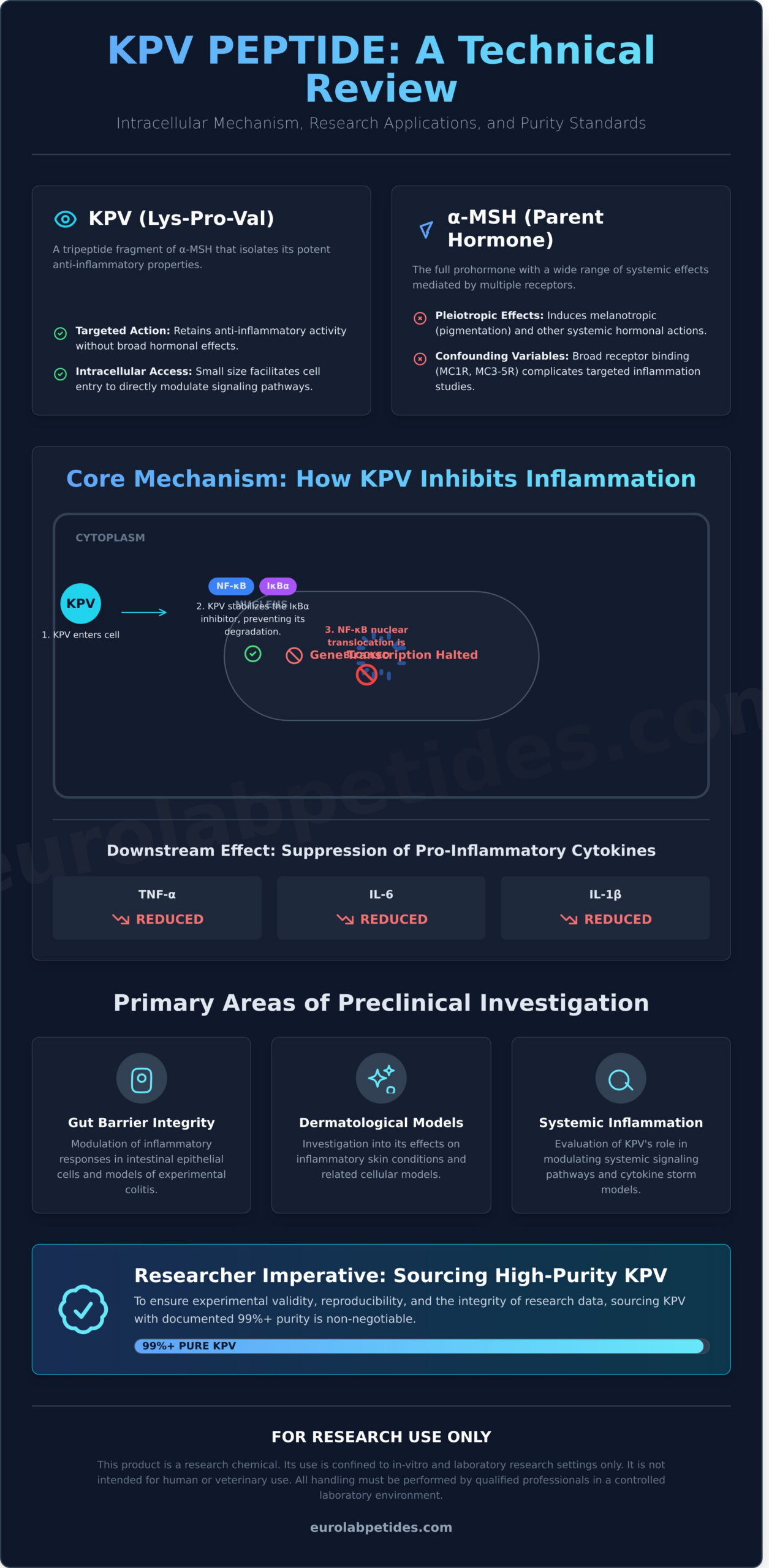
The KPV peptide is a tripeptide fragment representing the C-terminal sequence (residues 11-13) of the prohormone α-Melanocyte-Stimulating Hormone (α-MSH). Composed of Lysine-Proline-Valine, this molecule has become a subject of intense scientific interest because it retains the potent anti-inflammatory properties of its parent hormone without inducing its broader melanotropic (pigmentation) and other systemic hormonal effects. This targeted activity makes the kpv peptide a specialized tool for laboratory investigations into inflammatory pathways.
It is critical to establish that KPV is classified strictly as a research chemical. Its use is confined to in-vitro and laboratory settings and is not intended for human or veterinary application. The primary areas of its investigation focus on its capacity to modulate inflammatory responses in various cell models, including those related to:
- Gut barrier integrity and intestinal epithelial cells
- Inflammatory skin conditions in dermatological models
- Systemic inflammatory signaling pathways
Origin and Structure of KPV
Derived from the terminal end of α-MSH, the KPV tripeptide possesses a simple yet remarkably stable structure. This three-amino-acid sequence (Lys-Pro-Val) is biochemically significant as it constitutes the active site responsible for the anti-inflammatory activity of the full α-MSH molecule. Its small size and molecular configuration are believed to facilitate its entry into cells, allowing it to interact directly with intracellular signaling pathways involved in inflammation, a mechanism distinct from many surface-receptor-mediated hormones.
KPV vs. α-MSH in a Research Context
While α-MSH exerts pleiotropic effects by binding to a range of melanocortin receptors (MC1R, MC3R, MC4R, MC5R), KPV demonstrates a more focused mechanism of action. Its activity is not dependent on binding to the same full spectrum of receptors, thereby isolating its anti-inflammatory function from the other physiological roles of α-MSH. For researchers, this distinction is paramount. Isolating this fragment allows for the precise study of inflammation modulation without the confounding variables introduced by the systemic hormonal actions of the full-length parent peptide.
Mechanism of Action: How KPV Modulates Inflammatory Pathways
The anti-inflammatory efficacy of KPV is rooted in its unique biochemical structure, which facilitates its penetration of the cell membrane and translocation into the nucleus. Unlike many larger molecules that rely on cell surface receptors, this tripeptide can directly interact with intracellular signaling cascades that govern the inflammatory response. Once inside the cell, it functions as an upstream modulator of gene expression, targeting the core machinery of inflammation at its source.
This intracellular access allows the kpv peptide to exert precise control over key inflammatory pathways, a mechanism that has been substantiated through rigorous in-vitro and in-vivo modeling. Furthermore, research indicates that KPV possesses antimicrobial properties, adding another dimension to its potential utility in complex inflammatory conditions where pathogens may be present.
Inhibition of NF-κB Signaling
Nuclear Factor-kappa B (NF-κB) is a protein complex that functions as a master regulator of the inflammatory response, controlling the transcription of numerous pro-inflammatory genes. Preclinical evidence from cell culture models demonstrates that KPV exerts a significant inhibitory effect on this pathway. It achieves this by preventing the phosphorylation and subsequent degradation of IκBα, the inhibitory protein that sequesters NF-κB in the cytoplasm. By stabilizing IκBα, KPV effectively blocks the nuclear translocation of NF-κB, thereby preventing the activation of its target inflammatory genes.
Modulation of Cytokine Expression
A direct downstream consequence of NF-κB inhibition is the profound downregulation of pro-inflammatory cytokine production. Laboratory models have consistently shown that KPV treatment leads to a quantifiable reduction in the expression of key cytokines, including:
- Tumor Necrosis Factor-alpha (TNF-α)
- Interleukin-6 (IL-6)
- Interleukin-1 beta (IL-1β)
This mechanism has been extensively investigated in models of inflammatory conditions; for instance, preclinical research on KPV has documented its capacity to ameliorate experimental colitis by suppressing the local inflammatory milieu. In vitro modeling suggests that KPV can attenuate the hypercytokinemia characteristic of a cytokine storm by suppressing the transcriptional activation of key pro-inflammatory genes.
Section 3
Direct Antimicrobial Efficacy
Beyond its well-documented immunomodulatory functions, the KPV peptide has also demonstrated direct antimicrobial properties. This expands its research applications considerably, moving beyond solely inflammation control. In vitro studies have confirmed this activity against various microorganisms commonly associated with clinical infections and complicated wound healing. The dual capacity of the KPV peptide to act as both an anti-inflammatory and an antimicrobial agent offers a truly unique profile for scientific investigation.
Activity Against Key Pathogens
Laboratory analysis consistently indicates that the KPV peptide exhibits both inhibitory and cidal activity against several clinically relevant pathogens. This broad-spectrum potential represents a critical area of its characterization and ongoing research. Key microbial targets frequently documented in scientific literature include:
- Staphylococcus aureus (S. aureus): A prevalent gram-positive bacterium responsible for a significant percentage of skin and soft tissue infections, including difficult-to-treat, antibiotic-resistant strains (MRSA).
- Candida albicans (C. albicans): An opportunistic fungal pathogen known to form biofilms and cause infections in wound environments, particularly in immunocompromised subjects.
The demonstrated efficacy against both bacterial and fungal species underscores the KPV peptide’s versatile therapeutic potential, particularly in complex, polymicrobial environments.
Mechanism and Application in Wound Healing
The precise antimicrobial pathway of the KPV peptide remains under rigorous scientific scrutiny. While extensive research has meticulously detailed KPV’s mechanism of action concerning its potent anti-inflammatory effects, its antimicrobial function is currently hypothesized to involve direct physical disruption of the microbial cell membrane. This proposed cytolytic action suggests that the peptide compromises the integrity of the phospholipid bilayer, ultimately leading to increased permeability, leakage of intracellular contents, and subsequent microbial cell death—a mechanism distinct from that of traditional antibiotics.
This dual functionality positions the KPV peptide as a compound of significant interest for advanced wound healing studies. A compromised wound environment is typically characterized by excessive inflammation and a high risk of microbial colonization. Therefore, an agent capable of concurrently mitigating pro-inflammatory cytokine cascades while reducing pathogenic bioburden could theoretically accelerate and significantly improve the quality of tissue repair. This unique profile firmly positions the KPV peptide as a subject of stringent analysis in advanced models of dermal regeneration.
Current Applications in Preclinical Research Models
It is imperative to state that the following applications of the KPV peptide are confined exclusively to preclinical research models. These investigations do not represent approved clinical uses or therapeutic claims. The data derived from these models serve to elucidate the peptide’s fundamental biological activities under controlled laboratory conditions.
Inflammatory Bowel Disease (IBD) Models
In the context of gastrointestinal research, KPV has been extensively studied in murine models of colitis, often induced by agents like dextran sodium sulfate (DSS). In these models, the peptide’s effects are quantified by assessing reductions in histological damage scores, colonic myeloperoxidase (MPO) activity, and the expression of pro-inflammatory cytokines. Furthermore, its role in preserving gut epithelial barrier function is evaluated using ex-vivo Ussing chamber systems to measure transepithelial electrical resistance (TEER), directly linking its action to the maintenance of cellular integrity under inflammatory stress.
Dermatological and Wound Healing Studies
Preclinical dermatological research utilizes both in-vitro and in-vivo models. In cell culture systems employing human keratinocytes, KPV is investigated for its capacity to attenuate inflammatory responses initiated by stimuli such as UV radiation or bacterial lipopolysaccharides (LPS). In animal wound healing models, topical formulations of the kpv peptide are assessed for their influence on wound closure rates and tissue granulation. This area of study is particularly valuable as it explores the peptide’s dual-action potential, combining its established anti-inflammatory signaling inhibition with its intrinsic antimicrobial properties to create a more favorable environment for tissue repair.
Mast Cell Stabilization Research
Mast cells are pivotal effector cells in allergic and inflammatory responses, releasing potent mediators upon degranulation. A significant area of in-vitro research focuses on KPV’s ability to stabilize these cells. In laboratory assays, mast cell lines are stimulated to degranulate, and the subsequent release of substances like histamine and β-hexosaminidase is measured. Studies consistently demonstrate that KPV can inhibit this release, suggesting a mechanism for modulating the initial phase of allergic-type inflammatory reactions. This positions KPV as a critical research tool for investigating the upstream regulation of hypersensitivity pathways.
Protocol for Handling KPV in a Laboratory Setting
The integrity of any research study hinges on the meticulous handling of its constituent reagents. For studies involving the kpv peptide, adherence to a stringent protocol is paramount to ensure experimental validity and reproducibility. Upon delivery, our KPV is supplied as a lyophilized (freeze-dried) powder, a state which ensures maximum stability during transit. The purity and identity of each batch are uncompromisingly verified via High-Performance Liquid Chromatography (HPLC) and Mass Spectrometry, with corresponding certificates of analysis available to validate product quality prior to use.
Storage and Stability
Proper storage is critical to preserving the structural integrity of the peptide. The following conditions are recommended to maintain optimal stability and biological activity:
- Lyophilized Powder: For long-term storage, the unopened vial should be kept in a desiccated environment at -20°C to -80°C.
- Reconstituted Solution: For short-term use (up to one week), the solution can be stored at 4°C. For long-term storage, it is essential to create aliquots to prevent contamination and store them at -20°C.
It is imperative to avoid repeated freeze-thaw cycles, as this process can significantly degrade the peptide and compromise experimental outcomes.
Reconstitution Procedure
Reconstitution is the process of dissolving the lyophilized kpv peptide into a liquid buffer or solvent to create a stock solution. This step requires precision to ensure the final concentration is accurate for downstream applications.
- Equilibration: Before opening, allow the vial to reach room temperature for approximately 15-20 minutes. This minimizes the risk of moisture condensation, which can affect peptide stability.
- Solvent Selection: Aseptically add a sterile, appropriate solvent. For most applications, bacteriostatic water or sterile water for injection is suitable. The choice of solvent may vary depending on the specific experimental design.
- Dissolution: Gently introduce the solvent into the vial, allowing it to run down the side of the glass. Swirl the vial gently or roll it between the palms to dissolve the powder. Do not shake or vortex, as vigorous agitation can cause aggregation or denaturation of the peptide.
For precise calculations to achieve your desired solution concentration, we provide an essential laboratory tool. You can access the Eurolab Peptides Reconstitution Calculator to ensure uncompromising accuracy in your preparations.
Sourcing High-Purity KPV for Valid Research Outcomes
The integrity of any scientific investigation is fundamentally linked to the quality of its constituent materials. In peptide research, this principle is absolute. The reproducibility and validity of experimental data derived from studies on the kpv peptide are directly dependent on the purity of the compound used. Contaminants, such as byproducts from synthesis or residual solvents, can introduce confounding variables, leading to inaccurate results and invalid conclusions. For this reason, a purity level of 99% or greater is not merely a preference but the established minimum standard for all credible scientific applications.
The Importance of Third-Party Verification
Third-party testing is the definitive, objective measure of a peptide’s quality. This process involves sending a sample from each production batch to an independent, unaffiliated analytical laboratory for comprehensive analysis. The resulting document, a Certificate of Analysis (CoA), provides verifiable proof of purity and identity. Researchers should scrutinize any supplier’s CoA for key data points, including High-Performance Liquid Chromatography (HPLC) results to confirm purity and Mass Spectrometry (MS) data to verify the correct molecular weight. This independent verification is the primary differentiator between professional-grade research chemicals and materials of uncertain quality.
Why Choose EuroLab Peptides for KPV Research
EuroLab Peptides operates on a foundation of uncompromising quality assurance, where purity is a verifiable metric, not a marketing claim. Our multi-level quality control protocol ensures that every batch of kpv peptide is first subjected to stringent in-house analysis before being sent for independent third-party verification. As a European-based supplier, our operations adhere to the highest manufacturing and quality standards prevalent in the EU. This dual-validation process guarantees that the product delivered meets the 99%+ purity threshold required for sensitive and high-stakes research.
For research projects demanding the highest degree of accuracy and reproducibility, sourcing is a critical preliminary step. Ensure your study is built on a foundation of analytical integrity. Procure third-party tested KPV peptide with >99% purity for your research from EuroLab Peptides.
Advancing Inflammatory Research with High-Purity KPV Peptide
As this comprehensive review has detailed, the tripeptide KPV represents a significant molecule of interest due to its potent anti-inflammatory properties and its direct, targeted modulation of critical signaling pathways. The expanding applications in preclinical models, from dermatological to gastrointestinal research, underscore the necessity for stringent laboratory protocols. The successful application of kpv peptide in these future studies is fundamentally dependent on the integrity and purity of the source material, as this is the variable upon which reproducible data is built.
For researchers demanding uncompromising quality for their investigations, Eurolab Peptides provides KPV synthesized and shipped from within the EU. Each batch is subjected to rigorous High-Performance Liquid Chromatography (HPLC) analysis to guarantee a minimum of 99%+ purity. This standard is not merely an internal claim; it is confirmed through independent, third-party laboratory verification. View our third-party tested KPV peptide for your laboratory research.
Your commitment to rigorous scientific inquiry deserves a reagent of equal, verifiable caliber. We look forward to facilitating your next breakthrough in inflammatory research.
Frequently Asked Questions
Is KPV peptide legal to purchase for research in Europe?
The purchase of KPV peptide for in-vitro research and laboratory purposes is legally permissible within the European Union. These compounds are strictly designated for scientific inquiry by qualified professionals and are not intended for human or veterinary use. EuroLab Peptides operates in full compliance with all applicable European regulations governing the sale and distribution of research-grade peptides, ensuring that every transaction adheres to stringent legal and ethical standards for scientific materials.
What is the difference between research-grade and pharmaceutical-grade KPV?
The primary distinction lies in the manufacturing protocols and intended application. Pharmaceutical-grade peptides are synthesized under stringent Current Good Manufacturing Practice (cGMP) regulations for use in human clinical trials. Research-grade KPV, while demonstrating high purity (typically >99%), is produced for laboratory research and in-vitro studies only. It does not carry the cGMP certification required for human administration, ensuring a clear boundary between preclinical investigation and clinical use.
What is the molecular weight and sequence of KPV?
The KPV peptide is a tripeptide with the amino acid sequence Lys-Pro-Val (Lysine-Proline-Valine). Its precise molecular formula is C16H31N3O4, corresponding to a molecular weight of 341.44 g/mol. This fundamental data is confirmed for each batch via mass spectrometry analysis, ensuring the structural integrity and identity of the compound supplied for research. This verification is a standard component of our quality assurance protocol.
How is the purity of KPV verified by EuroLab Peptides?
The purity of every KPV peptide batch is rigorously verified through a multi-step analytical process. High-Performance Liquid Chromatography (HPLC) is employed to determine purity levels, which consistently exceed 99%. Additionally, Mass Spectrometry (MS) is utilized to confirm the correct molecular weight and sequence integrity. To ensure complete objectivity and transparency, these analyses are conducted by an independent, third-party laboratory, with Certificates of Analysis made available for each specific lot.
In what form is KPV peptide shipped?
KPV is shipped as a white, lyophilized (freeze-dried) powder in a sterile vial. This state ensures maximum stability and shelf-life during transit and subsequent storage prior to reconstitution. Lyophilization removes water content under vacuum, preventing degradation of the peptide structure and preserving its biological integrity until it is prepared for use in a laboratory setting. Each vial is securely sealed to maintain sterility and prevent contamination.
What solvent should be used for reconstituting KPV?
For reconstituting lyophilized KPV, the recommended solvent is bacteriostatic water (containing 0.9% benzyl alcohol) for extended storage of the solution. Alternatively, sterile water can be used for immediate use applications. The choice of solvent and final concentration should be determined by the specific experimental protocol. It is critical to introduce the solvent gently to avoid agitation and potential denaturation of the peptide structure during the reconstitution process.
Does KPV require cold chain shipping?
Due to its high stability in lyophilized form, KPV does not necessitate cold chain shipping for standard transit times, as the freeze-dried powder remains stable at ambient temperatures. However, upon receipt, it is imperative for long-term preservation that the vial be stored in a freezer at -20°C or below. Once reconstituted into a liquid solution, the peptide should be refrigerated or frozen according to the specific research protocol to maintain its integrity.
