

The reproducibility of your metabolic research is fundamentally compromised before the first assay if your peptide’s sequence and purity are not independently verified. For researchers investigating the tesamorelin peptide and other growth hormone-releasing hormone (GHRH) analogues, this is not a theoretical risk; it is a persistent variable that invalidates data and wastes laboratory resources. The market is saturated with compounds of questionable origin, making sequence validation and stability testing non-negotiable prerequisites for any serious inquiry.
This technical profile provides the definitive 2026 analysis of Tesamorelin, moving beyond theoretical specifications to deliver verifiable data. We will dissect its precise 44-amino-acid structure, its mechanism of action on GHRH receptors in visceral adipose tissue models, and the stringent analytical methods required to confirm its identity and unrivaled 99%+ purity. From detailed HPLC and Mass Spectrometry results to reconstitution protocols optimized for maximum stability, this document serves as an essential laboratory reference for securing and utilizing research-grade peptides sourced exclusively from European facilities.
Key Takeaways
- Understand how a key structural modification differentiates Tesamorelin’s chemical profile and stability from endogenous GHRH.
- Grasp the specific mechanism of action by which the tesamorelin peptide stimulates pulsatile GH secretion in validated research models.
- Review primary research applications in metabolic studies, particularly those investigating visceral adipose tissue (VAT) and hepatic fat accumulation.
- Master the critical protocols for ensuring experimental validity, from accurate reconstitution to verifying compound purity via third-party analysis.
Chemical Identity and Structural Analysis of Tesamorelin
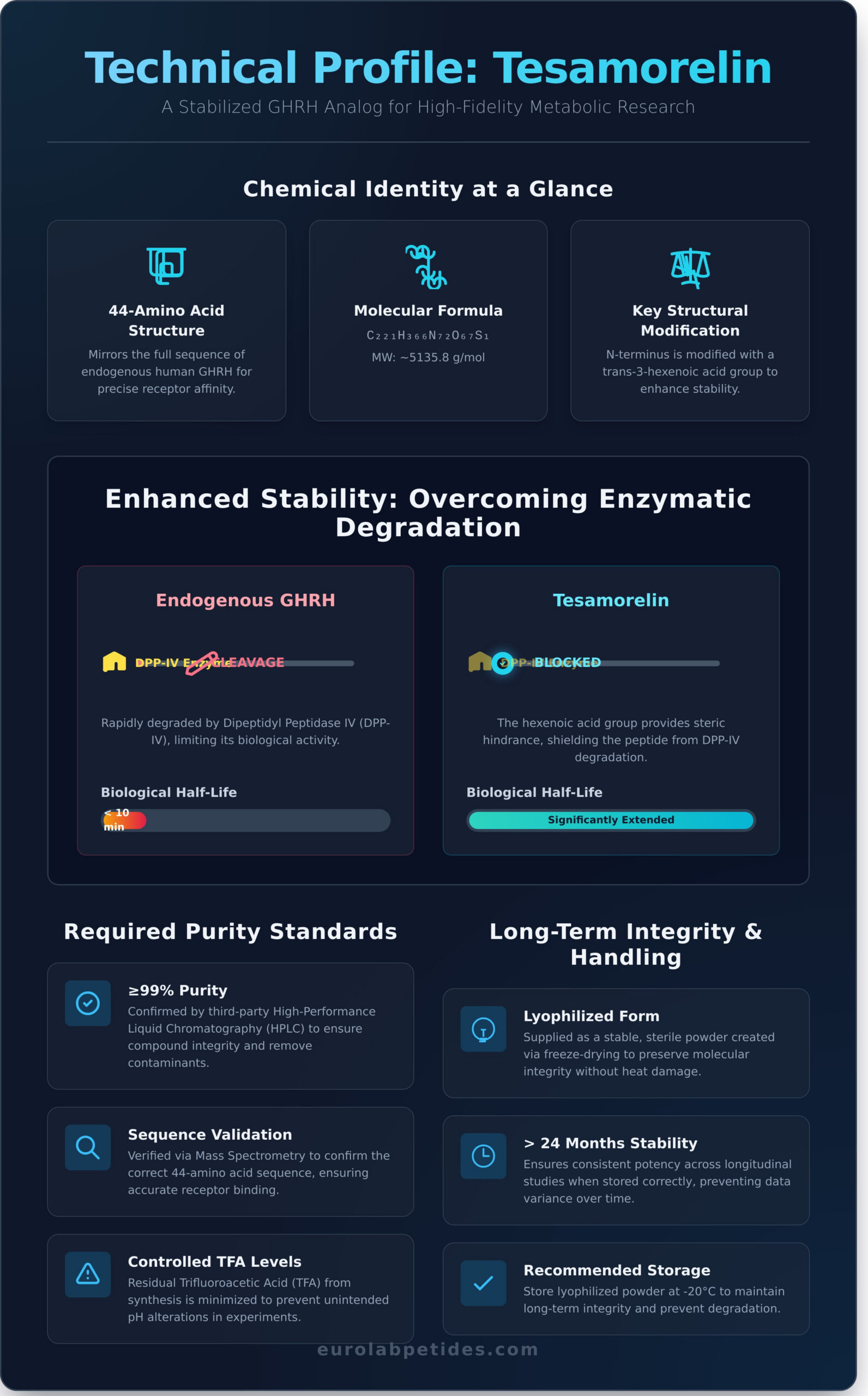
Tesamorelin is a synthetic polypeptide analog of human growth hormone-releasing hormone (GHRH). Its structure comprises the full 44-amino acid sequence of endogenous GHRH, ensuring precise biological mimicry and receptor affinity. The empirical chemical formula for this compound is C221H366N72O67S1, corresponding to a molecular weight of approximately 5135.8 g/mol. This molecular identity is the foundation of its function as a research tool for investigating the hypothalamic-pituitary-somatotropic axis.
The defining structural modification of the tesamorelin peptide is the addition of a trans-3-hexenoic acid group to the N-terminus of the amino acid chain. This seemingly minor addition is a critical feat of chemical engineering designed to overcome the primary limitation of native GHRH: its rapid enzymatic degradation. Endogenous GHRH has a circulatory half-life of less than 10 minutes, primarily due to cleavage by the enzyme dipeptidyl peptidase IV (DPP-IV). The hexenoic acid moiety provides steric hindrance at the cleavage site, effectively shielding the peptide from DPP-IV action. This modification extends the peptide’s biological activity, providing a more stable and prolonged secretagogue effect for controlled experimental conditions. The full structural details and mechanism are well-documented for further review on platforms like Tesamorelin (Wikipedia).
Sequence Validation and Purity Standards
For research applications, absolute fidelity to the native GHRH sequence is paramount. Sequence homology is verified through mass spectrometry to confirm that each of the 44 amino acids is present in the correct order. Any deviation would compromise the peptide’s ability to bind to GHRH receptors, rendering experimental data invalid. A purity level of 99% or higher, confirmed by third-party HPLC analysis, is the required baseline for reliable in-vitro data. Researchers must also consider the impact of residual trifluoroacetic acid (TFA), a remnant of the synthesis process. Uncontrolled TFA levels can alter experimental pH and induce unintended cellular responses, confounding results.
Stability of the Lyophilized Powder
The long-term integrity of the tesamorelin peptide is maintained through lyophilization, a process also known as freeze-drying. This technique involves freezing the purified peptide solution and then sublimating the ice under a vacuum, which removes water content without the molecular damage caused by heat. This results in a stable, sterile powder. When stored under recommended conditions of -20°C, the lyophilized peptide resists degradation for periods exceeding 24 months, ensuring consistent potency across longitudinal studies. Tesamorelin is a stabilized GHRH analog engineered for research into the mechanisms of GH-mediated lipolysis.
Mechanism of Action: Pulsatile GH Release in Research Models
The primary mechanism of action for the tesamorelin peptide is its function as a synthetic analogue of human growth hormone-releasing hormone (GHRH). It selectively binds to and stimulates GHRH receptors (GHRHR) located on somatotroph cells in the anterior pituitary gland. Unlike direct administration of exogenous growth hormone (GH), which introduces a constant, supraphysiological level of the hormone, tesamorelin’s action induces the synthesis and secretion of endogenous GH in a pulsatile manner that closely mimics natural physiological rhythms.
This preservation of pulsatility is a critical distinction in metabolic research. By stimulating the body’s own production pathway, the tesamorelin peptide allows the natural endocrine feedback loops to remain intact. The subsequent rise in serum GH concentration stimulates hepatic production of insulin-like growth factor 1 (IGF-1). Elevated levels of both GH and IGF-1 exert negative feedback on the hypothalamus and pituitary, regulating further GHRH and GH release. This self-regulating system prevents the pituitary shutdown and systemic imbalances often observed with continuous, high-dose GH administration models, making it a superior tool for studying targeted metabolic effects.
Signal Transduction Pathways
Upon binding to the GHRH receptor, a G-protein-coupled receptor, tesamorelin initiates a well-defined intracellular signaling cascade. This activation stimulates the adenylate cyclase pathway, leading to a rapid increase in intracellular cyclic adenosine monophosphate (cAMP). As a crucial second messenger, cAMP activates Protein Kinase A (PKA), which in turn phosphorylates downstream targets, including the CREB (cAMP response element-binding protein) transcription factor. This process upregulates the transcription of the GH gene, directly increasing the synthesis of growth hormone within somatotrophs for subsequent release.
Pharmacokinetics in In-Vitro Environments
The molecular structure of tesamorelin was engineered for enhanced stability compared to endogenous GHRH. The precise formulation, as detailed in the initial 2010 FDA Approval of Tesamorelin, includes a trans-3-hexenoyl group at the N-terminus. This modification confers significant resistance to degradation by the enzyme dipeptidyl peptidase-IV (DPP-IV). This structural integrity results in a markedly different pharmacokinetic profile:
- Half-Life Comparison: Endogenous GHRH has an extremely short plasma half-life, often cited as less than 10 minutes. In contrast, tesamorelin exhibits a half-life of approximately 25 to 40 minutes in human studies, a stability that is replicated in simulated biological fluids for in-vitro analysis.
- Binding Affinity: Despite its structural modification, tesamorelin retains a high binding affinity for the GHRH receptor, comparable to that of native GHRH. This ensures targeted action with minimal off-target effects, a critical parameter for reproducible experimental outcomes.
- Metabolic Clearance: Its resistance to DPP-IV enzymatic cleavage directly results in a lower metabolic clearance rate than natural GHRH, permitting a more sustained period of pituitary stimulation from a single administration in a research setting.
These pharmacokinetic properties demand a compound of uncompromising quality for valid research. The stability and activity of the peptide are directly dependent on its purity. Researchers can access third-party analysis for our tesamorelin to confirm its structural integrity and 99%+ purity, ensuring that experimental results are attributable to the compound’s specific mechanism of action.
Primary Research Applications: Visceral Adiposity and Metabolism
The primary utility of the tesamorelin peptide in a research context is its validated capacity to investigate the intricate relationship between growth hormone (GH) secretion and metabolic dysregulation. Its mechanism, which involves stimulating endogenous GH release from the pituitary, provides a precise tool for studying downstream effects on adipose tissue, hepatic function, and glucose homeostasis. Unlike direct GH administration, tesamorelin preserves the physiological pulsatility of GH secretion, a critical variable in metabolic signaling studies.
Initial and ongoing investigations focus on its pronounced effect on visceral adipose tissue (VAT), the metabolically active fat depot strongly correlated with cardiometabolic risk. In landmark studies involving models of HIV-associated lipodystrophy, administration protocols demonstrated a VAT reduction of approximately 15-18% over a 26-week period, quantified via CT scan. This specific action allows researchers to isolate the effects of visceral fat reduction from broader changes in body composition.
While this research explores potential therapeutic pathways, monitoring these cardiometabolic risk factors in humans is a key aspect of preventive medicine. For those interested in the clinical application of such monitoring, you can learn more about Health Screen Test and their approach to early detection of heart disease and other conditions.
Similarly, for men seeking comprehensive management of these health factors, physician-led practices like Men’s Wellness Centers specialize in creating tailored health strategies that address metabolic and hormonal balance.
This targeted lipolysis has direct implications for research into non-alcoholic fatty liver disease (NAFLD). As VAT is a principal source of free fatty acids contributing to hepatic steatosis, its reduction is a key therapeutic target. The efficacy of tesamorelin in this area is under rigorous examination; for instance, the Tesamorelin NAFLD Clinical Trial was designed specifically to assess its potential to reduce liver fat in subjects with NAFLD. The peptide’s role in modulating glucose metabolism is also an area of intensive study. While acute GH elevation can induce transient insulin resistance, long-term VAT reduction via tesamorelin is associated with improvements in insulin sensitivity, offering a model to study the complex interplay between adiposity and glucose regulation.
Selectivity for Visceral vs. Subcutaneous Fat
The biochemical basis for tesamorelin’s VAT selectivity lies in the differential expression of GH receptors on adipocytes. Visceral adipocytes exhibit a higher density of these receptors compared to subcutaneous adipocytes, rendering them more responsive to GH-mediated lipolysis. This targeted action is critical for studies aiming to reduce VAT while preserving lean muscle mass, an effect confirmed by dual-energy X-ray absorptiometry (DEXA) scans in multiple trials. The corresponding reduction in VAT-secreted inflammatory cytokines, such as IL-6, often results in a measurable decrease in C-reactive protein (CRP) levels.
Comparative Research: Tesamorelin vs. CJC-1295
When selecting a GHRH analog, the distinction between tesamorelin and a long-acting analog like CJC-1295 with DAC is paramount. Tesamorelin is the full 44-amino acid GHRH sequence with an N-terminal modification to prevent degradation. In contrast, CJC-1295 with DAC utilizes a Drug Affinity Complex to bind to serum albumin, extending its half-life from minutes to days. This structural difference creates divergent pharmacokinetic profiles: tesamorelin amplifies natural GH pulses, while CJC-1295 with DAC produces a sustained, non-pulsatile elevation of GH. The choice depends entirely on the research objective; tesamorelin is superior for studying physiological pulsatility, whereas CJC-1295 is selected for protocols requiring constant GH exposure with minimal administration frequency.
Laboratory Protocols: Reconstitution and Handling
The transition of a lyophilized peptide from a stable, inert powder to a bioactive solution is a critical control point in any research protocol. The viability and experimental reproducibility of tesamorelin are contingent upon stringent adherence to aseptic reconstitution and handling procedures. Improper technique can introduce contaminants or induce structural degradation, rendering the compound ineffective and invalidating downstream data. The following protocols are designed to preserve the peptide’s integrity from vial to final application.
Accurate dosing begins with precise calculation of the required solvent volume. To achieve a desired concentration, researchers must account for the peptide’s mass and the target molarity. For instance, to prepare a 1 mg/mL solution from a 2 mg vial of tesamorelin, exactly 2 mL of a suitable solvent is required. For molar calculations, the molecular weight of Tesamorelin (5135.8 g/mol) is the critical variable. We recommend utilizing a dedicated peptide reconstitution calculator to eliminate potential human error and ensure dose-response accuracy.
Solubility and Reconstitution Steps
The primary structure of the tesamorelin peptide dictates its handling requirements. Reconstitution must be performed with either bacteriostatic water (containing 0.9% benzyl alcohol) for multi-use protocols or sterile 0.9% sodium chloride for immediate single-use applications. Introduce the solvent slowly down the side of the vial. To facilitate dissolution, employ gentle swirling or several slow inversions. Vigorous shaking or sonication is strictly prohibited, as the resulting shear stress will denature the peptide’s secondary structure and compromise its biological activity.
Storage and Shelf Life Post-Reconstitution
Once reconstituted, the solution’s stability is finite. When stored under refrigerated conditions at 2-8°C and protected from light, the solution remains viable for up to 14 days. For long-term storage exceeding this period, the reconstituted solution must be aliquotted into single-use volumes and frozen at -20°C or below. This practice is mandatory to avoid multiple freeze-thaw cycles, a process known to cause peptide aggregation and a cumulative activity loss of up to 15% per cycle.
Aseptic technique is non-negotiable. All reconstitution should occur within a laminar flow hood or a similarly controlled sterile environment. Before use, the vial’s septum must be sanitized with a 70% isopropyl alcohol wipe. Use only sterile, pyrogen-free syringes and needles for both reconstitution and administration. After reconstitution, a visual inspection is required. The solution must be completely clear and free of any particulate matter. Any sign of cloudiness, precipitation, or discoloration indicates potential contamination or chemical degradation, and the vial must be discarded immediately.
To ensure the integrity of your metabolic research from the very first step, acquire third-party tested tesamorelin with verifiable 99%+ purity.
Sourcing Research-Grade Tesamorelin in Europe
For any laboratory engaged in metabolic research, the integrity of experimental outcomes is directly correlated with the purity of the compounds utilized. Sourcing research-grade peptides within the European Union demands an uncompromising approach to quality assurance, logistical stability, and strict regulatory adherence. Every vial must be supplied with the explicit understanding that it is intended for in vitro research and laboratory use only, a standard that protects both the researcher and the integrity of the scientific process. The acquisition of a tesamorelin peptide, for instance, is not a simple transaction; it is the procurement of a critical analytical tool.
The non-negotiable standard for verifying peptide quality rests on two pillars of analytical chemistry: High-Performance Liquid Chromatography (HPLC) and Mass Spectrometry (MS). HPLC analysis provides a quantitative purity value, chromatographically separating the target peptide from any residual synthesis fragments or impurities. A purity level below 99% can introduce confounding variables into sensitive assays. Mass Spectrometry complements this by confirming the peptide’s identity, verifying that its molecular weight matches the theoretical mass of Tesamorelin’s 44-amino-acid sequence. A comprehensive Certificate of Analysis (CoA) must present the data from both tests for a specific batch number, ensuring what is documented is what is delivered.
The EuroLab Quality Protocol
Our commitment to unrivaled quality is codified in a multi-level validation process. Each synthesized batch first undergoes stringent in-house analysis. Upon passing internal benchmarks, a sample is sent to an independent, third-party laboratory for impartial verification of purity and identity. This dual-validation system guarantees that every batch of Tesamorelin meets or exceeds a 99% purity standard. The lyophilized peptide is then vacuum-sealed in sterile vials to prevent degradation from atmospheric moisture and oxygen during transit.
Logistical efficiency is another critical component of a reliable laboratory supply chain. Sourcing from within the EU eliminates the complexities and delays associated with international customs clearance, drastically reducing transit times from weeks to days. For researchers in the European Economic Area, this translates to faster project initiation and minimized risk of sample degradation due to prolonged shipping. This is particularly vital for longitudinal studies, which demand a consistent and predictable supply of materials over months or even years.
Batch-to-batch consistency is the bedrock of such long-term projects. A new batch of a peptide that differs in purity from a previous one can invalidate an entire data set. Reputable suppliers must therefore provide archived CoAs, allowing researchers to confirm that the purity profile of a new batch, such as batch number AZ-26B1, aligns with a previous one, like AZ-25A9, within a tolerance of less than 0.5%. This meticulous documentation ensures that the only variable being tested is the one intended by the experimental design.
Reliable Supply for Longitudinal Studies
Ensuring the continuity of long-term research requires absolute confidence in batch-to-batch consistency. Our transparent documentation allows for direct comparison of purity profiles across multiple orders. All shipments are dispatched via secure, temperature-controlled European logistics networks to maintain peptide stability from our facility to your laboratory. This meticulous process guarantees that the tesamorelin peptide you receive maintains its specified purity and structural integrity. View the latest HPLC reports for Tesamorelin at EuroLab Peptides.
Ensuring Experimental Integrity with Research-Grade Tesamorelin
Tesamorelin’s capacity to stimulate endogenous, pulsatile growth hormone release offers a refined mechanism for metabolic studies, particularly those focused on visceral adiposity. As this technical profile has detailed, the precision required for such research means that experimental outcomes are directly dependent on the chemical integrity of the peptide. Inconsistent purity or incorrect handling can compromise entire datasets, invalidating months of rigorous work and investment.
For researchers requiring the highest standard of tesamorelin peptide, Eurolab Peptides provides a verifiable solution grounded in analytical data. Every batch is guaranteed to possess 99%+ purity, a specification confirmed by independent, third-party HPLC and Mass Spectrometry analysis, with certificates available for every lot. Our commitment to quality extends through the entire cold chain. All products are dispatched from our EU facility under stringent, temperature-controlled protocols to ensure absolute stability upon arrival. When your results can’t be compromised, your materials shouldn’t be either.
Secure the integrity of your next research project. Order Research-Grade Tesamorelin with 99%+ Purity. We are committed to supporting the advancement of your critical scientific inquiry.
Frequently Asked Questions
What is the exact molecular weight of Tesamorelin peptide?
The exact molecular weight of Tesamorelin is 5135.89 g/mol. This value corresponds to its chemical formula, C221H366N72O67S, which represents a 44-amino acid sequence. Accurate mass is verified for each batch using Mass Spectrometry to confirm the identity and structural integrity of the synthesized peptide. This verification is a non-negotiable step in our quality assurance protocol, ensuring the compound matches its specified structure for reproducible research outcomes.
How does the trans-3-hexenoic acid modification affect Tesamorelin stability?
The trans-3-hexenoic acid modification significantly enhances Tesamorelin’s stability by protecting it from enzymatic degradation. This N-terminal modification shields the peptide from cleavage by the dipeptidyl peptidase-4 (DPP-4) enzyme. This protection extends the biological half-life from less than 10 minutes for native GHRH to over 30 minutes for Tesamorelin in various laboratory models. This extended activity is critical for achieving consistent downstream signaling effects in metabolic studies.
Can Tesamorelin be used for in-vivo research studies?
Yes, Tesamorelin is intended for use in in-vivo research studies within controlled laboratory settings. It is frequently employed in validated animal models to investigate mechanisms of visceral adipose tissue reduction, growth hormone secretion pathways, and metabolic regulation. Preclinical studies in rodent models of lipodystrophy, for example, utilize the tesamorelin peptide to assess its impact on lipid profiles and glucose homeostasis. All such research requires proper institutional animal care and use committee (IACUC) approval.
What is the recommended storage temperature for lyophilized Tesamorelin?
The recommended long-term storage temperature for lyophilized Tesamorelin is -20°C. Storing the peptide in a sealed container at this temperature preserves its structural integrity and purity for periods exceeding 24 months. For short-term storage of up to four weeks, refrigeration at 2°C to 8°C is acceptable. Exposure to ambient temperatures or frequent freeze-thaw cycles must be avoided, as it can induce degradation and compromise experimental validity.
How long does reconstituted Tesamorelin remain stable in a lab setting?
Reconstituted Tesamorelin remains stable for up to 14 days when stored at 2°C to 8°C. For optimal stability, reconstitution should be performed using sterile, bacteriostatic water and handled with aseptic techniques to prevent microbial contamination. After this 14-day period, the risk of peptide aggregation and degradation increases, potentially affecting its bioactivity. It’s recommended that fresh solutions are prepared for experiments that demand maximum potency and consistency.
What is the difference between Tesamorelin and Egrifta?
Tesamorelin is the active pharmaceutical ingredient (API), which is the pure, synthesized peptide molecule. Egrifta® is the commercial brand name for a prescription drug product that contains Tesamorelin as its active component, along with other excipients for formulation. The Tesamorelin available from chemical suppliers is intended exclusively for in-vitro and in-vivo laboratory research. It is not manufactured for human use or clinical administration, and researchers must distinguish between the pure compound and the pharmaceutical product.
Why is third-party testing critical for Tesamorelin research?
Third-party testing is critical because it provides objective, unbiased verification of Tesamorelin’s purity, identity, and concentration. An independent laboratory analysis, typically using High-Performance Liquid Chromatography (HPLC) and Mass Spectrometry (MS), confirms that a batch meets a purity standard of >99% and has the correct molecular weight. This independent validation ensures that research results are attributable solely to the peptide, eliminating confounding variables from impurities or synthesis errors and upholding the integrity of the study.
Does Tesamorelin affect IGF-1 levels in laboratory models?
Yes, Tesamorelin administration directly affects IGF-1 levels in laboratory models by stimulating the pulsatile release of growth hormone (GH) from the pituitary gland. This increase in circulating GH subsequently induces hepatic production of Insulin-like Growth Factor 1 (IGF-1). In validated rodent models, administration of Tesamorelin has been shown to produce a dose-dependent elevation in serum IGF-1, with levels increasing by 50-150% within 12 hours post-administration, depending on the specific research protocol.
