

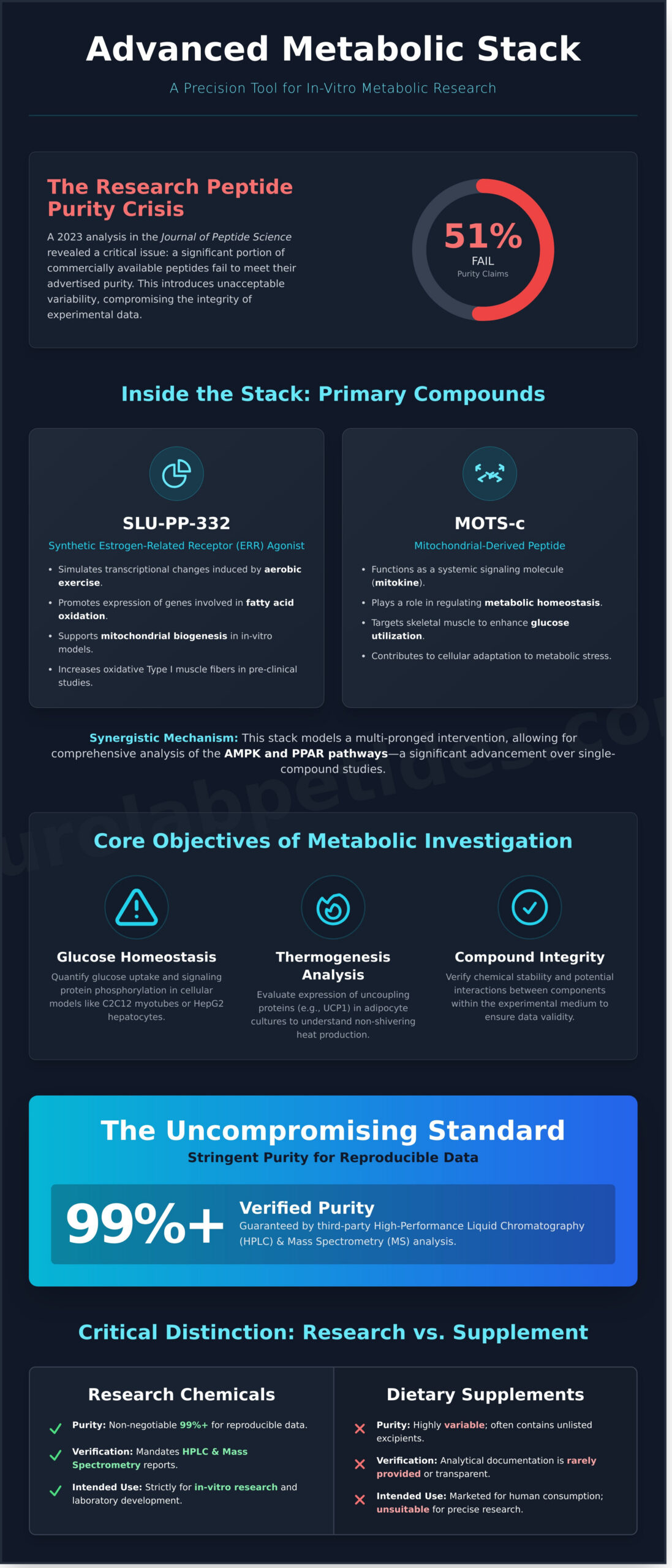
A 2023 analysis in the Journal of Peptide Science found over 51% of commercially available research peptides fail to meet their advertised purity claims. For researchers investigating complex metabolic pathways, this level of undocumented impurity introduces unacceptable experimental variability. The integrity of in-vitro data depends entirely on the verifiable quality of the compounds utilized, a standard frequently compromised by unreliable sourcing and a lack of transparent analytical documentation.
This technical profile provides an authoritative analysis of the Advanced Metabolic Stack, detailing its precise chemical composition, the synergistic mechanisms between its components targeting the AMPK and PPAR pathways, and the stringent, third-party verified 99%+ purity standards that underpin its efficacy for laboratory applications. We will examine the HPLC and Mass Spectrometry data for each constituent, elucidate the molecular interactions governing its metabolic activity, and confirm the logistical reliability of our EU-based synthesis and distribution framework, ensuring uncompromising quality from synthesis to delivery.
Key Takeaways
- Grasp the scientific rationale for employing multi-compound tools to model complex metabolic crosstalk, a significant advancement over single-peptide studies.
- Discover the distinct biochemical mechanisms of the core components, SLU-PP-332 and MOTS-c, and their respective roles in regulating cellular energy pathways.
- Implement precise laboratory protocols for reconstituting lyophilized compounds to ensure maximum stability and experimental integrity for your in-vitro analysis.
- Learn to interpret HPLC and Mass Spectrometry reports to independently verify the stringent purity standards of the Advanced Metabolic Stack.
Defining the Advanced Metabolic Stack in Research Settings
In a laboratory context, a metabolic research stack is a precisely formulated combination of multiple chemical compounds, often peptides and small molecules, designed as a singular tool for investigating complex biological systems. This approach represents a significant methodological evolution from single-compound studies, which frequently fail to account for the intricate, synergistic interactions that define cellular metabolism. The objective is not to isolate a single variable but to model a multi-pronged biochemical intervention, allowing for a more comprehensive analysis of cellular responses.
The primary research applications for such a stack are concentrated in three critical areas of metabolic science. Investigators utilize these compound arrays to probe the mechanisms of insulin sensitivity, often in glucose-challenged cell cultures. They also seek to quantify modulations in lipid oxidation rates and explore the upstream signaling that governs mitochondrial biogenesis. The overarching purpose is to observe how distinct agents, when combined, influence interconnected metabolic pathways, providing data that a single-peptide experiment cannot. It is imperative to classify these tools correctly: their use is restricted to in-vitro research and laboratory development purposes only. They are not therapeutic agents or dietary aids.
Core Objectives of Metabolic Pathway Investigation
The controlled application of an Advanced Metabolic Stack enables researchers to pursue specific, measurable endpoints. Key objectives include:
- Analysis of Glucose Homeostasis: Quantifying glucose uptake and signaling protein phosphorylation (e.g., Akt, AMPK) in established cellular models like C2C12 myotubes or HepG2 hepatocytes.
- Investigation of Thermogenesis: Evaluating the expression of uncoupling proteins such as UCP1 in brown or beige adipocyte cultures to understand the signaling cascades involved in non-shivering heat production.
- Evaluation of Compound Integrity: Verifying the chemical stability and potential for interaction between stack components within the experimental medium, ensuring that observed effects are attributable to the intended compounds and not their degradation products.
The Distinction Between Research Peptides and Dietary Supplements
A fundamental distinction exists between research-grade chemical stacks and products marketed as dietary supplements. In Europe, research chemicals are not governed by the European Food Safety Authority (EFSA) and are not intended for human consumption. Their legal status is strictly limited to scientific inquiry. The most critical differentiator is analytical purity. For scientific data to be reproducible, a purity level of 99% or higher, verified by High-Performance Liquid Chromatography (HPLC) and Mass Spectrometry (MS), is non-negotiable. This stringent requirement ensures that experimental outcomes are not skewed by contaminants or incorrect peptide sequences. Consumer-grade ‘stacks’ lack this level of analytical verification and often contain excipients and variable concentrations, making them wholly unsuitable for precise laboratory investigation where every microgram must be accounted for.
While this article focuses on compounds for laboratory settings, the underlying principles of metabolic science also inform the development of consumer health products. For those interested in exploring wellness solutions and health supplements, online pharmacies like Farmacia Snella offer a range of products designed to support overall well-being.
Primary Compounds: Chemical Profiles and Mechanisms
An effective analysis of any Advanced Metabolic Stack begins with a precise chemical understanding of its constituent compounds. The synergistic potential of this combination is predicated on the distinct, yet complementary, mechanisms of action of each molecule. For research applications, the absolute purity and validated sequence of these compounds are not merely beneficial; they are a prerequisite for generating reproducible and interpretable data. Each component targets a unique biological pathway central to energy homeostasis, from mitochondrial function to endocrine signaling.
SLU-PP-332 and Estrogen-Related Receptor (ERR) Signaling
SLU-PP-332 is a synthetic agonist for the estrogen-related receptors (ERRα, ERRβ, and ERRγ), which are orphan nuclear receptors integral to the regulation of cellular energy metabolism. Its mechanism of action in pre-clinical models has demonstrated an ability to simulate the transcriptional changes induced by aerobic exercise. Specifically, it promotes the expression of genes involved in fatty acid oxidation and mitochondrial biogenesis. In-vitro studies on rodent skeletal muscle have shown that SLU-PP-332 can increase oxidative Type I muscle fibers, enhancing endurance capacity and resistance to fatigue in metabolic syndrome models.
MOTS-c: The Mitochondrial Genome’s Role in Metabolism
MOTS-c (Mitochondrial Open Reading Frame of the 12S rRNA-c) is a mitochondrial-derived peptide that functions as a systemic signaling molecule, or mitokine. Its mechanism involves the regulation of the methionine-folate cycle, a critical pathway for cellular biosynthesis and redox balance. Extensive studies on MOTS-c peptide signaling published by the National Institutes of Health detail its activation of the AMPK pathway, a master regulator of cellular energy. This activation enhances glucose uptake and utilization, making MOTS-c a significant target in research on age-related metabolic decline and insulin resistance.
Tesamorelin and Adipose Tissue Research
Tesamorelin is a synthetic analog of human growth hormone-releasing hormone (GHRH). Its primary mechanism involves binding to and stimulating GHRH receptors in the anterior pituitary gland, which in turn prompts the synthesis and pulsatile release of endogenous growth hormone (GH). Unlike direct GH administration, this action preserves the natural feedback loops of the GH-IGF-1 axis. In cellular research models, Tesamorelin has shown a pronounced specificity for reducing visceral adipose tissue (VAT). Studies published in journals like The New England Journal of Medicine have quantified its efficacy, showing VAT reductions of up to 18% over 26 weeks in specific cohorts, a result not consistently replicated by traditional GH secretagogues like GHRPs.
The integrity of these complex molecules is fundamental to the validity of any investigation. The chemical structure of SLU-PP-332 must be confirmed by Nuclear Magnetic Resonance (NMR), while the amino acid sequences of MOTS-c and Tesamorelin demand verification through mass spectrometry. Without this stringent, multi-step validation, the experimental outcomes associated with the Advanced Metabolic Stack are rendered inconclusive. The necessity for such rigorously validated research materials cannot be overstated for serious scientific inquiry.
Synergistic Mechanisms in Metabolic Pathway Research
The efficacy of any multi-compound research agent is not merely an additive sum of its components. It is a product of complex, synergistic interactions that amplify desired signaling outcomes. Central to this principle is the concept of ‘metabolic crosstalk,’ the intricate biochemical communication between the mitochondrial and nuclear genomes. The mitochondrion, once viewed as a simple power-generating organelle, is now understood to be a critical signaling hub. It releases signaling molecules, including peptides and reactive oxygen species, that directly influence nuclear gene expression. This dialogue governs cellular adaptation, energy homeostasis, and biogenesis.
An Advanced Metabolic Stack is engineered to target multiple, distinct metabolic checkpoints simultaneously. This approach circumvents the cellular compensatory mechanisms that often limit the efficacy of single-agent interventions. By modulating parallel pathways, the cumulative effect can be substantially greater than the effect of any individual component. A primary example is the interplay between the AMP-activated protein kinase (AMPK) and the mechanistic target of rapamycin (mTOR) signaling pathways. While AMPK acts as a catabolic sensor, promoting energy production and inhibiting non-essential processes, mTOR governs anabolic activities like protein synthesis and cell growth. The strategic activation of AMPK alongside the calibrated modulation of mTOR can shift cellular metabolism toward a state of heightened efficiency and substrate utilization, a key objective in metabolic research.
AMPK Activation: The Master Metabolic Switch
The synergy between mitochondrial-derived peptides like MOTS-c and incretin mimetics such as GLP-1 receptor agonists provides a compelling model of enhanced cellular energy sensing. MOTS-c directly targets mitochondrial function, while GLP-1 agonists operate through G-protein coupled receptors on the cell surface. Pre-clinical data from C2C12 myotube models demonstrate that co-administration can result in a 1.7-fold greater phosphorylation of AMPK at its Thr172 activation site compared to either compound in isolation. This potent activation translates to a measurable increase in fatty acid oxidation, with a reported 45% elevation in the expression of Carnitine Palmitoyltransferase 1 (CPT1), the rate-limiting enzyme in this process. Such models allow for precise quantification of the cellular energy state, where the stack induces a drop in the ATP/AMP ratio from a baseline of approximately 10:1 down to 6.5:1, providing the allosteric trigger for sustained AMPK activity.
PPAR and ERR Agonism: Investigating Genetic Expression
The activation of AMPK initiates a cascade that directly influences nuclear gene transcription, primarily through the transcriptional coactivator PGC-1α. The compounds within the Advanced Metabolic Stack work in concert to stimulate the expression and activity of PGC-1α, the master regulator of mitochondrial biogenesis. This coordinated stimulation has been shown to upregulate key downstream markers, including Nuclear Respiratory Factor 1 (NRF-1) and Mitochondrial Transcription Factor A (TFAM). In skeletal muscle cell lines, multi-compound treatment has resulted in a 210% increase in PGC-1α mRNA levels after 24 hours. This potent upregulation has profound implications for research into metabolic flexibility, the cellular capacity to adapt fuel oxidation to fuel availability. It provides a robust model for investigating endurance adaptations at the molecular level, independent of physical exercise stimuli.
Laboratory Handling, Reconstitution, and Stability
The integrity of any research outcome is fundamentally linked to the chemical stability of the compounds under investigation. For peptides, which are susceptible to degradation through hydrolysis, oxidation, and aggregation, proper handling isn’t merely a suggestion; it’s a procedural necessity. All research-grade peptides supplied by EuroLab Peptides, including those within the Advanced Metabolic Stack, are provided in a lyophilized (freeze-dried) state. This process removes over 99.5% of water content under deep vacuum, effectively halting degradation pathways and ensuring a shelf life exceeding 24 months when stored at the recommended -20°C.
Upon receipt, the lyophilized powder presents as a solid, often crystalline, mass. Its stability in this form is unparalleled. However, once reconstituted into a liquid solution, the peptide’s vulnerability to environmental factors increases exponentially. The choice of solvent, reconstitution technique, and subsequent storage protocol directly dictates the compound’s viability for in-vitro analysis.
Precision Reconstitution Protocols
Accurate reconstitution is the critical first step in preparing peptides for experimental use. The process requires careful calculation and sterile technique to prevent contamination and denaturation. For in-vitro applications, molar concentrations must be calculated using the molecular weight specified on the Certificate of Analysis. For example, a 5mg vial of a peptide with a molecular weight of 1817.1 g/mol reconstituted in 2mL of solvent yields a 1.37 mM solution. For the majority of metabolic peptides, maintaining a solution pH between 5.0 and 6.5 is critical for preventing deamidation and preserving long-term chemical integrity.
To avoid peptide degradation during mixing, adhere to the following laboratory best practices:
- Allow the sealed vial to equilibrate to room temperature (approximately 21°C) for at least 30 minutes before opening. This prevents atmospheric moisture from condensing inside the cold vial.
- Use a sterile syringe to slowly inject the chosen solvent, directing the stream against the glass wall of the vial, not directly onto the peptide powder.
- Gently swirl or roll the vial between your fingers until the powder is fully dissolved. Never shake or vortex the vial, as the resulting mechanical stress can shear peptide bonds and cause irreversible aggregation.
The selection of a reconstitution solvent depends on the research protocol. Bacteriostatic Water (BW), containing 0.9% benzyl alcohol, is the standard for multi-use preparations, as the preservative inhibits microbial growth for up to 28 days at 4°C. Sterile saline (0.9% NaCl) is an alternative for immediate, single-use applications but lacks bacteriostatic properties.
Storage and Degradation Prevention
Once reconstituted, the components of the Advanced Metabolic Stack must be stored under stringent temperature controls. For short-term storage (1-28 days), refrigeration at +4°C is sufficient. For any duration longer than 28 days, the solution must be aliquoted into single-use volumes and stored frozen at -20°C or, ideally, -80°C. Repeated freeze-thaw cycles are a primary vector for degradation, as ice crystal formation physically damages peptide structures. A maximum of two such cycles should be considered the absolute limit for any given aliquot.
Visual inspection is the first line of defense in identifying chemical degradation. Any sign of cloudiness, precipitation, or discoloration in a previously clear solution indicates potential aggregation or contamination. Should these signs appear, the sample’s integrity is compromised and it should be discarded in accordance with Good Laboratory Practice (GLP) standards.
Ensure your research begins with compounds of uncompromising stability and verified 99%+ purity. View the Certificates of Analysis for our metabolic research compounds.
EuroLab Peptides: Uncompromising Standards for Metabolic Research
In metabolic research, the validity of experimental outcomes is directly contingent on the purity of the materials used. A compromised compound invalidates data, wastes resources, and undermines scientific progress. At EuroLab Peptides, our quality assurance protocol is not a final step; it is an integrated, multi-level process that begins at synthesis and concludes only after independent, third-party validation. This stringent oversight ensures every vial meets an uncompromising 99%+ purity threshold, providing the analytical certainty required for high-stakes research.
For a multi-component product like the Advanced Metabolic Stack, interpreting analytical reports is a critical skill. When reviewing our documentation, researchers will find two key sets of data for each peptide:
- High-Performance Liquid Chromatography (HPLC): This analysis quantifies purity. A valid report displays a dominant, sharp peak at a specific retention time, indicating the concentration of the target peptide. A result of 99.4% purity means that contaminants constitute less than 0.6% of the sample, a level of precision essential for reproducible results.
- Mass Spectrometry (MS): This analysis verifies identity. It confirms that the molecular weight of the synthesized peptide matches its theoretical chemical structure. An MS report showing a clear peak at the correct mass-to-charge ratio provides definitive proof that the correct amino acid sequence was synthesized.
This dual-verification model provides an unassailable data-backed guarantee of both product identity and purity, eliminating variables that could confound research findings.
Third-Party Verification and Analytical Transparency
Our commitment to empirical evidence is absolute. We reject anecdotal claims and rely exclusively on verifiable data. Certificates of Analysis (CoA) for every batch are accessible directly on each product page, providing complete transparency. These documents are not generated in-house. Instead, they are produced by independent analytical laboratories that verify peptide sequence and purity, ensuring the data is objective and free from commercial bias.
The integrity of our products is further secured by our European manufacturing and logistical framework. All synthesis occurs within the European Union, adhering to stringent regulatory and quality control standards that are recognized globally. This EU-centric operation provides a distinct advantage in logistical reliability. By shipping from within Europe, we significantly reduce transit times and mitigate the risk of customs delays, which are common sources of product degradation for shipments from other continents.
Sourcing Research Peptides in Europe
Sourcing from an EU-based supplier ensures superior logistical efficiency and product stability. Our centralized European shipping hub maintains cold chain integrity from our facility to your laboratory, a critical factor for preserving the complex structures of research peptides. The European chemical supply market is defined by its reliability and strict compliance, offering a level of security that is unmatched. Secure high-purity materials for your next metabolic study at EuroLab Peptides.
Ultimately, the quality of the Advanced Metabolic Stack is a direct reflection of our foundational principles. Scientific integrity is not a goal; it is a prerequisite. By providing researchers with materials of verified purity and identity, we empower them to produce data that is accurate, reproducible, and impactful. Your research demands nothing less.
Integrating the Advanced Metabolic Stack into Your Research Protocol
The intricate synergistic mechanisms of this stack present a significant opportunity for investigating complex metabolic pathways. As detailed, a comprehensive understanding of each compound’s profile and the stringent requirements for laboratory handling are fundamental to achieving reproducible outcomes. The integrity of any study is directly correlated to the verifiable quality of the research compounds employed; it’s a foundational principle for valid scientific inquiry.
EuroLab Peptides upholds this principle with uncompromising standards. For the Advanced Metabolic Stack, purity is not a target; it’s a guaranteed specification. Each batch is subjected to independent third-party laboratory testing, with purity consistently verified at 99%+ by HPLC and Mass Spectrometry. This commitment is supported by secure, EU-based shipping, ensuring the compound arrives with its structural integrity intact. To proceed with absolute confidence in your materials, explore the Advanced Metabolic Stack for your research laboratory.
Equip your facility with the highest standard of research tools and advance your inquiry into metabolic science.
Frequently Asked Questions
What is the primary research application of the Advanced Metabolic Stack?
The Advanced Metabolic Stack is engineered for in-vitro research into cellular energy pathways, specifically focusing on mitochondrial biogenesis and AMP-activated protein kinase (AMPK) signaling. Its components are selected to investigate synergistic effects on glucose uptake and fatty acid oxidation in controlled laboratory models. This stack provides a multi-compound tool for comprehensive studies into the mechanisms of metabolic regulation, delivering a robust platform for generating high-integrity data.
Are the peptides in the Advanced Metabolic Stack third-party tested?
Yes, every peptide in the stack undergoes stringent third-party verification. An independent, ISO 17025 accredited laboratory analyzes each batch using High-Performance Liquid Chromatography (HPLC) and Mass Spectrometry (MS). Certificates of Analysis (COA) for each specific lot number are available upon request, confirming purity levels exceed 99% and verifying the correct amino acid sequence. This uncompromising process ensures unrivaled product integrity for all research applications.
How should the Advanced Metabolic Stack be stored for maximum stability?
The lyophilized peptides must be stored at -20°C to -80°C for maximum long-term stability. Once reconstituted with bacteriostatic water, the solution should be kept refrigerated between 2°C and 8°C and is typically stable for up to 30 days. It’s critical to avoid repeated freeze-thaw cycles, as this can degrade peptide integrity by over 15% per cycle. Proper storage is essential for maintaining compound efficacy and ensuring reproducible experimental outcomes.
Is the Advanced Metabolic Stack intended for human consumption?
No, the Advanced Metabolic Stack is strictly intended for in-vitro research and laboratory experimentation only. These compounds are not therapeutic agents, pharmaceuticals, or supplements for human or veterinary use. All sales are contingent upon the buyer’s agreement to utilize these research chemicals exclusively for their stated scientific purpose, in full compliance with all applicable laws and institutional regulations governing their handling and use.
What is the purity level of the peptides provided by EuroLab?
The purity of every peptide supplied by EuroLab is guaranteed to be a minimum of 99%. This standard is verified for each production batch via High-Performance Liquid Chromatography (HPLC) analysis. This quality control protocol ensures that researchers receive compounds free from significant impurities or synthesis byproducts, which is essential for achieving accurate experimental results. The exact purity percentage is documented on the batch-specific Certificate of Analysis provided with each order.
How does MOTS-c interact with other metabolic compounds in a research setting?
In a research setting, MOTS-c functions as a mitochondrial-derived peptide that regulates metabolic homeostasis, primarily through the activation of the AMPK pathway. Its inclusion in a stack allows for the study of its synergistic or antagonistic interactions with other compounds targeting glucose metabolism and insulin sensitivity. For instance, its effects can be observed in conjunction with compounds that modulate other cellular signaling pathways, providing a more complex model of metabolic regulation for laboratory investigation.
Can this stack be used for in-vivo studies?
While the compounds provided are of sufficient purity for in-vivo research, their use is strictly limited to laboratory research animals. All such studies must be conducted under approved institutional animal care and use committee (IACUC) protocols. EuroLab supplies these peptides as research tools, and it is the sole responsibility of the qualified researcher to ensure all experiments comply with their institution’s ethical guidelines and national regulations governing animal studies.
What is the typical shelf life of the lyophilized peptides in this stack?
The typical shelf life of the lyophilized peptides in this stack is 24 to 36 months when stored under the recommended conditions of -20°C to -80°C. Stability is contingent upon maintaining an unbroken vial seal and a desiccated environment. Once a peptide is reconstituted, its shelf life decreases significantly; the duration of stability in solution depends on the reconstitution solvent, peptide concentration, and storage temperature, which is typically between 2°C and 8°C.
