

In biochemical research, a miscalculation during peptide reconstitution is not a minor setback. It is a fundamental protocol failure that can compromise the integrity of an entire data set, rendering months of work invalid.
We recognize that the transition from a lyophilized mass in milligrams (mg) to a precise dose in micrograms (mcg) represents a critical control point where variability is unacceptable. The potential for peptide degradation or inaccurate solution concentrations due to procedural inconsistencies poses a significant threat to experimental validity. This article provides the definitive tools required to mitigate these risks. Here, you will gain access to a professional-grade peptide calculator engineered for error-free reconstitution mathematics, presented alongside a stringent, standardized laboratory protocol for handling research-grade peptides.
By implementing this protocol and utilizing our computational tool, your laboratory can achieve the uncompromising standards of precision required for producing reliable, reproducible in-vitro results.
Key Takeaways
- Understand the critical process of reconstitution and select the appropriate solvent to ensure the stability of your in-vitro samples.
- Utilize our professional peptide calculator to accurately determine dosage by mastering the relationship between peptide mass, solvent volume, and final concentration.
- Implement a standardized laboratory protocol, including essential aseptic techniques, to prevent contamination and maintain the integrity of lyophilized peptides.
- Learn why a verified peptide mass, confirmed by HPLC and mass spectrometry, is the foundational requirement for any accurate reconstitution calculation.
Understanding Peptide Reconstitution in Laboratory Environments
In quantitative research, precision is not an objective; it is a prerequisite. The process of peptide reconstitution, which involves restoring lyophilized peptides to a liquid state, represents the first critical control point in any experimental protocol. An error at this stage compromises every subsequent measurement. Reconstitution is a foundational technique where the solid, freeze-dried peptide powder is carefully dissolved in a specific volume of a suitable solvent to achieve a precise, known concentration. This step directly dictates the molarity of the stock solution, from which all working solutions are derived.
The consequences of imprecision are severe. A calculation error as small as 5% during reconstitution can cascade into significantly skewed results, potentially invalidating entire datasets on cellular response or receptor binding affinity. Such deviations are unacceptable in environments where reproducibility is the standard. For this reason, reliance on a validated peptide calculator is an essential component of modern laboratory quality assurance, eliminating the variable of human error from this fundamental procedure.
The Science of Lyophilized Peptides
The stability of peptides is intrinsically linked to their physical state. The lyophilization process, defined as the removal of water via sublimation under vacuum, is employed to preserve molecular integrity for long-term storage. This technique gently removes the aqueous solvent from the peptide sample after it has been frozen, preventing the formation of ice crystals that could damage the delicate peptide structure. The resulting stability of lyophilized peptides is superior, protecting them from proteolytic degradation and hydrolysis that occurs rapidly in solution. However, once reconstitution begins, solubility becomes the primary challenge, governed by factors including:
- pH Level: The net charge of a peptide changes with pH, directly influencing its interaction with a polar solvent like water.
- Sequence Length: Longer peptide chains can present more complex folding and a higher potential for aggregation.
- Hydrophobicity: Peptides rich in hydrophobic amino acids (e.g., Valine, Leucine, Isoleucine) exhibit poor solubility in aqueous solutions.
Solvent Compatibility and Research Integrity
The selection of a reconstitution solvent is a decision with direct implications for research integrity and the stability of the peptide in its active state. For in-vitro models requiring multiple aliquots over time, bacteriostatic water containing 0.9% benzyl alcohol is the solvent of choice. The benzyl alcohol acts as a preservative, inhibiting microbial growth and extending the peptide’s half-life in solution from days to several weeks under proper refrigerated storage (2-8°C). Conversely, for immediate single-use applications or in cellular assays where benzyl alcohol could be cytotoxic, sterile water or an isotonic sterile saline solution is required. All solvents utilized must conform to stringent European Pharmacopoeia (Ph. Eur.) standards to ensure they are free of pyrogens and contaminants that could interfere with experimental outcomes. The wrong choice doesn’t just risk contamination; it can chemically alter the peptide itself, rendering any precise dosage calculated by a peptide calculator meaningless.
The Variables of Peptide Calculation: Mass, Volume, and Concentration
Accurate peptide dosing is not a matter of estimation; it’s a function of precise mathematical inputs. The integrity of any research protocol depends on the stringent control of three core variables. An error in any one of these components will compromise the entire experiment, rendering the results invalid. These variables form the foundation of every reconstitution and are the primary data points required by any digital peptide calculator. Understanding their interplay is fundamental to achieving reproducible outcomes in a laboratory setting.
The principal components for calculation are:
- Mass (mg): This represents the total quantity of lyophilized peptide powder present in the vial. It’s an absolute value, typically 5mg or 10mg, that serves as the starting point for all subsequent calculations. The integrity of any calculation begins with this confirmed mass, a metric verified by HPLC and Mass Spectrometry for every batch at EuroLab Peptides.
- Volume (mL): This is the precise volume of diluent, such as bacteriostatic water, added to the vial to reconstitute the lyophilized powder into a solution. The chosen volume directly dictates the final concentration of the peptide.
- Target Dose (mcg): This is the specific quantity of peptide, measured in micrograms, required for a single administration in a given research application. It is the desired outcome of the calculation.
- Syringe Units: Laboratory measurements are executed using syringes, most commonly U-100 insulin syringes. These instruments are calibrated in units, where 100 units correspond to a total volume of 1 milliliter (mL). Therefore, one unit is equivalent to 0.01 mL.
The Mathematical Formula for Reconstitution
The concentration of a reconstituted solution is determined by a direct formula: Total Peptide Mass (mg) divided by Total Solvent Volume (mL). For example, if a 5mg vial of peptide is reconstituted with 2mL of bacteriostatic water, the concentration is 2.5 mg/mL. To find the dose per unit on a U-100 syringe, this concentration is converted to micrograms (2500 mcg/mL) and then divided by 100 units, yielding a final dose of 25 mcg per 1 unit.
Common Unit Conversion Pitfalls
Precision demands an uncompromising attention to units, as conversion errors are a primary source of dosing failure. The most critical distinctions involve a factor of 1000. A misinterpretation between milligrams (mg) and micrograms (mcg) results in a dose that is either completely inert or catastrophically excessive. Similarly, confusing milliliters (mL) with syringe units can lead to a tenfold dosing error. Researchers must also account for the dead space volume of the syringe, which can retain up to 50 mcg of peptide, impacting the accuracy of micro-dosing protocols.
Mastering these variables is not optional. While a quality peptide calculator automates the process, a foundational understanding of the underlying mathematics is essential for validating results and maintaining absolute control over experimental parameters. It’s the only way to ensure the protocol is executed with the required scientific rigor.
Syringe Dynamics and Unit Conversion in In-Vitro Studies
Translating a calculated dose from a digital interface to a physical volume is a critical control point in any experimental protocol. The integrity of research data depends on the accurate administration of a specified peptide mass, a process governed by the interplay between syringe mechanics, volumetric standards, and meticulous technique. An error of a single tick mark can introduce significant variance, compromising the validity of study outcomes. Understanding these physical dynamics is as essential as the initial reconstitution.
The selection of the appropriate syringe is the first procedural decision. The choice directly impacts dosing resolution. For most research applications involving lyophilized peptides, three sizes of insulin syringe are standard:
- 1.0mL (100-Unit): Suitable for larger volume administrations or less concentrated solutions. Each tick mark typically represents 2 units (0.02mL), offering lower precision for micro-dosing.
- 0.5mL (50-Unit): Offers a superior balance for common dosing ranges. Tick marks are spaced further apart than on a 1.0mL syringe, typically representing 1 unit (0.01mL), which reduces the margin for measurement error.
- 0.3mL (30-Unit): The instrument of choice for high-potency peptides requiring minute doses. These syringes often feature half-unit markings, providing the highest degree of volumetric resolution.
Most laboratory protocols have standardized on the U-100 insulin syringe scale. This convention designates that 100 units are equivalent to 1 milliliter (mL) of fluid. This direct relationship simplifies conversions and is the default setting for any competent peptide calculator. The calculator’s primary function is to convert a target dose in micrograms (mcg) into a specific number of these units, providing a clear, actionable instruction. It effectively bridges the gap between the abstract mass of the peptide and the tangible volume to be drawn into the syringe barrel, eliminating the potential for manual calculation errors which can compound over the course of a study.
To preserve the complex tertiary structure of a peptide, the draw process must minimize mechanical stress. Rapidly pulling the plunger creates a vacuum, causing turbulence and high shear forces as the solution is forced through the narrow needle aperture. This can lead to aggregation or fragmentation of peptide chains, reducing biological activity. A slow, deliberate draw is the validated method for maintaining structural integrity.
Syringe Calibration and Measurement
Volumetric accuracy is contingent on correctly reading the instrument. Due to surface tension, the liquid’s surface, or meniscus, will be concave. The measurement must be taken from the bottom of this curve, ensuring alignment with the desired graduation mark on the barrel. While tuberculin syringes measured in mL exist, U-100 insulin syringes are superior for peptide research due to their finer gradations and fixed needles that minimize dead space. Needle gauge also impacts peptide integrity; a 29-31 gauge needle provides an optimal balance, as gauges finer than 31 may increase shear stress during expulsion.
Calculating Micro-Dosages
For high-potency peptides requiring doses below 10mcg, direct measurement becomes impractical. The required volume may be smaller than a single graduation mark. The correct laboratory procedure is serial dilution. A precisely measured portion of the primary reconstituted solution is further diluted with a known volume of bacteriostatic water. This secondary, less concentrated solution allows a larger, more accurately measurable volume to be drawn for the target micro-dose. Crucially, the unit markings on any syringe are relative to its total volume. This volumetric relativity necessitates the use of a precise peptide calculator to translate a target microgram dosage into the correct volumetric unit for a specific syringe and concentration.
A Standardized Protocol for Reconstituting Lyophilized Peptides
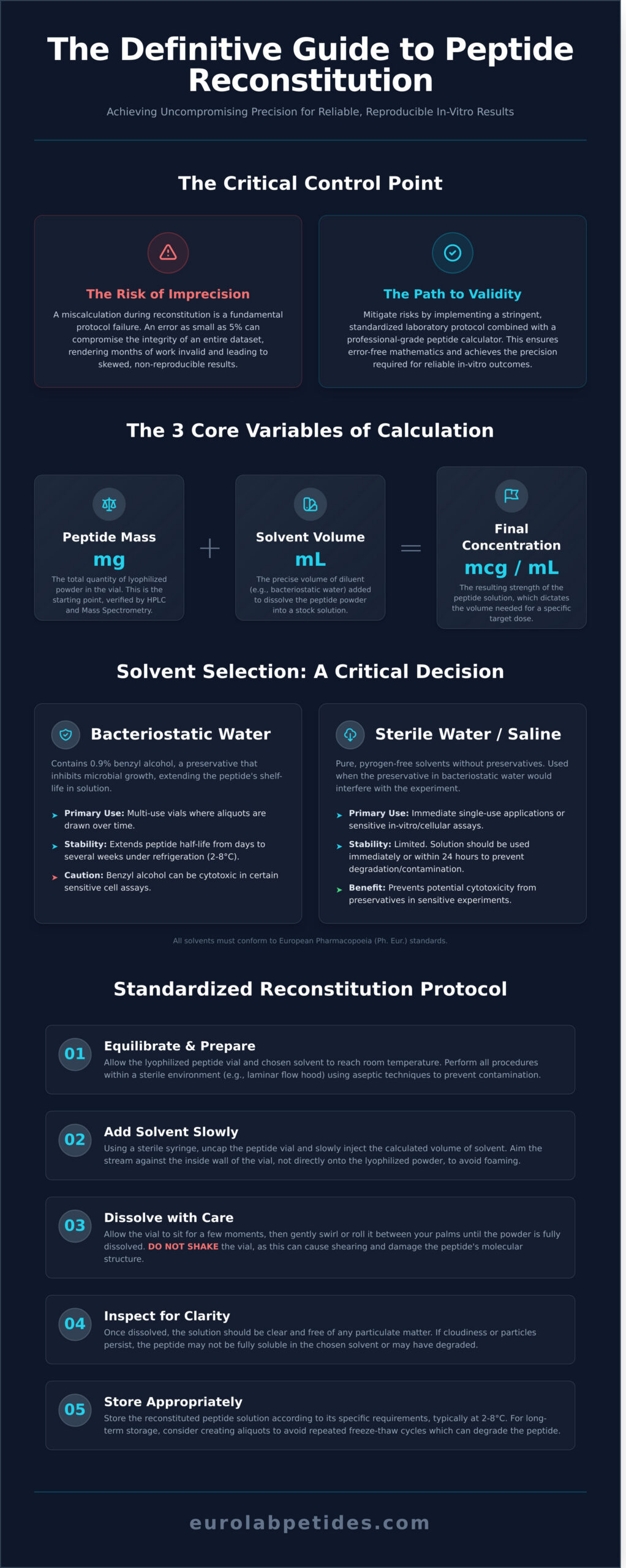
The transition of a peptide from its stable, lyophilized state to a solvated, active solution is a critical control point in any research protocol. The integrity and bioactivity of the peptide are contingent upon precise reconstitution technique. An improper procedure can introduce contaminants, cause peptide aggregation, or result of an incorrect final concentration, thereby invalidating subsequent experimental data. The following protocol outlines the stringent, laboratory-grade steps required to preserve the verified 99%+ purity of your research peptides.
Before introducing any solvent, the vial must undergo thermal equilibration. Lyophilized peptides are typically stored at or below -20°C; they must be allowed to reach ambient room temperature (approximately 20-25°C) over a period of 30-60 minutes. This step is non-negotiable. Opening a cold vial introduces atmospheric condensation, which can alter the peptide mass and final solution concentration before the reconstitution volume is even added.
Aseptic technique is paramount. The vial’s rubber stopper must be thoroughly sanitized with a 70% isopropyl alcohol wipe and allowed to air dry completely. When the predetermined volume of solvent is introduced, the needle should be angled to direct the liquid stream down the interior wall of the vial. This controlled introduction minimizes mechanical stress and prevents foaming. Vigorous agitation or shaking is strictly contraindicated, as the resulting shear forces can denature the peptide’s tertiary structure or induce aggregation, rendering it biologically inert. Instead, gentle rotation or swirling is employed until the lyophilized powder is fully dissolved.
Step-by-Step Reconstitution Procedure
For optimal results, a systematic approach is required. First, equalize vial pressure by gently inserting a sterile vent needle or by slowly injecting the solvent to allow displaced air to exit through the same needle. After solvent introduction, allow the solution to stand for 1-2 minutes. While many peptides dissolve within 60 seconds, complex hydrophobic sequences may require longer. Finally, perform a visual inspection; the final solution must be completely clear and free of any visible particulate matter before proceeding.
Stability and Handling Post-Solvating
Once reconstituted, peptide solutions must be stored at the industry standard of 2-8°C to mitigate degradation. It’s critical to avoid multiple freeze-thaw cycles. Each cycle promotes ice crystal formation, which can fracture peptide structures and cause irreversible aggregation. For long-term storage, aliquoting the solution into single-use volumes is the recommended procedure. Every vial must be meticulously labeled with the reconstitution date, final concentration (as derived from a peptide calculator), and the specific solvent used for absolute traceability.
Adherence to this protocol ensures that the concentration value entered into a peptide calculator for dosing calculations accurately reflects the true, active concentration within the vial. The integrity of your research begins with uncompromising starting materials handled with exacting precision. All our lyophilized peptides are synthesized and verified under stringent European standards to ensure maximum stability for your reconstitution protocol. Explore our third-party verified peptide catalog.
EuroLab Peptides: Ensuring Analytical Integrity through Precision Tools
Accurate experimental outcomes depend on the integrity of every input variable. A precise dosing calculation is rendered invalid if the foundational purity of the peptide itself is compromised. The mathematical accuracy of any reconstitution tool, including a peptide calculator, is directly contingent on the verifiable mass of the active compound. At EuroLab Peptides, we provide the analytical certainty required for reproducible research, where product quality and precision tools form a single, integrated system.
The baseline for all valid reconstitution mathematics is a purity level of 99% or greater. A vial containing 10mg of a peptide with only 95% purity introduces a 5% margin of error before the first measurement is ever taken. This discrepancy invalidates dosing schedules and compromises the statistical significance of study results. Our uncompromising commitment to a minimum 99% purity standard ensures that the mass stated on the vial is the true, effective mass for your calculations, eliminating the variable of product contamination from your experimental design.
This level of purity is not merely claimed; it’s analytically verified. Every batch of synthesized peptide undergoes a stringent, two-stage validation process:
- High-Performance Liquid Chromatography (HPLC): This technique separates the target peptide from any residual synthesis-related impurities. The resulting chromatogram provides a quantitative purity value, confirming that the primary compound constitutes at least 99% of the sample.
- Mass Spectrometry (MS): Following HPLC separation, mass spectrometry is used to confirm the molecular weight of the primary peptide. This analysis verifies that the compound’s identity and amino acid sequence are correct, ensuring you are working with the exact molecule required for your research.
Quality Assurance in Peptide Synthesis
Our quality assurance is built on a framework of multi-level verification and regulatory alignment. Each batch is subjected to rigorous in-house testing post-synthesis and is then sent for independent analysis by a third-party European laboratory. This non-negotiable, third-party verification provides an objective, unbiased confirmation of purity and identity, with the corresponding Certificate of Analysis (COA) made available for every product. This process is rooted in European manufacturing excellence, ensuring compliance with stringent quality control standards from raw material procurement to final lyophilization.
Advanced Tools for Modern Researchers
To complement our high-purity products, we provide tools designed to streamline laboratory workflows. The EuroLab peptide calculator is engineered to translate the certified purity of our peptides into precise, repeatable dosing solutions. For researchers encountering complex reconstitution scenarios or requiring guidance on specific peptide characteristics, our technical support team offers expert consultation. We function not just as a supplier, but as a dedicated partner in scientific inquiry. Access our high-purity peptide catalog for your next study.
Ensuring Experimental Integrity from Calculation to Culmination
Accurate peptide reconstitution is the foundational step upon which all subsequent experimental data relies. Mastering the interplay between peptide mass, diluent volume, and final concentration is non-negotiable for achieving the desired molarity and ensuring your results are valid. A standardized protocol, executed with precision instruments and an accurate peptide calculator, transforms this complex task into a reproducible procedure. It systematically eliminates variability, but this procedural rigor is only half of the equation for success.
The analytical integrity of your research is ultimately dependent on the purity of the source compound. EuroLab Peptides provides materials engineered to meet the most stringent laboratory standards. We guarantee a minimum of 99%+ purity, a specification that isn’t just a claim but a verifiable fact confirmed by third-party HPLC and Mass Spectrometry analysis for every batch. Shipped from our EU-based facilities under European standards, our peptides provide the quality your work demands. Explore EuroLab’s 99%+ Purity Research Peptides and equip your laboratory with the materials required for data of the highest caliber.
Frequently Asked Questions
How much bacteriostatic water should I add to a 5mg peptide vial?
The volume of bacteriostatic water added to a 5mg peptide vial determines the final concentration per unit, which is a critical input for any peptide calculator. A common practice is to add 2.0mL of water, which yields a concentration of 250 micrograms (mcg) per 0.1mL. Adding 1.0mL would double this concentration to 500 mcg per 0.1mL. Precise calculation is fundamental for maintaining experimental integrity and achieving reproducible results.
What is the difference between a peptide calculator and a dosage calculator?
A peptide calculator is engineered specifically for reconstituting lyophilized peptides, converting mass (mg) into volume (mL) and concentration (mcg/unit). In contrast, a general dosage calculator often handles a wider range of substances and may lack the specific inputs for vial size and solvent volume. Our peptide calculator is a specialized instrument designed for the stringent accuracy required in research, ensuring that dosing protocols are executed with uncompromising precision.
Can I use sterile water instead of bacteriostatic water for reconstitution?
Sterile water is appropriate for reconstitution only in single-use scenarios where the entire vial is consumed immediately. It contains no antimicrobial preservative, such as the 0.9% benzyl alcohol found in bacteriostatic water. This absence renders the solution highly susceptible to bacterial contamination after the vial’s septum is first punctured. For any multi-use protocol, bacteriostatic water is the required standard to ensure peptide stability and sterility for up to 28 days.
How many mcg are in 1 unit on a 100-unit syringe?
The quantity of micrograms (mcg) per unit is entirely dependent on the solution’s final concentration after reconstitution. For example, if a 5mg (5000mcg) vial is reconstituted with 2mL of bacteriostatic water, the total volume equals 200 units on an insulin syringe. This results in a concentration of 25mcg per unit (5000mcg / 200 units). Using 1mL of water would create a 100-unit solution, with each unit containing 50mcg.
What happens if I shake the peptide vial after adding water?
Shaking a peptide vial after adding a solvent introduces excessive mechanical stress that can denature the peptide’s complex amino acid chains. This action compromises the compound’s structural integrity and biological efficacy, rendering it ineffective for research. The correct procedure is to gently roll the vial between your fingers or swirl it slowly. This method ensures the lyophilized powder dissolves completely while preserving the peptide’s molecular structure.
How long do peptides remain stable after being reconstituted?
When reconstituted with bacteriostatic water and stored under refrigerated conditions at 2°C to 8°C, most peptides maintain stability for 28 to 30 days. The presence of a bacteriostatic agent is critical for preventing microbial degradation during this period. After approximately 30 days, a decline in purity becomes a significant variable, which can compromise the validity of experimental data. Always consult the specific peptide’s technical data sheet for precise stability information.
Why does my peptide look cloudy after adding the solvent?
A cloudy or turbid solution after reconstitution often indicates peptide degradation, poor solubility, or potential contamination. Peptides with a verified purity of 99% or higher, as confirmed by HPLC analysis, should dissolve into a completely clear solution. If cloudiness persists after gentle swirling, it suggests a compromised product. For reasons of safety and data integrity, any solution that is not perfectly clear should be discarded and not used in research applications.
Is a 0.3mL syringe more accurate than a 1.0mL syringe for small doses?
Yes, a 0.3mL syringe offers superior measurement accuracy for small doses due to its finer gradations and smaller barrel diameter. The measurement markings on a 0.3mL syringe are in 0.5 or 1-unit increments, whereas 1.0mL syringes typically have 2-unit increments. This increased resolution minimizes the margin of error, a critical factor when administering doses under 10 units. For research protocols demanding the highest level of precision, the 0.3mL syringe is the correct instrument.
