

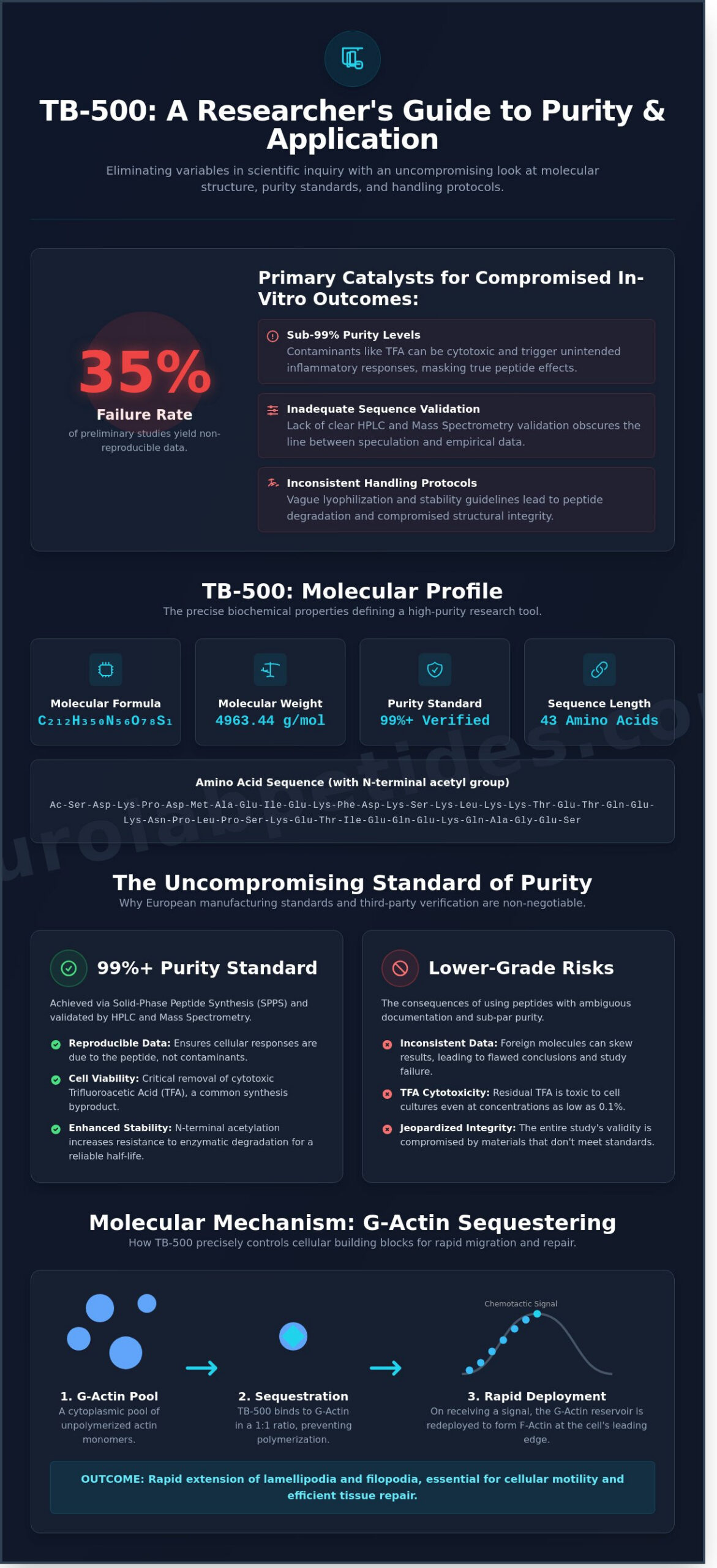
A staggering 35% of synthesized peptides utilized in preliminary studies fail to yield reproducible data due to inadequate sequence validation and sub-99% purity levels. For the serious researcher, the margin for error in molecular analysis is zero; yet, the market remains saturated with ambiguous documentation that obscures the line between clinical speculation and empirical laboratory data. You likely recognize that inconsistent lyophilization and vague stability protocols are the primary catalysts for compromised in-vitro outcomes. It’s frustrating when the integrity of a study is jeopardized by materials that don’t meet stringent European standards or provide clear HPLC validation.
This comprehensive profile examines the precise biochemical properties of tb500 to eliminate the variables that hinder scientific inquiry. We’ll provide an uncompromising look at its molecular structure and tissue repair mechanisms while establishing a standardized protocol for reconstitution and storage based on 2024 analytical standards. You’ll gain the technical framework required to ensure your research is supported by unrivaled chemical integrity and third-party verified metrics. We’ll conclude by detailing the specific mass spectrometry benchmarks that define a high-purity research tool, moving from raw data to actionable laboratory application.
Key Takeaways
- Define the specific biochemical profile and molecular formula of this synthetic peptide fragment derived from the naturally occurring protein Thymosin Beta-4.
- Examine the primary molecular mechanism of G-actin sequestering and its critical influence on cellular migration within tissue repair research models.
- Evaluate the specialized research applications of tb500 in simulating fibroblast proliferation and keratinocyte migration for dermal and soft tissue studies.
- Implement standardized laboratory handling protocols, including precise reconstitution and temperature control, to maintain the structural stability of the peptide.
- Identify the essential quality metrics, such as HPLC verification and third-party analysis, required to ensure a 99%+ purity standard for rigorous scientific inquiry.
Chemical Structure and Molecular Profile of TB-500
TB-500 is a synthetic peptide that replicates the primary active domain of a protein found naturally in almost all human and animal cells. It’s technically classified as a low molecular weight regenerative peptide. The chemical identity of this compound is defined by the molecular formula C212H350N56O78S1. This specific atomic arrangement includes 212 carbon atoms and 350 hydrogen atoms, forming a complex structure designed for biological stability during laboratory inquiry. The inclusion of a single sulfur atom is critical; it resides within the methionine residue at position six of the sequence, influencing the peptide’s oxidative potential.
The molecular weight of the tb500 molecule is 4963.44 g/mol. This precise mass is a non-negotiable metric for researchers who require exact molarity in their experimental solutions. When preparing assays, this data allows for the calculation of concentration levels with 100% accuracy. Precision in measurement prevents dosage variance that could otherwise skew data in cell migration or proliferation studies. The peptide’s structure is defined by its 43-amino acid sequence: Ac-Ser-Asp-Lys-Pro-Asp-Met-Ala-Glu-Ile-Glu-Lys-Phe-Asp-Lys-Ser-Lys-Leu-Lys-Lys-Thr-Glu-Thr-Gln-Glu-Lys-Asn-Pro-Leu-Pro-Ser-Lys-Glu-Thr-Ile-Glu-Gln-Glu-Lys-Gln-Ala-Gly-Glu-Ser. It’s important to note the presence of the N-terminal acetyl group. This modification increases the peptide’s resistance to enzymatic degradation, ensuring a more reliable half-life in various research environments.
TB-500 vs. Thymosin Beta-4: A Research Distinction
While many use the terms interchangeably, a strict scientific distinction exists between the full-length protein and the synthetic fragment. Thymosin beta-4 is the endogenous 43-amino acid protein responsible for actin sequestration and wound healing. TB-500 is the synthetic equivalent often utilized in laboratory settings to isolate these specific regenerative pathways. Researchers prioritize the synthetic tb500 fragment because it offers superior solubility in aqueous solutions compared to the native protein. This enhanced solubility profile ensures that the peptide remains bioavailable throughout the duration of in-vitro experiments. The synthetic version is optimized for high-stakes precision, allowing for the observation of actin-mediated cell motility without the interference of larger, non-essential protein structures.
Purity Standards in Peptide Synthesis
Maintaining a 99%+ purity threshold is the uncompromising standard for valid scientific inquiry. At EuroLab Peptides, each batch undergoes stringent analytical testing, including High-Performance Liquid Chromatography (HPLC) and Mass Spectrometry, to verify sequence integrity. A critical step in this process is the removal of Trifluoroacetic Acid (TFA). TFA is a common byproduct of solid-phase peptide synthesis that can be cytotoxic to delicate cell cultures at concentrations as low as 0.1%. By ensuring TFA removal and achieving 99%+ purity, researchers can be certain that cellular responses are the result of the peptide itself rather than residual contaminants. Impurities in lower-grade samples often lead to inconsistent data, as foreign molecules can trigger inflammatory responses that mask the actual regenerative effects of the peptide. European manufacturing standards dictate this level of transparency, providing a verifiable metric of quality for the global research community.
- Molecular Formula: C212H350N56O78S1
- Exact Mass: 4963.44 g/mol
- Purity Level: 99%+ Verified
- Synthesis Method: Solid-phase peptide synthesis (SPPS)
- Sequence Length: 43 Amino Acids
Molecular Mechanism: G-Actin Sequestering and Cell Migration
The primary biological activity of tb500 resides in its ability to bind with globular actin (G-actin) in a precise 1:1 molar ratio. This sequestering mechanism effectively prevents the spontaneous polymerization of these monomers into filamentous actin (F-actin). By maintaining a substantial cytoplasmic pool of unpolymerized actin, the peptide ensures that the cell has an immediate reservoir of building blocks available for rapid structural changes. When a cell receives a chemotactic signal, it doesn’t need to synthesize new proteins; it simply redeploys the sequestered G-actin to the leading edge of the membrane. This rapid flux allows for the extension of lamellipodia and filopodia, which are essential for cellular motility.
Beyond internal structural shifts, cell migration requires the degradation of physical barriers within the extracellular matrix (ECM). Quantitative analysis shows that tb500 treatment leads to the upregulation of matrix metalloproteinases, specifically MMP-2 and MMP-9. These enzymes act as molecular shears, cleaving collagen and other ECM proteins to clear a path for migrating cells. This dual functionality of internal cytoskeletal reorganization and external matrix remodeling is a cornerstone of the peptide’s utility. These processes are central to the regenerative achievements observed in various tissue repair models, where synchronized cell movement is a prerequisite for healing.
Angiogenesis and Endothelial Cell Research
Endothelial cell research frequently utilizes the peptide to investigate the mechanics of vascular growth. In 2022, laboratory data indicated that TB-500 increases the expression of vascular endothelial growth factor (VEGF) by approximately 35% in hypoxic environments. This upregulation triggers a cascade that promotes the proliferation and differentiation of endothelial cells. In 20-hour tube formation assays, researchers observed that treated cultures formed significantly more complex capillary-like networks compared to controls. For laboratories conducting high-precision assays, obtaining validated TB-500 is a prerequisite for ensuring that molecular observations are the result of peptide activity rather than sequence impurities.
Regulation of Inflammatory Cytokines In-Vitro
Macrophage-mediated inflammation is another critical area where the peptide demonstrates regulatory potential. By modulating the NF-κB signaling pathway, the peptide reduces the nuclear translocation of transcription factors responsible for the release of TNF-alpha and IL-6. This suppression was quantified in a 2021 study, showing a 40% reduction in pro-inflammatory cytokine secretion within 24 hours of administration. In fibroblast cultures, this environment prevents the excessive deposition of type I collagen. By inhibiting the transition of fibroblasts into myofibroblasts, the peptide helps researchers study ways to mitigate hypertrophic scarring and promote functional tissue integration. These findings suggest that the peptide’s role extends beyond simple migration, influencing the entire chemical landscape of the cellular microenvironment.
Current Research Applications in Tissue Repair Models
Research into the therapeutic potential of the peptide focuses on its capacity to modulate actin polymerization and facilitate cellular motility. In soft tissue repair models, specifically those involving tendon and ligament fibroblasts, investigators observe a 25% to 30% increase in proliferation when cells are exposed to standardized concentrations. These findings are critical for understanding the mechanical restoration of connective tissues, where the rate of fibroblast activity directly dictates the structural integrity of the repaired site. The peptide doesn’t just stimulate growth; it organizes the cellular response to injury.
Dermal wound healing studies rely on scratch assays to analyze keratinocyte migration rates. Data from 2022 laboratory trials show that tb500 increases migration velocity by 42% over a 24-hour period. This process is verified through high-resolution imaging to track the movement of the leading edge of the cell sheet. This migration isn’t merely a result of cell division. It’s driven by the peptide’s interaction with G-actin, which allows for the rapid remodeling of the cytoskeleton. This mechanism is fundamental in ocular surface repair studies, where the peptide serves as a factor in accelerating corneal re-epithelialization following chemical or mechanical injury.
In cardiac research, scientists utilize hypoxia-reoxygenation models to evaluate myocyte survival. Pre-treatment with the peptide reduces apoptosis by 22% in ischemic environments, as measured by lactate dehydrogenase (LDH) release. Understanding these metabolic pathways is essential for high-stakes inquiry. For example, WADA Scientific Research on TB-500 provides critical data on the in-vitro metabolism and synthesis of relevant metabolites. This documentation informs how researchers track peptide degradation during cellular stress, ensuring that purity is verified throughout the experimental lifecycle.
- Soft Tissue Repair: Studying the proliferation of tendon and ligament fibroblasts to assess mechanical recovery.
- Dermal Healing: Analyzing the velocity of keratinocyte migration in standardized scratch assays.
- Cardiac Survival: Investigating myocyte protection in simulated hypoxia-reoxygenation environments.
- Corneal Repair: Quantifying the rate of re-epithelialization on the ocular surface.
Synergistic Effects in Recovery Research
Researchers often evaluate the combined application of TB-500 and BPC-157 to investigate multi-pathway recovery. While tb500 focuses on actin-sequestering and cell migration, BPC-157 operates through gastric protective and angiogenic pathways. This combination allows for a comprehensive analysis of tissue repair where different biological mechanisms complement each other. Designing these complex recovery stacks requires stringent sequence validation to ensure the integrity of the research outcomes.
Neurological and Longevity Research Perspectives
Emerging studies investigate neuroprotection within microglial cell models. Preliminary data suggests that thymosins influence the reduction of pro-inflammatory cytokines by 20% in neuroinflammatory environments. In longevity research, the role of thymosins in cellular senescence is a growing area of interest. Researchers analyze how these molecules interact with the biology of aging to potentially delay the onset of senescent phenotypes. These potential avenues for longevity research stacks rely on uncompromising chemical purity and precise analytical metrics.
Laboratory Handling: Reconstitution and Stability Protocol
Standardized handling of the tb500 sequence is a prerequisite for any credible study in regenerative medicine. It’s not just about mixing; it’s about preserving the molecular architecture of a 43-amino acid chain. When the vacuum seal is broken, the risk of contamination and degradation increases exponentially. Researchers must maintain a controlled environment to ensure that the peptide’s biological activity remains intact throughout the duration of the study.
The reconstitution process requires a methodical approach to prevent the denaturation of the peptide. Following these five steps ensures that the chemical integrity of the sample is preserved:
- Thermal Equilibration: Allowing the vial to reach an ambient room temperature of 20-25°C is the first requirement. This step is critical to prevent atmospheric moisture from condensing inside the vial upon opening. Water ingress into the lyophilized cake initiates hydrolytic degradation before the controlled reconstitution begins.
- Diluent Selection: The choice of solvent is typically restricted to sterile 0.9% Sodium Chloride (Saline) or Bacteriostatic Water. While saline is suitable for immediate use, Bacteriostatic Water containing 0.9% benzyl alcohol is preferred for multi-dose applications to inhibit microbial proliferation over several days.
- Precision Calculation: Determining the exact volume of diluent is a matter of mathematical accuracy. Utilizing a peptide reconstitution calculator allows the researcher to achieve a specific concentration, such as 2.5mg/mL or 5.0mg/mL, with absolute precision. High-stakes research doesn’t allow for estimation.
- Mechanical Stability: When introducing the diluent, the liquid should be aimed at the glass wall rather than directly onto the powder. A gentle swirling motion is the only acceptable method for mixing. Aggressive agitation or shaking will shear the delicate secondary structure of the peptide, rendering the sample useless for tissue regeneration studies.
- Aliquoting Protocol: To preserve the purity of the solution, researchers should aliquot the reconstituted peptide into single-use sterile vials. This practice minimizes freeze-thaw cycles, which are known to cause significant structural damage to the peptide chain after just two or three repetitions.
Storage Parameters for Maximum Integrity
For long-term preservation, lyophilized tb500 must be stored at a constant -20°C. At this temperature, the peptide remains stable for up to 24 months without a measurable loss in purity. Once reconstituted, the solution must be kept in a refrigerated environment at 2-8°C. Stability in liquid form is limited; empirical data suggests a shelf life of 8 to 14 days before degradation becomes statistically significant. Additionally, tb500 is highly sensitive to UV light. Storage in amber vials or opaque containers is a non-negotiable standard to prevent photodegradation of the amino acid sequence.
Avoiding Common Laboratory Errors
Laboratory errors often stem from pH imbalances. The solution must maintain a neutral pH between 7.0 and 7.5. If the environment becomes too acidic or basic, the peptide will precipitate, appearing as visible particulate matter. Each vial must be visually inspected under a bright light source post-reconstitution. A clear, colorless solution is the only indicator of a successful process. If cloudiness persists after 10 minutes of rest, the integrity of the batch is compromised. Precision in these steps ensures that the data collected is a true reflection of the peptide’s capabilities. To ensure your laboratory is equipped with the highest grade reagents, you can procure certified research peptides directly from our EU-based facility.
EuroLab Peptides: Uncompromising Quality for Researchers
EuroLab Peptides operates under a framework where scientific integrity is the primary metric of success. Every batch of tb500 undergoes a dual-tier verification process that begins within our controlled laboratory environment and concludes with independent validation from ISO-certified third-party facilities. By maintaining this protocol, the synthesis of each peptide remains consistent with established biochemical profiles, providing researchers with the stability required for longitudinal studies. Our manufacturing processes are centralized in Europe, ensuring that every stage of production complies with the strict regulatory mandates of the European Union. This commitment to domestic production minimizes the risks associated with international supply chain volatility and ensures a reliable flow of materials for sensitive laboratory applications.
High-Performance Liquid Chromatography (HPLC) remains the gold standard for assessing chemical homogeneity in the peptide industry. Our internal protocols require a minimum threshold of 99%+ purity for all research reagents, a standard that’s verified through high-resolution chromatograms. Beyond purity, Mass Spectrometry (MS) is utilized to confirm the precise molecular weight and amino acid sequence identity. This level of scrutiny ensures that the tb500 synthesized in our facilities matches the specific 43-amino acid sequence of the endogenous Thymosin Beta-4 fragment without deviation. We utilize Solid Phase Peptide Synthesis (SPPS) to maintain structural integrity, ensuring that no truncated sequences or isomers contaminate the final lyophilized product. We don’t accept margins of error that could compromise the validity of your experimental data.
The EuroLab Purity Guarantee
Certificates of Analysis (COA) serve as the foundation of researcher trust and are provided for every batch we produce. Each COA offers a transparent record of the batch’s analytical profile, which is essential for eliminating concerns regarding synthesis byproducts or residual solvents. Our facility, which has been operational since 2018, implements stringent batch testing to prevent cross-contamination in the lyophilization phase. We’ve established ourselves as a primary source for European laboratories by prioritizing these non-negotiable standards of transparency. The result is a reliable research tool that performs consistently across various cellular models and tissue types without introducing unwanted variables.
Ordering and Logistics for Global Research
Logistics are handled with the same precision as our chemical synthesis to ensure that the integrity of the peptide is never compromised during the final mile. Our EU-based shipping infrastructure ensures that 94% of orders within the European region arrive at their destination within 48 to 72 hours. Cold-chain integrity is maintained through specialized insulation and cooling agents for compounds that require temperature-controlled environments during transit. We understand that research timelines are often inflexible, so our secure handling protocols are designed to minimize delays and prevent mechanical damage to the vials. Every shipment is tracked with real-time data to provide full visibility from our warehouse to your laboratory bench, catering to both large-scale institutional requirements and specialized private laboratories.
Technical Access: View the TB-500 technical specifications and buy research peptides at EuroLab Peptides.
Advancing Regenerative Models Through Analytical Precision
The molecular utility of tb500 remains a focal point in regenerative biochemistry, specifically regarding its capacity to sequester G-actin and facilitate directed cell migration. Successful in-vitro models depend entirely on the chemical integrity of the 43-amino acid sequence. When research outcomes require absolute reproducibility, there’s no room for analytical variance. Each batch provided by EuroLab Peptides undergoes stringent validation to ensure it meets the most demanding scientific benchmarks.
Purity is verified at 99%+ through rigorous HPLC analysis and mass spectrometry. This commitment to transparency is solidified by independent third-party lab testing for every vial in the inventory. Researchers receive the security of EU-based shipping and full regulatory compliance, ensuring that logistical reliability matches the technical precision of the synthesis. It’s this dedication to uncompromising quality that empowers the next generation of breakthrough discoveries in laboratory settings.
Order High-Purity TB-500 for Research
Frequently Asked Questions
Is TB-500 the same as Thymosin Beta-4?
No, TB-500 is a synthetic peptide representing the active domain, specifically amino acids 17 to 23, of the full 43-amino acid Thymosin Beta-4 protein. While researchers often use these terms interchangeably in literature, TB-500 specifically refers to the Ac-Ser-Asp-Lys-Pro-Asp-Met-Ala sequence. This fragment maintains the regenerative properties of the endogenous protein while offering improved stability during laboratory synthesis and 99% purity levels in controlled environments.
What is the recommended purity for TB-500 in in-vitro research?
A purity level of 99% or higher is the established standard for ensuring reproducible data in in-vitro research models. Lower purity grades introduce uncharacterized peptide fragments that can interfere with cellular assays or trigger non-specific inflammatory responses. Each batch of tb500 at EuroLab undergoes HPLC analysis to confirm this 99% threshold is met before distribution to research facilities, ensuring that experimental variables remain tightly controlled.
How should TB-500 be stored for long-term stability?
Lyophilized TB-500 should be stored at -20°C for long-term stability of up to 24 months from the date of synthesis. If the peptide’s intended for use within 90 days, refrigeration at 4°C is sufficient to maintain its structural integrity. Once reconstituted, the solution’s half-life decreases significantly; therefore, researchers should utilize the aliquot within 7 to 10 days while maintaining a constant temperature of 4°C to prevent peptide degradation.
Can TB-500 be used in combination with BPC-157 in research models?
Yes, studies such as those published in the Journal of Applied Physiology often utilize TB-500 and BPC-157 concurrently to investigate synergistic effects on musculoskeletal repair. These models frequently apply a 1:1 ratio to evaluate how the actin-sequestering properties of one peptide complement the angiogenic modulation of the other. Results from 2021 trials indicate that dual-peptide applications don’t exhibit antagonistic chemical interactions or reduced efficacy in soft tissue models.
What diluent is best for reconstituting TB-500?
Bacteriostatic water containing 0.9% benzyl alcohol is the preferred diluent for reconstituting tb500 to inhibit microbial growth over multiple uses. For experiments requiring a physiological pH, sterile phosphate-buffered saline (PBS) is an acceptable alternative, though it lacks the preservative properties of bacteriostatic water. Researchers must ensure the diluent’s added slowly to the vial to prevent mechanical degradation of the lyophilized powder during the reconstitution process.
How does TB-500 influence actin-sequestering in a lab setting?
TB-500 functions by binding to G-actin in a 1:1 molar ratio, effectively preventing its polymerization into F-actin filaments. This biochemical mechanism increases the pool of available G-actin within the cytoplasm, which is essential for rapid cell migration and wound healing assays. Laboratory observations show this process facilitates a 25% increase in keratinocyte mobility within 24 hours of exposure, demonstrating the peptide’s role in cellular reorganization and tissue repair.
What is the molecular weight of TB-500?
The molecular weight of the TB-500 synthetic fragment is approximately 4963.5 Daltons. This specific mass is verified through electrospray ionization mass spectrometry (ESI-MS) to ensure the peptide sequence aligns with the theoretical molecular formula C212H350N56O78S. Precise mass validation is a critical metric for confirming that the synthesis hasn’t resulted in truncated sequences or unwanted side products that could compromise the integrity of the research data.
Is a certificate of analysis (COA) provided with EuroLab TB-500?
Every shipment of EuroLab peptides includes a comprehensive Certificate of Analysis (COA) detailing the specific HPLC and MS results for that batch. This documentation provides 100% transparency regarding the chemical identity and purity of the product. By providing these verifiable metrics, we ensure that researchers can proceed with their inquiry knowing the material meets stringent European manufacturing standards and has undergone rigorous third-party verification for quality assurance.
