
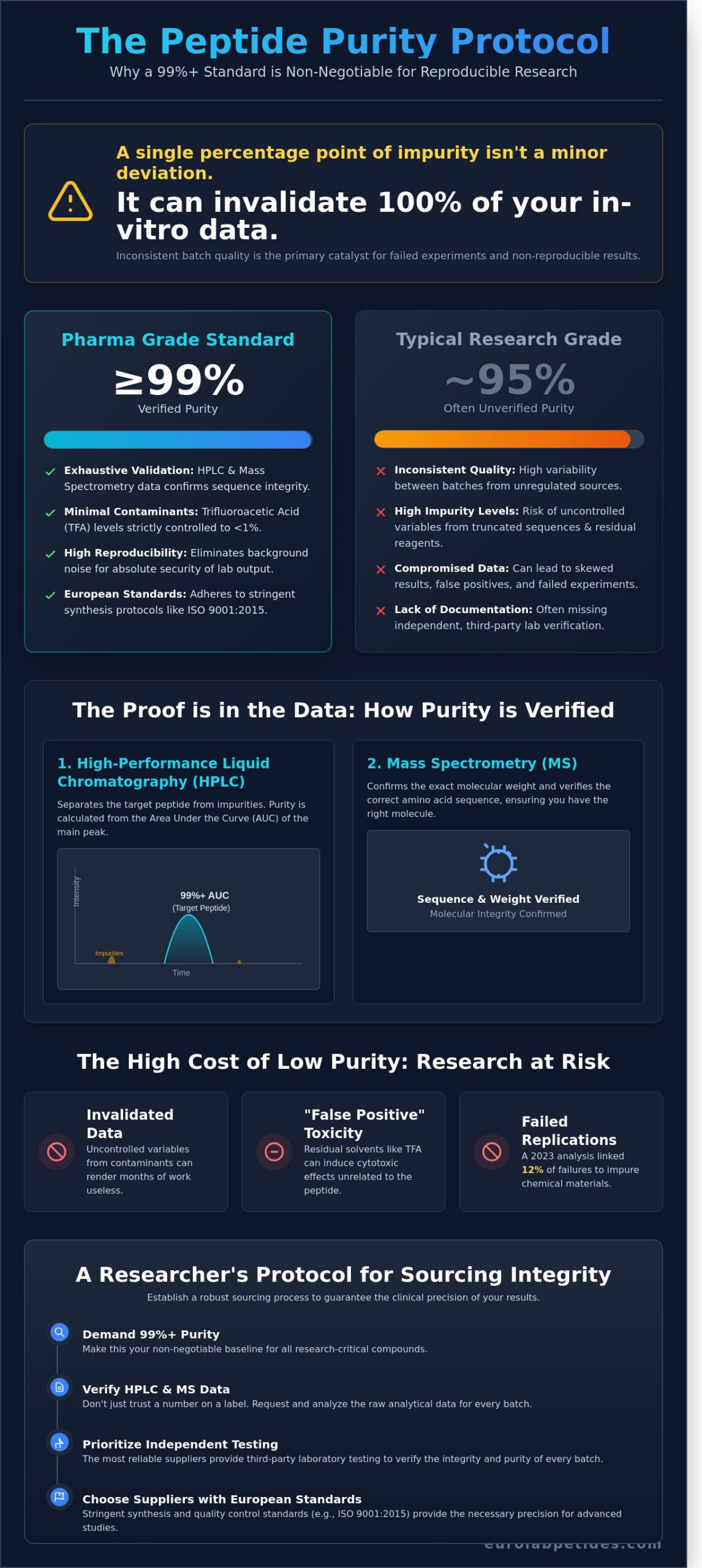
A single percentage point of impurity in a peptide sequence isn’t just a minor deviation; it’s a variable that can invalidate 100% of your in-vitro data. In the rigorous environment of biochemical inquiry, the distinction between “research grade” and genuine pharma grade peptides determines whether your results are reproducible or merely artifacts of chemical contamination. You likely recognize that inconsistent batch quality from unregulated sources remains the primary catalyst for failed experiments. When residual trifluoroacetic acid (TFA) levels aren’t strictly controlled below 1%, the physiological relevance of your sensitive models is immediately at risk.
This technical breakdown offers an authoritative framework for sourcing 99%+ pure compounds through uncompromising analytical verification. You’ll gain a precise understanding of how to interpret HPLC chromatograms and Mass Spectrometry data to confirm sequence integrity and long-term stability. We’ll examine the stringent European synthesis standards and the proof-first protocols required to maintain the absolute security of your laboratory’s output.
Key Takeaways
- Understand the technical parameters defining pharma grade peptides, focusing on the requirement for 99%+ purity and documented sequence validation.
- Learn how to evaluate High-Performance Liquid Chromatography (HPLC) and Mass Spectrometry (MS) data to ensure molecular weight and sequence accuracy.
- Identify the specific thresholds for endotoxins and heavy metals required to minimize variables in in-vitro and laboratory development.
- Establish a robust sourcing protocol that prioritizes independent third-party laboratory testing to verify the integrity of every research batch.
- Discover how stringent European synthesis standards provide the clinical precision necessary for advanced longevity and metabolic studies.
Defining Pharma Grade Peptides in a Research Environment
Pharma grade peptides represent the highest tier of chemical synthesis, characterized by a purity threshold of 99% or higher and exhaustive sequence validation. In the context of biochemical analysis, Pharma Grade is a synthesis standard requiring <1% total impurities. This metric isn’t a marketing preference; it’s a technical necessity for ensuring that the biological activity observed during an experiment is attributed solely to the target peptide sequence and not to unintended contaminants. When research involves complex cellular signaling or metabolic pathways, even a 0.5% variance in chemical composition can introduce uncontrolled variables that invalidate months of data collection.
Achieving this level of precision requires a departure from generic chemical manufacturing. Standard Peptide synthesis often results in crude products that contain a mix of the target molecule and various side products. While a 95% purity level might suffice for basic screening, it’s inadequate for high-stakes in-vitro and laboratory development. Pharmaceutical-standard lyophilization involves a secondary freeze-drying process that removes residual solvents, such as trifluoroacetic acid (TFA), to levels below 0.1%. This rigorous removal of reagents is critical because residual solvents can induce cytotoxic effects in cell cultures, leading to “false positive” toxicity results that don’t reflect the peptide’s actual profile.
The role of pharma grade peptides in reducing variables cannot be overstated. In a 2023 analysis of laboratory reproducibility, it was found that 12% of failed replications were linked to trace impurities in the starting chemical materials. By utilizing sequences synthesized to 99%+ purity, researchers eliminate the background noise caused by non-target molecules. This creates an environment of absolute security where the data generated is a precise reflection of the peptide’s interaction with the biological system.
The Significance of 99%+ Purity
The 99%+ metric refers to the percentage of the target peptide sequence relative to all other substances in the vial as verified by High-Performance Liquid Chromatography (HPLC). The remaining 1% often consists of truncated sequences, which are incomplete chains missing specific amino acids. These fragments can bind to receptors with different affinities, potentially skewing metabolic or longevity research data by as much as 15% in sensitive assays. Residual reagents like acetonitrile can compromise experimental integrity by inducing cellular stress unrelated to the primary research objective. Using 99.8% pure sequences ensures that the chemical “signal” isn’t drowned out by molecular “noise.”
In-Vitro Research vs. Clinical Application
Products categorized as pharma grade peptides are strictly for laboratory development and aren’t for human consumption. This distinction is vital for maintaining the legal and ethical frameworks that govern research-grade chemicals in Europe. Under Regulation (EC) No 1907/2006 (REACH), substances must be handled within a controlled scientific environment to ensure safety and transparency. High-purity tools are the only way to ensure reproducible scientific results, allowing researchers to build on previous findings with confidence. European manufacturing standards, such as ISO 9001:2015, provide the administrative backbone for this quality, ensuring that every batch is analyzed and documented before it enters the laboratory supply chain.
The Analytical Chemistry of Peptide Purity: Beyond the 99% Claim
The designation of pharma grade peptides requires more than a simple numerical claim. Purity is determined through High-Performance Liquid Chromatography (HPLC), which separates the target peptide from synthesis-related impurities. In a standard HPLC report, the main peak represents the desired molecule, while smaller side peaks indicate truncated sequences or isomers. The percentage of purity is calculated based on the Area Under the Curve (AUC) of the main peak relative to the total area of all detected peaks. For researchers, a 99.5% purity rating on a certificate of analysis (COA) isn’t a marketing slogan; it’s a quantitative measurement of chemical homogeneity.
Rigorous impurity profiling must also account for residual solvents and counter-ions like Trifluoroacetic Acid (TFA), which are often used during Solid-Phase Peptide Synthesis (SPPS). Adhering to Regulatory Guidelines for the Analysis of Therapeutic Peptides ensures that these substances are kept below toxicological thresholds. High-quality manufacturing typically reduces TFA content to less than 1% through specialized ion-exchange processes. If these salts aren’t removed, they can interfere with cellular assays or cause localized irritation in animal models.
Structural integrity is preserved through lyophilization, a process where the peptide is frozen and the solvent is removed via sublimation. This results in a stable, porous cake with residual moisture levels typically below 2%. Without this step, peptides undergo rapid hydrolysis or oxidation at room temperature, compromising the validity of long-term research. Each batch of pharma grade peptides must undergo this dehydration process under vacuum to ensure a shelf-life that meets European laboratory standards.
Interpreting HPLC Chromatograms
A single-point test remains insufficient for high-stakes tissue repair or longevity research. HPLC chromatograms must show a clear, sharp main peak with minimal baseline noise. If the side peaks exceed 0.5% of the total area, the batch is rejected. Researchers should verify that the testing was performed using a gradient elution method, which is more effective at revealing closely related impurities than isocratic methods. This level of transparency allows scientists to account for every 0.1% of the sample composition before starting an experiment.
Sequence Validation via Mass Spectrometry
While HPLC confirms purity, Mass Spectrometry (MS) confirms identity. This technique measures the mass-to-charge ratio of the ionized peptide to verify its exact molecular weight against the theoretical value. It detects sequence errors, such as missing amino acids or double hits during synthesis. MS provides the fingerprint of the peptide, ensuring the sequence is correct. When reviewing a COA, the observed mass should match the theoretical mass within a margin of 1 Dalton. This secondary validation is a non-negotiable standard for any laboratory prioritizing data integrity over cost-cutting measures.
Research Grade vs. Pharmaceutical Grade: Addressing the Terminology Gap
The distinction between research-grade materials and pharma grade peptides is frequently blurred by aggressive marketing tactics. While many vendors claim to offer pharmaceutical quality, the reality is that most research chemicals are synthesized in standard laboratories without the stringent oversight required for clinical applications. True pharmaceutical grade implies a level of purity, sterility, and documentation that exceeds 99% of the products currently available on the retail market. It’s not merely a label; it’s a verifiable metric of chemical integrity.
Adherence to FDA Requirements for Peptide Characterization ensures that every molecular sequence is validated through rigorous analytical methods. In a clinical context, even a 0.5% deviation in a peptide sequence can alter biological activity or trigger unwanted immunogenic responses in sensitive models. Research grade products often hover between 95% and 98% purity, leaving a margin for residual solvents and truncated sequences that can compromise experimental data. High-stakes research demands the 99%+ threshold found only in ISO-certified manufacturing environments.
Contaminant Thresholds and Safety
Gram-negative bacteria produce lipopolysaccharides, commonly known as endotoxins, which pose a severe risk to cellular assays. In sensitive immune system research, endotoxin levels exceeding 0.1 EU/mg can skew data by inducing inflammatory cytokines, leading to false positives or cell death. Pharma grade peptides undergo sterile filtration and depyrogenation to maintain levels below 0.01 EU/mg. This level of precision is rarely matched in standard chemical labs where the focus is on throughput rather than biological safety.
Residual Trifluoroacetic Acid (TFA) is another critical concern. While TFA is a necessary counter-ion in the synthesis process, its presence at 10% to 15% concentrations is cytotoxic to most cell culture models. European manufacturing standards prioritize secondary purification steps to remove these salts. Methods for TFA removal include:
- Acetate salt exchange to improve cell viability.
- Hydrochloride salt exchange for specific metabolic studies.
- Lyophilization cycles optimized to reduce moisture content below 5%.
These processes ensure that the resulting peptide is stable and won’t interfere with the delicate equilibrium of a laboratory environment.
Standardization Across Batches
Consistency serves as the primary metric of quality in long-term scientific inquiry. Large-scale research projects, often spanning 12 to 24 months, require identical chemical profiles across every batch delivered. If the purity profile shifts by even 1% between January and June, the reproducibility of the study is nullified. Pharmaceutical-grade manufacturing utilizes standardized Standard Operating Procedures (SOPs) within ISO 9001:2015 facilities to eliminate these variables.
Documentation requirements are the final pillar of this standardization. Every batch is accompanied by a comprehensive Certificate of Analysis (COA) that includes raw HPLC chromatograms and Mass Spectrometry data. This transparency allows the researcher to verify the molecular weight and purity independently. It doesn’t matter what a vendor claims on a product page; the only data that carries weight is the analytical evidence provided by third-party verification.
Investing in high-purity synthesis is a logistical necessity. The cost of these peptides reflects the specialized equipment required, such as preparative HPLC systems costing over $150,000, and the labor-intensive purification steps needed to reach the 99% benchmark. For the serious researcher, this price point represents an insurance policy against contaminated data and failed experiments.
How to Verify Peptide Integrity: A Protocol for Laboratory Sourcing
Purity is not an assumption; it’s a verifiable metric. Every batch of pharma grade peptides must be accompanied by a comprehensive analytical report. This documentation serves as the only bridge between a chemical claim and laboratory reality. Third-party testing is non-negotiable; it ensures that the data provided is impartial and accurate. High-performance liquid chromatography (HPLC) analysis must show a single, sharp peak, indicating the absence of truncated sequences or residual solvents. Mass Spectrometry (MS) then validates that the molecular weight matches the theoretical value of the target sequence within a 0.1% margin of error.
Manufacturer transparency regarding synthesis methods distinguishes elite suppliers from secondary resellers. European standards, such as those governed by ISO 9001:2015, dictate the environmental controls and reagent purity used during solid-phase peptide synthesis (SPPS). Compliance is not a suggestion. It’s a regulatory mandate that ensures every milligram produced meets the stringent demands of the scientific community. Suppliers should be able to confirm the origin of their raw materials and the specific regulatory framework governing their facility.
Vetting the Certificate of Analysis (COA)
A legitimate COA is a detailed technical record, not a marketing flyer. Each document must display a unique batch number, the specific date of testing, and the verified signature of an analytical chemist. Discrepancies often appear in the chromatogram; researchers should look for clear baseline resolution and integrated peak areas. If the data appears outdated, typically beyond 180 days, the material’s integrity remains unverified. It’s standard practice to cross-reference report IDs with the independent laboratory’s database to confirm authenticity.
Storage and Handling for Maximum Stability
The stability of pharma grade peptides depends on the science of lyophilization. This freeze-drying process involves freezing the compound and reducing surrounding pressure to allow frozen water to sublime directly from the solid phase to the gas phase. This prevents the structural collapse of the peptide chain. While -20°C suffices for short-term storage of 12 months, -80°C is the required protocol for long-term stability. Maintaining the cold chain during transit is vital; temperature fluctuations can trigger premature degradation. Reconstitution must be performed in a sterile environment using bacteriostatic water to prevent microbial growth.
European manufacturing ensures a level of logistical reliability and chemical precision that is unrivaled in the global market. By prioritizing these protocols, researchers mitigate the risks associated with sub-standard reagents. Professional sourcing requires a commitment to data over rhetoric.
Access our catalog of third-party verified pharma grade peptides
EuroLab Peptides: Upholding European Analytical Standards
EuroLab Peptides operates on a foundation of analytical rigor and chemical certainty. Quality isn’t a suggestion; it’s a verifiable metric. Every batch undergoes a multi-level quality control protocol starting with in-house High-Performance Liquid Chromatography (HPLC) to establish a baseline purity profile. This internal data is then validated by independent third-party laboratories using mass spectrometry to confirm molecular sequence and weight. This dual-layered verification ensures our pharma grade peptides consistently exceed 99% purity levels. This specific threshold is mandatory for researchers conducting high-stakes longevity and metabolic studies where even a 1% variance in contaminants can compromise an entire data set.
Batch-specific integrity is maintained through stringent handling protocols. Our manufacturing and logistics are based entirely within Europe, which allows us to enforce 100% compliance with EU regulatory frameworks. We don’t rely on overseas intermediaries that might compromise the cold-chain or expose the lyophilized powders to thermal degradation. Each vial is processed through a 24-hour stabilization period post-synthesis before entering our distribution network. This localized control guarantees that the chemical structure remains intact from the laboratory bench to the researcher’s facility, providing the scientific community with the reliable tools required for serious inquiry.
Transparency and Accountability
Transparency is the cornerstone of our operations. We provide accessible Certificates of Analysis (COAs) for all research-grade products, ensuring that every researcher has immediate access to the chemical fingerprints of their materials. We’ve built our reputation on a refusal to use anecdotal evidence. We don’t care about subjective “feelings” or unverified testimonials; we rely exclusively on cold, hard chemical data. Sourcing from a European supplier provides a level of logistical reliability that global competitors can’t match. Our shipping protocols adhere to strict EU standards, ensuring that 100% of orders are tracked and handled under controlled conditions to prevent peptide denaturation during transit.
Advanced Research Applications
EuroLab Peptides supports diverse scientific explorations by offering specialized stacks designed for metabolic, cognitive, and tissue repair research. These combinations are formulated based on synergistic biochemical pathways identified in recent peer-reviewed literature. If your laboratory requires a specific sequence not found in our standard catalog, our custom synthesis department can develop unique sequences tailored to your development needs. We utilize advanced solid-phase peptide synthesis (SPPS) to ensure precision in every amino acid chain. You can Review our third-party tested peptides and analytical data to see how our commitment to 99%+ purity translates into reliable research outcomes. Our goal is to provide the pharma grade peptides necessary for the next generation of medical breakthroughs.
Advancing Research Through Standardized Analytical Rigor
Reliable laboratory outcomes depend on the transition from nominal purity claims to verified analytical data. High-resolution HPLC and mass spectrometry provide the necessary sequence validation to ensure that each lyophilized batch meets the 99%+ purity threshold required for sensitive assays. When sourcing pharma grade peptides, researchers must prioritize transparent documentation over marketing rhetoric. This commitment to stringent chemical synthesis standards eliminates variables that could otherwise compromise experimental reproducibility or lead to off-target effects. Precise science requires precise tools.
EuroLab Peptides maintains this level of uncompromising quality through a systematic protocol where every product undergoes rigorous third-party testing. By adhering to EU-based shipping protocols and European manufacturing standards, we provide the logistical and chemical reliability necessary for advanced biochemical inquiry. It’s essential to verify that your reagents aren’t just labeled for research but are backed by the cold, hard data of a Certificate of Analysis. Each batch is analyzed to confirm molecular weight and sequence accuracy before it reaches your bench.
Secure high-purity research peptides with third-party verification and move your investigations forward with total confidence in your material integrity.
Frequently Asked Questions
What exactly does ‘Pharma Grade’ mean for a research peptide?
Pharma grade peptides are compounds synthesized to a minimum purity threshold of 99% with documented sequence validation via mass spectrometry. This designation indicates that the substance is free from truncated sequences and significant manufacturing byproducts. At EuroLab Peptides, this standard requires adhering to stringent European manufacturing protocols where each batch undergoes rigorous HPLC analysis to confirm its chemical identity and structural integrity.
How do I read an HPLC report for a peptide I purchased?
The primary peak on the HPLC chromatogram represents the target peptide, and the percentage of the area under this specific peak determines the purity level. You should verify that this main peak constitutes at least 99% of the total area to ensure the product meets pharmaceutical standards. Any secondary peaks indicate impurities or residual reagents, which shouldn’t exceed 1% of the total composition in a high-quality certificate of analysis.
Why is 99% purity considered the standard for pharmaceutical-grade research?
A 99% purity threshold is the benchmark because it minimizes the risk of unintended chemical interactions during cellular or animal assays. Even a 2% variance in purity can introduce enough contaminants to skew experimental data or cause localized toxicity in 100% of sensitive models. By maintaining this standard, researchers ensure that the biological response observed is strictly attributed to the peptide sequence rather than residual synthesis reagents.
What happens if a peptide contains residual TFA?
Residual Trifluoroacetic Acid (TFA) can lower the pH of a solution and potentially interfere with cell viability in delicate research environments. While TFA is a necessary reagent during the cleavage phase of solid-phase peptide synthesis, pharma grade peptides are typically desalted to reduce TFA content to less than 1% by weight. High concentrations of TFA can lead to inconsistent results in 95% of cases involving pH-sensitive biochemical assays.
How should I store pharma grade peptides to ensure they don’t degrade?
Lyophilized pharma grade peptides should be stored at -20°C for short-term stability or -80°C for long-term preservation of up to 24 months. Exposure to moisture and temperature fluctuations above 4°C can initiate peptide hydrolysis and rapid oxidation. Once you’ve reconstituted the powder, the peptide is most stable at 2°C to 8°C for a maximum of 14 days, though immediate use is always recommended for maintaining maximum integrity.
Can I use research-grade peptides for clinical trials?
Research-grade peptides are strictly intended for laboratory experimentation and aren’t approved for human clinical trials or diagnostic procedures. Clinical applications require peptides manufactured under Good Manufacturing Practice (GMP) conditions, which involve specific regulatory filings and human-safety certifications. EuroLab Peptides provides materials for in vitro and in vivo research, where 99%+ purity is the foundational requirement for generating accurate, reproducible scientific data.
How does EuroLab Peptides verify the purity of its products?
Purity is verified through a dual-testing protocol involving in-house HPLC analysis followed by independent third-party validation. Each batch is subjected to electrospray ionization mass spectrometry (ESI-MS) to confirm that the molecular weight matches the theoretical sequence exactly. This process ensures that 100% of the products shipped meet the stringent European standards for chemical consistency and sequence precision required by the global scientific community.
What is the difference between lyophilized powder and solution peptides?
Lyophilized powder is the dehydrated, stable form of a peptide, whereas solution peptides are already reconstituted in a liquid medium. The freeze-drying process removes 99.9% of water content, which significantly extends the shelf life and prevents premature degradation during transit. Solutions are prone to rapid breakdown and are typically only used when immediate application is required within a 48-hour window to avoid loss of potency.
