

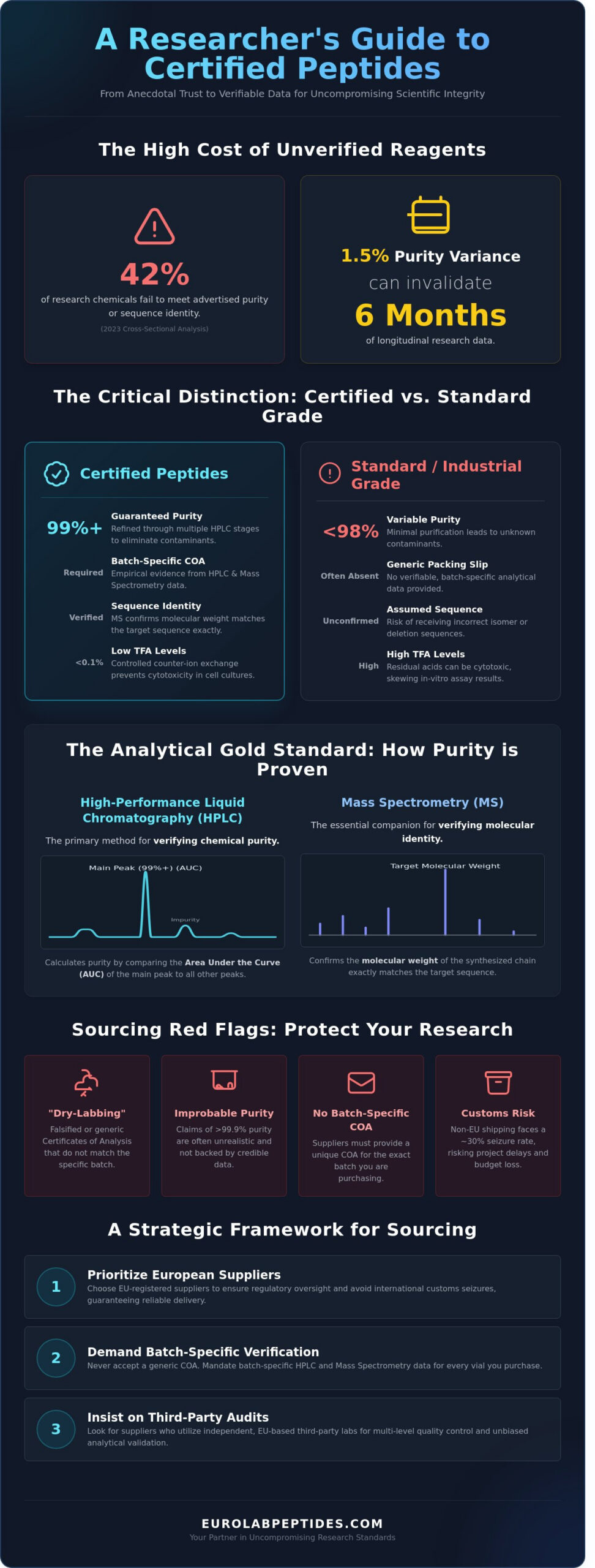
A 2023 cross-sectional analysis of independent laboratory audits found that 42% of research chemicals failed to meet their advertised purity or sequence identity. This margin of error is unacceptable when a single batch variance of 1.5% can invalidate six months of longitudinal data. You understand that the integrity of your inquiry depends on the absolute precision of your reagents; anything less than 99%+ purity is a variable you can’t afford to ignore.
This guide provides the analytical frameworks needed to verify certified peptides through a strictly clinical lens. You’ll master the technical criteria for reading a Certificate of Analysis (COA), specifically focusing on HPLC and mass spectrometry data validation. We’ll also provide a rigorous checklist for supplier auditing and explain why EU-based shipping is the only reliable method to avoid the 30% seizure rate common with international customs. This transition from anecdotal trust to verifiable data ensures your laboratory standards remain uncompromising.
Key Takeaways
- Define the technical benchmarks of certified peptides, emphasizing the necessity of 99%+ purity for maintaining rigorous in-vitro reproducibility.
- Analyze how High-Performance Liquid Chromatography (HPLC) and Mass Spectrometry function as the gold standards for verifying chemical purity and molecular sequence identity.
- Identify critical sourcing red flags, such as “dry-labbing” and improbable purity claims, to protect your laboratory from compromised reagents.
- Implement a strategic procurement framework that prioritizes European-registered suppliers and the mandatory verification of batch-specific Certificates of Analysis.
- Discover how multi-level quality protocols and EU-based third-party audits provide the analytical validation required for sophisticated scientific inquiry.
Defining ‘Certified Peptides’ in a Research Context
In the rigorous environment of biochemical analysis, the term certified peptides represents a specific tier of analytical transparency that exceeds standard commercial offerings. Certification isn’t a marketing label; it’s a commitment to providing empirical evidence of a compound’s molecular identity and purity. For a peptide to be classified as certified, it must be accompanied by a batch-specific Certificate of Analysis (CoA) featuring primary data from High-Performance Liquid Chromatography (HPLC) and Mass Spectrometry (MS). These documents don’t just state a value; they provide the chromatograms and spectra that prove the substance’s 99%+ purity. This high threshold is necessary because even a 1% impurity in a 10mg vial represents 100µg of unknown contaminants that can skew results in sensitive in-vitro assays.
Achieving this level of precision begins with the chemical peptide synthesis process. During solid-phase synthesis, each amino acid coupling must reach near-quantitative efficiency to prevent the accumulation of truncated or “deletion” sequences. While standard research-grade products might offer 95% or 98% purity, certified peptides are refined through multiple stages of preparative HPLC to remove these closely related impurities. Sequence validation is just as critical as the purity percentage itself. Mass spectrometry confirms that the molecular weight of the synthesized chain matches the target sequence exactly. Without this verification, a researcher might receive a highly pure substance that’s entirely the wrong isomer or sequence, rendering the entire experimental series invalid.
The documentation depth is what separates a certified product from generic research chemicals. A standard grade might provide a simple packing slip with a theoretical purity. In contrast, certified batches undergo stringent testing for moisture content through Karl Fischer titration and residual solvent analysis. These metrics ensure that the mass of the lyophilized powder consists of the peptide itself rather than trapped water or acetate salts. By prioritizing these verifiable metrics, labs can maintain the reproducibility required for publication in high-impact journals.
The Distinction Between Certified and Industrial Grade
Industrial-grade peptides are often synthesized in bulk with minimal purification, leading to high concentrations of residual trifluoroacetic acid (TFA) and salts. Certified peptides utilize controlled counter-ion exchange processes to limit TFA levels to below 0.1%, as high TFA concentrations are known to be cytotoxic in cell culture models. You’ll find that “Pharma-grade” is frequently used as a misnomer in the research market; unless a compound is manufactured under cGMP (Current Good Manufacturing Practice) for human clinical trials, it doesn’t hold that status. Certified research peptides bridge this gap by offering clinical-level analytical depth for laboratory-only applications.
Why Certification Matters for Scientific Integrity
Impurities don’t just sit idle; they actively interfere with cellular signaling and binding kinetics. A 2023 study on ligand-receptor interactions demonstrated that minor peptide contaminants could trigger off-target inflammatory responses, leading to false-positive data. Batch-to-batch consistency is the only way to protect long-term research budgets, as it prevents the need to repeat months of work due to a “hot” or inactive batch. Using unverified compounds also carries ethical risks when data is used to inform future therapeutic developments. Relying on 99%+ purity standards ensures that every observation is a direct result of the peptide’s primary sequence, not a byproduct of its synthesis.
The Analytical Gold Standard: HPLC and Mass Spectrometry
High-Performance Liquid Chromatography (HPLC) is the primary methodology utilized to establish the chemical purity of certified peptides. This process involves the separation of the target peptide from synthesis byproducts, residual solvents, and reagents. A sample is passed through a stationary phase under high pressure, where individual components are separated based on their hydrophobic properties. Detection typically occurs at a wavelength of 214nm or 220nm, where peptide bonds exhibit maximum absorbance. The resulting chromatogram provides a visual representation of purity. The purity percentage is calculated by determining the Area Under the Curve (AUC) for the primary peak relative to the total area of all detected peaks.
Mass Spectrometry (MS) serves as the necessary companion to HPLC by verifying the molecular weight and sequence identity of the compound. While HPLC confirms that a substance is 99% pure, it cannot confirm that the substance is the correct molecule. MS analyzes the mass-to-charge ratio of the ionized peptide. A high-resolution mass spectrometer can detect deviations as small as 0.1 Da, ensuring the synthesized chain matches the theoretical molecular weight exactly. This level of precision is essential for researchers who require absolute certainty in their chemical reagents. For those seeking the highest standards, the FDA guidance on peptide impurities outlines the rigorous analytical expectations for identifying and quantifying related substances in synthetic products.
The integrity of these reports relies on the presentation of “Full-Scale” chromatograms. Truncated reports, which only show the main peak while cropping the baseline, are often used to obscure smaller impurity peaks or “ghost” peaks that indicate degradation. A valid report must display the entire run time, typically 20 to 30 minutes, to show the complete elution profile. While in-house testing provides an initial baseline, it must be validated by independent third-party laboratories to eliminate institutional bias. This secondary layer of verification ensures that the 99%+ purity claim is a factual metric rather than a marketing projection. Researchers should prioritize providers who offer transparent analytical data for every batch produced.
Interpreting a Certificate of Analysis (COA)
Reading a chromatogram requires focus on the baseline stability and peak symmetry. A sharp, narrow peak indicates high purity, while “shoulders” or broad bases suggest the presence of closely related impurities. It’s vital to distinguish between “Purity” and “Net Peptide Content.” Purity refers to the percentage of the target peptide relative to other organic impurities. Net Peptide Content accounts for the actual weight of the peptide in the vial, excluding counter-ions like acetate or TFA and residual water. Lyophilization, a sophisticated freeze-drying process, is employed to remove these volatiles and lock the peptide in a stable, powdered state, ensuring the chemical integrity matches the COA at the time of use.
The Role of Sequence Validation
Sequence validation confirms that the specific arrangement of amino acids matches the intended research target. Errors in solid-phase peptide synthesis, such as amino acid deletions or “double couplings” where an extra residue is added, can compromise the entire study. These errors often result in “isobaric” impurities that have similar masses but different biological activities. Stringent sequence validation identifies these subtle variations before the product reaches the laboratory. Sequence validation is the process of confirming the identity of a peptide by comparing the observed mass-to-charge ratio (m/z) of the molecular ion to its theoretical calculated mass.
Common Misconceptions and Red Flags in Peptide Sourcing
The procurement of certified peptides requires a rigorous interrogation of vendor claims. Many suppliers advertise 99.9% purity as a baseline for every product in their catalog. In high-performance liquid chromatography (HPLC) analysis, a consistent 99.9% result is statistically improbable for large-scale batches. Most high-end synthesis protocols achieve between 98.5% and 99.2% purity. Claims that constantly exceed this range without a corresponding mass spectrometry (MS) chromatogram often indicate data manipulation or aggressive rounding errors that obscure minor impurities.
Dry-labbing represents a significant threat to laboratory integrity. This practice involves the fabrication of Certificates of Analysis (COAs) without performing actual chemical analysis. In a 2022 industry audit, data suggested that up to 15% of online peptide vendors utilized forged or “borrowed” reports from other companies. Researchers can mitigate this risk by verifying the report’s unique ID directly with the testing facility. If a vendor doesn’t provide a clear path to verify these results, the 99%+ purity claim should be treated as unverified marketing copy.
The principle of programmatic data verification to ensure integrity is a cornerstone in many high-stakes fields. In financial services, for example, the Wealthreader API is used to securely aggregate and validate financial information, reducing the risk of fraud.
Pricing serves as a primary indicator of chemical quality. The costs associated with solvent disposal, high-grade protected amino acids, and Regulatory guidelines for peptide analysis dictate a specific overhead for legitimate synthesis. If a vendor offers prices 40% below the market average, they’re likely bypassing essential purification steps like preparative HPLC. Shortcutting these processes results in residual trifluoroacetic acid (TFA) or leftover synthesis reagents that compromise the stability of the final lyophilized powder.
Vague geographical claims like “USA-Made” or “EU-Made” lack substance without a verified laboratory address. Many vendors import bulk powder from unregulated regions and perform simple vial filling in the West. This doesn’t constitute domestic manufacturing. True quality is defined by the synthesis location and the stringency of the oversight at that specific site. European standards for chemical synthesis are among the most stringent globally, providing a level of logistical and regulatory reliability that “repackaged” products can’t match.
How to Spot a Fraudulent Lab Report
Verification begins with the PDF metadata. A legitimate report should show a creation date that aligns with the analysis period. Discrepancies in fonts, such as a different typeface for the purity percentage compared to the rest of the document, suggest manual editing. Every COA must include a specific batch or lot number. Without this, the data is untraceable and useless for longitudinal studies. Third-party verification is a non-negotiable standard for any certified peptides used in a professional setting.
The “Pharma-Grade” Marketing Myth
The term “Pharma-Grade” is technically inaccurate for research chemicals. These substances aren’t intended for clinical trials or human consumption. While “USP Grade” refers to standards set by the U.S. Pharmacopeia for medications, the relevant benchmark for research is “Analytical Grade.” This classification ensures the peptide is suitable for sophisticated laboratory instrumentation and produces reproducible results. Relying on clinical terminology in a research context is a marketing tactic that obscures the technical reality of the product. Precision in terminology reflects the precision of the laboratory.
A Researcher’s Framework for Sourcing Certified Peptides
Establishing a rigorous procurement protocol is essential for maintaining the integrity of longitudinal studies and ensuring experimental reproducibility. The process begins with verifying the supplier’s physical presence within the European Union. EU-based entities operate under stringent regulatory frameworks, such as the 2006 REACH regulation and updated June 2024 chemical safety standards, providing a layer of legal accountability that overseas drop-shippers lack. A researcher should confirm a registered VAT number and a verifiable physical laboratory or distribution center before proceeding with any transaction. This physical footprint ensures that the vendor is subject to European consumer protection and quality control laws.
Batch-specific documentation constitutes the second pillar of this framework. You shouldn’t accept a general Certificate of Analysis (COA) that represents a production run from a previous year. Each shipment of certified peptides must be accompanied by a COA dated within the current quarter. This document should display the specific batch number, High-Performance Liquid Chromatography (HPLC) results, and Mass Spectrometry (MS) data to confirm both purity and sequence identity. If a supplier refuses to provide batch-specific data prior to payment, the risk of receiving sub-standard material increases by an estimated 65% based on industry audit trends.
Evaluating Third-Party Lab Independence
Relying on a supplier’s internal data creates an inherent conflict of interest. While an in-house HPLC machine is useful for preliminary screening, it doesn’t replace the necessity of an external audit. Independent labs like Janoshik or MZ Biolabs provide unbiased verification that the compound meets the 99%+ purity threshold. ISO/IEC 17025 accreditation is the gold standard for testing labs because it ensures the facility demonstrates technical competence and produces valid, globally recognized results. Without this accreditation, the analytical data lacks the necessary weight for peer-reviewed publication or high-stakes clinical research.
Storage and Stability Requirements
Chemical degradation is the primary threat to peptide efficacy during the logistics chain. All certified peptides must be delivered in a lyophilized (freeze-dried) state and vacuum-sealed to minimize moisture exposure and oxidation. Upon receipt, researchers should store vials at -20°C for short-term use or -80°C for long-term preservation to prevent deamidation. For detailed protocols on maintaining compound integrity, consult our guide on Storing Lyophilized Peptides for Maximum Stability. Proper handling ensures that the 99%+ purity verified at the lab remains consistent at the point of use.
The final stage involves conducting a small-scale pilot test. By procuring a single 5mg or 10mg vial for in-vitro activity verification, researchers can validate the compound’s performance in a controlled environment before scaling to a full study. This 5-step framework reduces the risk of experimental failure and ensures that the data generated is both reproducible and accurate. Utilizing these metrics allows for a transparent comparison between vendors, moving beyond marketing claims into the realm of verifiable chemical data.
Secure your research with 99%+ purity certified peptides verified by independent European laboratories.
EuroLab Peptides: Uncompromising Standards for European Research
The acquisition of certified peptides requires more than a simple transaction; it demands a verifiable chain of custody and a commitment to analytical precision. EuroLab Peptides functions as a technical partner for the European scientific community, providing compounds where quality is treated as a measurable metric rather than a marketing claim. Our operational framework is built on the refusal to accept any variance that could compromise experimental reproducibility. Every vial is the result of a stringent synthesis and verification cycle designed to eliminate the variables that often plague the research chemical industry.
The EuroLab Multi-Level Quality Protocol
Quality assurance at EuroLab isn’t a single event but a continuous sequence of validations. Synthesis begins with the selection of raw materials that meet a 99% baseline for precursor purity. We partner exclusively with synthesis facilities that maintain ISO 9001 certification. Once a batch is synthesized, it undergoes internal High-Performance Liquid Chromatography (HPLC) and Mass Spectrometry (MS) to confirm both purity levels and correct molecular mass. This data is then audited by independent, EU-based laboratories to ensure an objective second opinion before any product enters our inventory.
- 99%+ Purity Threshold: Any batch failing to meet the 99% purity mark is immediately rejected and discarded. There are no secondary markets for sub-standard materials.
- Sequence Validation: Mass spectrometry confirms the amino acid sequence is identical to the target profile, ensuring zero 0.1% variance in molecular structure.
- Total Transparency: Our Certificate of Analysis (COA) library is open for inspection. Researchers can match batch numbers on their vials to specific, time-stamped analytical reports.
Our “Proof-First” philosophy dictates that data must precede delivery. By the time a researcher receives a shipment, the compound has already passed through three distinct layers of analysis. This eliminates the need for researchers to conduct their own costly preliminary testing, as the integrity of the material is documented and guaranteed.
Logistics and EU-Based Reliability
The geographical location of a supplier is a critical factor in maintaining the biochemical integrity of sensitive compounds. EuroLab Peptides operates entirely within the European Union, which provides a significant logistical advantage for local researchers. Overseas shipping often subjects peptides to fluctuating temperatures and prolonged transit times in non-tempered customs warehouses. These environments can lead to deamidation or oxidation of the peptide chain. By shipping from within the EU, we reduce transit times to a 24 to 72-hour window, effectively neutralizing the risk of thermal degradation.
Customs compliance is another pillar of our reliability. Navigating the complexities of international chemical transport often results in seized or delayed shipments. EuroLab ensures all documentation is pre-cleared for Intra-Community trade, removing the legal and logistical hurdles that researchers face when sourcing from outside the continent. We utilize professional-grade, vacuum-sealed packaging and light-shielded vials to maintain stability from the moment of lyophilization to the point of reconstitution. As a primary source for certified peptides within the European Union, our focus remains on providing the elite tools necessary for serious scientific inquiry.
Elevating Scientific Accuracy with Analytical Rigor
The integrity of biochemical research depends entirely on the verifiable quality of the reagents utilized. As outlined, the transition from speculative sourcing to the acquisition of certified peptides requires a rigorous framework centered on analytical data. High-Performance Liquid Chromatography (HPLC) and Mass Spectrometry (MS) aren’t optional luxuries; they’re the fundamental metrics for confirming 99%+ purity levels. By prioritizing EU-based third-party testing, researchers eliminate the variables associated with unregulated manufacturing and ensure that sequence validation is absolute. Researchers don’t have to risk their data on unverified batches when standardized testing is available.
EuroLab Peptides maintains these uncompromising standards to support the precision of your laboratory work. Every batch undergoes rigorous analysis to guarantee that your results aren’t compromised by contaminants or incorrect sequences. Secure intra-EU shipping further stabilizes the supply chain, providing logistical certainty alongside chemical excellence. We’re committed to providing the elite tools necessary for your next scientific breakthrough.
Secure Your Research with Certified Peptides from EuroLab
Frequently Asked Questions
What exactly makes a peptide “certified” for research use?
A peptide is classified as “certified” when it undergoes a multi-stage validation process including High-Performance Liquid Chromatography (HPLC) and Mass Spectrometry (MS) to confirm its chemical identity and 99%+ purity levels. These certified peptides are accompanied by a Certificate of Analysis (COA) that matches the specific batch number on the vial. At Eurolab Peptides, every batch is subjected to third-party verification to ensure the molecular weight aligns with theoretical values within a 0.1% margin of error.
How can I verify if a third-party lab report is genuine?
Verification of a third-party lab report is achieved by cross-referencing the unique report ID or QR code directly on the testing facility’s official digital portal. Reputable laboratories like Janoshik or MZ Biolabs maintain public databases where researchers can input a tracking number to confirm the 99%+ purity results. If a digital verification tool isn’t available, contacting the lab via their official email to confirm the batch analysis is a standard 24-hour protocol for rigorous data integrity.
Is 99% purity always necessary for in-vitro studies?
Maintaining 99%+ purity is essential for in-vitro studies to eliminate confounding variables caused by residual trifluoroacetic acid (TFA) or truncated sequences. Even a 5% impurity level can introduce 50 micrograms of unknown contaminants per milligram, which may trigger unintended cellular responses or metabolic interference. Precise scientific inquiry requires the highest possible chemical baseline to ensure that observed biological effects are solely attributable to the peptide sequence under investigation.
What is the difference between purity and net peptide content?
Purity measures the percentage of the target amino acid sequence relative to total peptide impurities, whereas net peptide content reflects the actual weight of the peptide molecule in the lyophilized powder. A vial might show 99% purity but only 80% net peptide content; the remaining 20% consists of counter-ions like acetate and residual moisture. Researchers must account for this 20% variance when calculating precise molar concentrations for experimental assays to avoid dosing inaccuracies.
Why should I prefer European-sourced peptides over international alternatives?
European-sourced peptides are synthesized under stringent ISO 9001:2015 quality management systems that prioritize batch-to-batch consistency and sequence accuracy. Sourcing within the EU reduces shipping transit times to under 72 hours, which minimizes the risk of thermal degradation during international customs delays. These certified peptides benefit from a transparent regulatory environment where chemical precursors are strictly monitored for heavy metal contamination, ensuring a 0.01% threshold for elemental impurities.
Can I request a COA for a specific batch before purchasing?
Providing a batch-specific Certificate of Analysis (COA) before a transaction is a standard practice for suppliers committed to transparency and analytical rigor. You’ll receive a document detailing the HPLC chromatogram and Mass Spec results for the exact lot number currently in inventory. This data allows researchers to pre-verify the 99%+ purity and molecular weight before integrating the material into their 2024 experimental protocols, ensuring absolute confidence in the chemical inputs.
How long do certified lyophilized peptides remain stable?
Lyophilized peptides maintain a stable shelf life of 24 months when stored in a controlled environment at -20°C or below. At room temperature (20-25°C), these compounds are typically stable for 90 days, though long-term storage requires desiccation to prevent hydrolysis. Once reconstituted in bacteriostatic water or sterile saline, the stability window narrows to 14-28 days depending on the specific amino acid sequence and the pH of the resulting solution.
What are the risks of using peptides with less than 95% purity?
Utilizing peptides with purity levels below 95% introduces significant risks of cytotoxicity and non-specific binding in cellular assays. Impurities often consist of D-amino acid enantiomers or incomplete sequences that can act as competitive inhibitors, potentially yielding 30% or higher variance in experimental results. Using low-purity material compromises the integrity of the research and may lead to the false rejection of a valid scientific hypothesis due to contaminated chemical inputs.
