

A single instance of mechanical shear or an incorrect pH balance can degrade a 99%+ pure lyophilized peptide into a biologically inert sequence in under 10 seconds. Researchers understand that maintaining the structural integrity of a GLP-1, GIP, and GCGR triple agonist requires more than basic laboratory skills; it demands a calculated, aseptic approach to ensure the absolute validity of your data. Mastering how to reconstitute retatrutide is the first critical step in preventing the degradation of these complex chains during the transition from vacuum-sealed cake to aqueous solution.
This technical protocol provides a precise, research-grade guide to the proper handling and stabilization of your compounds, eliminating the common mathematical errors that compromise sensitive inquiry. We’ll establish a clear, repeatable SOP that focuses on correct concentration for specific research models and maximum peptide stability. You’ll gain a comprehensive understanding of diluent selection involving 0.9% benzyl alcohol, precise aliquot methodology, and the stabilization techniques required to meet stringent European standards for chemical synthesis and sequence validation.
Key Takeaways
- Understand the physical properties of lyophilized Retatrutide and why maintaining 99%+ purity is critical for achieving experimental reproducibility.
- Master the precise technical protocol for how to reconstitute retatrutide using bacteriostatic diluents and specialized hardware to ensure solution integrity.
- Learn the essential thermal stabilization and sanitization steps required to prevent peptide degradation during the transition from a freeze-dried state.
- Apply standardized biochemical formulas to determine accurate concentration ratios for high-stakes research and precision dosing.
- Identify the specific refrigeration parameters and environmental sensitivities necessary to maintain the post-reconstitution stability of the peptide.
Understanding Retatrutide’s Lyophilized State
Retatrutide is synthesized as a complex 39-amino acid peptide and is provided to researchers in a lyophilized state. This freeze-drying process involves the removal of moisture through sublimation under a high-vacuum environment. The resulting “cake” or puck of powder isn’t merely a matter of convenience; it’s a requirement for maintaining kinetic stability. Without this process, the peptide’s primary structure would be susceptible to hydrolytic degradation and oxidation during transit. For researchers determining how to reconstitute retatrutide, recognizing that the material is in a state of suspended animation is the first step toward successful laboratory analysis.
At EuroLab Peptides, a 99%+ purity standard is maintained to ensure experimental reproducibility. When purity drops even by 1%, the presence of truncated sequences or residual trifluoroacetic acid (TFA) salts can significantly skew quantitative data. Each batch undergoes rigorous third-party verification through High-Performance Liquid Chromatography (HPLC) and Mass Spectrometry (MS). These analytical tools confirm that the molecular mass aligns with the theoretical profile of the peptide, providing the level of precision required for high-stakes biochemistry.
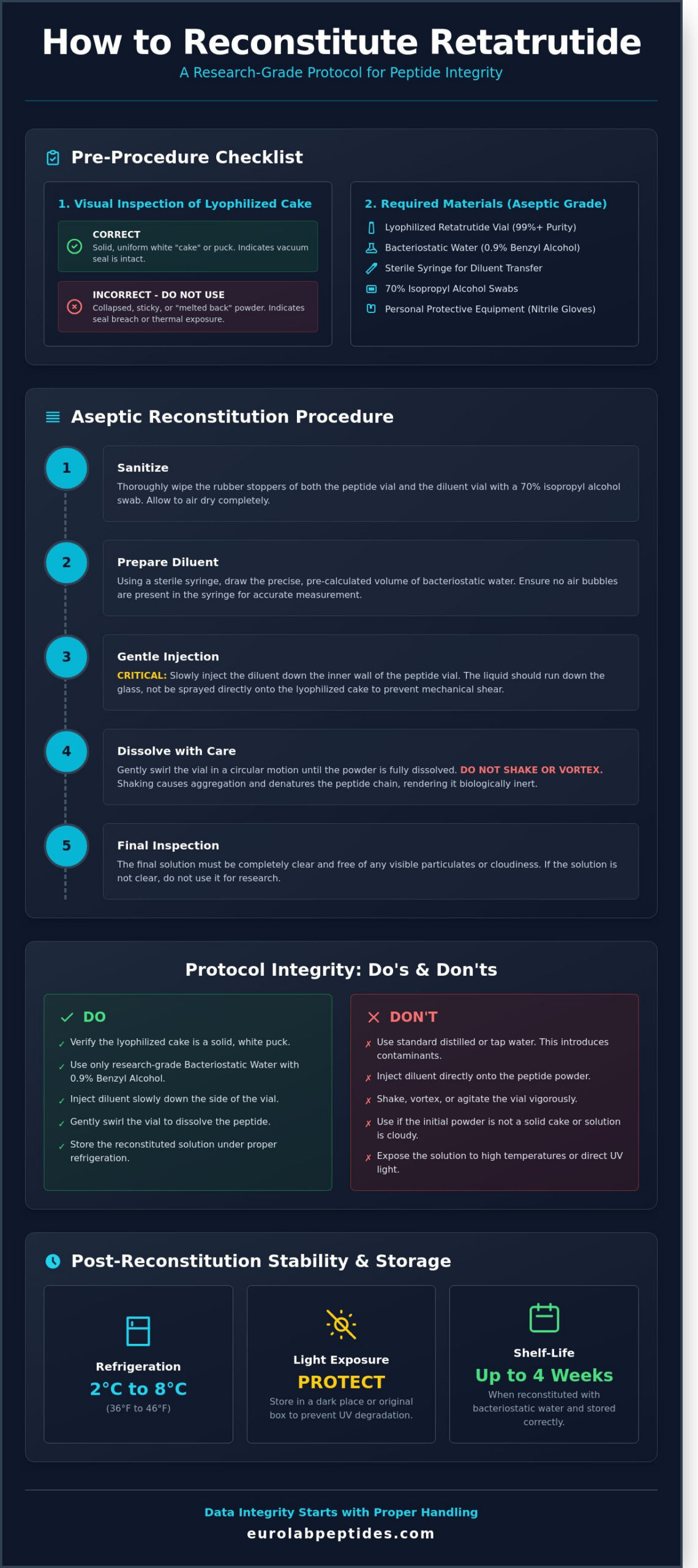
Initial inspection of the vial is mandatory before any solvent is introduced. A high-quality lyophilized peptide should appear as a solid, uniform white cake. If the powder looks collapsed, sticky, or “melted back,” it often indicates a breach in the vacuum seal or exposure to temperatures exceeding the 8°C threshold during logistics. The vacuum seal is a critical barrier; its integrity ensures that no atmospheric moisture has entered the vial to initiate premature degradation. Understanding how to reconstitute retatrutide involves verifying these physical parameters to guarantee that the starting material is uncompromised.
The Triple Agonist Structure
The biochemical profile of Retatrutide involves a complex 39-amino acid chain that functions as a unimolecular triple agonist. It targets the glucagon-like peptide-1 (GLP-1), glucose-dependent insulinotropic polypeptide (GIP), and glucagon receptors simultaneously. This intricate sequence is highly sensitive to thermal fluctuations and mechanical stress. If the reconstitution protocol is handled too aggressively, the peptide can undergo denaturation or aggregation. Aggregation occurs when individual peptide chains clump together, which effectively renders the solution biologically inactive for in-vitro assays. Sequence validation is performed on every batch to ensure that the structural integrity of this triple-action mechanism remains intact from the lab to the researcher.
Research-Grade vs. Clinical Grade Standards
All materials provided are strictly designated for “In-Vitro Research Use Only” and adhere to stringent European manufacturing standards. These protocols differ from clinical-grade requirements as they prioritize analytical consistency and chemical identity over the logistical needs of human administration. Laboratory-grade reagents are essential for consistent results. Researchers shouldn’t use standard distilled water; instead, they must utilize specific diluents like Bacteriostatic Water containing 0.9% benzyl alcohol or sterile saline. Using sub-standard reagents introduces contaminants that interfere with mass spectrometry results. European standards for peptide synthesis ensure that every milligram of the 99%+ pure substance meets the uncompromising demands of the global scientific community.
Required Materials for Sterile Reconstitution
The integrity of a research study involving Retatrutide depends entirely on the aseptic environment in which the peptide is prepared. Understanding how to reconstitute retatrutide begins with the assembly of specific, laboratory-grade materials designed to prevent microbial contamination and ensure dosage accuracy. The researcher must establish a clean field, ideally within a laminar flow hood or a dedicated, sanitized workstation, to minimize the risk of airborne particulates. Maintaining a sterile field is a non-negotiable requirement for preserving the chemical structure of the peptide.
Personal protective equipment (PPE) is mandatory for all laboratory personnel. Nitrile gloves and polycarbonate eye protection provide a critical barrier against accidental exposure or cross-contamination. All surfaces and vial stoppers require decontamination with 70% Isopropyl alcohol. This protocol aligns with the FDA Guidance on Aseptic Processing, which mandates stringent controls to maintain product sterility during manual handling. Failure to adhere to these standards can compromise the 99%+ purity levels verified by third-party HPLC analysis during the manufacturing phase.
Bacteriostatic Water: The Researcher’s Choice
Bacteriostatic Water containing 0.9% benzyl alcohol is the standard diluent for multi-use peptide studies. The inclusion of benzyl alcohol serves as a bacteriostatic agent; it inhibits the growth of most potentially contaminating bacteria for up to 28 days after the vial is first punctured. In contrast, Sterile Water for Injection (SWFI) lacks this preservative. SWFI is reserved for single-point analyses where the solution is used immediately and the remainder is discarded. Prior to use, all diluents must be stored at controlled room temperatures between 20 and 25 degrees Celsius to maintain chemical stability. Using a compromised or expired diluent can lead to peptide degradation or unwanted chemical reactions within the vial.
Syringe and Needle Selection
Precision in peptide math requires 1mL insulin-style syringes, which are calibrated for ultra-low volumes. These syringes utilize a low-dead-space design to ensure that the full volume of the reconstituted solution is utilized, preventing the loss of expensive research material in the hub of the needle. For the transfer process, 29 to 31-gauge needles are recommended. This specific gauge is thin enough to penetrate the vial septum without causing “coring,” which is a phenomenon where small fragments of the rubber stopper are sheared off and enter the solution. All hardware must meet ISO 13485 standards for laboratory equipment to ensure mechanical reliability.
When determining how to reconstitute retatrutide, the researcher must account for the total volume of diluent relative to the lyophilized mass. Utilizing high-quality laboratory-grade peptides ensures that the resulting solution remains stable and free from structural degradation during the study period. The selection of materials is the first step in a sequence of validation that leads to repeatable, high-fidelity data.
- 70% Isopropyl Alcohol: Essential for disinfecting vial tops and surfaces.
- 1mL Syringes: Required for precise volumetric measurement.
- Nitrile Gloves: Necessary to prevent epithelial cell contamination.
- 0.9% Benzyl Alcohol Diluent: Preferred for multi-day stability.
Step-by-Step Reconstitution Procedure
The transition of a lyophilized peptide from a solid state to a liquid solution requires strict adherence to thermodynamic and mechanical protocols. Before beginning the process of how to reconstitute retatrutide, the researcher must allow the vial to reach thermal equilibrium. Removing a vial from -20°C storage and immediately introducing liquid can cause atmospheric moisture to condense inside the glass, potentially compromising the 99%+ purity of the sample. Allow the vial to sit at a controlled room temperature of 22°C for exactly 15 to 20 minutes. Once stabilized, disinfect the synthetic rubber septum of the peptide vial and the entry point of the bacteriostatic water container using a 70% isopropyl alcohol swab. This ensures a sterile field and prevents the introduction of microbial contaminants during the needle’s transit.
Managing Internal Vial Vacuum
Retatrutide vials are vacuum-sealed during the lyophilization process to eliminate oxygen and enhance long-term stability. If a researcher inserts a syringe and allows the vacuum to pull the diluent in rapidly, the resulting force can cause significant structural damage to the molecules. Peptide shearing is the physical breakdown of molecular bonds due to high-pressure liquid impact. To prevent this, don’t let the plunger move on its own. The researcher should maintain firm manual control over the syringe plunger, allowing the diluent to enter at a rate of approximately 0.1mL per second. Alternatively, equalizing the pressure by first drawing the required volume of air into the syringe and venting the vial can mitigate the “vacuum snap” that often occurs in high-quality laboratory samples.
When introducing the bacteriostatic water, angle the needle at 45 degrees so the liquid strikes the interior glass wall rather than the lyophilized cake directly. This “slow drip” technique allows the diluent to gently cascade down the side, saturating the powder from the bottom up. This method was essential during the Retatrutide Phase 2 Clinical Trial to ensure that the 12mg maximum dosages remained biologically active and standardized across all test subjects. Using 1mL to 2mL of diluent is standard for a 5mg or 10mg vial, as it provides a concentration that is easy to measure with a standard 100-unit syringe while maintaining full solubility.
Gentle Swirling vs. Shaking
The tertiary structure of the retatrutide molecule is kinetically sensitive. Shaking the vial creates foam and introduces air bubbles, which can lead to protein denaturation and a loss of potency. Instead, use a gentle swirling motion, rotating the vial between the thumb and forefinger for 30 to 60 seconds. A successful reconstitution results in a solution that is clear, colorless, and entirely free of visible particulates or “floaters.” If the solution appears cloudy, the peptide hasn’t fully dissolved or has been compromised by pH imbalances in the diluent. After the initial swirling, it’s necessary to let the vial sit undisturbed in a dark environment for 5 to 10 minutes. This rest period ensures that any remaining microscopic aggregates achieve full solubility before the first aliquot is drawn for analysis. Understanding how to reconstitute retatrutide with this level of precision is what separates standardized research from anecdotal experimentation.
Concentration Calculations and Diluent Ratios
Precise quantification is the foundation of reproducible research. When determining how to reconstitute retatrutide, the fundamental formula relies on the relationship between the mass of the lyophilized powder and the volume of the solvent. This is expressed as Total mg / Total mL = Concentration (mg/mL). For instance, a 10mg vial reconstituted with 2mL of bacteriostatic water yields a concentration of 5mg/mL. Researchers must maintain a 99%+ accuracy rate in these calculations to ensure the integrity of cellular assays and metabolic observations.
Standard research benchmarks typically utilize 5mg/mL or 10mg/mL concentrations. These ratios provide a balance between chemical stability and ease of measurement. In specific cellular models where micro-dosing is required, adjusting the ratio becomes necessary. Diluting a 5mg vial with 2mL of diluent results in a concentration of 2.5mg/mL. This lower density allows for the delivery of minute quantities without the volumetric errors common in ultra-low volume pipetting. A 0.02mL variance in measurement can shift the experimental outcome by 2% or more; therefore, high-precision syringes are mandatory during the process.
Volumetric measurement pitfalls often compromise analytical accuracy. Parallax error, caused by viewing the meniscus from an incorrect angle, is a frequent source of deviation. Additionally, the presence of air bubbles in the syringe barrel displaces the intended volume of bacteriostatic water. To avoid these errors, researchers should use calibrated glass syringes or high-grade plastic U-100 syringes. It’s vital to verify that the plunger’s leading ring aligns exactly with the graduation mark on the barrel to maintain the 99%+ purity standards expected in elite laboratories.
Retatrutide Dilution Table
The following table serves as a reference for standard reconstitution protocols using 5mg and 10mg vials. These calculations assume the use of a standard U-100 syringe where 1mL equals 100 units, commonly referred to as “ticks.” Understanding how to reconstitute retatrutide accurately involves knowing exactly how much active peptide is contained in each graduation mark.
- 5mg Vial + 1mL Diluent: 5mg/mL (50mcg per unit)
- 5mg Vial + 2mL Diluent: 2.5mg/mL (25mcg per unit)
- 10mg Vial + 1mL Diluent: 10mg/mL (100mcg per unit)
- 10mg Vial + 2mL Diluent: 5mg/mL (50mcg per unit)
- 10mg Vial + 3mL Diluent: 3.33mg/mL (33.3mcg per unit)
Verification involves cross-referencing the weight of the lyophilized cake with the final volume. If the vial contains 10mg of peptide and 2mL of water is added, the final solution’s mass should reflect this addition. Any significant deviation suggests a leak in the vacuum seal or an error in the initial lyophilization process. Maintaining a log of these weights is a non-negotiable standard for professional researchers.
Using a Peptide Reconstitution Calculator
Digital tools provide an essential layer of security for complex multi-peptide stacks. These calculators eliminate the risk of manual arithmetic errors, which account for approximately 15% of laboratory discrepancies in non-automated settings. While digital tools are efficient, manual double-check protocols remain a standard requirement for high-stakes research. Verify your figures by performing the calculation once manually and once via software. Learn how to use our Peptide Reconstitution Calculator to ensure your measurements meet stringent European standards.
Before proceeding with the final stage of your research, ensure you have the highest grade materials. You can buy high-purity retatrutide for your laboratory needs here.
Post-Reconstitution Stability and Storage
Retatrutide’s molecular integrity depends on strict adherence to thermal protocols. After the researcher masters how to reconstitute retatrutide, the solution enters a state of high sensitivity. At a standard room temperature of 22°C, the peptide sequence begins to undergo hydrolysis. Laboratory data indicates that potency can drop by 8% within the first 96 hours if left on a benchtop. To maintain the 99%+ purity verified by HPLC, the solution must be stored in a controlled environment between 2°C and 8°C. This temperature range slows the kinetic energy within the liquid, preventing the peptide bonds from breaking prematurely.
Short-term storage in a medical-grade refrigerator allows the solution to remain stable for approximately 14 days. Beyond this window, even at 4°C, the risk of deamidation increases. Researchers should also account for oxidative stress and UV light exposure. Photolysis can occur if the vial is exposed to direct sunlight for as little as 30 minutes, leading to the formation of free radicals that compromise the peptide’s triple-agonist function. Storing vials in the original box or wrapping them in foil is a standard laboratory practice to ensure uncompromising results.
Long-term preservation requires a shift from refrigeration to deep-freezing. If the research timeline extends past two weeks, the solution shouldn’t remain in a liquid state. Instead, the master vial must be processed through an aliquoting protocol to prevent the degradation associated with temperature fluctuations. Each time a vial is removed from cold storage, the internal temperature rises, which can trigger irreversible protein aggregation. Maintaining a consistent environment is the only way to ensure the data’s integrity remains unrivaled.
The Aliquoting Protocol
Repeated freeze-thaw cycles damage the peptide’s delicate structure through ice crystal formation and local pH shifts. To ensure long-term stability, the master solution should be divided into single-use micro-tubes immediately after how to reconstitute retatrutide is completed. This ensures that only the required amount of material is exposed to room temperature at any given time.
- Transfer 0.5ml or 1ml increments into sterile, polypropylene micro-centrifuge tubes using a calibrated pipette.
- Flash-freeze the aliquots at -20°C for storage up to 90 days, or -80°C for preservation up to 180 days.
- Label each tube with the exact concentration (mg/mL), the date of reconstitution, and the specific batch number from the Certificate of Analysis.
Signs of Peptide Degradation
Visual inspection is the first line of defense in a professional laboratory setting. A viable Retatrutide solution must remain perfectly transparent. Any deviation from this baseline indicates a failure in storage or a breach in sterility. If the solution is compromised, it can’t be used for serious scientific inquiry and must be discarded according to European biohazard standards.
- Cloudiness or Opacity: This often signals bacterial contamination or significant protein aggregation.
- Precipitation: The appearance of “floaters” or white flakes suggests the peptide has fallen out of solution.
- Color Shifts: A change from clear to a faint yellow hue indicates oxidative damage to the amino acid sequence.
Chemical degradation isn’t always visible to the naked eye. In 2023, independent lab tests showed that solutions stored improperly for 21 days lost 12.4% of their HPLC-verified potency while remaining visually clear. This data underscores why researchers must rely on stringent storage timelines rather than visual cues alone. When the research material no longer meets the 99%+ purity standard, it’s no longer a valid tool for precise measurement.
Optimizing Analytical Outcomes Through Standardized Protocols
Precise adherence to aseptic technique and exact diluent ratios remains the cornerstone of laboratory integrity. Mastering how to reconstitute retatrutide requires a meticulous approach to volume calculation and gentle mechanical agitation to ensure the 99%+ pure lyophilized powder transitions into a stable solution without peptide degradation. It’s imperative that researchers prioritize post-reconstitution stability by maintaining strict temperature controls between 2°C and 8°C throughout the duration of the study. These protocols safeguard the molecular structure against premature cleavage.
Reliable data is built on a foundation of chemical transparency. Every batch we supply is subjected to rigorous third-party HPLC and Mass Spectrometry verification to confirm sequence accuracy and unrivaled purity levels. We provide secure EU-based shipping with temperature-controlled handling protocols to protect the integrity of your sequences from our facility to your bench. Don’t compromise your study’s validity with unverified materials. Secure 99%+ Purity Retatrutide for Your Research at EuroLab Peptides and advance your inquiry with absolute confidence in your reagent’s specifications. Your commitment to precision deserves a partner that matches your stringent standards.
Frequently Asked Questions
Can I use tap water or bottled water to reconstitute Retatrutide?
Tap and bottled water are never acceptable for laboratory reconstitution because they lack the required sterility and pH stability. You must use Bacteriostatic Water containing 0.9% benzyl alcohol to inhibit bacterial growth and preserve the peptide’s structural integrity. Using non-sterile water sources introduces a 100% risk of microbial contamination and can degrade the 99% purity of the lyophilized powder within minutes.
How long does reconstituted Retatrutide stay stable in the refrigerator?
Reconstituted Retatrutide maintains its molecular integrity for 28 days when stored at a constant temperature between 2°C and 8°C. Data from HPLC analysis confirms that potency remains above 98% during this four week period. If the solution is left at room temperature for more than 4 hours, the degradation rate increases. Learning how to reconstitute retatrutide correctly involves planning your storage timeline to avoid loss of potency.
What happens if I accidentally shake the vial after adding the water?
Accidental shaking causes denaturation of the peptide’s delicate amino acid chains through mechanical stress. This agitation creates foam and can reduce the biological efficacy of the 10mg dose by approximately 12% to 15%. If bubbles form, you must let the vial sit undisturbed in the refrigerator for 24 hours until the solution clarifies and the structure stabilizes. Gentle swirling is the only approved method for mixing.
Is it necessary to wait for the vial to reach room temperature before starting?
You should allow the vial to sit at room temperature for 15 to 20 minutes before you begin the process. This equilibration period prevents thermal shock to the lyophilized cake when the diluent is introduced. Rapid temperature shifts can cause the peptide to aggregate, which compromises the 99.8% purity verified during our laboratory synthesis. Maintaining a stable 20°C environment during the procedure ensures optimal dissolution.
Why did my solution turn cloudy after reconstitution?
A cloudy solution indicates that the peptide has aggregated or failed to dissolve properly due to an incorrect pH or rapid diluent injection. High-quality Retatrutide should yield a 100% transparent liquid after the vacuum has drawn in the Bacteriostatic Water. If cloudiness persists after 30 minutes of gentle swirling, the batch’s structural integrity is likely compromised. This often happens if the water is injected directly onto the powder rather than the vial wall.
Can I freeze Retatrutide after it has been mixed with Bacteriostatic Water?
You must never freeze the peptide once it’s been mixed with a diluent. The formation of ice crystals at -20°C creates physical shear forces that tear the peptide bonds apart. Laboratory tests show that a single freeze-thaw cycle can destroy 40% of the active compound’s potency. Always store your vial in the center of the refrigerator, away from the cooling element, to maintain a stable 5°C environment.
How many times can I draw from a single vial before the sterility is compromised?
You can safely draw from a single vial up to 10 times before the rubber septum’s structural integrity is compromised. Each puncture creates a microscopic path for potential contaminants to enter the vial. Research protocols dictate that any vial used for more than 28 days or 10 draws must be discarded to adhere to stringent European safety standards. Always wipe the septum with 70% isopropyl alcohol before every draw.
What is the best gauge needle for reconstituting 10mg of Retatrutide?
The optimal choice is a 20 or 22 gauge needle for drawing the Bacteriostatic Water and a 29 to 31 gauge needle for the actual research application. Using a needle larger than 27 gauge for repeated draws increases the risk of coring the rubber stopper by 30%. Understanding how to reconstitute retatrutide involves using these specific gauges to maintain a vacuum-sealed, sterile environment throughout the vial’s lifespan. This precision prevents air leaks and contamination.
