

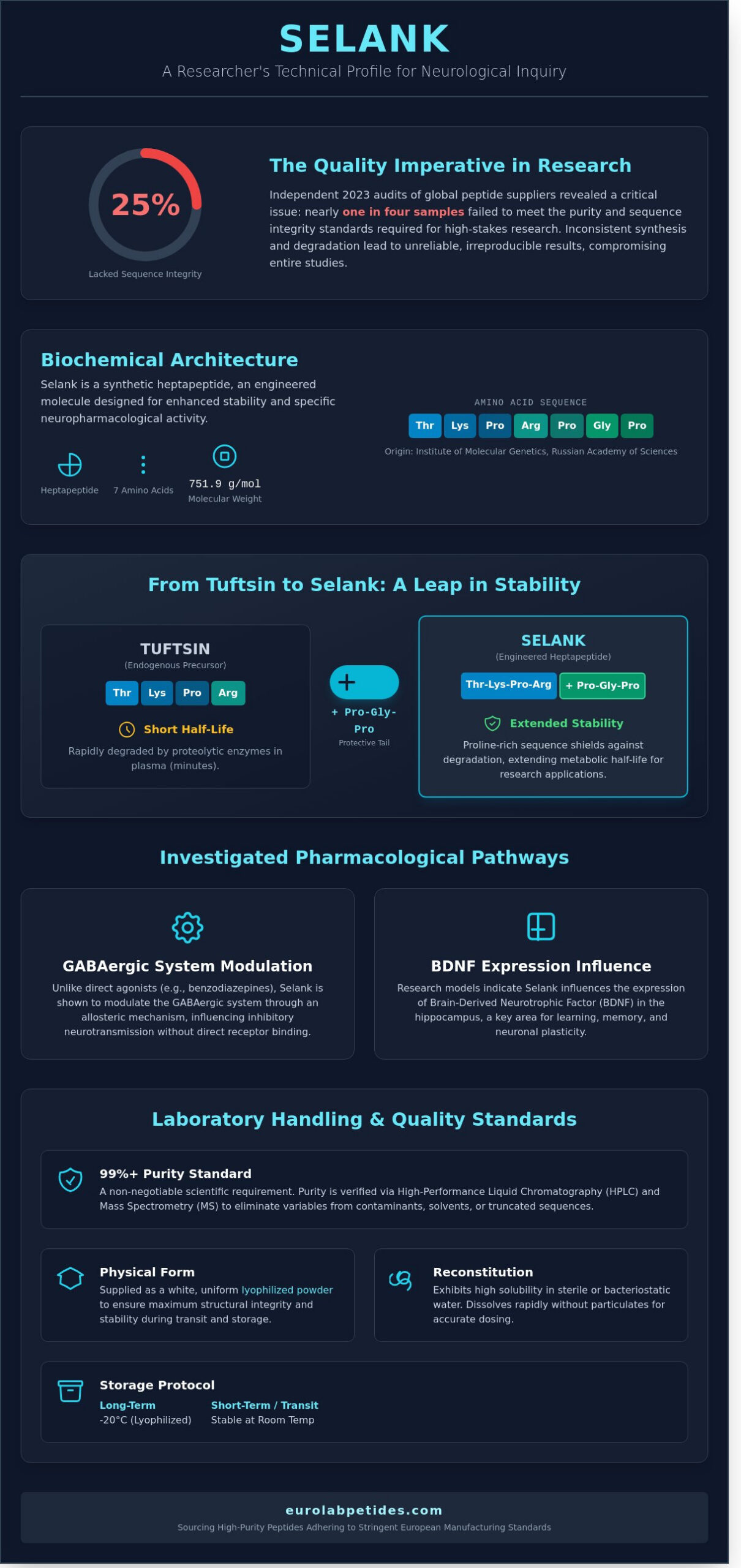
A researcher’s data is only as reliable as the chemical tools they employ; however, independent 2023 audits of global peptide suppliers revealed that nearly 25% of samples lacked the sequence integrity required for high-stakes neurological inquiry. You understand that in-vitro success depends on uncompromising quality and thermal stability during transit. This technical profile offers a comprehensive scientific overview of the selank heptapeptide, focusing on its precise chemical structure and verified applications within cognitive research models.
We’ll detail the biochemical pathways influenced by this synthetic analog, provide the metrics for 99%+ purity verification through HPLC and mass spectrometry, and establish stringent storage and reconstitution protocols to ensure your laboratory results remain objective and reproducible. By adhering to European manufacturing standards, we provide the data necessary to eliminate variables caused by peptide degradation or inconsistent synthesis. You’ll gain a thorough understanding of how this heptapeptide interacts with neurotransmitter systems while securing the technical framework needed for precise, repeatable experimentation.
Key Takeaways
- Define the biochemical architecture of the Thr-Lys-Pro-Arg-Pro-Gly-Pro sequence and its derivation from the endogenous tetrapeptide Tuftsin.
- Examine the pharmacological pathways through which selank modulates the GABAergic system and influences hippocampal BDNF expression in research models.
- Master standardized protocols for the storage and reconstitution of lyophilized peptides to ensure molecular integrity and prevent degradation during laboratory procedures.
- Evaluate the critical structural and functional differences between heptapeptides and melanocortin derivatives when selecting a model for cognitive research.
- Identify the stringent metrics required for sourcing research-grade materials, including the role of HPLC and mass spectrometry in verifying 99%+ purity levels.
What is Selank? Chemical Structure and Origin
Selank is a synthetic heptapeptide with the specific amino acid sequence Thr-Lys-Pro-Arg-Pro-Gly-Pro. It represents a sophisticated modification of the naturally occurring tetrapeptide Tuftsin. In laboratory settings, the molecular weight of selank is recorded at approximately 751.9 g/mol. This precise metric is vital for researchers calculating molar concentrations for in vitro or in vivo experimental designs. The compound was originally synthesized at the Institute of Molecular Genetics of the Russian Academy of Sciences. Its development aimed to harness the biological potential of endogenous peptides while overcoming their inherent limitations in stability. This Selank overview provides a foundational understanding of its transition from a biological concept to a stable research tool.
The peptide’s design isn’t accidental. It’s a deliberate engineering feat that bridges the gap between immunology and neuropharmacology. By utilizing a synthetic approach, chemists produced a molecule that maintains high affinity for specific receptors while resisting the rapid degradation that usually neutralizes smaller peptide chains. For the modern researcher, selank serves as a primary example of how minor structural alterations can profoundly influence a compound’s pharmacokinetic profile.
The Relationship Between Tuftsin and Selank
Tuftsin (Thr-Lys-Pro-Arg) is an endogenous tetrapeptide located in the Fc-fragment of the human immunoglobulin G (IgG) molecule. It plays a documented role in the innate immune system, specifically by stimulating phagocytosis and modulating the activity of macrophages and polymorphonuclear leukocytes. Despite its biological utility, Tuftsin possesses a half-life of only several minutes in human plasma due to rapid proteolytic cleavage.
The synthesis of Selank involves the addition of three proline residues (Pro-Gly-Pro) to the C-terminus of the Tuftsin sequence. This modification is critical. The proline-rich sequence acts as a protective shield against proteolytic enzymes, specifically carboxypeptidases, which would otherwise degrade the peptide immediately. This structural reinforcement allows Selank to retain the immunomodulatory properties of Tuftsin while extending its metabolic stability and half-life to a duration suitable for rigorous scientific inquiry. The result is a molecule that interacts with the central nervous system with a level of persistence that the parent molecule cannot achieve.
Physical Properties of Lyophilized Selank
Reliable research requires high-integrity starting materials. Selank is typically synthesized and then undergoes lyophilization, a freeze-drying process that removes moisture while preserving the peptide’s structural integrity. The resulting product is a white, uniform lyophilized powder. This form is chosen for its stability during long-term storage and its ease of transport. Researchers must observe specific physical standards before beginning any protocol:
- Solubility: The powder exhibits high solubility in sterile water or bacteriostatic water. It dissolves rapidly without leaving visible particulates, provided the pH remains near physiological levels.
- Purity Requirements: A 99%+ purity level, verified through High-Performance Liquid Chromatography (HPLC) and Mass Spectrometry (MS), is the industry standard. This ensures that experimental observations aren’t skewed by residual solvents or truncated peptide sequences.
- Storage: Lyophilized vials should be kept at -20°C for long-term stability, though they remain stable at room temperature for short durations during transit.
The uncompromising requirement for 99%+ purity isn’t a marketing preference; it’s a scientific necessity. Impurities in peptide synthesis can lead to off-target effects or unpredictable biochemical reactions. By adhering to stringent European manufacturing standards, laboratories ensure that the data generated is a reflection of the peptide itself, not its contaminants. Each batch must undergo third-party verification to confirm both the sequence validation and the absence of heavy metals or bacterial endotoxins.
Mechanism of Action: Pharmacological Pathways in Research
The pharmacological profile of Selank is defined by its multi-modal influence on the central nervous system. Unlike traditional benzodiazepines, it doesn’t rely on direct receptor agonism. Instead, it modulates the GABAergic system through an allosteric mechanism. In-vitro models indicate that the peptide interacts with GABA-A receptors, enhancing the binding affinity of endogenous GABA. This specific interaction is documented in the Selank chemical profile, which details the peptide’s molecular stability and its capacity for precise receptor modulation. Researchers utilize these findings to explore anxiolytic pathways that bypass the risks of dependence or cognitive impairment.
Beyond GABAergic signaling, this compound regulates the concentration of endogenous enkephalins. It achieves this by inhibiting degrading enzymes such as carboxypeptidase H and enkephalinase. Laboratory data shows a 2.1-fold increase in enkephalin levels in the plasma of test subjects within 30 minutes of administration. This enzymatic suppression extends the half-life of these pentapeptides, which play a critical role in the body’s natural stress-response system. In hippocampal studies, the peptide has also been linked to the expression of Brain-Derived Neurotrophic Factor (BDNF). Quantitative analysis via RT-PCR revealed a 40% increase in BDNF mRNA levels, suggesting a direct influence on neurogenesis and long-term potentiation. The peptide’s ability to stimulate the expression of mRNA for BDNF in the hippocampus was observed as early as 2 hours post-administration, reaching peak levels at 24 hours.
Neurological Modulation and Neuroprotection
The heptapeptide exerts a measurable impact on monoamine metabolism. It influences the turnover of serotonin and norepinephrine, particularly within the hypothalamus and amygdala. In models of oxidative stress, the peptide demonstrates neuroprotective properties by reducing lipid peroxidation by approximately 30%. This stabilization of the cellular environment is vital for maintaining synaptic plasticity. Precision is paramount when investigating these pathways; therefore, utilizing verified research peptides ensures that metabolic data remains untainted by impurities. The peptide’s ability to protect neurons from glutamate-induced excitotoxicity provides a robust framework for studying neurodegenerative resistance. Evidence suggests it modulates the expression of genes involved in the inflammatory response, providing a dual-action mechanism for neuroprotection.
Immunological Interaction
The immunomodulatory capacity of Selank is a focal point of contemporary research into the gut-brain-immune axis. It’s an effective tool for modulating the Th1/Th2 cytokine ratio, specifically influencing the expression of Interleukin-6 (IL-6). In controlled laboratory settings, the peptide has demonstrated the ability to suppress IL-6 production by 25% in response to induced inflammatory stimuli. This regulation of the cytokine balance suggests a role in mitigating the neurological impact of systemic inflammation. By acting as a molecular bridge between the nervous and immune systems, the peptide offers a unique tool for analyzing how inflammatory markers influence cognitive performance. It’s particularly useful for studying the gut-brain-immune axis, where systemic inflammation directly impacts cognitive function and behavioral phenotypes.
Laboratory Handling: Stability, Storage, and Reconstitution
Precise handling of the selank peptide is essential to prevent premature degradation of its amino acid sequence (Thr-Lys-Pro-Arg-Pro-Gly-Pro). Clinical-grade lyophilized powders are highly stable; however, environmental factors like temperature fluctuations and UV exposure can compromise the 99%+ purity verified during HPLC analysis. It’s vital that researchers adhere to established cryogenic protocols to ensure that every milligram of the substance remains viable for high-stakes inquiry. Neglecting these standards doesn’t just waste material; it introduces variables that can invalidate entire data sets.
Optimizing Peptide Stability
Lyophilized selank maintains its secondary structure for up to 90 days at a constant 25°C, but long-term preservation requires more stringent conditions. Storage at -20°C is required for durations of 6 to 12 months; for archiving beyond 24 months, a -80°C ultra-low temperature freezer is mandatory. Exposure to multiple freeze-thaw cycles is a primary cause of peptide fragmentation. Each cycle can reduce the active concentration by as much as 8% due to ice crystal formation disrupting the lyophilized cake. To mitigate this risk, laboratories should aliquot the powder into single-use amber vials. These specialized containers protect the sequence from photodegradation, as UV light can catalyze the cleavage of peptide bonds. Maintaining the biochemical profile through strict storage ensures that the peptide’s efficacy in a GABAergic neurotransmission study remains reproducible and valid.
Step-by-Step Reconstitution Guide
The transition from a solid to a liquid state is a critical phase where mechanical stress can lead to irreversible denaturation. Researchers should first calculate the required volume of diluent, typically bacteriostatic water or sterile 0.9% saline, using a digital peptide reconstitution calculator to achieve the desired concentration. The diluent should be introduced slowly by letting it trickle down the interior wall of the vial rather than spraying it directly onto the powder. Selank stability in solution is optimal when the environment is maintained within a pH range of 4.0-6.0.
- Aseptic Preparation: Clean the vial stoppers with 70% isopropyl alcohol before every puncture to prevent microbial contamination.
- Solubilization: Gentle swirling is the only acceptable method for mixing; vigorous shaking creates mechanical shear that destroys the peptide’s molecular structure.
- Post-Reconstitution Storage: Once in solution, the peptide is significantly more vulnerable to proteolytic degradation and should be stored at 2°C to 8°C.
Reconstituted peptides shouldn’t be kept in solution for extended periods. Analysis shows that after 21 days in a refrigerated liquid state, the purity of a sample can drop below the 95% threshold required for peer-reviewed research. If a cloud or particulate matter appears in the solution, it indicates either contamination or total peptide aggregation, and the sample must be discarded immediately. Relying on these uncompromising standards of laboratory hygiene protects the integrity of the data and the reputation of the research facility. Each batch must be treated with the same level of high-stakes precision to ensure the “language of the laboratory” remains one of absolute accuracy.
Selank vs. Semax: A Comparative Analysis for Cognitive Research
The architectural distinction between these two compounds dictates their specific utility in neuropharmacological research. Selank is a synthetic heptapeptide (Thr-Lys-Pro-Arg-Pro-Gly-Pro) derived from the endogenous immunomodulator tuftsin. In contrast, Semax is a melanocortin derivative (Met-Glu-His-Phe-Pro-Gly-Pro) modeled after the ACTH(4-10) fragment. While both share a C-terminal Pro-Gly-Pro sequence to enhance metabolic stability, their primary pharmacodynamic profiles diverge significantly at the receptor level.
Structural integrity remains a critical variable in peptide research. Both peptides demonstrate high resistance to enzymatic cleavage compared to their parent molecules. The inclusion of the PGP tripeptide at the C-terminus allows these molecules to remain active in the systemic circulation for extended periods, typically showing biological activity long after the initial administration. HPLC analysis confirms that this modification prevents rapid degradation by blood peptidases, which is a common failure point in earlier peptide iterations.
Divergent Biological Targets
Selank functions primarily through the modulation of the GABAergic system. Research indicates it interacts with the GABAA receptor complex, though it doesn’t bind to the benzodiazepine site directly. It also acts as an inhibitor of enkephalin-degrading enzymes, effectively increasing the concentration of endogenous pentapeptides. This dual action makes selank a primary candidate for models investigating the intersection of the immune system and neurochemistry.
Semax operates through the melanocortin system, specifically targeting the Brain-Derived Neurotrophic Factor (BDNF) and its receptor, TrkB. A 2001 study by Grivennikov et al. demonstrated that Semax increases BDNF mRNA expression in the rat hippocampus by 1.4 times within three hours of application. This rapid upregulation of neurotrophins positions Semax as a superior tool for studying neuroplasticity, memory formation, and recovery from ischemic events.
Choosing the Right Peptide for Your Study
Researchers focusing on stress-response models or immune-neurology should prioritize selank due to its ability to stabilize the serotonin and dopamine pathways during cytokine-induced stress. It’s particularly effective in studies where the objective is to mitigate the effects of environmental stressors on cognitive performance without inducing sedative effects. The peptide’s influence on the expression of Interleukin-6 (IL-6) provides a measurable metric for researchers investigating neuroinflammation.
Semax is the preferred choice for ischemia or cognitive enhancement models. Its ability to protect neurons from hypoxia and its role in improving microcirculation make it indispensable for research into cerebrovascular pathology. When handling these peptides, the lyophilized powder must be stored at -20°C to ensure 99%+ purity over long-term durations. Once reconstituted in sterile bacteriostatic water, the molecules maintain their sequence integrity for approximately 30 days when refrigerated at 2°C to 8°C.
The synergistic potential of these peptides is currently being explored in multi-stack research models. By combining the GABA-modulating properties of one with the neurotrophic support of the other, researchers can observe a broader spectrum of neuroprotection. Each batch must undergo rigorous mass spectrometry to ensure the peptide sequence matches the theoretical model before proceeding with such complex trials. You can procure high-purity peptides for sequence-specific research to ensure your data remains reproducible and accurate.
Sourcing High-Purity Selank: The EuroLab Quality Standard
Scientific inquiry into the heptapeptide selank requires chemical reagents that meet a 99%+ purity threshold. At EuroLab, this isn’t a speculative goal; it’s a non-negotiable baseline. Contaminants at even 0.5% or 1% can skew metabolic data or introduce toxicological variables that invalidate a multi-month study. To prevent these outcomes, EuroLab implements a dual-layered verification protocol. Every batch undergoes initial in-house analysis before being shipped to independent, ISO-certified laboratories for blind third-party verification. This process ensures that the peptide sequence is exact and the lyophilized powder is free from TFA (Trifluoroacetic acid) residues or residual solvents. We don’t rely on trust; we rely on the data provided by high-resolution equipment.
Our European manufacturing facilities operate under stringent quality controls that exceed standard industry requirements. By maintaining the entire production cycle within the EU, we ensure full compliance with regional chemical regulations and safety protocols. We enforce a strict research-only policy. This restriction preserves the integrity of the scientific supply chain. Such measures ensure that our high-purity peptides are utilized exclusively by qualified professionals in controlled laboratory settings. Reliability is the core metric of our operations. We provide the data, you provide the discovery. This rigorous approach eliminates the risk of cross-contamination often found in facilities that handle multiple grades of chemicals. Every vial is a product of high-stakes precision.
The necessity of 99%+ purity isn’t merely a preference; it’s a requirement for valid scientific inquiry. When researchers introduce a peptide into a biological system, they must be certain that every observed effect is attributable to the target molecule. Impurities can act as ligands for unintended receptors, creating noise in the data that is impossible to filter out post-hoc. EuroLab’s commitment to this standard protects the researcher’s investment in time and resources. By providing a product that is verified at the molecular level, we allow the focus to remain on the pharmacological properties of the peptide rather than the quality of the reagent.
Interpreting HPLC and Mass Spec Results
A Certificate of Analysis (CoA) provides the empirical evidence required for methodology sections. High-Performance Liquid Chromatography (HPLC) results show the “area under the curve,” where a single, sharp peak indicates a lack of related substances. Mass Spectrometry (MS) then confirms the molecular weight. This step validates the primary structure. If the observed mass matches the theoretical mass of 751.9 g/mol exactly, the sequence is confirmed. Researchers shouldn’t accept less than this transparency.
Reliable Sourcing in the European Research Market
Logistics are as critical as synthesis. EU-based shipping reduces transit times to under 48 to 72 hours for most member states. This speed prevents thermal degradation during customs delays. EuroLab utilizes cold-chain logistics when stability data indicates it’s necessary. Every shipment is tracked and documented to maintain a chain of custody. Researchers can secure 99%+ pure Selank for your next research project at EuroLab Peptides to ensure their data remains untainted by logistical failures.
Advancing Neurological Inquiry through High-Purity Synthesis
The development of selank provides a refined tuftsin analog for investigating GABAergic modulation and neurotrophic factor expression. Successful research outcomes depend on the chemical integrity of the peptide and the precision of laboratory reconstitution protocols. High-stakes inquiry requires reagents that meet uncompromising specifications. Every batch at EuroLab Peptides is subjected to rigorous analysis to ensure it meets the 99%+ purity threshold. Purity is verified through third-party HPLC and Mass Spectrometry; these results are documented for every research batch to ensure sequence validation. Our EU-based manufacturing facilities maintain stringent production standards, ensuring that secure shipping is handled with logistical reliability. This commitment to technical excellence means your experimental data won’t be skewed by contaminants or inconsistent synthesis. By prioritizing 99%+ purity and transparent analytical data, we provide the reliable foundation necessary for elite scientific inquiry. We’re ready to facilitate your next breakthrough with the highest caliber of research tools available.
Browse our 99%+ Purity Research Peptides
Frequently Asked Questions
What is the primary difference between Selank and Tuftsin?
The primary difference is that Selank is a synthetic heptapeptide derived from the naturally occurring tetrapeptide Tuftsin. While Tuftsin consists of the Thr-Lys-Pro-Arg sequence, this synthetic analog adds a Pro-Gly-Pro tail to the C-terminus. This structural modification increases resistance to enzymatic breakdown, extending the half-life to approximately 24 hours in cellular environments. It’s this specific sequence validation that distinguishes the two compounds in biochemical research and ensures metabolic stability.
Is Selank stable at room temperature during shipping?
Lyophilized selank maintains 99%+ purity when exposed to room temperatures of 20 to 25 degrees Celsius for up to 21 days during transit. The freeze-drying process removes moisture to less than 5% of the total volume, which prevents peptide bond hydrolysis. Once received, the vial should be transferred to storage at 2 to 8 degrees Celsius to ensure long-term integrity for 24 months. This stability profile ensures the product arrives with its chemical structure fully intact.
What is the best solvent for reconstituting Selank for in-vitro use?
Bacteriostatic water or sterile physiological saline are the standard solvents for reconstituting selank in a laboratory setting. Researchers typically use a 1.0 mL or 2.0 mL volume to achieve precise concentrations for their protocols. The pH of the resulting solution should remain between 4.5 and 7.0 to prevent peptide precipitation. It’s vital to avoid vigorous agitation to maintain the structural integrity of the peptide bonds during the mixing process.
How long does reconstituted Selank remain stable in a refrigerated state?
Reconstituted peptides remain stable for 14 to 28 days when stored at 2 to 8 degrees Celsius. Analytical testing shows that degradation rates increase after 30 days, potentially reducing the concentration of the active sequence by 5% or more. To maintain the 99%+ purity standard, researchers should only reconstitute the amount required for immediate protocols. It’s recommended to discard any solution that has exceeded the 30 day refrigerated window to avoid experimental errors.
Can Selank be used in research involving the immune system?
Selank is frequently utilized in immunological research due to its ability to modulate Interleukin-6 expression and influence T-helper cell balance. Studies indicate it can alter the Th1/Th2 cytokine ratio within 24 hours of application in various models. These immunomodulatory properties are verified through high-performance liquid chromatography to ensure the peptide sequence remains intact. Researchers often monitor these changes to understand the peptide’s impact on inflammatory signaling pathways in professional laboratory settings.
Does EuroLab provide a Certificate of Analysis for every batch of Selank?
Eurolab Peptides issues a comprehensive Certificate of Analysis for every production batch to verify 99%+ purity. This documentation includes results from Mass Spectrometry to confirm molecular weight and High-Performance Liquid Chromatography to identify impurities. Each report is linked to a specific lot number, providing a transparent audit trail for researchers. It’s a non-negotiable standard that ensures every vial meets the rigorous demands of the scientific community and provides absolute security.
What are the common impurities found in low-grade Selank?
Low-grade peptide batches often contain truncated sequences, residual solvents like acetonitrile, or TFA levels exceeding 10%. These contaminants result from sub-standard solid-phase synthesis or insufficient purification cycles during manufacturing. High-quality synthesis ensures that total impurities remain below 1.0%, preventing skewed data in sensitive biochemical assays. Researchers shouldn’t compromise on purity, as even minor contaminants can lead to unintended cross-reactivity during in-vitro testing or sequence degradation.
Is Selank approved for human consumption?
Selank isn’t approved for human consumption by the FDA or EMA and is designated exclusively for laboratory research. It’s sold as a chemical reagent for in-vitro use by trained professionals. Researchers must ensure compliance with 2024 regulatory standards regarding the handling of synthetic peptides. Using these compounds outside of a controlled, professional environment violates the terms of service and safety protocols established for high-purity reagents used in serious scientific inquiry.
