

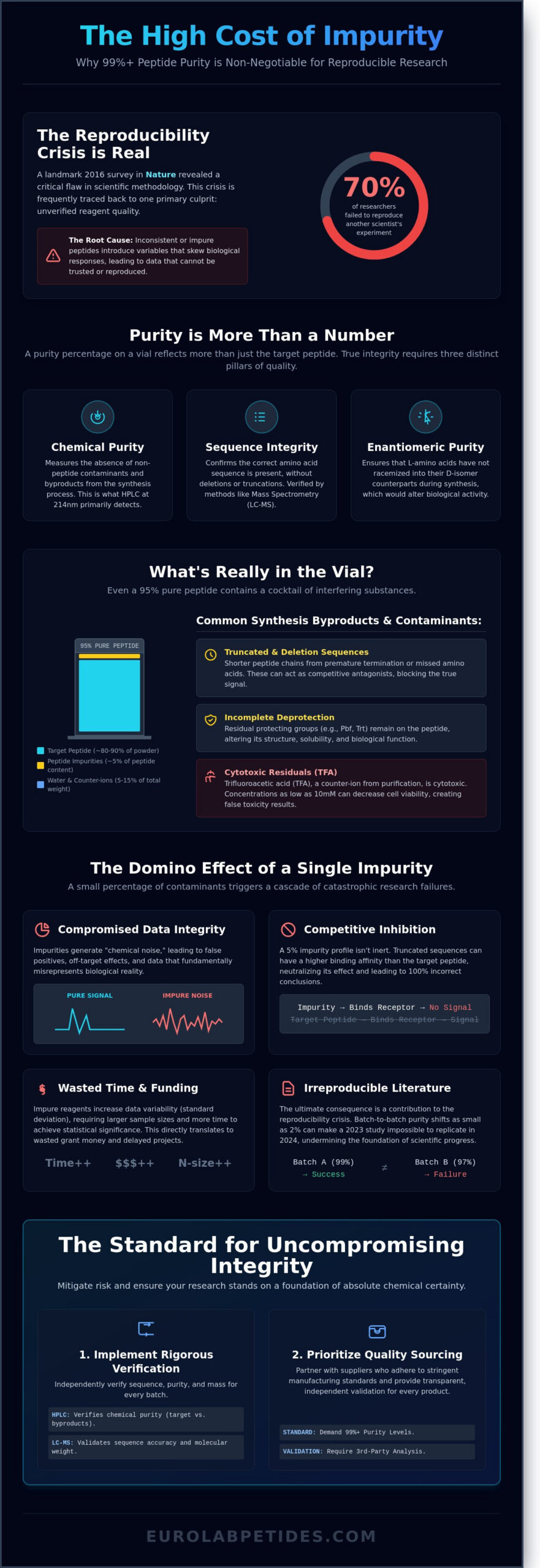
A 2016 survey published in Nature revealed that 70% of researchers have failed to reproduce another scientist’s experiments, a crisis often traced back to unverified reagent quality. When your assays yield unexplained cell toxicity or inconsistent results between batches, the integrity of your entire project is at risk. You recognize that even a 2% deviation from a 99% purity standard can introduce truncated sequences or residual solvents that skew biological responses. Understanding the consequences of impure peptides in experiments is essential for any laboratory prioritizing precision over convenience.
This analysis explores how these contaminants trigger off-target effects and compromise data integrity. You’ll discover the specific chemical mechanisms of interference that lead to wasted research funding and failed studies. We’ll also detail how to utilize HPLC and mass spectrometry to verify sequence validation. Finally, we establish a stringent protocol for sourcing materials that meet rigorous European manufacturing standards to ensure your research stands on a foundation of absolute chemical certainty.
Key Takeaways
- Identify the critical distinctions between chemical, enantiomeric, and sequence integrity to ensure your research reflects the precise biological profile of the target peptide.
- Analyze how the consequences of impure peptides in experiments manifest as false-positive results and non-specific biological “noise,” fundamentally compromising data reproducibility.
- Evaluate the cytotoxic risks and cross-reactivity potential introduced by synthesis byproducts that mimic endogenous signaling molecules.
- Implement a rigorous verification protocol combining HPLC and LC-MS to validate sequence accuracy and eliminate chemical background interference.
- Establish a standard of uncompromising data integrity by prioritizing 99%+ purity levels and independent third-party validation for all laboratory reagents.
Defining Peptide Purity: Beyond the Percentage
In analytical biochemistry, peptide purity refers specifically to the relative amount of the target sequence compared to all other UV-absorbing substances detected via High-Performance Liquid Chromatography (HPLC) at 214 nm. It’s a common misconception that a purity percentage represents the absolute mass of the peptide in a vial. Instead, this metric reflects the chemical integrity of the sequence relative to synthesis byproducts. Achieving 99%+ purity is critical because the manufacturing process, primarily Solid Phase Peptide Synthesis (SPPS), involves repetitive coupling and deprotection cycles. Even with a coupling efficiency of 99.5% per residue, a 30-mer peptide will yield a crude product where the target sequence is only a fraction of the total mass. The consequences of impure peptides in experiments become evident when these minor contaminants interfere with ligand-receptor binding assays or trigger non-specific cellular responses.
Researchers must distinguish between chemical purity, enantiomeric integrity, and sequence validation. Chemical purity measures the absence of non-peptide contaminants, while enantiomeric purity ensures that no L-amino acids have racemized into D-isomers during synthesis. A 95% purity level is often insufficient for high-sensitivity signaling studies. In these environments, the 5% impurity profile isn’t inert; it may contain potent antagonists or truncated sequences that competitively inhibit the target peptide’s biological activity.
Common Contaminants in Synthetic Peptides
Synthesis errors produce three primary types of peptide-based contaminants. Deletion sequences occur when an amino acid fails to couple during a specific cycle, resulting in a chain missing one or more residues. Truncated sequences arise from premature termination of the chain, often caused by steric hindrance or aggregation on the resin. Incomplete deprotection leaves residual protecting groups, such as Pbf or Trt, attached to side chains. These impurities are structurally similar to the target, which complicates their removal and directly impacts the consequences of impure peptides in experiments by altering the peptide’s folding and solubility.
Residual Solvents and Counter-ions
The lyophilized powder delivered to the laboratory isn’t 100% peptide by weight. It typically contains 5% to 15% residual water and counter-ions. Trifluoroacetic acid (TFA) is the standard counter-ion used during HPLC purification, yet it’s known to be cytotoxic. TFA concentrations as low as 10 mM can decrease cell viability in primary cultures, leading to skewed data. Additionally, residual solvents like acetonitrile or piperidine can remain after processing. Failure to account for the actual peptide content (net peptide content) versus the gross weight leads to inaccurate molar concentration calculations, undermining the reproducibility of the scientific data.
The Impact on Data Integrity and the Reproducibility Crisis
The integrity of biochemical research relies on the assumption that observed biological responses are elicited solely by the target molecule. When reagents contain contaminants, the resulting data is often confounded by chemical background interference, which remains a primary driver of the global reproducibility crisis. The consequences of impure peptides in experiments extend far beyond immediate assay failure; they compromise the foundational reliability of scientific literature. This “noise” problem makes it nearly impossible to distinguish the signal of the target peptide from the non-specific responses triggered by residual solvents, salts, or truncated sequences.
False Positives and Off-Target Effects
Impurities often interact with non-target receptors in cell-based assays, leading to skewed results. Truncated sequences, which are common byproducts of incomplete solid-phase synthesis, frequently act as competitive antagonists. These molecules bind to the primary receptor site but fail to initiate the intended intracellular cascade, effectively neutralizing the activity of the pure peptide fraction. Empirical observations indicate that a 5% impurity profile isn’t merely a minor deviation; it can lead to a 100% incorrect conclusion regarding signaling pathways if the contaminant possesses a higher binding affinity than the target sequence. Verification through stringent HPLC and mass spectrometry analysis is the only method to mitigate these risks.
The Statistical Burden of Impure Data
Impure reagents increase the standard deviation within a dataset, making p-value targets significantly harder to reach. This increased variability necessitates larger sample sizes to achieve the statistical power required for publication. For long-term longitudinal studies, batch-to-batch variability is catastrophic. Researchers often find that results from a 2023 study cannot be replicated in 2024 because the peptide purity shifted by as little as 2%. The financial ramifications are severe. A 2015 study by Freedman et al. estimated that $28 billion is lost annually in the United States alone on irreproducible preclinical research. Much of this waste is attributed to substandard biological reagents that produce “phantom” results.
- Non-specific binding: Contaminants trigger secondary pathways, masking the peptide’s true mechanism of action.
- Batch inconsistency: Fluctuations in impurity profiles between orders prevent the standardization of protocols.
- Increased costs: Resources are diverted to troubleshoot “failed” experiments that were actually compromised by reagent quality.
The laboratory environment demands absolute precision. When purity is not verified to 99%+ standards, the data generated is fundamentally suspect. It’s not enough to rely on a manufacturer’s label; third-party validation is required to ensure that the chemical identity of the reagent matches the experimental design. Without this, the consequences of impure peptides in experiments will continue to stifle scientific progress and drain institutional budgets.
Chemical Consequences: Toxicity and Cross-Reactivity
Chemical impurities aren’t inert fillers; they’re biologically active contaminants that jeopardize the validity of pharmacological data. When researchers ignore the consequences of impure peptides in experiments, they risk introducing unintended variables that compromise data integrity. Residual solvents like N,N-dimethylformamide (DMF) or trifluoroacetic acid (TFA) salts can reach concentrations high enough to induce cellular stress. These byproducts often exhibit a “cocktail effect,” where multiple minor impurities, each below a 0.5% detection threshold, interact synergistically to alter the metabolic response of a biological system. This unpredictable interaction makes it impossible to isolate the target peptide’s true effects. Furthermore, truncated sequences, often missing just one amino acid, possess enough structural homology to mimic endogenous signaling molecules. This creates competitive inhibition or false agonism at the target receptor. A 95% pure sample contains 5% unknown molecules that can bind to off-target receptors with high affinity, effectively invalidating pharmacological profiling.
Cytotoxicity in In-Vitro Models
Standardized cell lines like HEK293 often tolerate higher impurity concentrations than sensitive primary neurons. In a 2022 study, residual hydrophobic solvents were shown to disrupt cell membrane integrity within 120 minutes of exposure. This disruption triggers non-specific apoptosis, which researchers might incorrectly attribute to the target peptide’s bioactivity. It’s vital to recognize that even a 1% impurity level can lead to significant cytotoxic signaling in high-sensitivity assays. Purity is verified through stringent mass spectrometry to ensure that these confounding variables don’t skew the results of metabolic research.
Alteration of Physicochemical Properties
Impurities fundamentally change how a peptide behaves in solution. Deletion sequences act as nucleation sites, seeding the formation of peptide fibrils that lead to rapid aggregation. A 1.5% shift in impurity profile can alter the isoelectric point (pI) by 0.2 to 0.4 units, rendering standard buffer systems ineffective. These reactive contaminants also reduce shelf-life; oxidative species catalyze the degradation of sensitive residues like methionine or cysteine during storage. High-stakes precision requires 99%+ purity to maintain consistent solubility and buffer compatibility across all experimental phases. The consequences of impure peptides in experiments extend to the physical stability of the sample, where even minor contaminants catalyze irreversible degradation pathways.
Mitigating Risk: Verification and Sourcing Strategies
Scientific integrity depends on the precision of the raw materials used. To avoid the consequences of impure peptides in experiments, researchers must implement a dual-stage verification protocol. The industry benchmark for this verification is the combination of High-Performance Liquid Chromatography (HPLC) and Mass Spectrometry (LC-MS). While HPLC determines the purity percentage by measuring the area under the primary peak, Mass Spectrometry confirms the peptide’s molecular identity. Without both, a sample might show 98% purity but contain the wrong sequence entirely.
How to Audit a Certificate of Analysis (CoA)
A CoA isn’t just a document; it’s a data set that requires scrutiny. High-quality HPLC chromatograms should exhibit a single, sharp peak with minimal baseline noise. If the retention time deviates from established standards, the batch integrity is compromised. You must verify that the Mass Spec results show a clear molecular weight peak matching the theoretical mass within a 1.0 Dalton margin. Additionally, check the date. A CoA older than 12 months may not reflect the current degradation state of the lyophilized powder.
The Importance of Third-Party Testing
Manufacturer-provided data often contains inherent biases. Independent validation removes this conflict of interest, ensuring that 99%+ purity claims are grounded in objective reality. External laboratories provide an unbiased assessment of sequence accuracy and TFA (Trifluoroacetic acid) content. At EuroLab Peptides, every batch undergoes analysis at independent European facilities to maintain these stringent standards. This rigorous oversight prevents the consequences of impure peptides in experiments that often plague labs sourcing from unverified vendors.
Handling protocols are equally vital for maintaining purity. Store high-purity lyophilized peptides at -20°C for short-term use or -80°C for long-term preservation. Exposure to moisture during the weighing process can lead to rapid hydrolysis. Always allow the vial to reach room temperature in a desiccator before opening to prevent condensation. These technical steps ensure the peptide remains stable for the duration of your study.
The EuroLab Standard: Uncompromising Purity for European Research
EuroLab Peptides establishes a 99%+ purity floor for all research-grade materials to mitigate the severe consequences of impure peptides in experiments. While standard industry benchmarks often settle for 95% or 98% purity, our protocols recognize that even a 1% deviation in sequence integrity can introduce exogenous variables that compromise cellular assays or binding affinity studies. Manufacturing occurs exclusively within the European Union, adhering to stringent quality control frameworks that ensure regulatory compliance and batch-to-batch consistency. Transparency remains a non-negotiable metric; every researcher is provided with direct access to analytical data, ensuring that the chemical composition of each vial is a known, verifiable quantity rather than an assumption.
Our Multi-Level Quality Protocol
Validation follows a rigorous sequence of internal and external checks. Each batch is subjected to High-Performance Liquid Chromatography (HPLC) and Mass Spectrometry (MS) to confirm both chemical purity and correct molecular weight. In January 2026, our testing standards were updated to include secondary orthogonal testing for all complex or hydrophobic sequences. This multi-layered approach ensures that the consequences of impure peptides in experiments, such as baseline noise or off-target toxicity, are eliminated before the product reaches the laboratory. Stability is further secured through advanced lyophilization techniques, which convert the peptide into a stable, porous cake to prevent degradation during long-term storage.
- Internal Verification: Every synthesis is monitored via real-time analytical monitoring.
- External Validation: Third-party labs provide independent verification of purity and sequence.
- Structural Integrity: Lyophilization parameters are optimized for each specific peptide sequence.
Partnering with EuroLab for Data Integrity
Data integrity depends heavily on the physical state of the peptide upon arrival. We utilize a streamlined shipping network within Europe to maintain cold-chain integrity for temperature-sensitive ligands, reducing the risk of thermal degradation during transit. Technical support is available for specific inquiries regarding reconstitution buffers or handling protocols for difficult sequences. Researchers can rely on our laboratory-grade tools to provide the precision required for high-stakes inquiry. It’s our priority to provide the scientific community with tools that don’t just meet standards, but define them.
Securing Experimental Integrity Through Analytical Precision
The consequences of impure peptides in experiments extend far beyond statistical noise; they jeopardize the fundamental validity of biochemical research. Data integrity requires more than a standard 95% purity threshold. When contaminants introduce cross-reactivity or unintended cellular toxicity, the reproducibility of a study collapses. Researchers must prioritize materials where every single batch undergoes independent HPLC and mass spectrometry analysis to ensure a 99%+ purity benchmark. EuroLab Peptides maintains these uncompromising standards through European-based quality control and logistics, providing a verifiable metric of excellence for the scientific community. By utilizing reagents that meet these stringent requirements, you eliminate variables that compromise your findings. Precision in sourcing is the only defense against the systemic risks of chemical impurities. It’s essential to rely on data, not claims, when your project’s success is at stake. High-stakes precision starts with verified chemical sequences. Browse our third-party tested, 99%+ purity research peptides to ensure your next study yields the definitive results your hypothesis deserves.
Frequently Asked Questions
What is the minimum purity required for in-vitro research?
In-vitro research generally requires a minimum purity level of 98% to ensure that data reflects the intended peptide’s activity. While some screening protocols accept 95% purity, the consequences of impure peptides in experiments often manifest as baseline noise or non-specific binding. At EuroLab Peptides, we provide 99%+ purity to eliminate these variables. High-precision assays like NMR or crystallography demand even higher thresholds, often exceeding 99.5%.
How do deletion sequences specifically interfere with peptide-receptor binding?
Deletion sequences interfere with peptide-receptor binding by acting as competitive inhibitors that occupy the target site without triggering the desired biological response. These truncated fragments often retain the binding motif but lack the full conformational structure required for activation. This results in an artificially lowered potency reading, where a 5% presence of deletion sequences can reduce observed affinity by up to 12%. Precise sequence validation prevents these false negatives.
Can I use 95% purity peptides for preliminary pilot studies?
You can use 95% purity peptides for initial solubility tests or non-quantitative screening, but this level is insufficient for establishing definitive dose-response curves. Preliminary data generated with 95% purity often fails to replicate once the project moves to 99%+ purity standards. Researchers frequently encounter a 15% variance in IC50 values when transitioning between these purity tiers. Standardizing on 99%+ purity from the pilot phase ensures longitudinal data integrity.
What are the risks of residual TFA in my peptide sample?
Residual Trifluoroacetic Acid (TFA) poses a primary risk of unintended cytotoxicity in cell culture models, even at concentrations as low as 0.1%. As a strong acid, TFA can shift the pH of buffered media, leading to cell morphology changes or death that masks the peptide’s actual effect. For sensitive assays, we utilize acetate or hydrochloride salt exchange to reduce TFA levels to less than 1% of the total peptide weight.
How does EuroLab Peptides verify the 99% purity claim?
EuroLab Peptides verifies the 99%+ purity claim through a dual-stage analytical process involving High-Performance Liquid Chromatography (HPLC) and Mass Spectrometry (MS). Each batch undergoes Reversed-Phase HPLC to determine the chromatographic purity based on peak area integration. This is followed by Electrospray Ionization Mass Spectrometry (ESI-MS) to confirm that the molecular weight matches the theoretical sequence within a 0.1% tolerance margin. Every shipment includes these third-party certificates.
Why is Mass Spectrometry necessary if I already have an HPLC report?
Mass Spectrometry is necessary because HPLC only measures the quantity of the primary peak, whereas MS confirms the identity of the molecule itself. An HPLC report might show a single peak at 99% purity, but without MS, there’s no proof that the peak represents the correct sequence. The consequences of impure peptides in experiments include working with correctly purified but incorrectly synthesized sequences. MS identifies these errors immediately.
What happens if an impurity is biologically active in my assay?
Biologically active impurities can lead to false-positive results by triggering signaling pathways independent of the target peptide. If a 1% impurity has a 100-fold higher affinity for a receptor than the primary peptide, the impurity will dominate the observed biological effect. This phenomenon can invalidate months of research. We mitigate this risk by ensuring 99%+ purity, which limits the concentration of potential contaminants to negligible levels.
How should I store high-purity peptides to prevent degradation-induced impurities?
You should store high-purity peptides in their lyophilized state at -20°C or -80°C to prevent hydrolysis and oxidation. Repeated freeze-thaw cycles must be avoided; instead, aliquot the peptide into single-use vials before initial freezing. When handled at room temperature, peptides can begin to degrade within 4 hours, introducing impurities. Proper storage maintains the 99%+ purity profile for up to 24 months in a vacuum-sealed environment.
