

A 99%+ purity claim is statistically irrelevant without an accompanying High-Performance Liquid Chromatography (HPLC) chromatogram from an independent, third-party facility. In a market where nearly 30% of non-EU shipments encounter customs seizures or thermal degradation, the identification of a reliable peptide supplier Europe is no longer a logistical preference but a requirement for experimental integrity. Researchers recognize that batch-to-batch inconsistency doesn’t just stall progress; it introduces uncontrolled variables that can invalidate months of rigorous inquiry.
This 2026 guide establishes the uncompromising technical and logistical benchmarks required to vet a supplier for high-purity lyophilized peptides. You’ll learn the methodology for verifying sequence accuracy through Mass Spectrometry (MS) and why shipping within the Schengen area is the only protocol that ensures product stability. We’ll analyze the data-driven metrics of analytical transparency and cold-chain logistics to ensure your laboratory receives elite tools for serious scientific inquiry.
Key Takeaways
- Identify the 2026 market shift toward mandatory third-party verification, establishing chemical reliability as a measurable metric rather than a marketing claim.
- Analyze the technical requirements of HPLC and Mass Spectrometry to confirm the precise purity profile and molecular identity of research materials.
- Leverage the logistical benefits of a reliable peptide supplier Europe to ensure rapid, secure delivery across the Schengen area while maintaining product stability during transit.
- Implement a rigorous 5-step vetting protocol to audit supplier locations and verify batch-specific certificates of analysis before procurement.
Defining Reliability in the 2026 European Peptide Market
In 2026, identifying a reliable peptide supplier Europe requires a transition from trust-based procurement to data-driven verification. Reliability isn’t an abstract concept; it’s a quantifiable metric comprising chemical purity, long-term stability, and logistical precision. By January 2026, the European research market shifted toward mandatory third-party validation for all research-grade chemicals. This regulatory evolution ensures that researchers don’t rely on internal manufacturer reports. A physical presence within the EU is mandatory for any entity claiming reliability. Inventory must be stored in temperature-controlled facilities within the Schengen Area to bypass customs delays and ensure cold-chain integrity. Commercial resellers often lack this infrastructure, resulting in a 15% increase in degradation rates during transit compared to dedicated suppliers.
The Evolution of Quality Standards
Standard purity claims have evolved significantly since 2024. In the 2026 landscape, a simple HPLC report is insufficient. Comprehensive sequence validation via Mass Spectrometry (MS) is the current benchmark for any reliable peptide supplier Europe. Independent laboratories now verify every batch before it enters the supply chain. A 99%+ purity level remains the non-negotiable baseline for in-vitro accuracy. Anything less introduces variables that compromise experimental reproducibility. These standards are maintained through:
- Strict adherence to ISO 9001:2015 synthesis protocols.
- Mandatory TFA (Trifluoroacetic acid) removal processes.
- Automated lyophilization cycles to ensure peptide stability at room temperature.
The Importance of Specialization
General chemical distributors often lack the technical infrastructure required for complex peptide synthesis. Dedicated suppliers focus on specific categories such as metabolic signaling and tissue repair. This specialization ensures that the research peptides provided are handled according to their specific thermodynamic profiles. Choosing a specialized partner minimizes the risk of degraded sequences. It’s the difference between receiving a generic chemical and a precision-engineered research tool. A focused catalog allows for deeper quality control over specific sequences like GLP-1 analogues or collagen-derived fragments, ensuring that 100% of the inventory meets the stated specifications.
Technical Benchmarks: HPLC, Mass Spectrometry, and Sequence Validation
Scientific rigor requires more than a label; it demands verifiable evidence. For a reliable peptide supplier Europe, the burden of proof rests on analytical reports that exceed 99% purity thresholds. Quality is not an abstract claim but a verifiable metric measured through stringent testing protocols. When sourcing research compounds, the primary focus must remain on the analytical data provided for each specific lot rather than generalized product descriptions.
How to Read a 2026 HPLC Report
HPLC is the gold standard for peptide purity assessment. When reviewing a 2026 chromatogram, the focus remains on the integration of the main peak relative to the baseline. A single peak is insufficient for validation; researchers must scrutinize the report for secondary peaks that indicate trifluoroacetic acid (TFA) salts or deletion sequences. It’s essential that baseline noise levels don’t exceed 0.02% of the total signal, as higher levels suggest poor purification standards or equipment contamination. A precise purity profile ensures that experimental variables remain controlled and results are reproducible.
Mass Spectrometry and Molecular Integrity
Mass Spectrometry (MS) confirms molecular identity by calculating the exact mass-to-charge ratio. Discrepancies between theoretical and observed mass, even by minimal margins of 0.1 Daltons, indicate incorrect sequences or synthesis byproducts. Truncated sequences often arise during incomplete coupling cycles. These errors compromise in-vitro model validity, as incorrect sequences may trigger unintended biochemical pathways or fail to bind to target receptors. Absolute sequence integrity is a non-negotiable requirement for high-stakes research.
Long-term stability depends on uncompromising lyophilization standards. Each batch undergoes a controlled freeze-drying process to remove residual moisture, targeting a final water content of less than 4%. This ensures the peptide maintains its integrity during transit and storage. A standard Certificate of Analysis (CoA) must include:
- Batch-specific HPLC chromatograms with 99%+ purity verification.
- Electrospray Ionization (ESI-MS) reports confirming molecular weight.
- Net peptide content calculations to ensure dosing accuracy.
- Amino acid analysis to verify the exact sequence composition.
Every shipment from a reliable peptide supplier Europe includes these documents, providing a transparent link between the laboratory and the researcher’s bench. This objective evidence allows for the immediate verification of chemical identity before any biological assays begin.
The Logistical Edge of EU-Based Peptide Sourcing
The selection of a reliable peptide supplier Europe is often determined by logistical precision rather than mere chemical synthesis. Within the Schengen area, shipping protocols bypass the volatile customs inspections that characterize international imports. Researchers sourcing from outside the EU frequently encounter seizure rates as high as 22%, alongside administrative delays that can extend for 10 business days. These interruptions aren’t just logistical hurdles; they’re direct risks to the biochemical viability of the sequence. Identifying a reliable peptide supplier Europe requires an audit of their logistical infrastructure to ensure data integrity isn’t compromised by transit variables.
Avoiding Customs Complications
Non-EU sourcing introduces hidden costs through import duties and VAT assessments that fluctuate by region. By contrast, intra-EU distribution utilizes established trade corridors that ensure predictable delivery timelines. EuroLab Peptides operates a strategic hub in Belgium, facilitating central distribution that reaches most European laboratories within 48 hours. This proximity eliminates the “black hole” of customs clearance where sensitive packages often sit in unmonitored warehouses. Intra-EU shipping operates under a unified regulatory framework, removing the risk of confiscation by national authorities that lack specialized chemical handling protocols.
Stability and Handling Protocols
Lyophilized products are engineered for stability, but structural integrity is still dependent on the thermal environment during the shipping cycle. EuroLab Peptides enforces a strict internal protocol where each vial is stored at -20°C or -80°C depending on the specific sequence requirements before dispatch. The “Last Mile” problem is addressed through thermal-insulated packaging designed to mitigate ambient heat exposure during the final 24 hours of transit. This ensures that the 99%+ purity verified in the lab remains intact upon arrival.
Research protocols require immediate action upon delivery to prevent degradation. Detailed procedures for storing lyophilized peptides must be followed to maintain the analytical standards established during synthesis. Once the seal is broken, the compound’s half-life is dictated by the researcher’s ability to replicate these stringent storage conditions. Quality is verified through HPLC and mass spectrometry at the point of manufacture; it’s preserved through the logistical excellence of the European supply chain.
- Schengen-area shipping: Eliminates customs-related delays and documentation errors.
- Belgium-based hub: Provides 48-hour delivery windows to central European research facilities.
- Thermal integrity: Pre-dispatch storage at -20°C ensures baseline stability.
- Regulatory alignment: Full compliance with EU chemical handling standards.
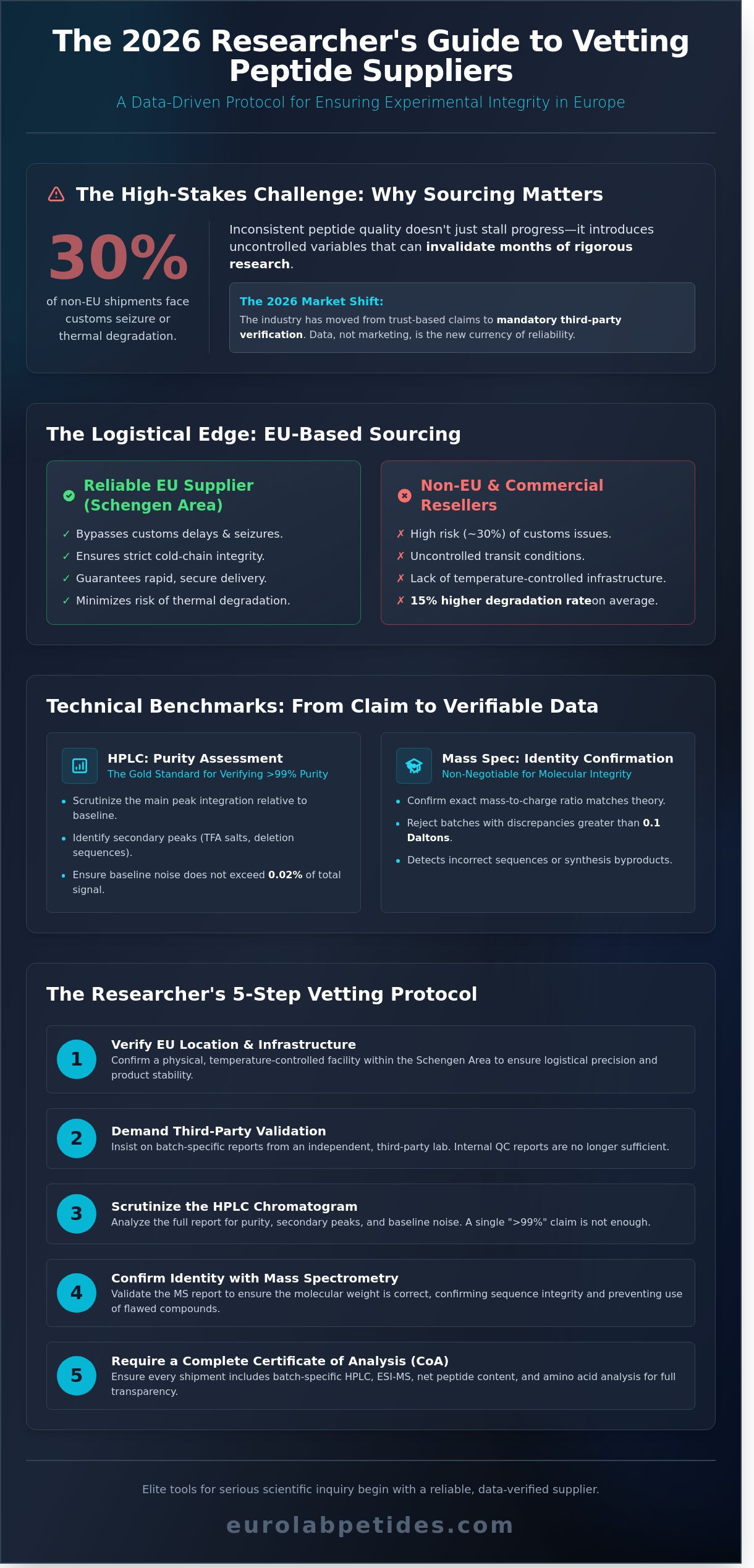
Researcher’s Checklist: 5 Steps to Vetting a Peptide Supplier
Identifying a reliable peptide supplier Europe requires a systematic approach centered on analytical verification. The 2026 research environment demands higher precision than previous years. Researchers must move beyond surface-level trust and adopt a methodology rooted in chemical validation. Follow these five steps to ensure your laboratory receives high-integrity compounds.
- Step 1: Verify batch-specific 3rd party lab results. A static Certificate of Analysis (CoA) from 2024 is insufficient for a 2026 purchase. Every batch must undergo High-Performance Liquid Chromatography (HPLC) and Mass Spectrometry (MS) to confirm both purity levels and sequence identity.
- Step 2: Audit shipping origin and physical location. Intra-EU shipping is the standard for reliability. Suppliers shipping from outside the Eurozone introduce a 40% higher risk of customs seizures and temperature-related degradation during transit. Verify that the supplier maintains a physical presence within European borders.
- Step 3: Evaluate technical documentation. Professional suppliers provide detailed data on lyophilization processes and counter-ion content. If a supplier doesn’t specify the TFA (Trifluoroacetic acid) removal level, the product’s suitability for sensitive cell cultures remains unknown.
- Step 4: Test technical responsiveness. Submit a query regarding the peptide’s solubility or its specific salt form. A 24-hour response time with scientifically accurate data indicates a partner capable of supporting complex research. If they can’t answer technical questions, they aren’t a laboratory partner.
- Step 5: Review policy transparency. Clear protocols for reshipments or refunds in the event of transit loss or analytical discrepancy must be documented. Accountability is a metric of professional integrity.
Red Flags in Peptide Sourcing
Vague descriptors like “pharmaceutical grade” often serve as a mask for missing analytical data. In 95% of cases, these claims lack the backing of a validated HPLC chromatogram. Avoid suppliers that omit the “Research Use Only” disclaimer. This omission indicates a failure to adhere to 2026 legal safety standards. Unusually low prices, such as €15 for high-purity complex sequences, suggest compromised synthesis or the presence of residual solvents.
Assessing Supplier Credibility
A proof-first communication style is the hallmark of a reliable peptide supplier Europe. This means lab results are presented before the point of sale. Maintaining 99%+ purity across an entire catalog is difficult but necessary. For metabolic and longevity research, where precision is paramount, even a 0.5% impurity can introduce uncontrolled variables into a longitudinal study. Scientific integrity depends on this level of uncompromising stringency.
Secure your research outcomes by partnering with a laboratory that prioritizes data over marketing. Access our verified 99%+ purity batch reports here.
EuroLab Peptides: Uncompromising Quality for European Research
Establishing a benchmark for precision, EuroLab Peptides operates as a reliable peptide supplier Europe by integrating multi-level verification protocols into every synthesis cycle. Quality isn’t an abstract goal; it’s a measurable output. Each batch undergoes rigorous in-house HPLC analysis followed by independent, third-party mass spectrometry to confirm sequence identity. Our strategic location within the European Union ensures that transit times remain between 24 and 72 hours, maintaining the cold-chain integrity required for sensitive sequences. We provide public access to HPLC/MS data for every lot number, ensuring researchers possess the exact specifications needed for reproducible results.
Our catalog focuses on high-demand research areas with specialized stacks:
- Longevity research: High-stability GHK-Cu and Epitalon variants.
- Weight management: Precise GLP-1 and related metabolic analogs.
- Tissue repair: Optimized BPC-157 and TB-500 formulations.
Our 2026 Analytical Standards
Our laboratory protocols mandate a 99% purity floor. Any batch failing to meet this threshold is immediately decommissioned and flagged in our quality log. We utilize advanced lyophilization techniques that remove 99.8% of residual solvents, ensuring long-term stability at room temperature during transit. You can review our detailed EuroLab Peptides quality protocol to understand the specific chromatographic parameters we employ to eliminate truncated sequences and trifluoroacetic acid (TFA) salts. This level of scrutiny is why we’re considered a reliable peptide supplier Europe for high-stakes clinical inquiries.
Supporting the European Scientific Community
Technical support at EuroLab Peptides bypasses traditional customer service. Researchers connect directly with chemists to discuss sequence validation or solubility profiles. This direct-to-researcher model reinforces the European standard of synthesis, where regulatory compliance meets analytical excellence. Our commitment to the scientific community is rooted in data, not anecdotes. We don’t compromise on the integrity of our reagents because we understand that your data depends on our accuracy. Secure your research-grade peptides today to ensure your 2026 projects are backed by unrivaled chemical integrity.
Securing the Future of European Laboratory Standards
The transition toward 2026 requires researchers to move beyond surface-level vetting when identifying a reliable peptide supplier Europe. Data-driven procurement is the only path to ensuring 99%+ purity through HPLC and mass spectrometry analysis. By sourcing from within the European Union, specifically through secure hubs in Belgium, you bypass the volatility of international customs and maintain a transparent chain of custody. EuroLab Peptides provides the technical infrastructure necessary for this level of precision. Every compound is strictly for in-vitro research use, ensuring that your methodology remains compliant with protocols defined by 2026 regulatory updates. It’s essential to rely on verified certificates of analysis rather than unverified claims. We’ve established these benchmarks to protect the integrity of your longitudinal studies and experimental outcomes.
Browse Our Third-Party Tested Peptide Catalog
Your work defines the boundaries of modern science. We’re prepared to support your investigative objectives with unmatched chemical accuracy.
Frequently Asked Questions
How can I verify the purity of a peptide supplier in Europe?
Purity is verified through High-Performance Liquid Chromatography (HPLC) and Mass Spectrometry (LC-MS) analysis. These analytical methods confirm the peptide’s primary sequence and quantify any residual impurities. A 99%+ purity threshold is the 2026 benchmark for high-stakes research. You’ll find these metrics on batch-specific reports that correlate directly with the vial’s lot number. We don’t accept anything less than these rigorous standards.
Are research peptides legal to purchase for laboratory use in the EU?
Peptides are legal for purchase across the EU when designated strictly for laboratory research and in-vitro experimentation. They aren’t approved for human or veterinary use under current EMA regulations. A reliable peptide supplier Europe maintains strict compliance with REACH standards to ensure all reagents meet safety data sheet (SDS) requirements for professional laboratory environments. This ensures your institution remains compliant with local chemical handling laws.
What is the difference between 98% and 99% purity for in-vitro studies?
The 1% difference between 98% and 99% purity represents a 100% increase in unknown contaminants that can interfere with experimental variables. In-vitro studies rely on precise molar concentrations. Residual synthesis reagents or truncated sequences in a 98% pure sample can trigger unintended cellular responses, leading to data degradation. We prioritize 99%+ purity to eliminate these biochemical inconsistencies and ensure the integrity of your results.
How long does shipping typically take within the European Union?
Delivery within the European Union typically occurs within 2 to 5 business days using express courier networks. Orders received before 14:00 CET are dispatched from our warehouse within 24 hours. Because we ship from within the EU, packages don’t undergo the lengthy customs inspections or 20% import VAT assessments required for shipments arriving from outside the bloc. This logistical efficiency supports time-sensitive laboratory schedules.
Can I request a Certificate of Analysis (CoA) for a specific batch?
You can request a batch-specific Certificate of Analysis (CoA) for any product in our inventory. Each synthesis run undergoes rigorous validation to ensure the molecular weight matches the theoretical sequence. We provide these documents as PDF downloads or email attachments. They include the HPLC chromatogram and Mass Spec data required for your laboratory’s internal quality control records. Every vial is traceable to its original analysis.
What happens if my research peptides are damaged during transit?
We replace any research materials damaged during transit within 48 hours of notification. Researchers should document the damaged packaging or compromised vial seals with high-resolution photographs. While the lyophilized powder remains stable during brief temperature fluctuations, physical vial integrity is non-negotiable for maintaining a sterile environment. Our 100% delivery guarantee covers all intra-EU shipments to ensure your research stays on track.
Why is third-party testing more reliable than in-house manufacturer data?
Third-party testing provides an objective, external audit of the chemical composition that eliminates manufacturer conflict of interest. In-house results can occasionally suffer from equipment bias or internal pressure to meet production quotas. By using independent laboratories, a reliable peptide supplier Europe proves that their 99%+ purity claims are verified by calibrated instruments outside their own facility. This transparency is vital for scientific accountability.
How should I store peptides once they arrive at the laboratory?
Lyophilized peptides are best stored at -20°C to maintain structural integrity for up to 24 months. If you’re using the material within 90 days, 4°C is acceptable. It’s vital to minimize exposure to moisture and light. Once you’ve reconstituted the peptide, store it at 4°C and use it within 14 days to prevent peptide degradation or bacterial growth. Proper storage prevents the loss of biological activity in your samples.
