

The transition from dual to triple receptor agonism marks a paradigm shift in metabolic modeling that renders traditional dual-agonist benchmarks insufficient for high-precision laboratory inquiry. Researchers often encounter significant variability when transitioning between these ligands, particularly regarding receptor affinity and structural stability in cell culture environments. This technical analysis provides a comprehensive retatrutide vs tirzepatide in vitro comparison, focusing on the biochemical divergence between GLP-1/GIP dual agonism and the GLP-1/GIP/Glucagon triple-agonist profile.
It’s established that maintaining experimental integrity requires more than just high-level observation; it demands a granular understanding of how triple agonism influences metabolic pathways differently than its predecessors. You’ll gain a data-driven perspective on receptor binding kinetics and standardized reconstitution protocols necessary for maintaining molecular stability. This article examines the critical necessity of 99%+ peptide purity and the specific methodologies required to validate these compounds in a controlled research setting. By prioritizing analytical rigor, the following sections provide the technical framework needed to navigate the complexities of multi-receptor ligand interactions.
Key Takeaways
- Identify the biochemical divergence between dual and triple receptor agonism to accurately predict ligand-specific cellular responses.
- Utilize a retatrutide vs tirzepatide in vitro comparison to analyze the specific metabolic impact of glucagon receptor recruitment on lipid oxidation.
- Evaluate structural modifications and amino acid sequences to optimize the stability and half-life of peptides in laboratory environments.
- Implement rigorous reconstitution and storage protocols to maintain molecular integrity and ensure the reproducibility of experimental data.
- Confirm peptide quality through external HPLC and MS validation to maintain a 99% purity standard and eliminate experimental artifacts.
Biochemical Profiles: Dual Agonism vs. Triple Agonism
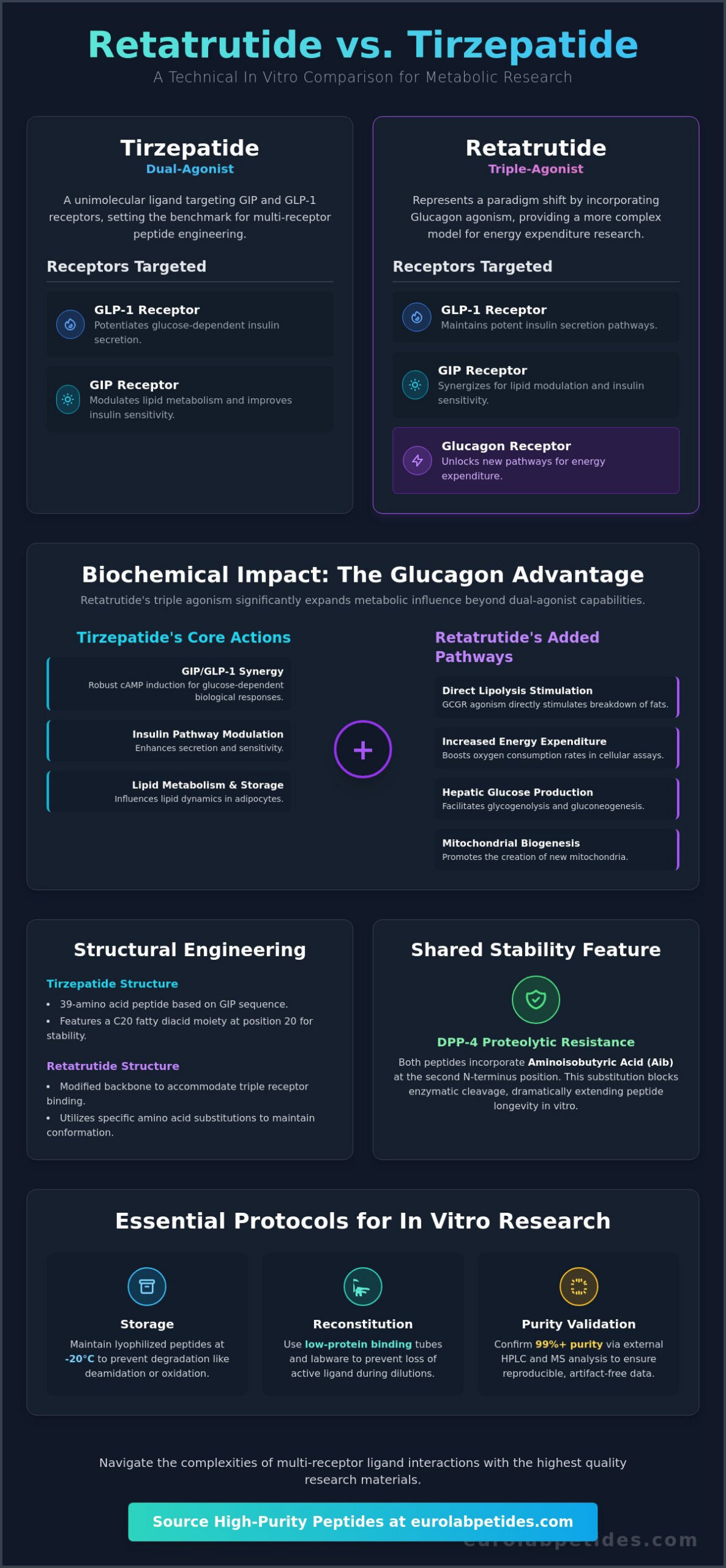
The biochemical architecture of metabolic research ligands determines the specificity of downstream signaling pathways. A precise retatrutide vs tirzepatide in vitro comparison requires an understanding of how these peptides interact with their respective G protein-coupled receptors (GPCRs). Tirzepatide functions as a unimolecular dual agonist. It targets the glucose-dependent insulinotropic polypeptide (GIP) receptor and the glucagon-like peptide-1 (GLP-1) receptor. Retatrutide expands this therapeutic window by functioning as a triple agonist, incorporating glucagon receptor (GCGR) activation alongside GIP and GLP-1 agonism.
The inclusion of GCGR agonism represents a fundamental shift in metabolic modeling. In vitro, the glucagon receptor facilitates glycogenolysis and gluconeogenesis in hepatocytes; it also promotes lipid oxidation in adipocytes. Researchers utilize these models to observe how triple agonism influences energy expenditure pathways that dual agonists cannot fully engage. Comparative data shows that receptor activation thresholds vary significantly between these compounds, necessitating meticulous titration in cell culture studies. Potency is often measured via the half-maximal effective concentration (EC50), where retatrutide exhibits balanced activity across its three targets to prevent over-stimulation of any single pathway.
Tirzepatide: The GIP/GLP-1 Synergy
Tirzepatide’s dual agonism focuses on the potentiation of insulin secretion through GLP-1 receptor pathways while utilizing GIP receptor signaling to modulate lipid metabolism. In laboratory settings, the GIP component is observed to improve insulin sensitivity and lipid storage dynamics. The synergy between these two pathways results in a more robust cAMP (cyclic adenosine monophosphate) induction than what is typically documented with GLP-1 mono-agonists. This dual mechanism provides a standardized baseline for studying glucose-dependent biological responses and serves as the benchmark for multi-receptor peptide engineering.
Retatrutide: The Addition of Glucagon Receptor Agonism
Retatrutide modifies the metabolic profile by integrating GCGR agonism, which alters cellular energy homeostasis. While GIP and GLP-1 focus on insulin-related pathways, the glucagon component directly stimulates lipolysis and mitochondrial biogenesis in vitro. Laboratory research indicates that retatrutide maintains high binding affinity across all three targets, though the potency ratios differ from dual-agonist models. Specifically, the triple-agonist profile shows a distinct capacity to increase oxygen consumption rates in cellular assays. This provides a more complex model for energy expenditure research, allowing scientists to quantify the metabolic contribution of the glucagon receptor in isolation or in tandem with incretin signaling.
Structural Differences and Peptide Stability
Peptide integrity in a laboratory setting depends entirely on the molecular architecture designed to resist enzymatic cleavage. A detailed retatrutide vs tirzepatide in vitro comparison reveals that while both molecules share a common ancestry in the incretin family, their structural modifications for stability are distinct. Tirzepatide is a 39-amino acid peptide based on the GIP sequence. It features a C20 fatty diacid moiety attached via a linker at position 20. Retatrutide also utilizes a modified backbone to accommodate its triple-agonist profile, requiring specific amino acid substitutions to maintain structural conformation across three different receptor interfaces.
Stability in the lyophilized state remains high for both compounds when stored under appropriate conditions. Researchers should maintain these peptides at -20°C to prevent deamidation or oxidation. Once reconstituted, the chemical stability profile shifts. The presence of non-natural amino acids provides a shield against common laboratory proteases, but the specific solubility of each peptide varies based on its acylation strategy. This variation impacts how each molecule interacts with plasticware and glassware during serial dilutions in cellular assays. It’s vital to use low-protein binding tubes to minimize loss of the active ligand.
Sequence Engineering for Proteolytic Resistance
The primary challenge in maintaining peptide longevity in vitro is the presence of dipeptidyl peptidase-4 (DPP-4). Both peptides incorporate aminoisobutyric acid (Aib) at the second position of the N-terminus. This substitution effectively blocks DPP-4 from recognizing the cleavage site, extending the half-life from minutes to several days in simulated biological fluids. Retatrutide incorporates additional non-natural residues to stabilize the alpha-helical structure required for glucagon receptor binding. These modifications ensure that the peptide remains bioactive throughout the duration of long-term incubation periods in metabolic research models.
Albumin Binding and Molecular Weight Considerations
Acylation is the primary strategy used to facilitate albumin binding, which reduces renal clearance and protects the peptide core. In this Retatrutide vs. Tirzepatide: A Biochemical Comparison, it’s noted that the specific fatty acid side chains determine the affinity for bovine or human serum albumin used in culture media. Tirzepatide’s C20 diacid creates a high-affinity bond that can limit the free fraction of the peptide available for receptor binding in high-protein environments. Researchers must account for this binding when calculating effective concentrations. For those conducting high-stakes metabolic studies, sourcing peptides with verified structural integrity for weight management research is essential to ensure that observed effects aren’t the result of degradation products.
Comparative Analysis of Metabolic Pathway Activation
The quantification of intracellular signaling remains the primary metric for evaluating the efficacy of multi-receptor agonists. Cyclic AMP (cAMP) induction serves as the critical second messenger in this context, providing a measurable readout of G protein-coupled receptor (GPCR) activation. When performing a retatrutide vs tirzepatide in vitro comparison, researchers observe distinct profiles in cAMP accumulation across various cell lines, including HEK293 cells transfected with human GLP-1R, GIPR, or GCGR. While both peptides demonstrate high potency at the GIP and GLP-1 receptors, the addition of the glucagon component in retatrutide introduces a third signaling vector that fundamentally alters the metabolic readout.
In vitro observations highlight a clear divergence between lipid oxidation and glucose uptake. Tirzepatide models typically show a prioritized focus on glucose-dependent insulin secretion and lipogenesis modulation through dual GIP and GLP-1 pathways. Retatrutide, however, engages the glucagon receptor to stimulate lipolysis and enhance mitochondrial biogenesis markers. In muscle cell cultures, this triple agonism often correlates with increased expression of PGC-1alpha, a key regulator of mitochondrial oxidative metabolism. Dose-response curve analysis is essential for identifying the precise concentration at which these thermogenic pathways become dominant without inducing cellular toxicity or receptor desensitization.
Glucagon-Mediated Pathways in Retatrutide Research
Retatrutide’s inclusion of glucagon receptor (GCGR) agonism enables the study of thermogenic pathways in brown adipocyte models. Unlike dual agonists, retatrutide directly stimulates the uncoupling protein 1 (UCP1) through GCGR-mediated cAMP elevation, effectively increasing the in vitro metabolic rate. In hepatic glucose production studies, the glucagon component allows researchers to model the balance between glycogenolysis and the insulinotropic effects of the GLP-1/GIP components. This creates a more dynamic laboratory environment for investigating how triple-agonist ligands manage energy homeostasis through simultaneous stimulation and inhibition of opposing pathways.
GIP and GLP-1 Crosstalk in Tirzepatide Models
Research involving tirzepatide often focuses on the “GIP-first” hypothesis, which suggests that GIP receptor activation may prime the cellular environment for more effective GLP-1 signaling. Laboratory settings reveal that tirzepatide acts as a biased agonist, showing higher potency at the GIP receptor compared to the GLP-1 receptor. This signaling bias is a critical factor in in vitro research outcomes, as it influences the recruitment of beta-arrestins and the subsequent internalization of receptors. Comparing the GLP-1R potency of tirzepatide versus retatrutide helps scientists determine how the presence of a third ligand affects the binding kinetics and downstream signaling efficiency of the original dual-agonist framework.
Handling and Reconstitution Protocols for In Vitro Studies
Standardization of reconstitution protocols is a prerequisite for generating reproducible data in metabolic signaling assays. A valid retatrutide vs tirzepatide in vitro comparison relies on the assumption that both ligands are at peak bioactivity when introduced to the cellular environment. Lyophilized peptides are inherently stable, but the transition to a liquid state introduces variables that can compromise molecular conformation. The selection of a diluent is the first critical decision in this process. While bacteriostatic water is often used for multi-use applications, high-precision in vitro research typically requires sterile, deionized water or phosphate-buffered saline (PBS) to maintain a consistent pH between 7.2 and 7.4. This prevents unexpected ion interference with GPCR binding sites.
Mechanical handling during the liquid transition significantly impacts peptide longevity. Researchers must avoid high-shear environments, such as vortexing or rapid pipetting, which can lead to peptide aggregation or denaturation. It’s recommended to allow the diluent to run slowly down the interior wall of the glass vial. The solution should then be swirled gently until complete dissolution is achieved. Any presence of particulates or persistent turbidity suggests that the peptide has reached its solubility limit or has begun to aggregate, which will skew the results of any retatrutide vs tirzepatide in vitro comparison by lowering the effective concentration of the ligand.
Reconstitution and Concentration Calculations
Achieving specific micromolar or nanomolar concentrations for dose-response curves requires precise volumetric measurement. Researchers should utilize a specialized peptide reconstitution calculator to determine the exact volume of diluent required for the specific mass of each lyophilized vial. Accuracy in this step is vital for calculating the EC50 values of triple versus dual agonists. For laboratories focused on high-stakes weight management research, even minor volumetric errors can lead to significant variances in cAMP induction data.
Long-term Storage and Stability Monitoring
Lyophilized powders should be stored at -20°C for short-term use, but archives intended for long-term study require -80°C to halt hydrolytic degradation. Once reconstituted, the peptides are significantly more susceptible to proteolytic cleavage and oxidation. Aliquoting the stock solution into single-use volumes is mandatory to prevent repeated freeze-thaw cycles. These cycles cause structural shear and a measurable reduction in binding affinity. Visual inspection must be performed before every assay; the solution should remain clear and colorless to ensure the chemical integrity of the peptide core is maintained.
Sourcing High-Purity Peptides for Rigorous Research
The validity of a retatrutide vs tirzepatide in vitro comparison is fundamentally dependent on the chemical purity of the ligands used. In laboratory environments, even minor contaminants can induce unintended cellular responses or inhibit receptor binding kinetics. A purity threshold of 99% or higher is the non-negotiable standard for high-precision metabolic research. When purity levels fall below this benchmark, the resulting data may reflect the influence of synthesis byproducts rather than the peptide’s intended mechanism of action. This leads to experimental artifacts that compromise the integrity of the entire study.
Reliable sourcing requires the provision of a comprehensive Certificate of Analysis (COA) for every batch. This document must include High-Performance Liquid Chromatography (HPLC) results to confirm purity and Mass Spectrometry (MS) data to verify the molecular weight. These metrics provide objective evidence that the peptide sequence is correct and free from significant impurities. EuroLab Peptides maintains a rigorous testing framework to ensure that every vial meets these exacting specifications, supporting the demands of the specialized scientific community.
Quality Assurance in Peptide Synthesis
The synthesis process often leaves behind residual solvents or trifluoroacetic acid (TFA) salts, which can be cytotoxic in cell culture models. High TFA concentrations can shift the pH of the culture media, leading to false-positive or false-negative results in cAMP induction assays. Utilizing best quality peptides produced through advanced purification techniques minimizes these risks. Multi-level testing protocols identify and remove these contaminants, ensuring that the observed biological effects are solely attributable to the peptide’s interaction with the GIP, GLP-1, or glucagon receptors.
Procurement for European Laboratories
Logistical efficiency is critical for maintaining the structural stability of sensitive ligands. Sourcing research peptides from within Europe offers significant advantages in terms of transit time and cold-chain management. Reduced shipping durations minimize the risk of temperature excursions that can lead to peptide degradation. EuroLab Peptides adheres to strict regional manufacturing standards, providing a transparent supply chain for institutions conducting longevity and weight management research. All products are intended strictly for laboratory-only use, ensuring compliance with current regulatory frameworks while supporting the development of next-generation metabolic stacks.
Advancing Metabolic Modeling Through Precision Agonism
The transition from dual to triple receptor agonism necessitates a more nuanced approach to cellular assay design. A rigorous retatrutide vs tirzepatide in vitro comparison demonstrates that glucagon receptor recruitment significantly alters thermogenic and lipolytic signaling pathways. Maintaining the structural integrity of these ligands through standardized reconstitution and storage protocols is essential for ensuring that observed metabolic shifts remain reproducible across different cell lines. It’s clear that data integrity relies on the elimination of variables that compromise binding kinetics or downstream cAMP induction.
Experimental precision begins with the chemical purity of the research material. EuroLab Peptides provides laboratory-grade materials that undergo third-party HPLC and MS validation to guarantee a 99%+ purity benchmark. These standards eliminate the risk of experimental artifacts caused by residual solvents or synthesis byproducts. Secure high-purity peptides for your next in vitro study at EuroLab Peptides and ensure your data reflects the highest standards of analytical rigor. High-stakes research demands materials that meet the most stringent manufacturing requirements available in the European market. Achieving these benchmarks ensures your laboratory remains at the forefront of metabolic discovery.
Frequently Asked Questions
Is retatrutide more potent than tirzepatide in in vitro models?
Potency is defined by the specific receptor endpoint and cellular environment utilized in the study. In a retatrutide vs tirzepatide in vitro comparison, retatrutide demonstrates an expanded pharmacological profile due to its triple-agonist activity at the GLP-1, GIP, and glucagon receptors. While tirzepatide remains a benchmark for dual-incretin signaling, retatrutide provides a more robust stimulus for energy expenditure pathways through its recruitment of the glucagon receptor.
Can retatrutide and tirzepatide be used in the same research stack?
These ligands are frequently integrated into the same Advanced Metabolic Stack to examine the interactions between dual and triple receptor agonism. Researchers utilize this combination to observe how varying levels of glucagon receptor stimulation influence established GIP and GLP-1 signaling. This approach is standard for high-precision metabolic research where the goal is to quantify the additive effects of multi-receptor ligands on intracellular cAMP accumulation.
How should research-grade retatrutide be stored to maintain stability?
Lyophilized retatrutide must be stored at -20°C for short-term laboratory use or -80°C for long-term archival purposes. Once the peptide is reconstituted, it’s susceptible to rapid degradation and should be aliquoted into single-use volumes to avoid repeated freeze-thaw cycles. These cycles induce mechanical shear that can compromise the peptide’s structural integrity and binding affinity, leading to inconsistent experimental results.
What is the primary difference in receptor affinity between these two peptides?
The fundamental distinction lies in retatrutide’s balanced affinity for the glucagon receptor (GCGR) alongside the GIP and GLP-1 receptors. Tirzepatide is engineered as a dual agonist that lacks significant glucagon receptor activity. This structural divergence allows retatrutide to engage thermogenic pathways in brown adipocytes and modulate hepatic glucose production in ways that dual-agonist models cannot replicate in a controlled environment.
What diluents are recommended for reconstituting tirzepatide for cellular assays?
Sterile, deionized water or phosphate-buffered saline (PBS) are the primary recommendations for reconstituting peptides intended for cellular assays. While bacteriostatic water is common for other applications, the benzyl alcohol preservative can introduce toxicity to sensitive cell culture models. PBS is often preferred because it maintains a stable physiological pH, ensuring that the peptide’s binding kinetics aren’t disrupted by ionic fluctuations during the assay.
What are the common contaminants to look for in low-purity research peptides?
Common impurities include residual synthesis solvents, truncated peptide sequences, and high concentrations of trifluoroacetic acid (TFA) salts. These contaminants often lead to experimental artifacts, such as unintended pH shifts in the culture media or direct cytotoxic effects on the cell line. Researchers must verify that their materials meet a 99% purity benchmark through third-party HPLC and MS validation to ensure data integrity.
How do triple agonists affect hepatic cell lines differently than dual agonists?
Triple agonists directly stimulate the glucagon receptor in hepatic cell lines, which influences glycogenolysis and gluconeogenesis pathways. In a retatrutide vs tirzepatide in vitro comparison, hepatocytes treated with retatrutide show distinct shifts in mitochondrial oxidative markers that are absent in dual-agonist models. This makes triple agonists essential tools for studying the complex balance between insulinotropic effects and glucagon-mediated energy regulation.
Is retatrutide available for clinical use in Europe in 2026?
As of June 2026, retatrutide is an investigational drug and hasn’t received regulatory approval for clinical use or human consumption. It remains in Phase 3 clinical trials and is available exclusively for laboratory research purposes. Researchers must ensure they source these materials from reputable suppliers who comply with current laboratory-only use regulations and provide comprehensive analytical validation for every batch.
