

The assumption that all melanocortin-derived or tuftsin-based peptides yield interchangeable results in neurological models is a technical oversimplification that frequently compromises experimental validity. When evaluating selank vs semax for neurogenic studies, the researcher must account for the fundamental biochemical divergence between Brain-Derived Neurotrophic Factor (BDNF) upregulation and GABAergic stabilization. You’ve likely encountered the frustration of ambiguous mechanism data and marketing-driven claims that fail to isolate these specific signaling pathways in a laboratory environment.
This comparative analysis provides a rigorous framework for differentiating these heptapeptide analogues based on their unique molecular weights and receptor affinities. We’ll examine the structural distinctions between the 751 Da Selank molecule and the 813 Da Semax analogue, alongside the standardized protocols required for high-precision in-vitro application. By prioritizing the 99% purity benchmarks verified by HPLC and Mass Spectrometry, as emphasized by the June 2026 EMA guidelines, data integrity is maintained against the variables of analytical noise.
Key Takeaways
- Distinguish the synthetic origins of Selank and Semax to accurately isolate their specific immunomodulatory and melanocortin-derived signaling pathways.
- Analyze the diverging biochemical mechanisms of selank vs semax for neurogenic studies, specifically contrasting BDNF-driven neuroplasticity with GABAergic stabilization.
- Evaluate research applications across specialized neurological models, ranging from ischemic-hypoxic environments to stress-induced immunomodulatory analysis.
- Implement standardized protocols for the reconstitution and handling of lyophilized peptides to maintain longitudinal data consistency in laboratory settings.
- Validate experimental inputs using verifiable metrics, including HPLC and Mass Spectrometry analysis, to meet the 99% purity benchmark required for professional inquiry.
Molecular Origins and Structural Profiles of Selank and Semax
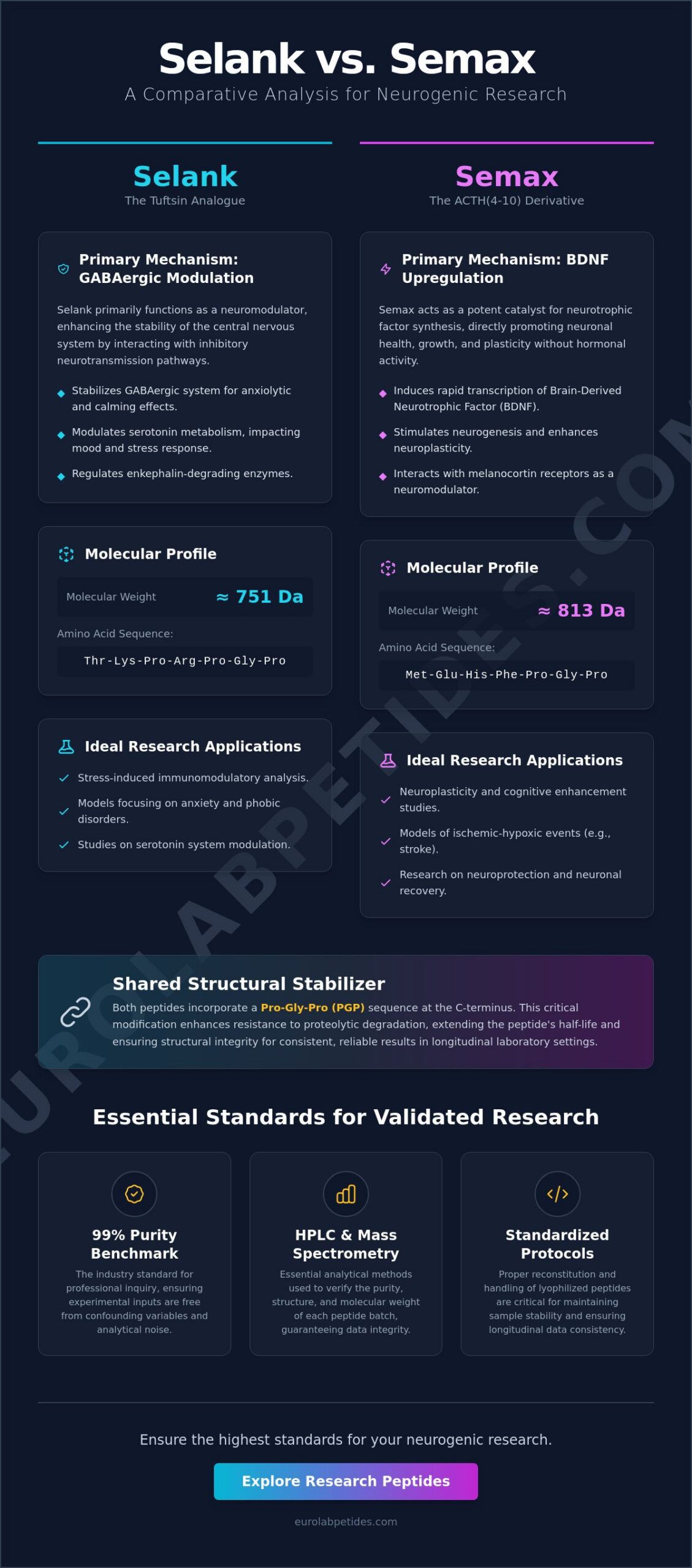
The synthesis of Selank and Semax at the Institute of Molecular Genetics represents a significant advancement in peptide engineering. Both molecules were designed to address the inherent instability of endogenous peptides within the central nervous system. By incorporating the Pro-Gly-Pro (PGP) tripeptide sequence at the C-terminus, researchers achieved enhanced resistance to proteolytic degradation. This modification is critical when evaluating selank vs semax for neurogenic studies, as it extends the experimental window for observing neuroplastic changes. The presence of the PGP sequence protects the peptide bond from aminopeptidases and carboxypeptidases, ensuring structural integrity during laboratory analysis.
The structural integrity of these heptapeptides is defined by their specific amino acid sequences. Semax is characterized by the sequence Met-Glu-His-Phe-Pro-Gly-Pro, representing a truncated fragment of the adrenocorticotropic hormone (ACTH). In contrast, Selank is a synthetic derivative of the immunomodulatory tetrapeptide tuftsin, possessing the sequence Thr-Lys-Pro-Arg-Pro-Gly-Pro. This divergence in primary structure dictates their unique receptor affinities and subsequent biochemical signaling pathways. While they share a common C-terminal stabilizer, their N-terminal sequences are entirely distinct, leading to different experimental outcomes in neurological models.
The ACTH(4-10) Derivative: Semax Structure
Semax is engineered as a synthetic analogue of a specific ACTH(4-10) fragment. Despite its derivation from a hormonal precursor, the peptide is characterized by a complete lack of hormonal activity. This ensures that experimental results in a Semax Overview are attributed to its neurotropic effects rather than systemic endocrine interference. With a molecular weight of approximately 813 Da, it displays high solubility in aqueous solutions, which facilitates standardized in-vitro application. Its primary interaction occurs via melanocortin receptors, where it serves as a potent neuromodulator. The peptide’s structure allows it to bypass traditional metabolic barriers that often limit the efficacy of larger ACTH-derived molecules.
The Tuftsin Analogue: Selank Structure
Selank was developed through the modification of tuftsin, a naturally occurring tetrapeptide involved in immunomodulation. By appending the PGP sequence to the Thr-Lys-Pro-Arg base, the resulting heptapeptide achieves a molecular weight of roughly 751 Da. This structural evolution significantly improves the peptide’s half-life compared to its parent molecule. The chemical profile of Selank ensures high stability in aqueous solution, which is a non-negotiable requirement for longitudinal research. When comparing selank vs semax for neurogenic studies, the Selank structure is prioritized in models focusing on the modulation of the GABAergic system and serotonin metabolism rather than direct neurotrophic factor stimulation. Its lower molecular weight contributes to its specific diffusion characteristics in cellular assays.
Mechanisms of Action: BDNF Upregulation vs. GABAergic Modulation
The functional divergence between these analogues is predicated on their discrete signaling cascades. Semax acts as a primary catalyst for the synthesis of neurotrophic factors, while Selank facilitates the modulation of inhibitory neurotransmission. This clear distinction is paramount when determining the suitability of selank vs semax for neurogenic studies involving hippocampal or cortical tissue models. The researcher’s choice depends on whether the experimental objective requires the stimulation of growth factors or the stabilization of neurotransmitter turnover.
Data from Synthetic Peptides Research confirms that Semax induces a rapid shift in the transcription of genes encoding Brain-Derived Neurotrophic Factor (BDNF). This induction occurs independently of the melanocortin receptor’s typical hormonal pathways. Conversely, Selank’s impact on mRNA expression is more closely linked to the regulation of enkephalin-degrading enzymes and serotonin metabolism. These differing profiles result in unique neurotransmitter turnover rates, providing researchers with specific variables for neurological modeling without the noise of systemic hormonal activity.
Neurotrophic Signalling Pathways in Semax Research
Semax facilitates the activation of the Tropomyosin receptor kinase B (TrkB) pathway through the sustained upregulation of BDNF and Nerve Growth Factor (NGF). This mechanism is central to its role in neuroplasticity research. It doesn’t merely increase growth factor levels; it also modulates the release and reuptake of dopamine and norepinephrine. These catecholaminergic adjustments are critical for studies focusing on cognitive function and neuroprotection in hypoxic environments, where neurotransmitter balance is often compromised.
Anxiolytic Mechanisms and GABA Stabilization in Selank Studies
Selank functions as a positive allosteric modulator of GABA-A receptors, enhancing the binding affinity of gamma-aminobutyric acid. It also exerts a protective effect on endogenous opioids by inhibiting enkephalinase activity, which sustains enkephalin levels in the synaptic cleft. In models of the hypothalamic-pituitary-adrenal (HPA) axis, Selank demonstrates a capacity to stabilize stress-induced hormonal fluctuations. For laboratories requiring consistent molecular results, utilizing a high-purity Cognitive Research Stack ensures that experimental variables remain within strictly defined parameters.
Comparative Efficacy in Neuroplasticity and Neuroprotection Models
While both peptides exhibit neuroprotective properties through the activation of antioxidant enzymes, their efficacy profiles diverge significantly when applied to specialized neurological models. The choice between selank vs semax for neurogenic studies is determined by the specific metabolic or behavioral stressors under investigation. Semax is predominantly utilized in models of cerebral ischemia and hypoxia, where its capacity to mitigate oxidative damage and preserve neuronal viability is well-documented. Conversely, Selank is the preferred agent for studying the intersection of neurobiology and immunology, particularly in models of stress-induced anxiety and cytokine dysregulation.
Both analogues share the ability to upregulate superoxide dismutase (SOD) and catalase, providing a foundational defense against reactive oxygen species (ROS). However, the therapeutic window and specific cellular targets differ. Semax facilitates neuroprotection by enhancing the sequestration of free radicals and stabilizing mitochondrial function during oxygen deprivation. Selank achieves comparable neuroprotective outcomes but does so by modulating the immune response and reducing the pro-inflammatory signaling that often accompanies chronic neurological stress. This divergence ensures that researchers can select a peptide that aligns with the specific neurogenic target of their protocol.
Semax in Cognitive and Recovery Research
In the context of cognitive function research, Semax demonstrates superior efficacy in studying memory consolidation and the enhancement of synaptic plasticity. It is frequently employed in cerebral circulation models to analyze how neurotrophic induction supports recovery after hypoxic insult. Researchers investigating the restoration of cognitive deficits often utilize specialized research stacks to observe the synergistic effects of melanocortin-derived signaling on neuronal survival and long-term potentiation. The peptide’s ability to maintain cognitive performance under conditions of reduced oxygen supply makes it a benchmark for recovery-based neurological modeling.
Selank in Stress Resilience and Immune Modulation
Selank research prioritizes the investigation of the link between anxiety and the systemic immune response. Unlike traditional benzodiazepine-based models, Selank provides a stable anxiolytic effect without the confounding variable of sedation, allowing for more accurate behavioral observations. Its role in modulating cytokine expression, specifically the reduction of IL-6 levels in neural tissues, makes it a critical tool for immune system research. This immunomodulatory capacity ensures that selank vs semax for neurogenic studies can isolate the effects of stress-induced inflammation on neuroplasticity without interfering with motor coordination or alertness in the subject model.
Methodological Considerations for In-Vitro Peptide Research
The integrity of longitudinal data in neurological research depends heavily on the chemical stability of the test subjects. When comparing selank vs semax for neurogenic studies, researchers must account for the high susceptibility of these heptapeptides to environmental degradation. Utilizing high-purity lyophilized peptides is the baseline requirement for minimizing analytical noise. A lyophilized matrix provides the necessary structural stability for long-term storage, preventing the premature cleavage of peptide bonds that occurs in aqueous solutions. Quality is not a subjective preference; it’s a verifiable metric of molecular consistency.
Environmental variables such as temperature fluctuations and UV exposure represent significant risks to peptide integrity. For short-term use, peptides may be stored at 4°C, but long-term preservation requires a controlled environment of -20°C or ideally -80°C. These parameters prevent the accumulation of moisture and inhibit any residual enzymatic activity that could compromise the molecular weight of the sample. Proper aliquoting after the initial reconstitution is also vital to avoid the detrimental effects of repeated freeze-thaw cycles, which can lead to peptide aggregation or denaturation.
Reconstitution and Concentration Accuracy
Precision during the transition from a lyophilized state to an aqueous solution is critical for maintaining experimental consistency. Accurate concentration is a primary variable when evaluating selank vs semax for neurogenic studies, as slight deviations in molarity can lead to inconsistent activation of BDNF or GABA pathways. Researchers should calculate the exact molarity required for their specific in-vitro dosing to ensure that the cellular response is a result of the peptide rather than concentration variances. Utilizing a peptide reconstitution calculator facilitates these calculations, reducing the margin for human error. It’s essential to avoid mechanical stress during this process; the diluent should be added slowly along the side of the vial, and the solution should be gently swirled rather than agitated.
Laboratory Safety and Compliance
Strict adherence to established in-vitro research protocols is a non-negotiable standard for professional laboratories. Documentation must include batch-specific purity certifications and HPLC results to verify that the peptides meet the required 99% purity benchmark. Proper disposal of all chemical research materials must follow regional regulatory guidelines to maintain a secure and compliant laboratory environment. For researchers seeking high-precision materials, sourcing from a provider that offers Cognitive Function Research tools ensures that every batch is backed by rigorous analytical validation and transparent quality assurance.
EuroLab Quality Standards: Purity Benchmarks for Neurological Research
The validity of neuroplasticity research is fundamentally tied to the chemical precision of the peptides utilized. In the context of selank vs semax for neurogenic studies, the presence of truncated sequences or residual trifluoroacetic acid (TFA) can lead to erroneous conclusions regarding cellular signaling. EuroLab enforces a rigid quality assurance framework where quality is treated as a verifiable metric rather than a marketing claim. This process begins with the synthesis of certified peptides that meet the stringent requirements of the global scientific community.
Analytical validation is performed using both High-Performance Liquid Chromatography (HPLC) and Mass Spectrometry (MS) to ensure that each vial contains the exact molecular structure specified. This dual-verification method isolates any potential contaminants, guaranteeing a purity level of 99% or higher. For longitudinal studies, batch-to-batch consistency is a non-negotiable requirement. Without this level of standardization, the subtle differences in neurogenic impacts between Selank and Semax could be masked by technical inconsistencies. The MS analysis provides a definitive molecular fingerprint, confirming the 751 Da weight for Selank and the 813 Da weight for Semax with absolute certainty.
Third-Party Laboratory Verification
Transparency is maintained through the provision of accessible Certificate of Analysis (COA) data for every production batch. These documents provide empirical evidence of purity, identity, and bioburden. Following the implementation of the June 2026 EMA guidelines for synthetic peptide manufacturing, independent third-party testing has become a non-negotiable industry benchmark. A 99%+ purity standard is required to ensure that the observed upregulation of BDNF or the positive allosteric modulation of GABA-A receptors is a direct result of the peptide’s primary sequence. Bioburden testing further ensures that no microbial contaminants interfere with the delicate environment of in-vitro cellular assays.
Sourcing Peptides for European Research
Research institutions within Europe require reliable logistics and strict adherence to regional regulatory compliance. EuroLab serves as a dedicated partner in cognitive function research, providing localized distribution that mitigates the risks associated with international shipping delays and temperature fluctuations. By maintaining high-end craftsmanship in chemical synthesis and robust logistical support, the brand ensures that critical neurological models are never compromised by sourcing failures. This proof-first approach respects the user’s intelligence by prioritizing data over anecdotal evidence. It’s this commitment to empirical results that establishes a secure environment for professional inquiry.
Explore our full range of research-grade peptides to secure high-purity materials for your next neurological protocol.
Advancing Precision in Neurological Research Models
The divergence between Semax and Selank is defined by their specific signaling pathways. One prioritizes neurotrophic induction while the other facilitates neurotransmitter stabilization. Selecting the appropriate analogue for selank vs semax for neurogenic studies requires a rigorous understanding of these molecular profiles to ensure experimental accuracy. Data integrity is maintained only when research materials meet the highest analytical standards, eliminating the noise of chemical impurities or manufacturing inconsistencies.
EuroLab provides a secure foundation for professional inquiry by offering 99%+ Purity Guaranteed research chemicals. Every batch undergoes Independent Third-Party HPLC/MS Testing to verify identity and concentration before distribution. With Specialized European Logistics, research institutions can rely on methodical delivery protocols that preserve the structural integrity of every peptide. Access High-Purity Semax and Selank for Your Research to ensure your data remains beyond reproach.
Precision in the laboratory begins with the selection of elite tools.
Frequently Asked Questions
What is the primary difference between Selank and Semax in a research setting?
The primary difference lies in their biochemical targets: Semax facilitates neurotrophic factor upregulation while Selank modulates the GABAergic system. In the context of selank vs semax for neurogenic studies, researchers select Semax for its impact on BDNF and NGF pathways. Selank is utilized for its immunomodulatory effects and stabilization of neurotransmitter turnover without hormonal interference. This functional divergence ensures that each peptide is applied to specific neurological models.
Can Selank and Semax be used together in cognitive research stacks?
Selank and Semax are frequently combined in cognitive research stacks to investigate the synergistic potential of their complementary mechanisms. This application allows for the simultaneous analysis of BDNF-driven neuroplasticity and GABA-mediated stress resilience. Such combined protocols are essential for modeling complex neurological interactions where multiple signaling pathways are engaged. Researchers must ensure that both peptides meet the same 99% purity benchmarks to maintain experimental validity.
How does Semax influence BDNF levels in neurological models?
Semax influences BDNF levels by inducing rapid changes in mRNA transcription within hippocampal and cortical tissues. It acts as a catalyst for the synthesis of Brain-Derived Neurotrophic Factor and Nerve Growth Factor. This upregulation occurs through the modulation of melanocortin receptors, though it lacks systemic hormonal activity. This specific mechanism makes it a foundational tool for studying neurogenesis and neuronal survival in ischemic or hypoxic models.
What are the storage requirements for lyophilised Selank and Semax?
Lyophilized peptides must be stored at temperatures of -20°C or -80°C to ensure long-term molecular stability. While short-term storage at 4°C is permissible for up to four weeks, deep-freeze conditions are necessary to prevent proteolytic degradation and moisture accumulation. Maintaining these strict thermal parameters protects the structural integrity of the heptapeptide sequence. Aliquoting the sample after the initial reconstitution is also required to avoid the detrimental effects of repeated freeze-thaw cycles.
Is Selank considered a sedative in neurogenic studies?
Selank is not classified as a sedative in neurogenic studies. It provides a stable anxiolytic effect through the allosteric modulation of GABA-A receptors and the inhibition of enkephalin degradation. Unlike traditional benzodiazepine models, it doesn’t impair motor coordination or alertness. This allows for precise behavioral observations in models investigating the intersection of anxiety and the immune response without the confounding variable of sedation.
What purity levels are required for in-vitro peptide research?
A purity level of 99% or higher is the non-negotiable standard for professional in-vitro peptide research. This benchmark is verified through High-Performance Liquid Chromatography (HPLC) and Mass Spectrometry (MS) to ensure the absence of residual reagents or truncated sequences. High-purity materials are essential for selank vs semax for neurogenic studies to prevent analytical noise from compromising the integrity of the data. Batch-specific Certificates of Analysis provide the necessary empirical validation.
How should Semax be reconstituted for laboratory development?
Reconstitution is performed by slowly adding bacteriostatic water or sterile saline along the interior wall of the vial. It’s critical to avoid mechanical stress; the solution should be gently swirled rather than agitated or shaken. This methodical approach prevents peptide denaturation and ensures the maintenance of the intended molarity. Utilizing a reconstitution calculator is recommended to achieve the high-stakes precision required for accurate in-vitro dosing in laboratory environments.
Are these peptides intended for human consumption?
These peptides are strictly intended for laboratory research and are not for human consumption. In the United States and Europe, Selank and Semax are sold exclusively as research chemicals to be used in controlled in-vitro or animal models. They have not received FDA approval for clinical use. All handling and application must adhere to professional research protocols and regional regulatory compliance standards governing chemical synthesis and laboratory safety.
