

The thermodynamic instability of aqueous peptide bonds dictates that any deviation from solid-state storage introduces a measurable risk of molecular degradation before the first aliquot is even drawn. While the convenience of ready-to-use formats is acknowledged, the primary challenge remains the maintenance of 99%+ purity in the face of chemical hydrolysis and microbial vulnerability. Researchers often find that experimental variability is directly correlated with the format of the compound utilized. This technical analysis explores the critical distinctions of lyophilized vs pre-dissolved research peptides to ensure that molecular integrity is preserved and laboratory protocols are standardized.
The requirement for absolute reagent stability is a non-negotiable standard in high-stakes biochemical inquiry. This article provides a clinical comparison of peptide formats, focusing on how lyophilization is utilized to mitigate the risks of deamidation and oxidation. We will examine the implications of the June 2026 EMA guidelines on synthetic peptides alongside the April 2026 FDA reclassifications. By the conclusion of this analysis, you’ll possess the technical framework required to minimize potency loss during shipping and eliminate the variables that threaten experimental reproducibility.
Key Takeaways
- Identify the specific biochemical pathways—including hydrolysis, oxidation, and deamidation—that compromise molecular integrity in non-solid formats.
- Analyze the comparative stability of lyophilized vs pre-dissolved research peptides to select the optimal reagent format for experimental reproducibility.
- Apply rigorous storage and logistics protocols that leverage the 2+ year shelf life inherent to the lyophilized solid-state morphology.
- Standardize laboratory reconstitution procedures by utilizing precise molarity calculations and hydrophobicity-based diluent selection.
- Ensure 99%+ purity benchmarks are maintained through the utilization of peptides subjected to multi-level analytical validation and regional manufacturing standards.
Understanding Peptide Morphology: Lyophilised vs. Pre-dissolved
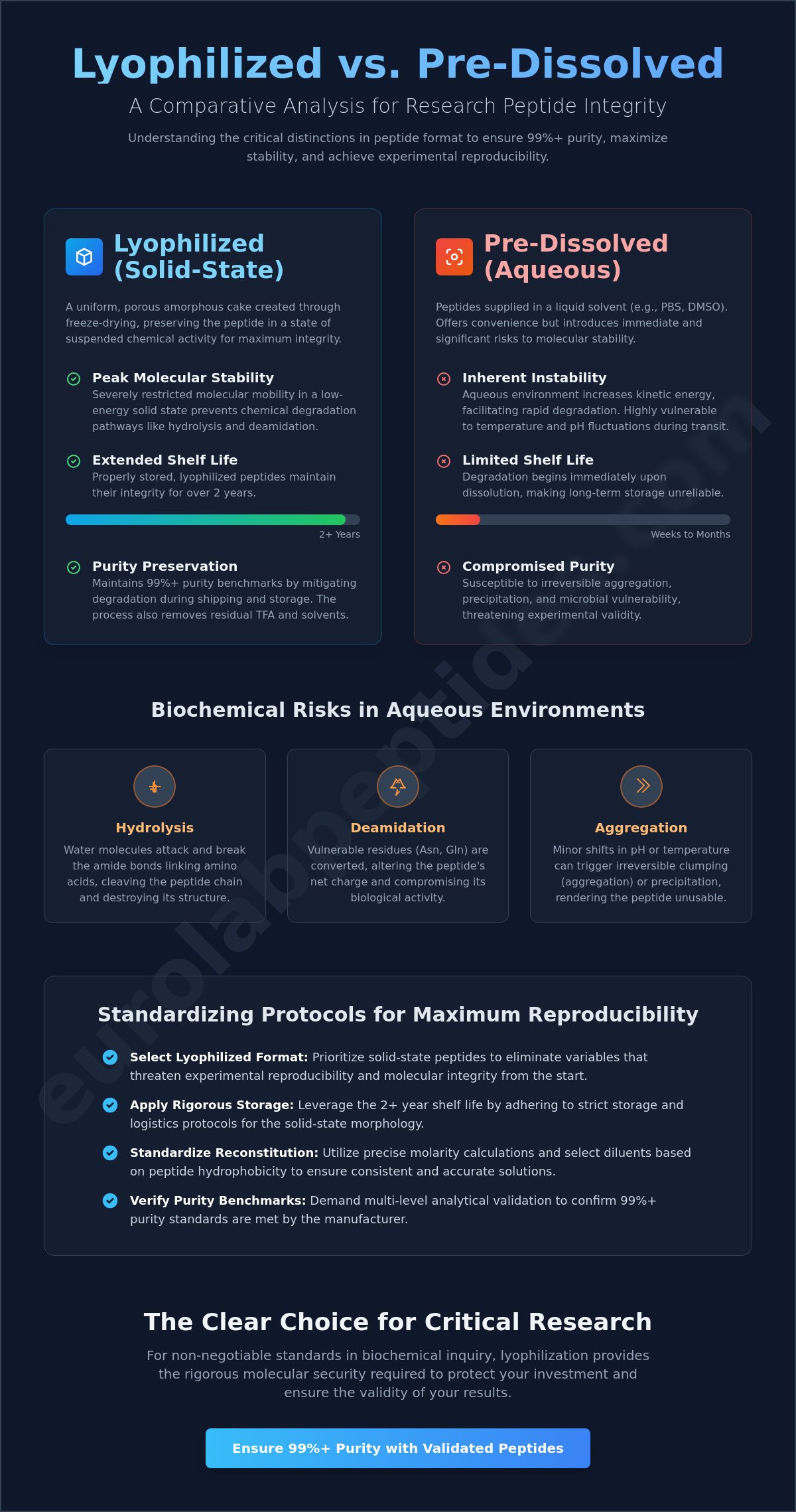
Peptide morphology is a fundamental determinant of stability and experimental accuracy. The technical distinction between lyophilized vs pre-dissolved research peptides begins at the molecular level during the final stages of synthesis. Lyophilization is a dehydration process where water is removed via sublimation, transitioning directly from a solid to a gas phase without passing through a liquid state. This method avoids the destructive forces of surface tension that occur during standard evaporation, which can lead to peptide denaturation. A high-quality lyophilized product manifests as a uniform, porous amorphous cake. This physical structure provides a high surface area for rapid reconstitution while maintaining the peptide in a state of suspended chemical activity. In contrast, pre-dissolved peptides are supplied in a liquid state, where the presence of moisture introduces immediate kinetic variables that threaten long-term shelf life.
The Lyophilisation Process in Peptide Synthesis
The manufacturing protocol follows a rigid three-stage sequence: freezing, primary drying, and secondary drying. During the freezing phase, the peptide solution is cooled below its triple point to ensure complete solidification. Primary drying removes the bulk of the ice through sublimation under a vacuum. The secondary drying phase targets ionically bound water molecules that remain after the initial sublimation. This methodical removal of moisture is critical since even trace amounts of residual water can catalyze degradative pathways. Precision in this phase also facilitates the removal of residual trifluoroacetic acid (TFA) and organic solvents used during synthesis. If these contaminants aren’t strictly managed, they can compromise the secondary structure of complex peptides and interfere with sensitive in-vitro assays.
Pre-dissolved Peptides: Convenience vs. Chemical Risk
Pre-dissolved formats are typically supplied in solvents such as Phosphate Buffered Saline (PBS), bacteriostatic water, or Dimethyl Sulfoxide (DMSO). While these formats offer immediate utility in high-throughput environments, they’re increasingly scrutinized in peer-reviewed research due to inherent chemical risks. The aqueous environment increases the kinetic energy of ions, facilitating rapid hydrolysis and deamidation. Furthermore, the solvent pH must be perfectly calibrated to the peptide’s isoelectric point to maintain solubility. Minor fluctuations in temperature or pH during transit can trigger irreversible aggregation or precipitation. When researchers evaluate lyophilized vs pre-dissolved research peptides, the decision typically rests on whether the laboratory prioritizes the temporary convenience of a solution over the rigorous molecular security of the solid-state cake.
The Biochemistry of Stability: Why Solid-State Matters
The fundamental distinction between lyophilized vs pre-dissolved research peptides lies in the thermodynamic state of the molecules. Peptides in a solid-state, lyophilized form exist in a low-energy environment where molecular mobility is severely restricted. This lack of kinetic energy prevents the frequent molecular collisions required for chemical degradation. In contrast, peptides in an aqueous solution are subject to constant motion. The kinetic energy of aqueous ions facilitates interactions that lead to the rapid cleavage of peptide bonds, especially when environmental factors like temperature aren’t strictly controlled. While solution-based formats might seem convenient, they don’t offer the same level of structural protection as a vacuum-sealed amorphous cake.
Hydrolysis and Deamidation in Aqueous Environments
Hydrolysis is the most prevalent chemical pathway for the degradation of peptides in solution. This process involves the breakdown of the amide bonds that hold the amino acid sequence together. Research indicates that certain residues, specifically Asparagine (Asn) and Glutamine (Gln), are highly vulnerable to deamidation when moisture is present. This reaction converts these residues into aspartic acid or glutamic acid, respectively, which alters the peptide’s net charge and can completely compromise its biological activity. Water acts as a nucleophile that attacks the carbonyl carbon of the peptide bond, initiating the cleavage process. Because this reaction is catalyzed by both acidic and basic conditions, maintaining a stable pH in a pre-dissolved vial is technically demanding and often unsuccessful over long periods.
Oxidation and Aggregation Risks
The presence of specific amino acids like Cysteine (Cys) and Methionine (Met) necessitates the use of lyophilized formats to prevent oxidation. When these residues are exposed to atmospheric oxygen in an aqueous environment, they frequently form unwanted disulfide bridges or sulfoxides. These structural changes are documented in established Peptide Handling and Storage Guidelines as primary causes of potency loss. Furthermore, the risk of peptide-to-peptide aggregation increases significantly with concentration in solution. As molecules collide, they may form insoluble fibrils or precipitates that can’t be reversed. This physical degradation is virtually non-existent in the solid-state, which is why many researchers choose tissue repair and recovery research compounds in their lyophilized form to ensure experimental precision.
Temperature serves as a primary catalyst in these degradative processes. For every 10°C increase in storage temperature, the rate of chemical reactions in an aqueous solution typically doubles or triples. This sensitivity makes shipping pre-dissolved peptides a high-risk endeavor, as even minor logistical delays can lead to a measurable drop in purity. By utilizing a lyophilized format, the “activation energy” required for these destructive reactions is significantly higher, providing a robust buffer against environmental fluctuations during transit and laboratory handling.
Comparative Analysis: Storage, Handling, and Logistics
The logistical profile of a peptide reagent is as critical to experimental success as its initial chemical purity. Choosing between lyophilized vs pre-dissolved research peptides requires an objective assessment of available laboratory infrastructure and the intended duration of the study. Lyophilized peptides offer a superior shelf life, often exceeding 24 months when maintained at -20°C. In contrast, pre-dissolved reagents typically show measurable degradation within 14 to 21 days, even when refrigerated at 4°C. This discrepancy creates a significant risk for long-term protocols where consistency across multiple time points is required.
Handling requirements also differ substantially between the two formats. Pre-dissolved solutions are inherently susceptible to microbial contamination and require immediate processing in a sterile environment. The aqueous medium acts as a growth substrate for opportunistic pathogens, which can introduce confounding variables into in-vitro models. Lyophilized cakes are vacuum-sealed in glass vials, providing a robust barrier against atmospheric moisture and contaminants. This format remains chemically inert until the moment of reconstitution, ensuring that the peptide’s primary and secondary structures are preserved during the handling phase.
Freeze-thaw cycles represent another point of failure for solution-based reagents. Each cycle of freezing and thawing a reconstituted peptide causes mechanical stress through ice crystal formation and localized concentration shifts. These shifts can lead to irreversible denaturation or aggregation. Because lyophilized peptides are stored as solids, they’re immune to these specific mechanical stressors until they’re prepared for immediate use. For researchers, this means that the solid-state format provides a level of reliability that aqueous solutions can’t match.
Storage Temperature Requirements
Optimal stability for lyophilized cakes is achieved at temperatures between -20°C and -80°C. While they’re resilient at room temperature for short durations, long-term storage in a standard laboratory freezer is the non-negotiable standard for maintaining 99%+ purity. Cooling pre-dissolved peptides carries the specific risk of precipitation. If the solution reaches its saturation point during refrigeration, the peptide may fall out of solution. Re-dissolving these precipitates often requires gentle heating or sonication, both of which can further degrade the molecular bonds and compromise the study’s data.
Logistics and the ‘Cold Chain’ Factor
Shipping stability is a primary concern in the international research community. Lyophilized peptides are remarkably resilient to thermal stress during transit, allowing them to survive room-temperature shipping across Europe without loss of potency. Pre-dissolved reagents require a continuous cold chain, involving insulated packaging and specialized gel packs. This adds hidden costs to the procurement process and introduces a single point of failure. EuroLab Peptides prioritizes lyophilization for all international research shipping because it eliminates the risk of potency loss during unforeseen logistical delays. Relying on a cold chain for aqueous reagents is a high-risk strategy that can invalidate an entire study if a temperature threshold is breached during transit.
Best Practices for Laboratory Reconstitution
Reconstitution is the critical juncture where a peptide transitions from its stable solid-state morphology to an active aqueous format. When evaluating lyophilized vs pre-dissolved research peptides, it’s essential to recognize that the responsibility for maintaining molecular integrity shifts to the laboratory once the vial’s seal is breached. Precision in calculating molarity and volume is required to ensure experimental reproducibility and accurate dosing across all study phases. Standard Operating Procedures (SOPs) should mandate the immediate aliquoting of the reconstituted solution into single-use vials. This practice effectively eliminates the risk of repeated freeze-thaw cycles, which are known to cause irreversible peptide denaturation and aggregation.
Step-by-Step Reconstitution Protocol
The protocol begins with equilibrating the lyophilized vial to room temperature before removing the seal. This prevents atmospheric moisture from condensing inside the vial, which can lead to premature hydrolysis. Aseptic technique is non-negotiable; all procedures should be performed within a laminar flow hood using sterile, pyrogen-free solvents. When adding the diluent, the liquid should be introduced slowly along the side of the glass. The vial is then gently swirled rather than vortexed. Vigorous agitation or vortexing introduces mechanical shear forces that can disrupt the secondary structure of complex molecules. Visual verification is the final step. A clear, particulate-free solution indicates successful solubilization, whereas cloudiness suggests that the peptide’s isoelectric point hasn’t been properly addressed by the solvent.
Solvent Selection Criteria
The choice of diluent is dictated by the peptide’s primary sequence and its inherent hydrophobicity. While sterile bacteriostatic water or PBS is sufficient for most sequences, acidic peptides may require a drop of 10% acetic acid, while basic peptides might necessitate dilute ammonia to achieve complete solubility. Highly hydrophobic sequences often require the use of Dimethyl Sulfoxide (DMSO) as a primary solvent before further dilution with aqueous buffers. To ensure precision in these calculations, researchers should utilize a peptide reconstitution calculator to determine the exact volumes required for specific molar concentrations. Utilizing standardized tools minimizes human error and ensures that every aliquot contains the precise concentration required for the study. For those conducting tissue repair and recovery research, the use of high-purity lyophilized reagents remains the industry standard for maintaining data accuracy and experimental control.
EuroLab Peptides: Ensuring Purity through Lyophilisation
EuroLab Peptides operates on the principle that experimental accuracy is contingent upon the chemical stability of the reagents utilized. The decision to supply compounds exclusively in the solid-state format is a direct response to the technical instability of aqueous solutions. While the market for research chemicals often offers various delivery methods, the comparative data on lyophilized vs pre-dissolved research peptides confirms that lyophilization is the only method capable of ensuring 99%+ purity over extended durations. This commitment to the solid-state morphology is a non-negotiable standard designed to eliminate the variables of hydrolysis and deamidation that compromise in-vitro data. By removing water through sublimation, we provide a product that remains in a state of suspended chemical activity until the exact moment of laboratory reconstitution.
Analytical validation serves as the cornerstone of our manufacturing process. Every batch of synthesized material undergoes rigorous testing to meet internal benchmarks that exceed industry norms. This proof-first approach ensures that researchers receive molecules with verified structural integrity. By maintaining a meticulous focus on regional manufacturing standards, EuroLab Peptides establishes a transparent partnership with the scientific community. There is no reliance on anecdotal quality claims. Instead, every product is framed by the objective metrics of biochemical analysis. This creates an atmosphere of high-stakes precision, suggesting that we understand the rigorous demands of the specialized community we serve.
Quality Control and Third-Party Validation
The verification of molecular purity is achieved through multi-stage analytical testing. High-Performance Liquid Chromatography (HPLC) is employed to determine the percentage of the target peptide relative to any residual synthesis byproducts. This process ensures that the 99%+ purity threshold is consistently met post-lyophilization. Following HPLC, Mass Spectrometry (MS) is utilized to verify the exact molecular weight and confirm the sequence identity of the compound. This dual-validation system provides a definitive molecular fingerprint for every vial. Researchers are encouraged to review EuroLab Peptides’ multi-level quality protocol to understand the specific parameters of our validation standards.
Research-Grade Standards for In-Vitro Studies
EuroLab Peptides provides high-stability chemical standards tailored for specialized fields, including Tissue Repair & Recovery Research, Longevity & Vitality Research, and Immune System Research. By focusing on these rigorous disciplines, we ensure that our synthesis and lyophilization protocols are optimized for the most demanding experimental models. Regional sourcing within Europe remains a critical component of our logistical strategy. This localized approach minimizes transit times and reduces the window of exposure to environmental fluctuations, further safeguarding the integrity of the lyophilized vs pre-dissolved research peptides we provide. To maintain the highest standards of experimental control, researchers may browse our high-purity lyophilised peptide catalogue to select the appropriate reagents for their upcoming studies.
Advancing Experimental Precision through Molecular Stability
The maintenance of molecular integrity is the foundational requirement for any reproducible in-vitro study. This technical analysis has demonstrated that the distinction between lyophilized vs pre-dissolved research peptides isn’t merely a matter of convenience; it’s a matter of chemical necessity. By utilizing the solid-state morphology, researchers effectively eliminate the kinetic energy of aqueous ions that triggers rapid hydrolysis and deamidation. This ensures that the compound’s primary sequence remains intact until the moment of laboratory application. Standardizing these protocols allows for a higher degree of experimental control and data accuracy across all research phases.
When compounds are vacuum-sealed for maximum shelf-life and subjected to third-party validation, the risks associated with atmospheric exposure and microbial contamination are minimized. EuroLab Peptides remains committed to these rigorous standards, specializing in compounds for longevity and metabolic research. Maintaining a 99%+ purity benchmark through multi-level quality control is our non-negotiable standard for the scientific community. By prioritizing these verifiable metrics, you ensure that your laboratory data is built on a foundation of absolute stability.
Secure high-purity lyophilised peptides for your next study at EuroLab Peptides and advance your research with confidence in every aliquot.
Frequently Asked Questions
Are pre-dissolved peptides less potent than lyophilised ones?
Pre-dissolved peptides aren’t inherently less potent at the point of synthesis, but they experience an accelerated loss of efficacy compared to their solid-state counterparts. The technical comparison of lyophilized vs pre-dissolved research peptides highlights that aqueous solutions are subject to immediate hydrolysis. This chemical reaction cleaves peptide bonds and reduces the concentration of the active molecule over time. Consequently, a solution format may possess significantly lower potency by the time it’s utilized in a study.
How long can a reconstituted peptide solution stay stable at room temperature?
A reconstituted peptide solution typically maintains its structural integrity for only a few hours at room temperature. Chemical degradation pathways, such as deamidation and oxidation, are temperature-dependent and accelerate rapidly outside of refrigerated conditions. For most research applications, it’s recommended to use the solution immediately or store it at 4°C for no more than 24 hours. Prolonged exposure to ambient temperatures introduces experimental variability that can compromise the accuracy of in-vitro results.
Why do some lyophilised peptides look like powder while others look like a solid cake?
The physical morphology of a lyophilized product, whether it appears as a solid cake or a loose powder, is determined by the concentration of the peptide and the presence of any bulking agents used during the freeze-drying process. A cake is formed when the solute concentration is high enough to maintain a structural matrix after sublimation. While a solid cake is often a marker of a well-executed lyophilization cycle, a powdered appearance doesn’t indicate lower purity or compromised molecular integrity.
Can I re-lyophilise a peptide if it has already been dissolved in water?
Re-lyophilization is technically possible but is not recommended for standard laboratory settings due to the risk of further degradation. The process of freezing and thawing a solution multiple times induces mechanical stress that can lead to peptide denaturation. Additionally, specialized equipment is required to ensure that the primary and secondary drying phases are performed under precise vacuum and temperature controls. Attempting this without industrial-grade machinery often results in a hygroscopic product that lacks long-term stability.
What is the best solvent for hydrophobic research peptides?
Hydrophobic peptides often require initial dissolution in an organic solvent such as Dimethyl Sulfoxide (DMSO) or 10% acetic acid before further dilution in aqueous buffers. The choice of solvent is dictated by the peptide’s isoelectric point and the ratio of non-polar amino acid residues in its sequence. Once the peptide is fully solubilized in the primary solvent, sterile water or PBS can be added slowly to reach the desired final concentration while monitoring for any signs of precipitation.
Does the lyophilisation process damage the peptide’s biological activity?
Lyophilization is specifically designed to preserve biological activity by removing moisture through sublimation at low temperatures. This process avoids the heat-induced denaturation associated with standard evaporation methods. When performed correctly, the secondary structure of the peptide remains intact within the amorphous cake. This state of suspended animation is the industry standard for maintaining the bioactivity of complex research molecules during storage and international transit, ensuring that the compound performs as expected upon reconstitution.
Is it necessary to use a vacuum sealer when storing opened peptide vials?
While a vacuum sealer isn’t strictly necessary for opened vials, minimizing exposure to atmospheric moisture and oxygen is essential for preserving the remaining peptide. Once a vial’s seal is breached, the lyophilized cake becomes highly hygroscopic and will readily absorb moisture from the air. Using Parafilm to seal the cap and storing the vial in a desiccator at -20°C is a standard laboratory practice. These steps help to mitigate the risk of premature hydrolysis and maintain the compound’s stability.
How do I know if my reconstituted peptide has degraded?
Physical indicators of degradation often include persistent cloudiness, the presence of particulates, or a change in the solution’s color after reconstitution. However, chemical degradation like deamidation may not always produce visible changes. The only definitive method to verify the purity of lyophilized vs pre-dissolved research peptides after storage is through analytical techniques like High-Performance Liquid Chromatography (HPLC). If a solution fails to clear after gentle swirling, it’s likely that aggregation or denaturation has occurred, rendering the reagent unsuitable for precise research.
