

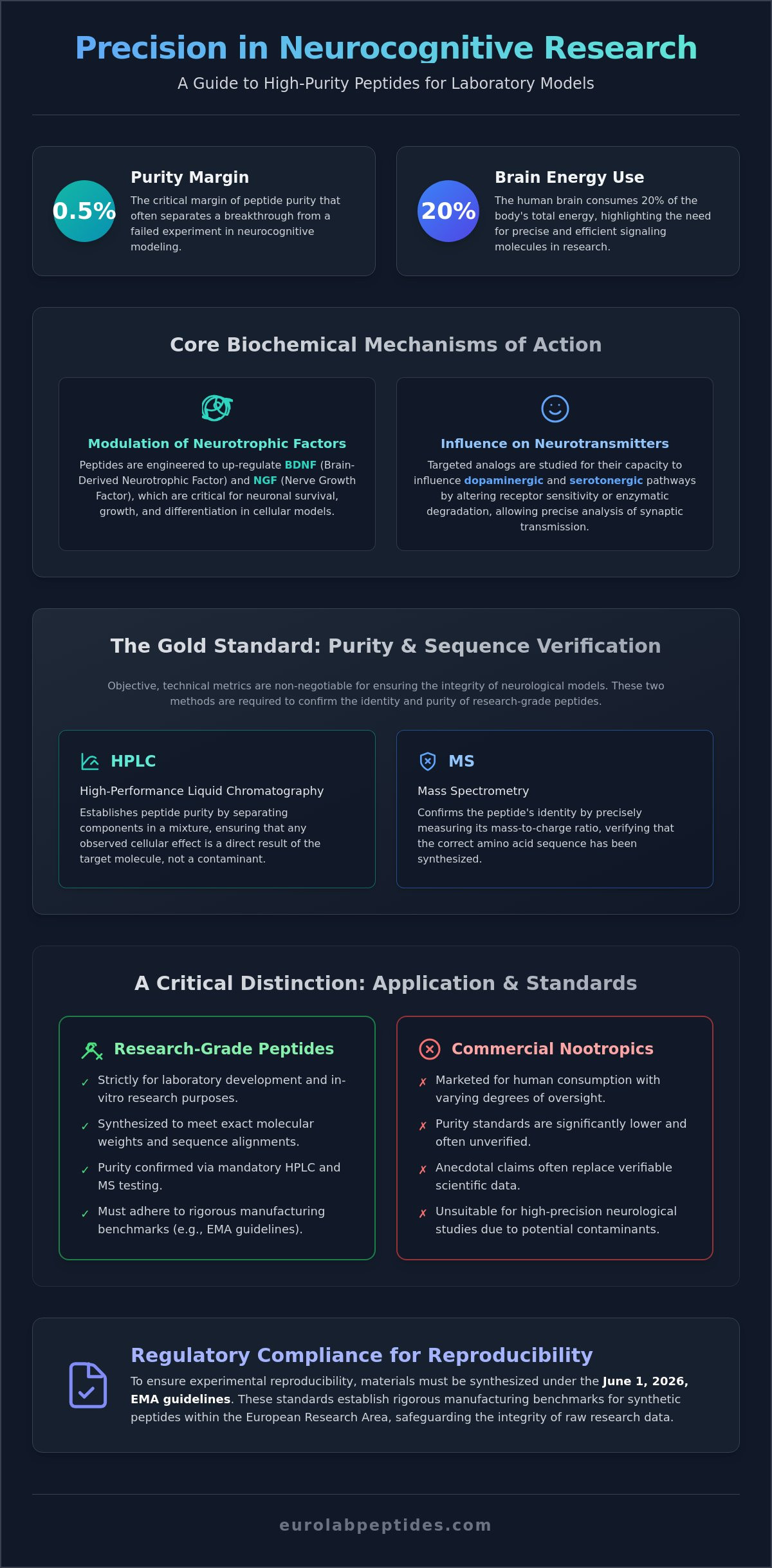
The distinction between a breakthrough in neurocognitive modeling and a failed experiment often rests on a 0.5% margin of peptide purity. In a field where the brain consumes 20% of the body’s total energy, the precision of signaling molecules is a fundamental requirement for valid data. Identifying high-purity peptides for cognitive research involves filtering through a landscape frequently obscured by marketing hyperbole and inconsistent third-party verification. Professional researchers don’t rely on anecdotal evidence; they require objective, technical metrics to ensure the integrity of their neurological models.
You likely understand the frustration of securing reliable materials in a market where raw research data is often confused with therapeutic claims. This scientific review provides an authoritative analysis of neurocognitive peptides and their biochemical mechanisms, adhering to the rigorous laboratory standards established by the June 1, 2026, EMA guidelines. We will detail the specific pathways of Semax and Selank, analyze the impact of neurotrophic factors like BDNF, and outline the logistical protocols for securing third-party tested materials from European sources.
Key Takeaways
- Analyze the biochemical mechanisms of neurocognitive signaling, focusing on the modulation of Brain-Derived Neurotrophic Factor (BDNF) and Nerve Growth Factor (NGF) in cellular models.
- Evaluate the molecular stability and signaling efficacy of specific peptides for cognitive research, including the ACTH(4-10) fragment and tuftsin analogs.
- Establish rigorous laboratory protocols by requiring High-Performance Liquid Chromatography (HPLC) and Mass Spectrometry (MS) for sequence confirmation and purity verification.
- Ensure experimental reproducibility by sourcing materials synthesized under the June 1, 2026, EMA guidelines for synthetic peptide manufacturing.
- Utilize specialized tools such as the Cognitive Research Stack to facilitate high-precision neurological studies with third-party validated signaling molecules.
Defining Peptides for Cognitive Research: Molecular Signaling in Neurological Models
Peptides for cognitive research are defined as precisely engineered sequences of amino acids designed to modulate specific cellular pathways within neurological models. These molecules function as high-precision signaling tools that interact with receptors to influence biochemical cascades. In laboratory settings, they’re utilized to study complex phenomena such as neurogenesis and synaptic plasticity. Unlike broad-spectrum compounds, these sequences allow for the targeted investigation of cellular responses in controlled in-vitro environments. Every batch is synthesized to meet exact molecular weights and sequence alignments, ensuring that experimental results remain reproducible across different trials.
The Evolution of Neurocognitive Research Compounds
The transition from broad-spectrum stimulants to targeted peptide signaling represents a fundamental shift in neuro-biochemical methodology. Early research often relied on crude extracts or non-specific stimulants that lacked the precision required for modern neurological modeling. Today, synthetic peptides are engineered to replicate or modify endogenous regulatory functions. This Neuropeptide overview details how these messengers function naturally; however, research-grade variants are often modified for enhanced metabolic stability. Current trends in 2026 emphasize the use of these molecules to observe specific protein expressions and receptor binding affinities without the interference of systemic variables. This evolution allows researchers to isolate individual biochemical variables with unprecedented accuracy.
Research vs. Clinical Application: A Critical Distinction
A definitive boundary exists between research-grade peptides and commercial nootropic supplements. While consumer products are often marketed for human consumption with varying degrees of oversight, peptides for cognitive research are strictly for laboratory development and in-vitro research purposes. The purity standards required for laboratory inquiry are significantly higher than those found in the supplement industry. Under the EMA guidelines that went into effect on June 1, 2026, synthetic peptides must adhere to rigorous manufacturing benchmarks within the European Research Area.
Purity is established through verifiable metrics rather than anecdotal claims. High-Performance Liquid Chromatography (HPLC) and Mass Spectrometry (MS) are employed as non-negotiable standards to confirm both the identity and the concentration of the peptide sequence. This level of scrutiny ensures that any observed change in a cellular model is a direct result of the signaling molecule rather than a contaminant. Compliance with these regional regulatory standards is a prerequisite for any professional laboratory seeking to maintain the integrity of its raw research data. The objective remains the advancement of scientific understanding through the use of elite, third-party validated tools.
Biochemical Mechanisms of Action in Neurocognitive Research
The efficacy of peptides for cognitive research is primarily measured by their ability to modulate neurotrophic factors within cellular models. Central to these investigations is the up-regulation of Brain-Derived Neurotrophic Factor (BDNF) and Nerve Growth Factor (NGF). These proteins serve as critical regulators of neuronal survival, differentiation, and growth. In-vitro studies demonstrate that specific peptide sequences can act as ligands for tropomyosin receptor kinase B (TrkB), triggering intracellular cascades that enhance cellular resilience. By stimulating these endogenous pathways, researchers can observe the fundamental processes of neuro-regeneration without the confounding variables present in complex biological systems.
Modulation of neurotransmitter systems provides another essential metric for evaluating neurological signaling molecules. Research-grade peptides often influence dopaminergic and serotonergic pathways by altering receptor sensitivity or enzymatic degradation rates. For instance, certain analogs are studied for their capacity to stabilize dopamine levels in the prefrontal cortex within in-vitro models. This targeted interaction allows for a precise analysis of how signaling molecules affect synaptic transmission. Laboratories investigating these pathways rely on high-purity materials, such as those found in the Cognitive Research Stack, to ensure that observed neurotransmitter shifts are statistically significant and reproducible.
Neuroprotection against oxidative stress remains a critical focus of modern biochemical research. Peptides are frequently analyzed for their antioxidant properties, specifically their ability to neutralize reactive oxygen species (ROS) and mitigate lipid peroxidation. In laboratory settings, these molecules demonstrate a capacity to protect neuronal membranes from chemically induced damage. This protective mechanism is often quantified by measuring the reduction in pro-inflammatory cytokines and the preservation of mitochondrial function during exposure to oxidative stressors.
Synaptic Plasticity and Long-Term Potentiation (LTP)
Synaptic plasticity is modeled through the observation of Long-Term Potentiation (LTP), a process where synaptic connections are strengthened based on activity patterns. Peptides influence this by modulating glutamate receptors, specifically the AMPA and NMDA subtypes. By increasing the density of these receptors at the postsynaptic membrane, certain sequences facilitate enhanced signaling efficiency. Quantifying these changes involves measuring excitatory postsynaptic currents (EPSCs) in-vitro, providing a verifiable metric for the peptide’s impact on cellular memory models.
Neurogenesis and Cellular Repair Pathways
Investigating neurogenesis involves tracking the proliferation and differentiation of neural progenitor cells in controlled environments. Research peptides are observed for their role in stimulating the Notch signaling pathway or other regulatory circuits that govern cell fate. Beyond proliferation, these compounds are studied for their impact on cellular repair. This includes the stabilization of damaged neuronal membranes and the reduction of inflammatory markers within the simulated nervous system. Precise amino acid sequences are required to activate these repair pathways effectively, highlighting the necessity for rigorous analytical standards in peptide synthesis.
Profile Analysis: Key Peptides in Modern Cognitive Studies
Successful neurological modeling requires a granular understanding of the specific molecular profiles of peptides for cognitive research. Each sequence possesses unique structural characteristics that dictate its interaction with cellular receptors and its metabolic half-life in laboratory environments. Semax, a synthetic heptapeptide, is derived from the ACTH(4-10) fragment. Unlike the full adrenocorticotropic hormone, this truncated sequence lacks hormonal activity while retaining the ability to influence melanocortin receptors. This specific modification enhances its utility in studying neurotrophic signaling without inducing systemic endocrine responses.
Selank is a synthetic analog of the naturally occurring tetrapeptide tuftsin. By appending a Pro-Gly-Pro sequence to the C-terminus of the tuftsin structure, the metabolic stability of the molecule is significantly increased. This modification prevents rapid enzymatic degradation by peptidases, allowing for more prolonged observation periods in in-vitro research. While Semax is often studied for its impact on neurotrophic expression, Selank is frequently utilized to model the modulation of inhibitory neurotransmission and the stabilization of metabolic processes under cellular stress.
Semax and Selank: A Comparative Research Overview
The structural differences between Semax and Selank result in distinct enzymatic degradation profiles. Semax’s heptapeptide structure provides a balance between rapid signaling and sufficient longevity for most acute models. Conversely, Selank’s tuftsin-based backbone offers a different set of binding affinities. These compounds are frequently integrated into the Cognitive Research Stack to investigate their complementary effects. In laboratory settings, researchers observe how their combined presence affects melanocortin receptor interaction and neurotransmitter homeostasis more effectively than individual application.
Specialized Peptides: DSIP and Pinealon
Delta Sleep-Inducing Peptide (DSIP) is a nonapeptide characterized by its role in modeling circadian rhythm and neuro-homeostasis. In cellular models, DSIP is utilized to investigate the biochemical response to sleep-wake cycle disruptions and the regulation of oxidative phosphorylation. Its mechanism involves the modulation of protein kinase C and the stabilization of neuronal membranes during periods of simulated stress. This makes it a critical tool for researchers focused on the intersection of metabolic efficiency and neurological health, a field where companies like Everbright Labs provide science-led insights into metabolic support pathways.
Pinealon, a tripeptide consisting of Glu-Asp-Arg, is studied for its direct impact on protein synthesis within brain tissues. Its small molecular size allows for efficient interaction with DNA structures in vitro, where it is observed to influence the expression of genes associated with cellular aging. Research protocols involving Pinealon often focus on age-related cellular changes, evaluating the tripeptide’s capacity to preserve protein synthesis rates in senescent cell models. When used within multi-peptide protocols, these signaling molecules provide a comprehensive framework for analyzing peptides for cognitive research across various physiological benchmarks.
Critical Standards for Sourcing and Handling Laboratory-Grade Peptides
The integrity of neurological data relies on the chemical fidelity of the signaling molecules employed. For peptides for cognitive research, analytical verification is not a recommendation but a technical requirement. High-Performance Liquid Chromatography (HPLC) is the primary methodology used to determine the purity percentage of a batch. This process separates the target peptide from any synthesis by-products, ensuring that the final material meets the 98% purity benchmark typically required for professional inquiry. Without this metric, researchers risk introducing unknown variables into their cellular models.
Sequence confirmation is achieved through Mass Spectrometry (MS). By measuring the mass-to-charge ratio of the ions, MS provides a definitive molecular weight that must align with the peptide’s theoretical value. This ensures that the amino acid sequence is synthesized correctly and is free from truncated fragments. Objective quality assurance is further established through third-party laboratory testing. Relying on manufacturer-issued Certificates of Analysis (COAs) introduces a risk of bias; therefore, independent validation remains the non-negotiable standard for serious research. To ensure experimental accuracy, laboratories should verify third-party HPLC reports for all cognitive research materials before initiating a protocol.
Cold chain logistics are equally critical. Peptides are susceptible to thermal degradation, which can lead to the denaturation of their secondary structure. Maintaining a stable, low-temperature environment during transit prevents the breakdown of sensitive peptide bonds. Researchers must verify that their supplier utilizes specialized, temperature-controlled packaging to mitigate the risks associated with global logistics. Even minor fluctuations in temperature during shipping can compromise the structural integrity of the molecule, leading to inconsistent in-vitro results.
Reconstitution and Stability Protocols
Lyophilized peptide powders must be reconstituted with precision to maintain molecular stability. The choice of solvent depends on the specific requirements of the in-vitro model. Sterile saline is frequently used for immediate applications, while bacteriostatic water provides a level of microbial protection for longer-term studies. Excessive agitation during the mixing process must be avoided, as mechanical stress can shear the peptide chains. A slow, gentle rotation of the vial is the preferred method for ensuring complete dissolution without compromising the structural integrity of the molecule.
Long-Term Storage and Preservation
Preserving the efficacy of peptides requires strict adherence to temperature and light-exposure protocols. Lyophilized vials should be stored at -20°C for long-term preservation, while reconstituted solutions are generally stable at 2-8°C for limited periods. Exposure to UV light and repeated freeze-thaw cycles are primary causes of molecular degradation. For a detailed technical breakdown of these procedures, refer to our guide on storing lyophilized peptides. Maintaining these rigorous standards ensures that the signaling molecules remain viable for the duration of the research project.
EuroLab Peptides: Precision Tools for Cognitive Function Research
EuroLab Peptides operates at the intersection of biochemical precision and logistical reliability, serving as a primary source for high-purity peptides for cognitive research. A multi-level quality control protocol is maintained to ensure that every sequence meets the stringent requirements of modern neurological modeling. This process begins with European-based synthesis, where manufacturing occurs under regional regulatory standards that prioritize purity and structural accuracy. By utilizing localized synthesis and logistics, the risks associated with long-distance transit and unregulated manufacturing are mitigated. It’s this focus on regional excellence that establishes a foundation for reproducible in-vitro data.
Data transparency is established through the provision of third-party analytical reports for every batch. These documents, including High-Performance Liquid Chromatography (HPLC) and Mass Spectrometry (MS) results, are accessible to researchers to confirm that the material meets the 98% purity benchmark. Supporting the scientific community with high-purity research peptides requires a commitment to verifiable metrics over anecdotal claims. This proof-first approach allows laboratories to proceed with confidence, knowing the chemical identity of their signaling molecules is validated by external experts before any protocol begins.
The Cognitive Research Stack Advantage
The Cognitive Research Stack is engineered to provide a standardized set of tools for broad-spectrum neurological modeling. This curated collection includes specific analogs like Semax and Selank, ensuring that researchers have access to complementary signaling molecules within a single procurement cycle. Batch-to-batch consistency in molecular weight and purity is guaranteed through standardized synthesis protocols. By streamlining laboratory procurement, this stack reduces the variables introduced by sourcing from multiple vendors. It provides a reliable baseline for investigating peptides for cognitive research across various cellular repair and neurogenesis pathways, allowing for more complex multi-peptide observations.
Commitment to Scientific Integrity
A strict “Research Only” distribution policy is enforced to maintain the definitive distinction between laboratory inquiry and clinical application. EuroLab doesn’t provide products for human consumption or offer medical advice; instead, the focus remains entirely on the technical demands of the research community. This commitment is evidenced by the provision of comprehensive technical documentation required for formal studies and regulatory compliance. How EuroLab supports longevity and cognitive function research is defined by this unwavering adherence to scientific rigor. By providing elite tools for serious professional inquiry, the integrity of the resulting data is preserved for the advancement of biochemistry and analytical science.
Advancing Neurological Modeling through Analytical Precision
Validating neurocognitive pathways requires an uncompromising approach to chemical purity and sequence accuracy. The transition toward high-precision peptides for cognitive research represents a shift from anecdotal observation to quantifiable biochemical data. By prioritizing HPLC and MS verification, laboratories ensure that experimental outcomes are a direct result of targeted signaling rather than synthesis contaminants. The integration of specialized analogs like Semax and Selank into standardized research protocols allows for the precise isolation of neurotrophic and neurotransmitter variables.
Securing high-purity materials synthesized under the 2026 EMA guidelines is a fundamental requirement for experimental reproducibility. To facilitate the next phase of your inquiry, Explore the Cognitive Research Stack for your next laboratory study. Every batch is third-party HPLC/MS verified to confirm research-grade purity exceeding 99%. Secure European shipping and strict cold chain logistics ensure that temperature-sensitive molecules maintain their structural integrity from the synthesis facility to your bench. We remain dedicated to providing the technical transparency required for formal scientific advancement in neurological signaling.
Beyond the scope of laboratory research, those in the UK looking for high-quality delivery systems and refill pods can learn more about the products offered by UK Vape Sales.
Frequently Asked Questions
What are the most studied peptides for cognitive research in 2026?
In 2026, the primary peptides for cognitive research include Semax, Selank, Delta Sleep-Inducing Peptide (DSIP), and Pinealon. These molecules are prioritized due to their documented influence on neurotrophic factors and synaptic plasticity in in-vitro models. Semax is frequently analyzed for its ACTH(4-10) fragment properties, while Selank remains a key subject for modeling metabolic stability. These compounds form the basis of most modern neurological signaling studies.
How do neurocognitive peptides differ from traditional nootropics?
Neurocognitive peptides are precisely engineered amino acid sequences designed for targeted cellular signaling, whereas traditional nootropics are often broad-spectrum dietary supplements. Research-grade peptides must meet 98% purity benchmarks verified by HPLC, a standard rarely applied to consumer products. These signaling molecules allow researchers to isolate specific biochemical pathways, such as BDNF modulation, in controlled laboratory environments without the interference of the systemic variables found in supplement use.
Why is third-party testing critical for peptides used in cognitive research?
Third-party testing provides an objective verification of a peptide’s purity and chemical identity, eliminating the potential for manufacturer bias. For valid results in neurological models, sequence confirmation via Mass Spectrometry and concentration analysis through HPLC are essential. Relying on external validation ensures that experimental data isn’t compromised by synthesis by-products or incorrect molecular weights. It’s a non-negotiable standard for professional laboratories seeking reproducible results.
What is the recommended storage temperature for cognitive research peptides?
Lyophilized peptides should be stored at -20°C for long-term preservation to prevent the denaturation of their secondary structure. Once reconstituted into a liquid solution, the molecules are typically stable at 2-8°C for limited periods. It’s critical to avoid repeated freeze-thaw cycles and direct UV light exposure, as these factors accelerate molecular degradation. Maintaining these strict thermal protocols is necessary to ensure the signaling efficacy of the peptide throughout the study.
Can peptides like Semax be used for in-vitro neurogenesis studies?
Semax is extensively utilized in in-vitro neurogenesis studies to model the up-regulation of Brain-Derived Neurotrophic Factor (BDNF) and Nerve Growth Factor (NGF). Researchers use this heptapeptide to observe the proliferation and differentiation of neural progenitor cells in controlled environments. Its ability to influence melanocortin receptors without inducing hormonal activity makes it an elite tool for isolating the biochemical triggers of cellular growth and repair pathways.
What solvents are used to reconstitute peptides for laboratory research?
The selection of a solvent depends on the specific requirements of the in-vitro model, with bacteriostatic water and sterile saline being the standard choices. Bacteriostatic water is preferred for multi-use vials due to its antimicrobial properties, while sterile saline is often used for immediate, single-application protocols. Precise reconstitution involves a gentle rotation of the vial to ensure complete dissolution without applying mechanical stress that could shear the sensitive peptide chains.
How does EuroLab Peptides ensure the purity of its cognitive research products?
EuroLab Peptides implements a multi-level quality control protocol that includes independent third-party HPLC and Mass Spectrometry testing for every batch. Synthesis occurs in European facilities to ensure adherence to regional regulatory standards and manufacturing precision. By providing transparent access to these analytical reports, the brand establishes a verifiable metric of quality that exceeds 99% purity. This process guarantees that the materials are suitable for high-stakes professional inquiry.
Are there specific regulatory requirements for buying research peptides in Europe?
In Europe, the procurement of peptides for cognitive research is governed by the EMA guidelines that went into effect on June 1, 2026. These regulations establish high manufacturing and quality standards for synthetic peptides within the European Research Area. Products must be distributed under a strict “Research Only” policy, meaning they aren’t approved for human consumption. Researchers must ensure their suppliers comply with these regional logistics and purity requirements to maintain experimental integrity.
