

With over 110 million adults in the United States currently experiencing systemic inflammation, the demand for precision in thymosin alpha-1 research has reached a critical threshold for scientific investigators. High-stakes laboratory environments require absolute certainty regarding peptide purity and molecular consistency. Confusing technical nomenclature between synthetic and endogenous forms often creates unnecessary barriers to successful T-cell differentiation assays. This article provides a technical analysis of Thymosin Alpha-1 molecular mechanisms and the current research frontiers as documented in 2026 clinical studies.
It’s vital to implement standardized laboratory handling and reconstitution protocols to ensure the reproducibility of experimental results. We examine the biochemical profile of this 28-amino acid peptide and establish rigorous benchmarks for storage and validation. This analysis details the requirements for maintaining 99% purity levels and provides an overview of the latest regulatory shifts in compounded formulations. By focusing on verifiable metrics and third-party validation, this profile serves as a definitive resource for professional inquiry into immune system modulation.
Key Takeaways
- Analyze the molecular signaling of Tα1, specifically its role in activating the MyD88-dependent pathway through TLR9 and TLR2 receptors.
- Explore the latest frontiers in thymosin alpha-1 research, including its potential as an adjuvant in oncology cellular models and virology studies.
- Implement standardized laboratory protocols for reconstitution and storage to preserve the structural integrity of the 28-amino acid sequence.
- Identify high-purity sources by utilizing HPLC and Mass Spectrometry as non-negotiable metrics for verifying peptide authenticity in scientific inquiry.
Biochemistry and Structural Analysis of Thymosin Alpha-1
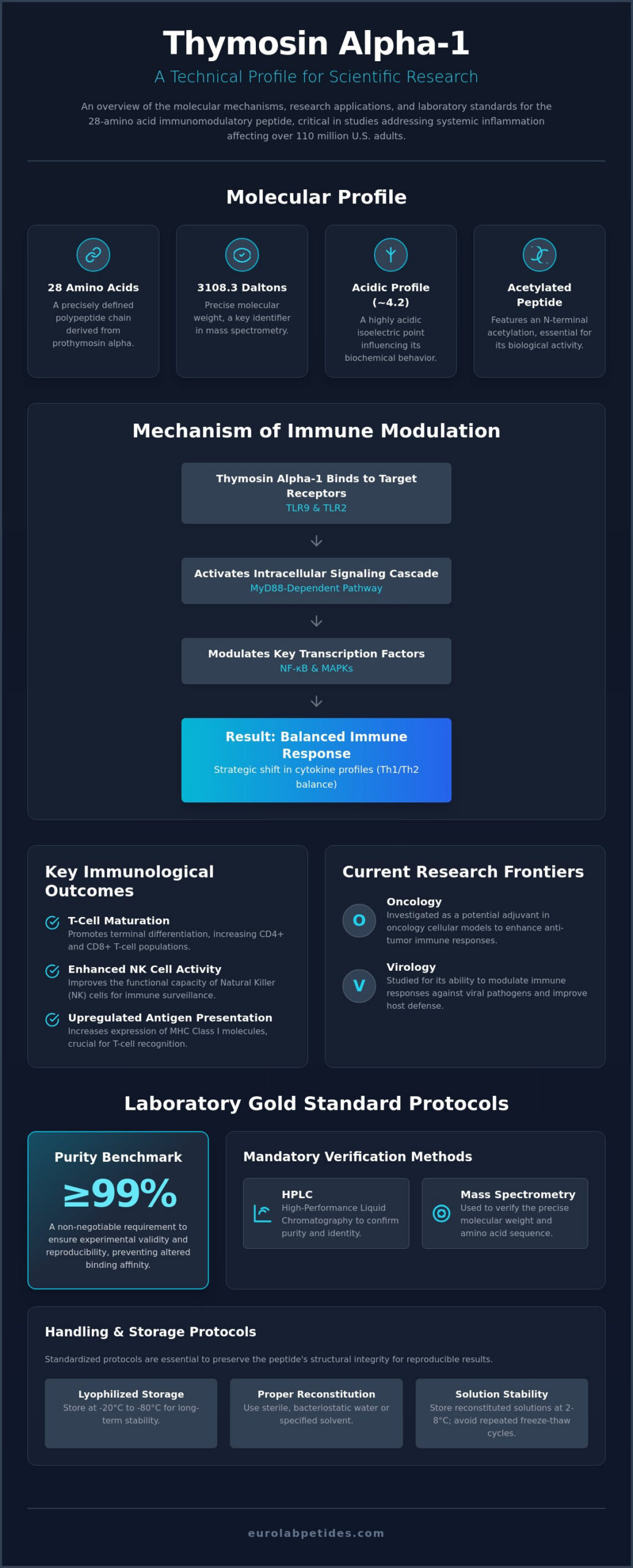
Thymosin Alpha-1 (Tα1) represents a critical focus in thymosin alpha-1 research due to its role as a potent immunomodulatory polypeptide. This 28-amino acid peptide is proteolytically cleaved from prothymosin alpha, a precursor protein that’s highly conserved across various vertebrate species. Its evolutionary preservation suggests that the peptide’s biological functions are foundational to vertebrate immune systems. In contemporary laboratory settings, researchers typically utilize Tα1 produced via solid-phase peptide synthesis (SPPS), which allows for the precise replication of the N-terminal sequence. Thymosin Alpha-1 is an acetylated polypeptide consisting of 28 amino acid residues with a molecular weight of 3108.3 Daltons, maintaining a highly acidic profile with an isoelectric point of approximately 4.2.
Endogenous Role in Thymic Function
Within the physiological environment, Tα1 is primarily synthesized and secreted by thymic epithelial cells. It functions as a biological response modifier, exerting influence over the differentiation and maturation of T-lineage cells. The peptide’s activity isn’t confined to the thymus; it’s released into systemic circulation to modulate peripheral immune responses. By interacting with specific cellular pathways, Tα1 assists in maintaining immune homeostasis. This balance is critical for preventing excessive inflammatory cascades while ensuring robust defense against pathogens. For those interested in the broader application of immune-supportive science, Vespera Wellness provides premium formulations designed to support these natural biological defenses. Data from studies in 2026 continue to highlight its capability to restore immune function in models of immunosenescence, where thymic output naturally declines.
Synthetic vs. Natural Peptide Profiles
A primary distinction in laboratory inquiry involves the comparison between endogenous human Tα1 and its synthetic analog, thymalfasin. While thymalfasin is chemically identical to the naturally occurring 28-amino acid sequence, the manufacturing process dictates its utility in rigorous thymosin alpha-1 research. Synthetic analogs must meet stringent structural integrity requirements to ensure experimental validity. High-Performance Liquid Chromatography (HPLC) and Mass Spectrometry (MS) are employed to verify that the synthetic peptide mirrors the endogenous form’s folding and sequence. The absence of post-translational modifications in the synthetic form must be accounted for during assay design.
For in-vitro development, purity benchmarks are typically set at 99% or higher. Inconsistent peptide purity remains a significant pain point in the supply chain, as even minor sequence variations can alter binding affinity to Toll-like receptors. Investigators must distinguish between research-grade synthetic peptides and lower-quality alternatives that lack the necessary verification. EuroLab Peptides addresses these requirements through multi-level quality control and third-party validation, ensuring that the biochemical profile remains consistent across batches. This technical precision is non-negotiable for investigators mapping the complex signaling pathways associated with thymic peptides.
Molecular Mechanisms of Thymosin Alpha-1 in Immune Modulation
The molecular efficacy of Tα1 is predicated on its interaction with specific pattern recognition receptors. Current thymosin alpha-1 research identifies Toll-like receptors (TLRs), specifically TLR9 and TLR2, as the primary binding targets in immune cell populations. This interaction initiates the MyD88-dependent signaling pathway, which serves as a central conduit for intracellular signal transduction. The subsequent recruitment of interleukin-1 receptor-associated kinases (IRAKs) leads to the phosphorylation of downstream targets. These effects involve the precise modulation of nuclear factor kappa B (NF-κB) and mitogen-activated protein kinases (MAPKs). A comprehensive review of Thymosin alpha 1 highlights how these interactions facilitate a strategic shift in the cytokine profile, specifically balancing Th1 and Th2 responses. This pleiotropic activity allows the peptide to act as a biological rheostat for immune function.
T-Cell Maturation and Differentiation
Tα1 is observed to stimulate the terminal differentiation of T-lymphocytes from immature precursor cells. In various laboratory models, this process results in a measurable increase in CD4+ and CD8+ T-cell populations, alongside enhanced natural killer (NK) cell activity. The peptide doesn’t merely increase cell count; it improves functional capacity. Increased expression of MHC Class I molecules is frequently documented on target cells. This upregulation is essential for antigen recognition by cytotoxic T-lymphocytes, thereby enhancing the precision of the cellular immune response in in-vitro assays. Researchers often utilize these metrics to quantify the potency of synthetic analogs against endogenous standards during thymosin alpha-1 research.
Dendritic Cell and Cytokine Signaling
Dendritic cells (DCs) undergo accelerated maturation and improved antigen presentation capabilities when exposed to standardized Tα1 concentrations. This maturation is characterized by the regulated secretion of cytokines, including IL-2, IL-10, and IFN-γ. In specialized cellular assays, Tα1 is used to induce indoleamine 2,3-dioxygenase (IDO). This enzyme remains a critical focal point in immune tolerance studies, as it modulates T-cell responses through the catabolism of tryptophan. The induction of IDO is particularly relevant in the study of regulatory T-cell (Treg) expansion. Investigators who require high-purity peptides to maintain the integrity of these complex signaling assays can source validated immune system research compounds through professional supply channels. Peptide stability is paramount, as degraded sequences fail to trigger the required TLR pathways.
Current Frontiers in Thymosin Alpha-1 Research: Oncology and Virology
Recent trajectories in thymosin alpha-1 research have transitioned from general immunomodulation to specialized applications in oncology and virology. Investigators utilize non-small cell lung cancer (NSCLC) cellular models to evaluate how Tα1 influences tumor microenvironments. It’s frequently studied in conjunction with conventional chemotherapeutic agents to identify potential synergistic effects. This dual approach aims to enhance cytotoxic efficacy while mitigating the immunosuppressive signals often produced by malignant tissues. A comprehensive scientific review of Thymosin alpha 1 details its capacity to modulate the immune response in these complex disease states, providing a foundation for modern in-vitro protocols. Emerging data also suggest a significant role for Tα1 in respiratory viral pathogenesis, where it’s used to model the stabilization of immune responses during acute infection phases.
Immuno-Oncology and Combination Research
In the field of immuno-oncology, Tα1 is evaluated for its ability to reverse efferocytosis-induced M2 macrophage polarization. This process is critical because M2 macrophages typically promote tumor growth and suppress active immunity. Laboratory investigations using breast cancer cell lines have demonstrated that Tα1 exposure can shift the macrophage phenotype toward a more pro-inflammatory M1 state. There’s also significant interest in its role as an adjuvant for immune checkpoint inhibitors (ICIs). By upregulating MHC Class I expression, Tα1 potentially increases the visibility of tumor cells to the immune system, thereby augmenting the efficacy of monoclonal antibody treatments in research models.
Viral Pathogenesis and Response Models
Virology research continues to focus on Tα1’s impact on Hepatitis B (HBV), Hepatitis C (HCV), and HIV models. Mechanistic studies involve hepatocyte cultures where the peptide’s ability to inhibit viral replication is quantified through rigorous viral load assays. Beyond chronic infections, research explores Tα1’s impact on lymphopenia and cytokine storms in severe infection simulations. Unlike Thymosin Beta-4, which primarily influences tissue repair and actin sequestration, Tα1 provides a more targeted modulation of the adaptive immune response. This distinction is vital for investigators who must select the correct thymic peptide for specific viral response assays. EuroLab Peptides maintains high-purity standards through third-party validation to prevent cross-contamination that could skew viral replication data in these sensitive thymosin alpha-1 research environments.
Laboratory Protocols: Handling, Reconstitution, and Stability
Maintaining the structural integrity of the 28-amino acid sequence is a primary requirement in thymosin alpha-1 research. Lyophilized peptides are highly susceptible to degradation via proteolysis and oxidation if they aren’t managed within a strict cold chain. Investigators must ensure that the peptide remains in a desiccated state during storage to prevent moisture-induced hydrolysis, which can compromise the N-terminal acetylation necessary for biological activity. Technical precision during the handling phase is as critical as the purity of the starting material itself. Failure to adhere to standardized storage and mixing protocols often leads to inconsistent results in cellular signaling assays.
Optimal Storage for Lyophilized Peptides
For long-term preservation, Tα1 must be stored at temperatures of -20°C or -80°C. At these sub-zero levels, the peptide remains stable for approximately 24 months, provided the vial remains sealed and protected from light. Exposure to UV light can trigger the degradation of specific amino acid residues, altering the peptide’s binding affinity to Toll-like receptors. Desiccated environments are mandatory; even minor moisture ingress can lead to the formation of aggregates. If the research timeline requires usage within a shorter window, refrigerated storage at 2-8°C is acceptable for up to four weeks. Beyond this period, the risk of sequence fragmentation increases significantly, potentially skewing data in immune modulation studies.
Reconstitution and Solution Stability
Reconstitution requires a methodical approach to prevent mechanical denaturation. The selection of a diluent depends on the intended assay; bacteriostatic water containing 0.9% benzyl alcohol is preferred for multi-use laboratory inquiry, while sterile 0.9% saline is utilized for single-use applications. The solvent should be introduced slowly by allowing it to run down the internal wall of the vial. Mechanical stress, such as vigorous agitation or vortexing, must be avoided to preserve the secondary structure of the peptide. Instead, gentle swirling is recommended until the lyophilized powder is completely dissolved. The optimal pH for maintaining the stability and biological activity of Thymosin Alpha-1 in solution ranges between 4.0 and 6.0.
Aliquoting the reconstituted solution into single-use volumes is a non-negotiable standard for professional investigators. This strategy minimizes the damage caused by repeated freeze-thaw cycles, which can lead to peptide aggregation and loss of potency. Once reconstituted in sterile saline, the peptide’s shelf life is significantly reduced, typically requiring use within 72 hours when kept at 2-8°C. For investigators who require consistent batch quality and verified molecular stability, EuroLab Peptides provides third-party tested research peptides that meet these rigorous laboratory standards. Maintaining these protocols ensures that the observed immunomodulatory effects are a result of the peptide’s biochemical properties rather than artifacts of degradation.
Sourcing Research-Grade Thymosin Alpha-1 for Scientific Inquiry
Scientific accuracy in thymosin alpha-1 research is fundamentally limited by the quality of the chemical reagents employed. Investigators must differentiate between industrial-grade chemicals and high-purity research-grade peptides. The synthesis of a 28-amino acid sequence requires sophisticated methodologies to ensure the N-terminal acetylation is precise. High-Performance Liquid Chromatography (HPLC) is the standard for purity verification, ensuring that the target peptide is isolated from truncated sequences or residual solvents. While HPLC confirms the quantity of the target molecule, Mass Spectrometry (MS) remains a non-negotiable tool for sequence confirmation. MS provides the exact molecular mass, verifying that the amino acid arrangement matches the theoretical profile of Tα1. Without these metrics, experimental data regarding T-cell differentiation or TLR activation remains scientifically untenable.
The Criticality of Third-Party Analytical Validation
In-house testing often lacks the objectivity required for high-stakes laboratory inquiry. Independent validation provides a layer of accountability that’s essential when mapping complex signaling pathways. When researchers interpret a Certificate of Analysis (CoA) for Tα1, they should look for several key indicators of quality:
- Chromatographic Purity: A singular, sharp peak on the HPLC spectrum indicates the absence of closely related peptide impurities.
- Mass Consistency: The MS peak must align with the calculated molecular weight of 3108.3 Daltons.
- Solubility Metrics: Clear evidence of complete dissolution in standardized solvents without the formation of visible aggregates.
Common contaminants in low-quality peptide synthesis include residual Trifluoroacetic acid (TFA), heavy metals, and bacterial endotoxins. These impurities can induce non-specific cellular responses, effectively invalidating the results of sensitive immune-modulatory assays. It’s vital to ensure that every batch used in a study originates from a source that provides external validation as a non-negotiable standard.
EuroLab Peptides: Standards in Chemical Synthesis
EuroLab Peptides implements a multi-level quality protocol to ensure the integrity of its research peptides. Every batch undergoes rigorous third-party validation to confirm purity levels that typically exceed 99%. This commitment to transparency supports the demands of the European research community, where localized logistics minimize the risk of peptide degradation during transit. By focusing strictly on in-vitro applications, the brand maintains a clear boundary between laboratory inquiry and human consumption, upholding the ethical standards required for professional thymosin alpha-1 research. European manufacturing standards offer an additional layer of reliability, ensuring that the chemical synthesis process adheres to stringent regional regulatory frameworks. This methodical approach from data to delivery respects the investigator’s time and intelligence, providing the high-end craftsmanship necessary for sophisticated biochemical analysis.
Advancing Analytical Standards in Thymic Peptide Inquiry
The complexity of T-cell differentiation and TLR signaling underscores the necessity for absolute precision in every phase of laboratory investigation. Successful thymosin alpha-1 research requires more than a conceptual understanding of MyD88-dependent pathways; it demands rigorous adherence to stability protocols. Precision is non-negotiable. By maintaining a strict cold chain and utilizing single-use aliquots, investigators protect the structural integrity of the 28-amino acid sequence from mechanical and thermal degradation. These methodologies ensure that experimental outcomes are the result of biochemical activity rather than artifacts of peptide fragmentation.
EuroLab Peptides supports the specialized community by providing strictly research-grade chemicals for in-vitro development. Every batch is verified by independent third-party HPLC/MS analysis to ensure purity levels exceeding 99%. Our specialized European logistics prioritize the stability of temperature-sensitive compounds throughout the delivery process. Secure High-Purity Thymosin Alpha-1 for Your Research to maintain the highest standards of empirical accuracy in your next study. We’re committed to supporting your pursuit of rigorous scientific discovery.
Frequently Asked Questions
What is the primary research application of Thymosin Alpha-1?
The primary application of Thymosin Alpha-1 involves the study of immunomodulatory signaling pathways, specifically within the fields of oncology and virology. Investigators use the peptide to evaluate T-cell differentiation and the activation of Toll-like receptors in various disease models. It’s also a central component in longevity research focusing on the reversal of immunosenescence and the restoration of thymic output.
How should Thymosin Alpha-1 be stored for long-term stability in a lab?
Lyophilized peptides must be stored at -20°C or -80°C for long-term preservation of structural integrity. Vials should be kept in a desiccated environment and protected from direct UV light to prevent sequence fragmentation. Stability benchmarks indicate that these conditions allow for a shelf life of approximately 24 months, while refrigerated storage at 2-8°C is only suitable for short-term use up to four weeks.
What is the difference between Thymosin Alpha-1 and Thymosin Beta-4?
Thymosin Alpha-1 primarily functions as an immunomodulator that targets T-lymphocyte maturation and cytokine regulation. In contrast, Thymosin Beta-4 is a 43-amino acid peptide focused on actin sequestration and tissue repair mechanisms. While both are thymic peptides, their molecular targets and research applications in thymosin alpha-1 research remain distinct and shouldn’t be used interchangeably in experimental designs.
Can Thymosin Alpha-1 be reconstituted in bacteriostatic water?
Reconstitution in bacteriostatic water containing 0.9% benzyl alcohol is a standard procedure for multi-use laboratory assays. This solvent provides antimicrobial properties that maintain solution integrity over several days when refrigerated at 2-8°C. For single-use experiments or sensitive cell cultures, sterile 0.9% saline is often preferred to eliminate potential interference from preservative agents during the assay.
What purity level is required for Thymosin Alpha-1 in-vitro research?
A minimum purity level of 99% is required for rigorous in-vitro research to ensure that observed cellular responses are a result of the target peptide. Lower purity levels often contain truncated sequences or residual synthesis solvents that can skew data and produce non-specific inflammatory responses. Every batch should be accompanied by independent third-party HPLC and Mass Spectrometry validation to confirm these metrics before use.
Is Thymosin Alpha-1 research-grade peptide intended for human use?
Research-grade Thymosin Alpha-1 is strictly intended for in-vitro laboratory inquiry and is not for human consumption. EuroLab Peptides provides these compounds exclusively for scientific investigators conducting controlled experiments in a professional setting. The products don’t meet the regulatory requirements for therapeutic administration and are handled as specialized chemical reagents to maintain research integrity.
How does Thymosin Alpha-1 influence T-cell maturation in models?
Tα1 influences T-cell maturation by stimulating the terminal differentiation of precursor cells into functional T-lymphocytes. This process is characterized by increased expression of MHC Class I molecules and the expansion of CD4+ and CD8+ populations in cellular models. These mechanisms are critical for understanding how thymosin alpha-1 research contributes to the mapping of adaptive immune responses in various pathological simulations.
What are the common solvents used for Tα1 in cellular assays?
Common solvents for Tα1 in cellular assays include sterile 0.9% saline and Phosphate-Buffered Saline (PBS). These solutions maintain the necessary osmotic balance and pH range for cell viability during in-vitro exposure. The choice of solvent depends on the sensitivity of the specific cell line to preservatives or buffer salts, with PBS being preferred for maintaining a stable pH of 7.4.
