

The integrity of neurological research often hinges on a molecular weight variance of less than 0.1 percent, making the chemical precision of your reagents the most critical variable in the laboratory. You likely recognize that inconsistent purity levels and ambiguous stability data from suppliers don’t just complicate workflows; they threaten the validity of empirical findings. This technical review addresses those volatility concerns by providing a comprehensive scientific analysis of the selank peptide, a synthetic heptapeptide analog of the endogenous tetrapeptide tuftsin.
We’ll move beyond surface-level descriptions to examine the peptide’s specific molecular weight of approximately 751.9 g/mol and its documented modulation of GABAergic and serotonergic systems. You’ll gain a clear understanding of standardized reconstitution protocols and the rigorous HPLC benchmarks required to ensure a 98 percent purity threshold. This analysis establishes a framework for the precise handling and storage instructions necessary for high-stakes research environments, ensuring that every batch meets the objective metrics of analytical science.
Key Takeaways
- Define the biochemical structure of Selank as a synthetic heptapeptide derived from the endogenous immunomodulatory peptide tuftsin.
- Analyze the unique mechanisms of the selank peptide, focusing on its modulation of GABAergic pathways and GABRA1 mRNA expression.
- Evaluate empirical data comparing Selank to traditional ligands like diazepam within standardized behavioral and chronic stress research models.
- Establish standardized laboratory protocols for reconstitution and handling to ensure the structural integrity and stability of the peptide.
- Identify critical quality benchmarks for sourcing research reagents, including the necessity of batch-specific third-party HPLC validation.
Molecular Profile and Chemical Composition of Selank
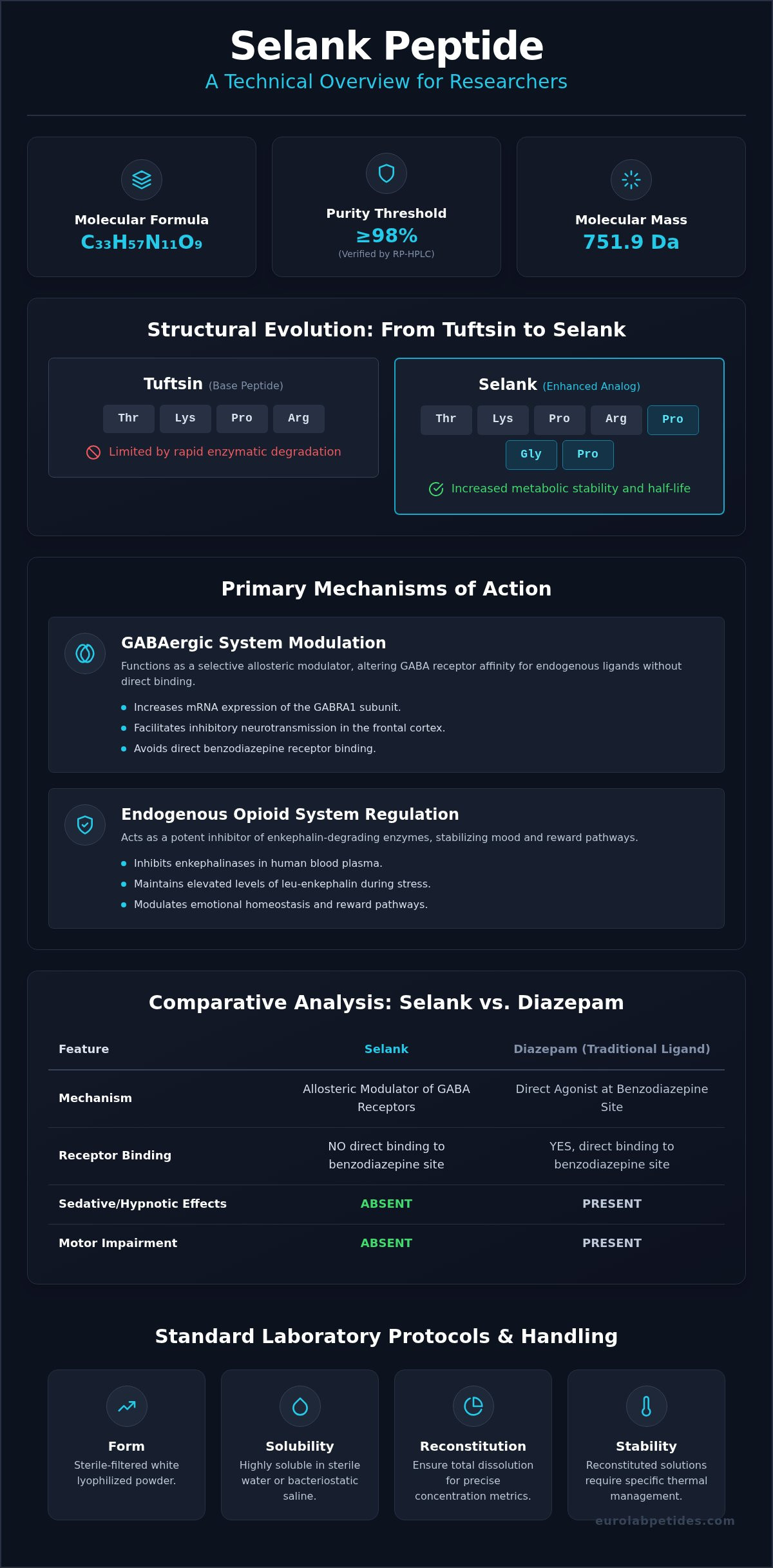
The selank peptide is a synthetic heptapeptide characterized by the amino acid sequence Thr-Lys-Pro-Arg-Pro-Gly-Pro. It functions as a synthetic C-terminal analog of the endogenous immunomodulatory tetrapeptide tuftsin. With a precise molecular formula of C33H57N11O9 and a molecular mass of 751.9 Da, this molecule represents a refined tool for investigating neurological and immunological pathways. This Selank peptide overview establishes its identity as a stable derivative of a naturally occurring regulatory sequence produced in the spleen.
The Structural Evolution from Tuftsin
Tuftsin is a biologically active tetrapeptide (Thr-Lys-Pro-Arg) that plays a role in the immune response. However, its utility in research is limited by a rapid rate of enzymatic degradation and a short half-life. Selank’s development addressed these limitations through the addition of a Pro-Gly-Pro tripeptide to the C-terminus. This structural modification provides a significant increase in metabolic stability. The Pro-Gly-Pro sequence acts as a terminal shield against peptidase activity, allowing for a sustained presence in research models that the native tuftsin cannot achieve. Because it’s a non-glycosylated polypeptide chain, the molecule offers high in-vitro consistency. Researchers can observe biochemical interactions without the confounding variables typically associated with complex glycosylation patterns found in other signaling molecules.
Physicochemical Properties and Purity Metrics
In its standardized laboratory form, the reagent is presented as a sterile-filtered white lyophilized powder. Maintaining the integrity of the research environment requires strict adherence to purity standards. Research-grade materials must demonstrate a purity level of 98 percent or higher as verified by Reversed-Phase High-Performance Liquid Chromatography (RP-HPLC) analysis. Using certified peptides is a non-negotiable requirement for ensuring that experimental results are reproducible and free from the influence of manufacturing impurities or residual solvents.
Solubility profiles are a critical component of experimental design. The lyophilized powder is highly soluble in sterile water and bacteriostatic saline, yielding a clear, colorless solution upon reconstitution. It’s vital to ensure total dissolution before beginning any assays to maintain precise concentration metrics. The lyophilization process itself is essential for stability, preserving the peptide’s structural configuration during transport and long-term storage. Under controlled conditions, the powder remains stable, though reconstituted solutions require specific thermal management to prevent degradation over time.
Investigating the Biochemical Mechanisms of Action
Selank peptide exhibits a pleiotropic pharmacological profile that extends beyond a single molecular target. Its primary influence is observed within the GABAergic system, yet it lacks direct affinity for the benzodiazepine receptor site. This distinction is vital for investigators examining non-sedative anxiolytic pathways. Analysis of the Biochemical Mechanisms of Selank reveals that the peptide modulates the expression of genes involved in neurotransmission, particularly those encoding the GABRA1 subunit of the GABA-A receptor. Such genomic influence suggests a regulatory role that stabilizes neuronal activity without the risk of receptor desensitization.
GABAergic System Modulation in Neurological Models
In research environments, Selank is utilized to alter the affinity of GABA receptors for their endogenous ligands. It doesn’t act as a direct agonist; instead, it functions as a selective allosteric modulator. Data indicates that the peptide increases the mRNA expression of the GABRA1 subunit in the frontal cortex, which facilitates inhibitory neurotransmission. Because it avoids direct benzodiazepine receptor binding, research models using Selank don’t exhibit the sedative-hypnotic side effects or motor impairment typical of classical ligands like diazepam. This allows for the study of emotional regulation in isolation from physical or cognitive impairment.
Interactions with the Endogenous Opioid System
The peptide’s secondary mechanism involves the precise regulation of the endogenous opioid system. Selank acts as a potent inhibitor of enkephalin-degrading enzymes, specifically enkephalinases found in human blood plasma. By inhibiting these enzymes, the peptide maintains elevated levels of leu-enkephalin, particularly during stress-induced states. This enzymatic inhibition suggests a role in modulating reward pathways and emotional homeostasis. In stress-based assays, the maintenance of enkephalin levels correlates with observed behavioral stability and a reduction in the biochemical markers of chronic stress.
Emerging data also points toward the modulation of Brain-Derived Neurotrophic Factor (BDNF) expression. In hippocampal models, Selank has been shown to influence BDNF mRNA levels, suggesting a potential pathway for investigating neuroplasticity and long-term potentiation. These multi-faceted interactions make the peptide an elite tool for cognitive function research where precise biochemical control is required. Every mechanism is a verifiable metric of its efficacy in complex neurological environments, provided the reagent meets strict purity standards.
Selank in Neurological and Immunological Research Models
The application of the selank peptide within standardized research models allows for the observation of behavioral and physiological changes under controlled stressors. Scientific inquiry often utilizes the unpredictable chronic mild stress (UCMS) paradigm to evaluate the peptide’s efficacy in stabilizing emotional responses. Unlike traditional GABA-A ligands, the heptapeptide demonstrates a capacity to modulate stress-related behaviors without the confounding variable of sedation. This specific characteristic makes it a preferred reagent for studies requiring high levels of motor coordination and cognitive engagement.
Stress and Anxiety Research Paradigms
Comparative studies involving Selank and diazepam in rodent models, such as the Elevated Plus Maze and Open Field assays, highlight significant differences in pharmacological outcomes. While both substances reduce avoidance behaviors, Selank doesn’t induce the myorelaxant effects or ataxia associated with benzodiazepines. Research indicates that the peptide demonstrates efficacy in reducing stress markers without motor impairment, ensuring that behavioral data remains untainted by physical lethargy. Some investigators have observed synergistic effects when the peptide is administered alongside traditional anxiolytics, potentially allowing for lower dosages of the latter in experimental settings. However, researchers must remain cognizant of the regulatory environment, as the FDA Safety Risks for Compounded Selank emphasize the risks associated with non-standardized compounding for non-research uses.
Cognitive and Nootropic Investigation
The nootropic potential of the selank peptide is frequently evaluated through memory consolidation and learning focus assays. In laboratory animals, the peptide has been shown to enhance exploratory behavior and improve cognitive flexibility, particularly in tasks involving spatial navigation. These effects are often attributed to the modulation of BDNF and the stabilization of neurotransmitter levels in the hippocampus. For a broader context on similar reagents, researchers often consult a review of peptides for cognitive function research to compare mechanistic pathways. Beyond behavioral metrics, neuronal cultures treated with the peptide show increased resilience against oxidative stress, suggesting a neuroprotective role that warrants further in-vitro investigation.
Immunomodulatory properties represent another significant area of inquiry. In laboratory settings, the peptide influences cytokine balance, specifically regulating the expression of Interleukin-6 (IL-6). By modulating the inflammatory response within neurological models, Selank provides a dual-pathway approach to studying the intersection of the immune and nervous systems. This regulatory capacity is measured through precise enzyme-linked immunosorbent assays (ELISA), where the peptide’s presence correlates with a more balanced pro-inflammatory versus anti-inflammatory profile. Such data reinforces the peptide’s utility as a comprehensive tool for investigating complex systemic interactions in high-stakes research environments.
Laboratory Protocols: Handling, Reconstitution, and Stability
Maintaining the structural integrity of the selank peptide requires a meticulous approach to laboratory handling. The tertiary structure of synthetic heptapeptides is highly sensitive to mechanical stress and thermal fluctuations. Adherence to standardized protocols isn’t merely a suggestion; it’s a prerequisite for ensuring that in-vitro assays yield accurate, reproducible data. Researchers must prioritize aseptic techniques to prevent microbial contamination within the vacuum-sealed environment of the vial.
Step-by-Step Reconstitution Guide
Precision in concentration is the baseline for clinical-grade research. Before beginning, investigators should utilize a peptide reconstitution calculator to determine the exact volume of diluent required for their specific target molarity. Once the calculation is verified, the following steps are mandatory:
- Sanitize the vial’s rubber stopper with 70% isopropyl alcohol and allow it to air dry.
- Introduce the sterile diluent, such as bacteriostatic water, by allowing the liquid to flow slowly down the side of the vial wall. This prevents the direct impact of the liquid on the lyophilized cake.
- Allow the vial to sit undisturbed for 5 to 10 minutes to facilitate complete dissolution.
- If necessary, gently swirl the vial to assist the process. Never shake the container, as high-velocity agitation can lead to peptide denaturation and the formation of insoluble aggregates.
Storage and Stability Optimization
Lyophilized powder exhibits the highest stability when stored at -18°C or below. Under these conditions, the peptide remains viable for extended periods, provided the vacuum seal hasn’t been compromised. Once the selank peptide is reconstituted, its shelf-life is drastically reduced. The solution should be maintained at a temperature between 2°C and 8°C and utilized within a 14 to 21-day window to minimize the risk of peptide fragmentation.
Freeze-thaw cycles represent a significant threat to potency. Each cycle of crystallization and thawing induces physical stress on the peptide chain, which can lead to degradation. To mitigate this risk, investigators should aliquot the reconstituted solution into single-use volumes if the entire vial won’t be used immediately. Adherence to these rigorous standards ensures that the biochemical properties remain consistent throughout the duration of the study. For laboratories requiring high-purity reagents that meet these strict stability metrics, sourcing research-grade selank peptide from a verified supplier is the first step in ensuring protocol security.
Sourcing High-Purity Selank for In-Vitro Studies
The validity of empirical research is inseparable from the chemical integrity of the reagents employed. For investigators focusing on the selank peptide, the presence of unidentified impurities or variations in peptide content can introduce confounding variables that compromise data reproducibility. Utilizing certified peptides is a fundamental requirement for maintaining the rigorous standards of high-stakes neurological inquiry. EuroLab Peptides implements a multi-level quality control protocol that subjects every batch to both in-house synthesis validation and independent third-party laboratory analysis.
Quality Assurance and Verification Standards
Confirming the molecular identity of a synthetic heptapeptide requires more than surface-level documentation. Mass Spectrometry (MS) is utilized to verify the exact molecular weight of the peptide, ensuring it aligns with the theoretical mass of 751.9 Da. Once identity is confirmed, the selank peptide undergoes High-Performance Liquid Chromatography (HPLC) to quantify purity levels. A Certificate of Analysis (COA) provides the necessary transparency, detailing the purity percentage and the presence of any residual solvents or salts. Researchers must prioritize suppliers that provide batch-specific third-party verification, as internal-only testing lacks the objective accountability required for peer-reviewed research.
Compliance and Ethical Research Sourcing
Sourcing reagents within a regulated framework is essential for logistical and ethical consistency. Adherence to European manufacturing standards ensures that the selank peptide is synthesized under strict environmental controls, minimizing the risk of cross-contamination. Regional sourcing provides logistical advantages, including shorter transit times and localized compliance with chemical transport regulations. These factors reduce the duration the peptide spends in sub-optimal thermal conditions during international transit, preserving the stability discussed in previous protocols.
All materials are provided with a strict “Research Use Only” designation. This classification underscores that these products are intended for in-vitro laboratory environments and are not for human consumption. This professional boundary maintains the ethical integrity of the scientific community and aligns with global regulatory expectations. By prioritizing transparency and empirical validation, EuroLab Peptides functions as a reliable partner in the advancement of biochemical science. Review our certified Selank batch data for your next study.
Advancing Neurological Research Through Chemical Precision
The integration of the selank peptide into neurological research frameworks provides a unique opportunity to observe complex neurotransmitter interactions without the interference of sedative side effects. This technical review has established that the heptapeptide’s efficacy is contingent upon both its specific biochemical mechanism, such as the modulation of GABRA1 mRNA expression, and the rigorous application of standardized laboratory protocols. Maintaining a purity threshold of 98 percent or higher via RP-HPLC analysis is essential for ensuring that empirical results remain reproducible and free from confounding variables.
EuroLab Peptides supports high-stakes research by providing reagents that have undergone multi-level validation, including independent third-party testing and European-based logistics for optimized stability. By adhering to these strict quality benchmarks, investigators can proceed with the confidence that their data reflects objective biochemical activity rather than reagent volatility. We invite you to View Technical Specifications for Research-Grade Selank to facilitate your next phase of inquiry. The pursuit of molecular precision continues to drive significant advancements in the fields of cognitive and immunological science.
Frequently Asked Questions
Is Selank peptide intended for human use?
Selank peptide is strictly intended for in-vitro laboratory research and is not for human consumption. It is classified as a research chemical and lacks approval from regulatory bodies like the FDA for medical application. EuroLab Peptides provides this material exclusively for scientific inquiry within controlled environments. Any use involving human subjects is prohibited. Researchers must ensure compliance with regional laboratory regulations and ethical standards when handling this synthetic heptapeptide.
What is the molecular weight and formula of Selank?
The molecular formula for Selank is C33H57N11O9, with a verified molecular mass of approximately 751.9 Da. This heptapeptide sequence, Thr-Lys-Pro-Arg-Pro-Gly-Pro, is a synthetic analog of the endogenous tetrapeptide tuftsin. These chemical specifications are confirmed through mass spectrometry to ensure the absolute identity of the reagent. Precision in these metrics is vital for calculating molar concentrations and ensuring the accuracy of quantitative biochemical assays in neurological models.
How should Selank be stored to maintain maximum stability?
Lyophilized selank peptide must be stored at temperatures of -18°C or below to ensure long-term structural stability. Once the vial is reconstituted, the solution should be refrigerated between 2°C and 8°C and used within 21 days. Exposure to light and repeated freeze-thaw cycles must be avoided to prevent peptide degradation. Maintaining these specific thermal parameters is necessary to preserve the integrity of the peptide chain throughout the duration of a study.
What is the standard purity level for research-grade Selank?
The standard purity for research-grade Selank is 98 percent or higher as determined by Reversed-Phase High-Performance Liquid Chromatography (RP-HPLC). This threshold is non-negotiable for high-stakes research where minor impurities can lead to skewed data. Each batch should be accompanied by a Certificate of Analysis (COA) that includes HPLC chromatograms. This verification ensures that the reagent is free from residual synthesis byproducts that could interfere with sensitive biological assays.
How does Selank differ from Semax in cognitive research?
Selank and Semax differ primarily in their structural origins and pharmacological profiles. Selank is an analog of the immunomodulatory peptide tuftsin and exhibits non-sedative anxiolytic properties. Semax is a fragment of adrenocorticotropic hormone (ACTH) known for its stimulating nootropic effects. In cognitive research, Selank is utilized to study emotional homeostasis and stress resilience, whereas Semax is often employed to investigate alertness, memory consolidation, and neurorestorative pathways following ischemic events.
Can Selank be reconstituted with bacteriostatic water?
Reconstitution of the selank peptide can be performed using bacteriostatic water, which contains 0.9% benzyl alcohol to inhibit microbial growth. This is particularly useful for multi-dose vials where the solution will be stored for several days. Alternatively, sterile water for injection may be used if the reagent is intended for immediate application. Regardless of the diluent, researchers should follow aseptic techniques and introduce the liquid slowly to avoid mechanical denaturation of the peptide.
What are the known mechanisms of action for Selank in neurological studies?
The known mechanisms for Selank include the allosteric modulation of the GABAergic system and the inhibition of enkephalin-degrading enzymes. It has been shown to increase the mRNA expression of the GABRA1 subunit, facilitating inhibitory neurotransmission without direct benzodiazepine receptor binding. Additionally, the peptide maintains elevated leu-enkephalin levels in blood plasma by suppressing enkephalinase activity. Recent studies also suggest a role in modulating Brain-Derived Neurotrophic Factor (BDNF) expression within hippocampal tissues.
Where can I buy third-party tested Selank in Europe?
High-purity, third-party tested Selank is available through EuroLab Peptides for researchers within the European region. Every batch undergoes rigorous HPLC and mass spectrometry validation to ensure it meets the 98 percent purity benchmark required for professional inquiry. By utilizing European-based logistics, the brand ensures that reagents are transported efficiently under compliant conditions. This regional focus provides researchers with a reliable supply chain and transparent technical documentation for their specialized laboratory requirements.
