

What if a peptide’s measured mass matches the expected value, but the result still doesn’t establish that the sample is pure? That distinction is central to interpreting mass spectrometry (MS) for peptide verification. An intact-mass result can support a molecular-mass assignment, while tandem MS can provide fragment evidence relevant to sequence. Neither result, by itself, answers every question about sample composition or purity.
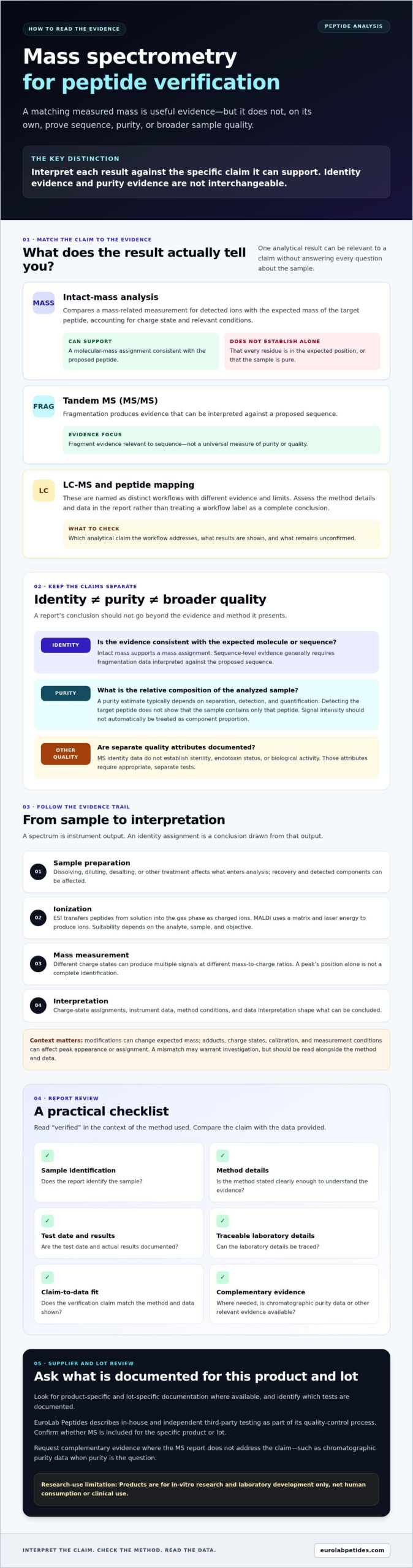
An MS report is important evidence, but its value depends on the claim and data it contains. Read “verified” in the context of the method used: evidence supporting molecular identity and evidence supporting purity are not interchangeable.
This guide explains what common MS workflows can and can’t verify, how intact-mass analysis differs from tandem MS and peptide mapping, and what to look for in a supplier certificate or test report. It also outlines complementary evidence to request, including method details, chromatographic purity data, and product-specific and lot-specific documentation where available. The goal is to help you assess what an MS result supports and what remains unconfirmed.
Key Takeaways
- Use mass spectrometry (MS) for peptide verification to assess specific analytical claims, not as a universal measure of quality.
- Match the workflow to the question: intact-mass analysis, LC-MS, and tandem MS provide different evidence and have distinct limits.
- Check whether the report identifies the sample, method, test date, results, and traceable laboratory details.
- Compare the verification claim with the method and data provided, then request complementary evidence where needed.
- For supplier and lot review, ask which product-specific tests are documented. EuroLab Peptides describes in-house and independent third-party testing, but confirm whether MS is included.
What mass spectrometry can verify about a research peptide
Mass spectrometry (MS) measures the mass-to-charge ratio of ions produced from a sample. The resulting signals provide evidence about molecules detected under the chosen analytical conditions. For mass spectrometry (MS) for peptide verification, the key is to identify the claim the data support: a measured mass, a proposed sequence, a sample’s relative composition, or another defined attribute.
Observed mass is an analytical measurement, not a complete quality assessment. It can be compared with the expected mass of a specified peptide, but that comparison alone doesn’t establish full sequence identity, sample purity, or suitability for a particular research purpose. Protein mass spectrometry provides a foundational overview of approaches used to analyze proteins and peptides.
What an intact-mass result can indicate
An intact-mass result reports a mass-related measurement for detected ions. When the instrument’s charge state and other relevant conditions are accounted for, the calculated molecular mass can be compared with the expected mass of the target peptide. Agreement supports the proposed identity, but it isn’t standalone proof that every residue is in the expected position.
Interpretation also depends on the signals observed. Chemical modifications can change the expected mass, while adducts, charge states, calibration, and measurement conditions can affect how peaks appear or are assigned. A mismatch may warrant investigation, but shouldn’t be interpreted without the method and data context.
Identity, purity, and quality are different claims
Identity concerns whether analytical evidence is consistent with the expected molecule or sequence. Intact mass supports a mass assignment; sequence-level evidence generally requires fragmentation data interpreted against the proposed sequence. These claims are related, but distinct.
Purity concerns the relative composition of the analyzed sample. A purity estimate typically depends on how components are separated, detected, and quantified. A mass spectrum that supports the presence of the target peptide doesn’t, by itself, establish that the sample contains only that peptide. Signal intensity also shouldn’t automatically be treated as a direct measure of component proportion.
Broader quality attributes require their own evidence. MS identity data do not establish sterility, endotoxin status, or biological activity; these require appropriate, separate tests. Conclusions also depend on the method, sample preparation, instrument performance, acquisition settings, and data interpretation. Match each report’s conclusion to the evidence it presents.
EuroLab Peptides describes in-house and independent third-party testing as part of its quality-control process. Confirm the documentation for a specific product or lot to determine whether MS testing is included. Products are for in-vitro research and laboratory development only, not human consumption or clinical use.
How peptide MS workflows produce identity evidence
A peptide MS result comes from a sequence of analytical steps, and each step shapes what can be concluded. Sample preparation controls what enters the analysis, ionization creates charged species for measurement, the mass analyzer records ion signals, and interpretation turns those signals into evidence about the peptide. A spectrum is instrument output; an identity assignment is a conclusion drawn from that output.
Preparation may involve dissolving, diluting, desalting, or otherwise treating a sample for introduction into the instrument. The procedure can affect recovery and which components are detected. If the analyzed portion isn’t representative of the material, even a technically sound measurement may not describe the whole sample.
From peptide sample to measured ions
Electrospray ionization (ESI) is commonly used to transfer peptides from solution into the gas phase as charged ions. Matrix-assisted laser desorption/ionization (MALDI) is another approach, using a matrix and laser energy to produce ions. Neither is universally superior; suitability depends on the analyte, sample, and analytical objective.
A peptide may acquire different numbers of charges during ionization, so one analyte can generate multiple signals at different mass-to-charge ratios. The analyst uses charge-state assignments and instrument data to relate those signals to a molecular mass. A peak’s position alone isn’t a complete identification.
From spectrum to interpreted evidence
The mass analyzer separates or measures ions according to their mass-to-charge ratios, producing a spectrum. Calibration supports accurate mass assignment, while acquisition settings determine which ions are measured and at what level of detail. Interpretation considers signal quality, charge states, expected mass, and possible interferences. A report should distinguish measured data from the conclusion drawn from them.
When tandem MS adds sequence information
In tandem MS, an ion of interest is selected and fragmented. The resulting fragment-ion pattern can be compared with fragments expected from a proposed peptide sequence, adding evidence beyond intact mass. This supports sequence assessment only when interpretable fragments are observed and appropriately assigned.
Fragmentation evidence can be incomplete or ambiguous. Modifications may change expected fragment patterns, and overlapping signals can complicate assignment. Consider a sequence match in light of coverage, data quality, and the interpretation method, rather than inferring it from a few compatible peaks.
When reviewing mass spectrometry (MS) for peptide verification, ask which preparation, ionization, acquisition, and interpretation steps were documented, and whether they support the stated identity claim. EuroLab Peptides describes in-house and independent third-party testing; confirm the method and lot documentation available rather than assuming MS was performed. Products are for in-vitro research and laboratory development only, not human consumption or clinical use. For product-specific documentation, review the information available for research-grade peptides.
Intact-mass MS, LC-MS, and MS/MS: which evidence fits the question?
These terms describe different parts or configurations of an analytical workflow, not interchangeable levels of a single test. Intact-mass analysis compares a peptide’s measured mass with an expected value. Liquid chromatography-mass spectrometry (LC-MS) adds a separation step before mass analysis. Tandem MS (MS/MS) fragments selected ions to generate additional structural evidence, often for sequence assessment.
Choose a workflow that produces evidence relevant to the claim, then check whether its limitations are acknowledged.
| Approach | Analytical question | Typical output | Interpretation limit |
|---|---|---|---|
| Intact-mass MS | Does the detected peptide’s mass agree with the expected molecular mass? | Mass spectrum and an assigned or calculated molecular mass | Mass agreement supports an assignment but may not distinguish sequence isomers or establish full sequence identity. |
| LC-MS | What mass signals are associated with components separated from the sample? | Chromatographic peaks linked to mass spectra or mass-based signals | Separation and detection depend on the method; a peak’s presence or area alone doesn’t establish complete identity or purity. |
| MS/MS | Do fragment patterns support a proposed sequence or structural feature? | Fragment-ion spectrum interpreted against an expected sequence or structure | Conclusions depend on fragment coverage, signal quality, and the interpretation approach. |
Match the method to the verification question
For a direct comparison with expected molecular mass, intact-mass analysis may address the immediate question. LC-MS is useful when separating sample components before mass-based characterization matters, such as when an analyst needs to associate detected masses with distinct chromatographic peaks. MS/MS is relevant when fragment evidence is needed to assess sequence or selected structural features. It may be part of an LC-MS workflow, so check the report to see what was actually acquired.
Why complementary methods can matter
Chromatographic purity assessment and mass identification answer different questions. High-performance liquid chromatography (HPLC) can separate components and produce a chromatogram used to estimate relative peak areas under the stated conditions. That estimate depends on the separation, detection method, and reporting basis; co-eluting components or unequal detector responses may affect interpretation.
An HPLC purity result and an MS identity result can complement each other, but neither guarantees complete purity, full structural characterization, or biological performance. For mass spectrometry (MS) for peptide verification, compare the report’s method and output with the supplier’s specific claim, and assess any complementary data separately.
How to assess an MS report without overreading the result
A useful MS report makes clear what was analyzed, how it was measured, and what conclusion the data support. Read the reported observation separately from the interpretation, any acceptance criteria, and attributes that weren’t tested. “Mass matched” is not equivalent to a claim of sequence confirmation or sample purity.
Report details that help establish context
Use this checklist when reviewing supplier or laboratory documentation:
- Sample and lot: Does the report identify the material analyzed and link it to the relevant product or lot?
- Method: Is the analytical approach named, with enough detail to tell whether it measures intact mass, uses LC-MS, or includes MS/MS?
- Date: Is the analysis date shown, and can you determine which material it applies to?
- Result: Are measured values or spectra provided, or only a summary conclusion? Is the expected value or reference sequence stated where relevant?
- Traceability: Is the testing laboratory identified? If accreditation is claimed, can its scope and status be verified rather than assumed?
Next, compare the documented method with the supplier’s exact verification claim. A mass measurement may support agreement with an expected molecular mass, while a sequence claim calls for appropriate fragment evidence. A purity claim requires suitable composition data, not simply confirmation that the target peptide was detected.
Limits to disclose when interpreting results
A matching mass alone may not resolve every sequence or impurity question. Similarly, a result from the tested sample doesn’t establish sterility, clinical suitability, or efficacy. These are separate attributes that require appropriate evidence and shouldn’t be inferred from an MS result.
Look for a clear distinction between instrument observations and the analyst’s interpretation. Ask which criteria informed the conclusion, what limitations apply, and which requested attributes weren’t assessed. Missing method details aren’t proof that a method was inadequate, but they leave its relevance unclear. Request clarification rather than filling gaps with assumptions.
These checks also help frame questions about third-party peptide testing: who performed the analysis, which material and lot were tested, and what the report documents. EuroLab Peptides describes in-house and independent third-party testing as part of its quality-control process. Confirm whether product-specific and lot-specific MS reports are available and which methods they record. Its
For research procurement, review research peptide information and verify the applicable documentation for the specific product and lot.
Applying peptide MS evidence to supplier and lot review
Supplier documentation is most useful when each result is linked to specific material and a defined analytical claim. Treat mass spectrometry (MS) for peptide verification as evidence for the question the reported method addresses, not as a general endorsement of every quality attribute. A careful review helps establish whether a test result applies to the material being considered and what it can reasonably support.
Questions to ask before relying on a verification claim
Use these questions to assess whether a certificate or test report is relevant to the product and lot under review:
- What was tested? Does the report identify the analyte and specific lot, and does that information correspond to the material supplied?
- Which method supports identity? Is the result based on intact-mass analysis, LC-MS, MS/MS, or another documented method? Does the output support the stated identity claim?
- What supports any purity statement? Is a separate chromatographic result provided, and does the report explain how the value was determined?
- Who performed the analysis? Is the laboratory identified, and are any accreditation statements specific enough to verify?
- What remains unclear? If method scope, report fields, or interpretation limits aren’t stated, ask for clarification instead of assuming what was done.
Keep observations distinct from conclusions. A reported mass or chromatographic peak is a measurement; “identity confirmed” or a purity percentage is an interpretation that should be supported by the described method and data. If a document reports identity but doesn’t describe a purity assay, don’t treat it as evidence of purity.
Use documentation within its stated research scope
EuroLab Peptides describes a quality-control process that includes in-house and independent third-party laboratory testing. The available information doesn’t establish that mass spectrometry is performed on every product or lot. Confirm whether a report is available for the specific product and lot, which method it documents, and which laboratory performed the analysis. Ask for details about unclear fields or claims.
Use results only within their stated scope: EuroLab Peptides’ products are for in-vitro research and laboratory development, not human consumption or clinical use. For broader procurement considerations, consult a guide to buying research peptides alongside the product-specific documentation. Sourcing context doesn’t replace method details or lot traceability.
For applicable product and quality information, review EuroLab Peptides’ documented quality process. Base your assessment on evidence available for the specific material, and keep conclusions limited to what the documented tests support.
Make Each Verification Claim Traceable
Use mass spectrometry (MS) for peptide verification as evidence for a defined analytical question, not as a universal quality certificate. Intact-mass results, LC-MS data, and MS/MS fragmentation support different conclusions, so the documented method should match the supplier’s claim. A report is more useful when it identifies the tested material and lot, describes the method, and separates measured results from interpretation.
MS evidence has limits. Identity, sample purity, sterility, endotoxin status, and biological activity are separate attributes, and a result for one doesn’t establish the others. Review complementary data where relevant, and request clarification when method or lot details are missing.
EuroLab Peptides describes a multi-level quality-control process that includes in-house and independent third-party laboratory testing. The available information doesn’t establish that MS is used for every product or lot, so check which product-specific documentation is provided.
For a closer look at the supplier’s research products and quality information, review EuroLab Peptides’ research products and quality information. Check the documentation for the specific product and lot when assessing whether the reported evidence fits your research requirements.
Frequently Asked Questions
Can mass spectrometry confirm a peptide’s identity?
Mass spectrometry can provide evidence supporting a peptide’s identity, but the strength of the conclusion depends on the method and data. An intact-mass result can show whether a measured mass agrees with the expected value. Tandem MS can add fragment-ion evidence for assessing a proposed sequence. Review the report’s method, sample details, and interpretation before treating an identity statement as confirmed; a mass match alone may not distinguish every possible sequence or modification.
Does mass spectrometry measure peptide purity?
Mass spectrometry can detect and characterize components, but a mass result alone isn’t necessarily a quantitative purity measurement. Purity concerns the relative composition of the analyzed sample and depends on suitable separation, detection, and quantitation methods. A chromatographic method, such as HPLC, may provide complementary peak-area data, subject to its method conditions and limitations. Check whether the report explicitly describes a purity method and how its result was calculated.
What is the difference between intact-mass MS and tandem MS for peptides?
Intact-mass MS measures ions from the peptide without first fragmenting the selected analyte, allowing its measured mass to be compared with an expected molecular mass. Tandem MS selects ions and fragments them, producing a pattern that can be interpreted against a proposed sequence. The approaches answer different questions: mass agreement supports a molecular-mass assignment, while informative fragment data can support sequence assessment. Interpret either result only within the limits of its documented evidence.
Can LC-MS identify a peptide sequence?
LC-MS can separate sample components and measure mass-related signals, but LC-MS without fragmentation data may not establish a complete peptide sequence. Sequence assessment commonly uses tandem MS, where selected ions are fragmented and the resulting pattern is interpreted against an expected sequence. Whether the combined method supports a sequence claim depends on acquisition and interpretation details, including the quality and coverage of fragment evidence. Check the report for the specific method performed.
Is a matching molecular mass enough to verify a peptide?
No. A matching molecular mass supports consistency with the expected mass, but it may not resolve sequence isomers, establish the order of residues, or identify all sample components. Modifications and other ion forms can also affect interpretation. For stronger sequence evidence, check whether tandem MS data were collected and how they were interpreted. Assess purity and other quality attributes separately, using documentation from methods suited to those specific claims.
What should a peptide mass spectrometry report include?
A useful report should identify the analyzed sample and lot, the test date, the analytical method, and the result being reported. It should make clear whether the conclusion concerns intact mass, chromatographic separation, fragment evidence, or another measurement. Laboratory identity and any accreditation claims should be stated clearly enough to verify. If the report omits method scope or relevant data, request clarification rather than assuming what the test establishes.
Does third-party testing mean a peptide was verified by mass spectrometry?
No. “Third-party tested” identifies who performed testing, not which analytical method was used. Confirm whether the report names mass spectrometry, identifies the tested product and lot, and states the claim supported by the result. EuroLab Peptides describes in-house and independent third-party laboratory testing, but the available information doesn’t confirm MS coverage for every product or lot. Its
