

An AMPK-linked signal is not the same as a demonstrated metabolic benefit. AICAR for metabolic research is often described as a simple AMPK activator, but that shorthand can obscure how it acts and what experimental results actually show. Cells convert AICAR to ZMP, an AMP-like molecule that can influence AMPK signaling. AICAR’s effects, however, are not limited to one pathway.
The interest is understandable: AMPK helps regulate cellular energy balance, and preclinical studies have reported metabolic effects. But findings in cells or animals do not establish that AICAR produces equivalent outcomes in humans. AICAR is also a small-molecule nucleoside analogue, not a peptide, despite occasional mislabeling.
This article explains the AICAR-ZMP-AMPK relationship and separates mechanistic observations from physiological and clinical evidence. It also explains why the model, concentration, exposure duration, and measured endpoint matter when interpreting a study, and what identity and analytical documentation to check when assessing research materials. The key question is not simply whether AICAR affects AMPK, but how well that effect supports the conclusion being drawn.
Key Takeaways
- Use AICAR for metabolic research to investigate pathway responses, not as standalone proof of a whole-body metabolic effect.
- Assess findings in context: the study model, exposure conditions, timing, controls, and selected endpoints all affect what a result can support.
- Compare in-vitro, animal, and human evidence by relevance and strength. Findings from one category are not equivalent to findings from another.
- Check primary papers and research-material documentation to verify methods, compound identity, and the limits of the conclusions.
- AICAR is a small molecule, not a peptide, and is not among EuroLab Peptides’ confirmed offerings.
What Is AICAR in Metabolic Research?
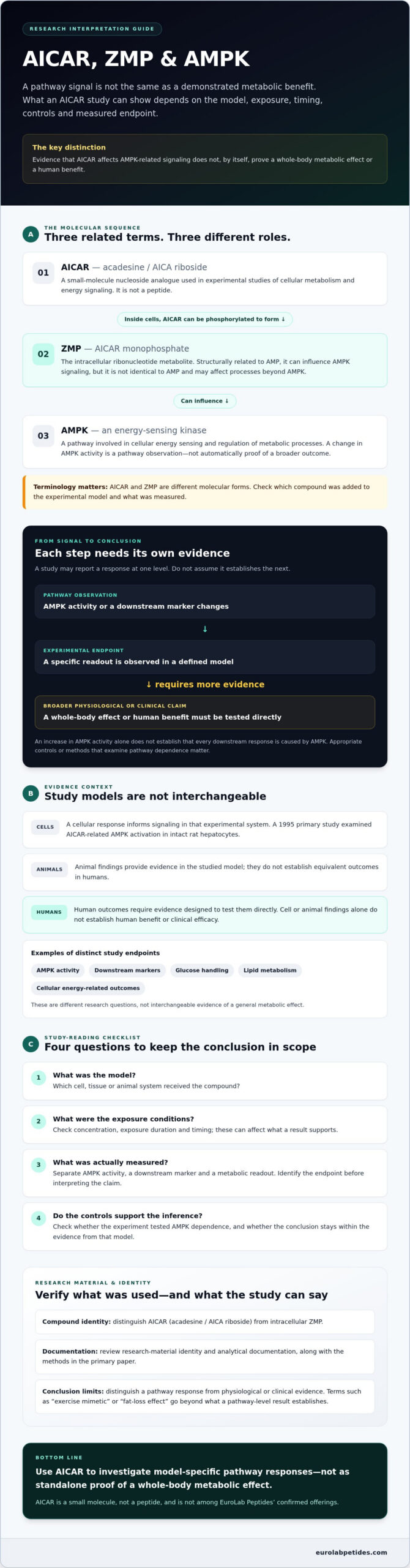
AICAR is a nucleoside analogue used in experimental studies of cellular metabolism and energy signaling. The name can be confusing: researchers and suppliers may use “AICAR” for acadesine, the riboside, while the phosphorylated molecule formed inside cells is ZMP. Keeping these compounds distinct helps clarify which material was used in an experiment and which intracellular effects were measured.
In brief: AICAR (acadesine) is a nucleoside analogue, ZMP is its intracellular ribonucleotide metabolite, and AMPK is an energy-sensing kinase pathway that ZMP can influence. The Acadesine (AICAR) overview summarizes the compound’s alternative name and background. Experimental interpretation still depends on the methods and evidence in primary research.
What do AICAR and ZMP refer to?
AICAR, also called acadesine or AICA riboside, is short for 5-aminoimidazole-4-carboxamide riboside. It is a small molecule, not a peptide. Within cells, it can be phosphorylated to form ZMP, short for 5-aminoimidazole-4-carboxamide ribonucleotide. ZMP is also called AICAR monophosphate and is structurally related to AMP, a cellular nucleotide.
These names refer to different molecular forms, not interchangeable labels for a single substance. When reviewing a paper, check which compound was added to the model and whether the study measured the intracellular metabolite or a downstream response.
Why do researchers investigate AICAR?
AMP-activated protein kinase (AMPK) is a kinase involved in cellular energy sensing and the regulation of metabolic processes. Because ZMP can influence AMPK signaling, AICAR gives researchers a way to examine pathway responses in defined experimental systems. A study may investigate a specific signaling event or metabolic readout, rather than an effect across an entire organism.
AICAR for metabolic research is a tool for studying model-specific responses, not proof of a treatment effect. Results can vary with the cell or animal model, experimental conditions, and endpoint. A change in an AMPK-related marker alone does not establish a corresponding change in whole-body metabolism, human benefit, or clinical efficacy. Those conclusions require evidence designed to test them directly.
How AICAR Connects to AMPK and Metabolic Signaling
The proposed sequence begins when AICAR enters a cell and is phosphorylated to ZMP. ZMP resembles AMP structurally and can interact with AMPK’s regulatory machinery, influencing the kinase’s activity. This makes ZMP relevant to AMPK research, but it is not a perfect proxy for AMP: the molecules differ, and ZMP may affect processes beyond AMPK.
How does ZMP relate to AMPK activation?
AMPK responds to cellular energy status through changes in nucleotide binding and phosphorylation. ZMP can mimic some AMP-related effects, including promoting AMPK activation, but an observed increase in AMPK activity does not by itself establish that every downstream response is caused by AMPK. To test pathway dependence, researchers need appropriate controls or methods that examine whether a response persists when AMPK signaling is disrupted.
Corton and colleagues’ 1995 primary study examined AICAR-related AMPK activation in intact rat hepatocytes. The model matters: a result in isolated liver cells informs cellular signaling, not automatically responses in other tissues or whole organisms. Downstream markers such as acetyl-CoA carboxylase (ACC) phosphorylation may be useful in a particular experiment, but their meaning depends on what the study measured and whether AMPK dependence was tested.
Which metabolic processes appear in AICAR studies?
Researchers may examine glucose handling, lipid metabolism, or cellular energy-related endpoints after AICAR exposure. These are distinct research questions, not interchangeable evidence of a general metabolic effect. For example, a glucose-uptake measurement in a cell or tissue preparation describes that preparation under its experimental conditions. It does not establish improved glucose regulation in humans.
For AICAR for metabolic research, interpret each result in sequence:
- Exposure: Which model received the compound, and under what conditions?
- Measurement: Was the endpoint AMPK activity, a downstream marker, glucose uptake, or another outcome?
- Inference: Did the experiment show AMPK dependence, or only a response observed alongside pathway activation?
AICAR can also influence cellular processes through effects that are not reducible to AMPK alone. That possibility limits broad claims based on a single marker and makes study design central to interpretation. Terms such as “exercise mimetic” or “fat-loss effect” go beyond what a pathway-level result establishes.
Keep reagent selection separate from interpretation of AICAR studies. For distinct in-vitro projects involving peptides, researchers can review EuroLab Peptides’ research peptide information. AICAR is a small molecule and is not a confirmed offering.
What AICAR Studies Can, and Cannot, Show
AICAR findings need to be read in the context of the model and the question the experiment was designed to answer. A signal in cultured cells may support a hypothesis about a pathway. An animal study can examine responses in an intact organism, but its findings remain specific to the species and protocol. Human studies of acadesine have examined other clinical questions, including cardioprotection during cardiac surgery. They do not establish metabolic or exercise-related benefits in people.
How should researchers interpret model-specific results?
Look for the species, cell type or tissue, exposure conditions, timing, and measured endpoint. For example, Narkar and colleagues’ 2008 study examined AICAR-related effects in mice, including exercise-associated outcomes. That animal model can inform hypotheses, but it cannot establish that the same response occurs in humans. A change in a biomarker is a measured result; a claim about whole-body physiology is an interpretation that requires further evidence.
| Evidence type | Can support | Cannot establish by itself |
|---|---|---|
| Pathway assay | A change in AMPK activity or a selected downstream marker under defined conditions | That AMPK caused every observed response, or that the response benefits an organism |
| Animal study | A response in the tested species, tissue, and protocol | Equivalent effects, safety, or efficacy in humans |
| Human study | Findings for its specific population, intervention, and clinical endpoint | Metabolic outcomes that the study was not designed to measure |
Why is AMPK activation not the whole story?
AMPK activation alongside an outcome does not prove that AMPK caused that outcome. Researchers can strengthen causal interpretation with appropriate controls, such as testing responses when AMPK signaling is disrupted, and with orthogonal methods that examine the same question in different ways. These steps help distinguish pathway dependence from correlation.
Caution is warranted because AICAR can have effects not attributable solely to AMPK. Višnjić and colleagues’ review of AICAR pharmacology discusses reported AMPK-independent actions, while Narkar et al. provide an example of preclinical work that must be interpreted within its mouse-model design. Such evidence does not invalidate pathway findings; it narrows what those findings can support.
For AICAR for metabolic research, keep conclusions matched to the data: specify the model, conditions, and endpoint, then label broader physiological implications as hypotheses unless they were directly tested. Avoid turning pathway activation into an established claim of fat loss, exercise mimicry, or clinical efficacy.
How to Evaluate AICAR Evidence and Research Materials
A disciplined review separates an experiment’s design from the conclusion drawn from it. For AICAR for metabolic research, trace the chain from the question being tested to the model, material, controls, measured endpoints, and limits of inference. Promotional summaries may omit details that affect interpretation, so consult the primary paper and its methods before relying on a headline or simplified claim.
Which details in a study should readers check first?
Start with the research question, then check the species or cell type, tissue, experimental context, and controls. Confirm exactly what was measured: a signaling marker, a cellular function, or a whole-organism outcome. These endpoints support different levels of inference.
Check concentrations, exposure periods, and sampling times in the paper itself. They describe that study’s conditions, not instructions or recommendations for other experiments. Also check whether the authors identify limitations, distinguish observed results from interpretation, and support causal claims with appropriate methods. If a summary leaves out these details, treat its conclusions cautiously.
What quality information matters for research reagents?
For any material under consideration, check that its stated identity matches the compound required by the protocol. Review available purity documentation, the analytical method used, and whether the records connect the documentation to the specific batch. These details help assess the material, but they do not guarantee compatibility with every assay.
A purity figure alone is not a complete quality assessment. The method behind the figure, what that method can establish, and batch traceability all matter. Check whether the documentation addresses identity as well as purity, rather than treating one reported metric as proof of suitability.
Use a consistent review sequence:
- Question and model: What is being tested, and in which system?
- Methods and controls: Are exposure conditions and comparisons clearly reported?
- Material: Do the identity and batch-specific analytical records match the compound required?
- Conclusion: Does the claim stay within the limits of the measured endpoints?
EuroLab Peptides describes in-house and independent third-party testing as part of its quality control for research peptides. AICAR is a small molecule and is not among the company’s confirmed offerings; its products are for in-vitro research and laboratory development only. To review information about the company’s research peptide offerings, visit EuroLab’s research peptide information.
AICAR, Peptides, and Responsible Research Next Steps
AICAR belongs to a different chemical category from peptides. It is a small-molecule nucleoside analogue studied in metabolic models, while peptides are molecules made from amino acid chains. The distinction matters for accurate literature searches, material identification, and supplier checks. AICAR for metabolic research should not be described as peptide research simply because it appears in listings alongside research peptides.
Is AICAR a peptide or a research peptide product?
No. AICAR is not a peptide. Its identity as a nucleoside analogue separates it from peptide compounds. The discussion of AICAR and its intracellular metabolite ZMP concerns a small-molecule research compound, not a peptide category or a treatment. Check the exact compound name and identity in primary papers and analytical records rather than relying on broad supplier labels.
EuroLab Peptides offers research peptides, but AICAR is not among its confirmed offerings. The company’s peptide categories and individual product information should be considered separately from research on AICAR. This avoids assuming that a compound is available simply because it is grouped with a product category.
What is a responsible next step for research readers?
Keep conclusions proportional to the evidence. Review primary literature for the model, experimental conditions, controls, endpoints, and stated limitations. If a project is being conducted within an institution, follow its applicable research oversight and material-handling requirements. Neither a pathway result nor a supplier description establishes human benefit or clinical efficacy.
For any research reagent, verify that the documented identity matches the intended material and assess the available analytical and batch information against the needs of the specific experiment. Product information cannot substitute for study methods, and quality documentation cannot expand what a study’s evidence supports.
EuroLab Peptides’ products are intended for in-vitro research and laboratory development only. They are not intended for human consumption or clinical use, and EuroLab does not sell pharmaceuticals or provide medical advice. AICAR is not a confirmed EuroLab offering.
For readers seeking peptide materials for separate laboratory projects, review EuroLab’s confirmed research peptide and quality information. This is a category-specific next step, not a source for AICAR.
Carry the Evidence Forward with Care
AICAR for metabolic research is best understood as a small-molecule probe for investigating AMPK-linked signaling, not as proof of a metabolic or clinical outcome. ZMP’s relationship with AMPK helps frame the mechanism, but pathway-level observations do not establish whole-organism effects. Conclusions depend on the model, exposure conditions, controls, and endpoints reported in each study.
Keep compound categories clear, too: AICAR is not a peptide, and it is not among EuroLab Peptides’ confirmed offerings. For research materials, assess identity and analytical documentation against the requirements of the specific project rather than relying on a single quality claim. EuroLab describes in-house and independent third-party laboratory testing as part of its quality control. Its products are designated for in-vitro research and laboratory development only, not human consumption or clinical use.
For details on EuroLab’s confirmed research-only products and quality information, review EuroLab Peptides’ product and quality information. Match evidence to the research question, and review EuroLab’s confirmed peptide offerings for separate laboratory projects.
Frequently Asked Questions
What is AICAR used for in metabolic research?
AICAR is used as an experimental compound to investigate cellular energy signaling and metabolic pathways, including AMPK-related responses. In AICAR for metabolic research, the relevant question is usually what changes in a defined cell, tissue, or animal model under the study’s conditions. Researchers should treat measured pathway or metabolic outcomes as model-specific findings, not evidence that AICAR produces the same effects in people.
How does AICAR activate AMPK?
After entering cells, AICAR can be converted into ZMP, a nucleotide that resembles AMP. ZMP can interact with AMPK’s regulatory system and influence kinase activity and signaling. This describes a proposed pathway mechanism, not a complete account of every response to AICAR. To determine whether a particular downstream effect depends on AMPK, researchers need suitable controls and evidence beyond observing AMPK activation alongside that effect.
Is AICAR a peptide?
No. AICAR, also known as acadesine or AICA riboside, is a small-molecule nucleoside analogue, not a peptide. Peptides consist of amino acid chains, so the terms refer to different chemical categories. This distinction matters when interpreting supplier descriptions or research literature: a listing that groups AICAR with peptides does not change its chemical identity or establish that a peptide supplier offers it.
What is the difference between AICAR and ZMP?
AICAR and ZMP are related but distinct molecules. AICAR is the nucleoside analogue introduced into an experimental system; inside cells, it can be phosphorylated to form ZMP, also called AICAR monophosphate. ZMP resembles AMP and is relevant to AMPK signaling. When reviewing a study, check whether it refers to the added compound, the intracellular metabolite, or measurements of downstream signaling.
Can AICAR research findings be applied to humans?
Not automatically. Cell and animal experiments test responses in specific models, and their results do not establish equivalent effects in humans. Human studies conducted for a different purpose also cannot demonstrate metabolic outcomes they were not designed to assess. Review each paper’s population or model, exposure conditions, duration, and measured endpoints. Claims about human metabolic benefits require direct human evidence addressing those outcomes.
Does AICAR only affect AMPK?
No. AICAR-related responses should not all be attributed to AMPK, because effects may occur through other mechanisms or pathways. An increase in AMPK activity alongside a change in another endpoint does not prove that AMPK caused that change. Researchers can assess pathway dependence using appropriate controls and complementary methods. Interpret conclusions according to what the experiments tested, rather than assuming one pathway explains every observation.
How should researchers assess an AICAR study?
Start with the research question and model, then check the compound identity, controls, exposure conditions, timing, and measured endpoints in the primary paper. Distinguish direct measurements, such as a pathway marker, from broader physiological interpretations. Review whether the authors address limitations and support causal claims. Concentrations and exposure periods describe the experiment; they are not recommendations for other studies or uses.
Does EuroLab Peptides sell AICAR?
AICAR is not among EuroLab Peptides’ confirmed offerings. It is a small molecule, whereas EuroLab is a supplier of research-grade peptides. The company describes in-house and independent third-party laboratory testing as part of its quality control. EuroLab’s products are intended for in-vitro research and laboratory development only, not for human consumption or clinical use. Consult the company’s confirmed product information for its current peptide offerings.
