

A purity percentage alone cannot establish peptide identity. Peptide quality control for academic institutions depends on complementary evidence: HPLC separates peptide-related components to estimate purity, while mass spectrometry compares measured molecular mass with the expected value to support identity assessment.
A clean chromatogram is useful, but it answers a different question from a molecular-weight result. HPLC separates and quantifies components, yet cannot definitively identify them. Mass spectrometry helps assess whether the peptide’s measured mass is consistent with its expected molecular weight. Neither result describes every quality attribute on its own.
This article explains how to interpret HPLC purity analysis and chromatograms, what mass spectrometry can establish about molecular weight, and why purity and net peptide content are distinct measures. It also shows how these results fit together when assessing research-use peptides, helping academic teams understand what the analytical evidence supports and where its limits lie.
Key Takeaways
- Use an HPLC chromatogram to assess separated peptide-related components, while treating its purity estimate as distinct from proof of identity.
- Compare a mass spectrometry result with the expected molecular weight to assess whether the peptide’s identity is consistent with the intended sequence.
- Interpret purity and net peptide content as different quality measures when considering how much peptide a sample contains.
- Explore how EuroLab Peptides’ Longevity & Vitality Research offering fits research focused on longevity-related questions.
HPLC purity analysis and chromatogram interpretation
Peptide quality control uses analytical HPLC to separate components and estimate purity, alongside mass spectrometry to assess molecular identity and weight. Together, these methods show whether a sample’s component profile and measured mass align with the intended peptide.
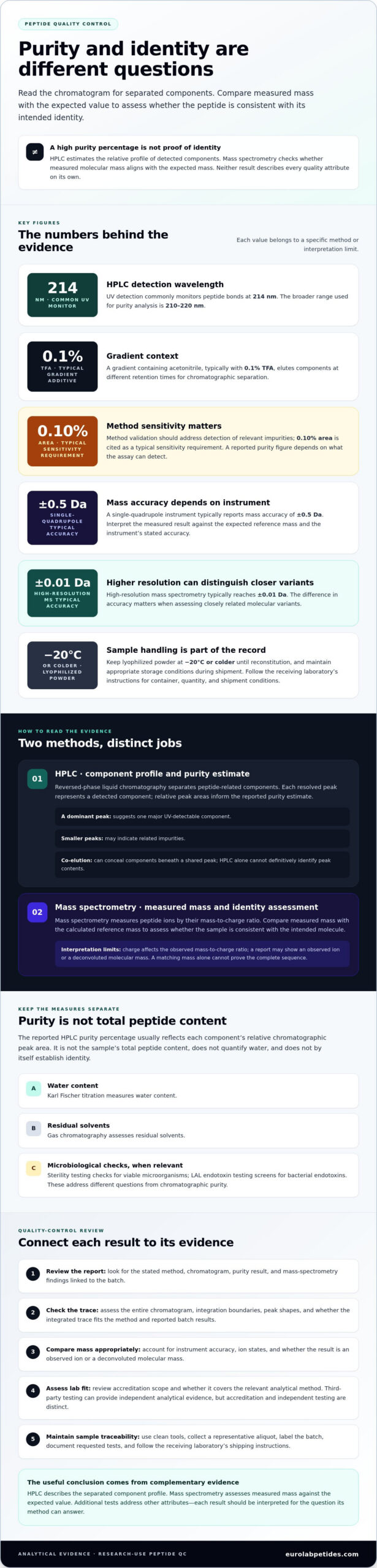
Reversed-phase liquid chromatography separates peptide-related components by their interactions with the stationary and mobile phases. UV detection commonly monitors peptide bonds at 214 nm, within the broader 210-220 nm range used for purity analysis. A gradient containing acetonitrile, typically with 0.1% TFA, elutes components at different retention times. In the chromatogram, each resolved peak represents a detected component; relative peak areas inform the reported purity estimate.
Interpret the entire trace, not just its largest peak. A dominant peak suggests one major UV-detectable component, while smaller peaks may indicate related impurities. Co-elution can conceal components beneath a shared peak, and HPLC alone cannot definitively identify peak contents. LC-MS combines separation and mass analysis, helping link chromatographic peaks to measured masses.
Automation can standardize sample injection, gradient delivery, and peak integration. Emerging LC-MS workflows pair chromatographic separation with mass analysis, while software-assisted review can flag inconsistent peak shapes or integration boundaries. Human review remains essential: analysts should compare the integrated trace with the method and the batch’s reported results.
A certificate of analysis or QC report is most useful when it links the batch to its analytical evidence. Review the stated method, chromatogram, purity result, and mass-spectrometry findings together: a purity percentage alone does not confirm identity. A QC panel may also include microbiological analyses when relevant to GMP products. Sterility testing checks for viable microorganisms, while LAL endotoxin testing screens for bacterial endotoxins. These tests address different questions from chromatographic purity and should be interpreted separately.
HPLC purity testing
High-performance liquid chromatography estimates peptide purity by separating a target peptide from detectable impurities. The reported percentage usually reflects each component’s relative chromatographic peak area, not the sample’s total peptide content. Method validation should address whether the instrument can detect relevant impurities; 0.10% area is a typical sensitivity requirement. A high purity result alone cannot establish identity or quantify water. A consistent approach to peptide quality control for academic institutions interprets the result against the assay’s requirements.
Laboratory accreditation provides evidence about testing competence and quality systems. ISO/IEC 17025 is the international standard for testing and calibration laboratories, according to the International Organization for Standardization. Third-party testing can add independent analytical evidence, particularly when an institution needs results separate from peptide synthesis or its internal quality process. Accreditation and independent testing are related but distinct: review the laboratory’s scope and whether it covers the relevant analytical method.
Academic peptide core facilities and commercial laboratories differ mainly in access, workflow, and analytical scope. A core facility supports research groups with shared institutional equipment and established local procedures. Commercial laboratories may provide dedicated analytical services and formal batch reports. Compare methods, sample requirements, reported data, and fit with the research question; neither setting is universally preferable.
How much does third-party peptide testing cost in the United States? The method panel and number of analyses determine what each quoted scope covers.
For lab selection, compare the report’s method, chromatogram, integration criteria, and instrument performance data. Karl Fischer titration measures water content, while gas chromatography assesses residual solvents. Collect a representative aliquot with clean tools, label the batch, and document requested tests. How should academic labs collect, store, and ship peptide samples for testing? Keep lyophilized powder at -20°C or colder until reconstitution, and maintain appropriate storage conditions during shipment. Follow the receiving laboratory’s instructions for container, quantity, and shipment conditions. Reliable peptide quality control for academic institutions depends on connecting these records to the sample tested.
Mass spectrometry and molecular-weight verification
Mass spectrometry measures peptide ions by their mass-to-charge ratio, supporting molecular-weight assessment and identity testing. Interpret results against the expected reference mass and analytical method.
Molecular-Weight Verification
Molecular-weight verification compares a peptide’s measured mass with its calculated reference mass. The comparison helps reveal whether the sample is consistent with the intended molecule, but matching mass alone cannot prove its complete sequence. A single-quadrupole instrument typically reports mass accuracy of ±0.5 Da; high-resolution mass spectrometry typically reaches ±0.01 Da. These differences matter when assessing closely related molecular variants.
Charge affects the observed mass-to-charge ratio, so interpretation accounts for the peptide’s ion states. A report showing only ±0.1% accuracy may reflect instrument limitations. Researchers should consider the instrument’s stated accuracy and whether the reported result is an observed ion or a deconvoluted molecular mass.
Sequence Confirmation by Mass Spectrometry
Sequence confirmation uses fragmentation patterns to assess whether the amino-acid order matches the intended sequence. Tandem mass spectrometry breaks selected peptide ions into smaller fragments; their measured masses can be compared with predicted fragments from a reference sequence. This provides more sequence-specific evidence than intact molecular weight alone.
Review which sequence regions the fragment data support and whether modifications affect interpretation. For example, two peptides can share an intact mass but differ in residue order. Fragment coverage helps distinguish them, although the strength of the conclusion depends on the data and analytical method.
Mass Spectrometry and Peptide Mapping
Peptide mapping analyzes fragments generated from a larger peptide or protein and compares their measured masses with expected map components. The resulting pattern can help assess sequence coverage, modifications, and molecular consistency across samples. This approach is useful when intact-mass analysis cannot resolve structural differences.
Nuclear magnetic resonance spectroscopy provides complementary structural evidence by measuring signals from nuclei in different chemical environments. Unlike mass spectrometry, NMR can inform assessments of molecular structure and conformation. In academic studies, reference-based mass analysis, peptide mapping, and NMR can address distinct identity questions; one measurement should not be treated as a substitute for another.
Quality control considerations for research-use peptides
Research peptide quality control should reflect the intended application, target, and consequences of analytical variation. In the United States, FDA classification, state requirements, and institutional procedures address different scopes. Local handling protocols also shape sample custody and documentation.
Rules for Research Peptide Testing and Handling
FDA, state, and institutional rules depend on the material’s intended use and regulatory category. The FDA definition describes peptides as polymers of 40 or fewer amino acids, but that definition alone does not establish handling requirements for every research sample. State requirements and institutional biosafety or chemical-hygiene procedures can govern local receipt, storage, and handling.
Separate research-use quality assessment from drug-substance specifications. USP-NF chapter <1503> addresses quality attributes of synthetic peptide drug substances; it is not a universal purity threshold for every academic experiment. For each batch, document its identity, intended application, storage conditions, and analytical results. This traceability helps distinguish a sample issue from assay variation or degradation during storage.
Purity Levels for Academic Research
Appropriate purity depends on the assay’s sensitivity and the study’s purpose. Research-use peptide purities may range from 70% to greater than 98%, depending on application. Above 70% may suit screening and research applications; above 85% may suit qualitative and semi-quantitative assays. These ranges guide selection, but they are not interchangeable acceptance criteria.
Quantitative assays and structural studies generally call for purity above 95%; purities of 95% or higher are generally recommended for in vivo studies. A project targeting precise concentration-response comparisons may therefore need a higher-purity material than an initial screen. Match the test method to the target question, and review identity and impurity data alongside the purity result.
Purity also differs from net peptide content. A 10 mg lyophilized sample may contain only 6-8 mg of actual peptide, so weighing the full powder mass can misstate the working concentration. A peptide powder with 75% net peptide content contains 75% peptide by weight. Account for that distinction when preparing quantitative samples, comparing batches, or interpreting experimental variation.
EuroLab Peptides: Longevity & Vitality Research
EuroLab Peptides offers Longevity & Vitality Research for studies focused on longevity-related questions. Its research-grade peptides undergo multi-level quality control, including in-house and independent third-party laboratory testing to assess purity and consistency. When selecting research material, academic teams should consider analytical evidence alongside the study’s purpose and assay requirements.
Choose this offering when a research project concerns longevity or vitality and requires peptide materials for scientific research. EuroLab Peptides also offers Weight Management Research, Tissue Repair & Recovery Research, and Cognitive Function Research. These categories align research materials with distinct areas of scientific inquiry, while experimental design and independent interpretation remain part of the institution’s research process.
For information about Longevity & Vitality Research, contact EuroLab Peptides or visit eurolabpetides.com.
Make Your Next Research Decision Evidence-Led
Make peptide quality control for academic institutions a consistent part of study planning by defining acceptance criteria before selecting research material. Align the criteria with the assay’s purpose, the identity evidence required, and how results will be interpreted. Recording the rationale helps research teams compare experiments more systematically.
For studies involving longevity, weight management, or tissue repair, EuroLab Peptides offers Longevity & Vitality Research, Weight Management Research, and Tissue Repair & Recovery Research. These research categories provide a relevant starting point for identifying materials in those areas of inquiry. Keep the experimental question central to selection and interpretation.
Continue planning your research with EuroLab Peptides’ research offerings. A clearly defined analytical approach gives your team a stronger basis for the next study.
Frequently Asked Questions
Identity: Is it the desired product?
Confirm identity by checking whether the analytical results match the intended peptide’s sequence, modifications, and expected molecular mass. For example, if two candidate peptides have the same intact mass, sequence-specific fragmentation can help distinguish them. Compare the batch label and analytical report with the exact target in the research protocol, including any specified terminal groups or modified residues.
Purity: How pure is the product?
Purity is the proportion of detected peptide-related components attributed to the target under the stated analytical method. Interpret the reported value in relation to the experiment: an exploratory screen may tolerate a different impurity profile from a quantitative comparison. Check whether the report identifies the method and includes chromatographic data, so you can assess the result in context rather than as an isolated percentage.
What is RP-HPLC?
RP-HPLC means reversed-phase high-performance liquid chromatography, a separation method commonly used to analyze peptides. Its stationary phase is relatively nonpolar, while the mobile phase changes composition to elute sample components. Differences in peptide interactions with these phases produce distinct retention behavior. Researchers use the resulting chromatogram to assess component separation and support a purity estimate, not as standalone proof of molecular identity.
What quality control tests are standard for research peptides?
A typical analytical panel can include chromatographic purity testing and mass spectrometry for identity assessment. Other tests depend on the research application and material requirements: amino acid analysis assesses composition, Karl Fischer titration measures water, and gas chromatography evaluates residual solvents. Endotoxin or sterility testing addresses separate concerns. A fit-for-purpose panel selects tests based on the assay instead of assuming every sample needs every analysis.
How do academic institutions verify peptide identity and purity?
Institutions compare batch documentation with the experiment’s predefined acceptance criteria, then assess whether the reported methods answer the study’s specific questions. For a functional assay, researchers might document the lot, analytical results, sample preparation, and assay conditions together. This record helps distinguish peptide-related variation from changes in experimental handling, instrument settings, or data analysis.
What documentation and certificates should institutions require from peptide suppliers?
Request batch-specific documentation identifying the material and reporting the analytical methods and results used for its quality assessment. Useful records include the certificate of analysis, chromatogram, mass-spectrometry result, stated purity, and batch identifier. For independent testing, retain the testing laboratory’s name and the report scope. Linking these documents to the received sample supports traceability through storage, preparation, and experimental use.
