
A peptide can pass sterility testing and still contain bacterial endotoxin: bacterial debris may remain after the bacteria are dead. Endotoxin testing for research peptides measures this contamination, rather than detecting live microbes. In UK laboratory research, there is no single regulatory mandate for endotoxin testing equivalent to pharmaceutical GMP requirements.
Sterility and endotoxin results answer different questions, so neither can replace the other. The relevant threshold depends on the research use: a level suitable for one study may interfere with sensitive cell-based work.
This article explains what bacterial endotoxin is, how contamination can occur, and which research-grade thresholds matter. It also distinguishes endotoxin assays from sterility testing and explains what UK research rules do and do not require.
Key Takeaways
- UK laboratory research has no single endotoxin-testing mandate equivalent to pharmaceutical GMP requirements; sterility and endotoxin tests assess different risks.
- Read a peptide certificate of analysis by checking the reported unit, assay method, detection limit and evidence that the sample did not interfere with the test.
- Choose an endotoxin threshold suited to the study: sensitive cell-based experiments may need tighter limits than general research applications.
- Finnrick notes that peptide samples with purity of 99% or more can still contain endotoxin that standard HPLC testing does not measure.
Is endotoxin testing required by UK research regulations?
UK laboratory research has no single regulatory mandate for endotoxin testing equivalent to pharmaceutical GMP requirements. USP <85> sets the US compendial bacterial endotoxin standard; it does not create a general UK research mandate. A research-use label alone doesn’t impose the sterility-testing requirements for regulated sterile medicinal products.
Sterility testing under USP <71> looks for viable microorganisms in tested samples. Methods include membrane filtration through pores no larger than 0.45 µm, or direct inoculation into culture media. Incubation typically takes 14 days. An endotoxin test instead detects bacterial lipopolysaccharide (LPS), a component of the membrane of gram-negative bacteria. It doesn’t confirm the absence of live yeast or mold.
A negative sterility result only speaks to the samples tested. It does not show that bacterial endotoxin is absent. Dead bacteria can leave LPS behind, so a sample may pass sterility testing yet affect a biological assay. The two tests address different risks and are not interchangeable.
USP <85> uses Limulus amebocyte lysate (LAL) in gel-clot, turbidimetric or chromogenic formats. USP <1085> provides endotoxin-test guidance, while USP <86> covers bacterial endotoxin testing using recombinant reagents. These are US pharmacopeial references, not a single UK research rule. Endotoxin testing can produce results within hours, unlike the 14-day USP <71> incubation.
In the United States, testing costs depend on the assay format, sample matrix and validation work; turnaround depends on the method and required controls. Endotoxin testing often takes hours, while sterility testing requires 14 days of incubation.
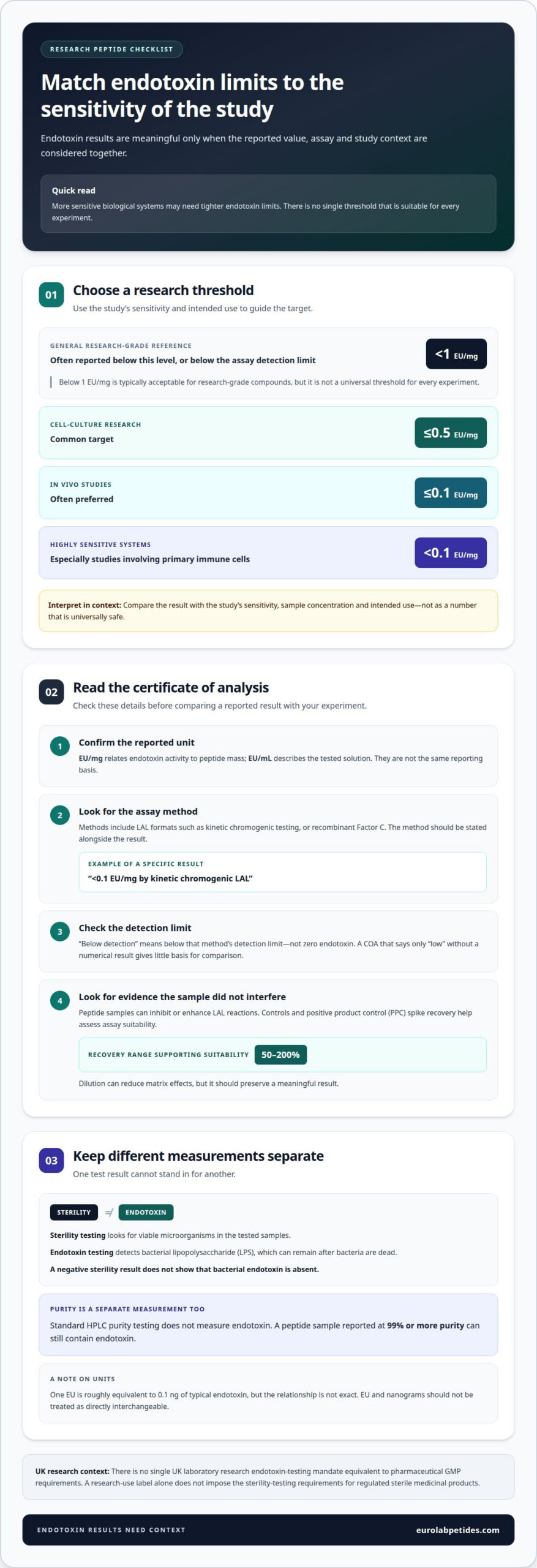
Peptide samples can inhibit or enhance LAL reactions, distorting quantitative results. Laboratories assess interference with controls and positive product control (PPC) spike recovery. A recovery range of 50-200% supports assay suitability; dilution can reduce matrix effects while preserving a meaningful result.
US analytical laboratories use LAL or recombinant Factor C methods for endotoxin testing. The sample quantity depends on the assay, dilution and control requirements, so no single amount applies across laboratories. Reported results should identify the method and detection limit, not simply describe endotoxin as “low.”
What thresholds matter for endotoxin levels?
Endotoxin units (EU) express biological activity, not peptide mass. One EU is roughly equivalent to 0.1 ng of typical endotoxin, but the relationship isn’t exact. Lipopolysaccharide from the outer membrane of gram-negative bacteria can trigger different responses across assays, so EU and nanograms shouldn’t be treated as directly interchangeable.
A certificate of analysis (COA) is useful only when its result matches the question your study asks. Check whether the result is reported as EU/mg of peptide or EU/mL of sample. These units differ: EU/mg relates activity to peptide mass, while EU/mL describes the tested solution. A COA stating “low” without a numerical result gives little basis for comparison.
Research-grade peptide endotoxin is often reported as < 1 EU/mg or below the assay’s detection limit. Below 1 EU/mg is typically acceptable for research-grade compounds, but it isn’t a universal threshold for every experiment. Cell-culture research commonly targets ≤0.5 EU/mg; in vivo studies often prefer ≤0.1 EU/mg. Highly sensitive systems, especially those involving primary immune cells, may need levels below 0.1 EU/mg.
For a COA, read the method beside the result. “<0.1 EU/mg by kinetic chromogenic LAL” identifies both the reported level and assay. A recombinant Factor C method measures endotoxin without horseshoe-crab lysate; assay choice can affect how results are generated. Also examine the detection limit: “below detection” means below that method’s limit, not zero endotoxin.
A COA cannot establish suitability for every biological model. Peptide purity and endotoxin are separate measurements; standard HPLC purity testing does not measure endotoxin. Compare the reported value with the study’s sensitivity, sample concentration and intended use, then interpret it against a relevant threshold rather than treating one number as universally safe.
Manufacturing, storage, and handling contamination risks
Endotoxin contamination can enter during manufacture or handling and persist after bacteria die. It can confound biological results by triggering inflammatory responses unrelated to the peptide’s intended experimental effect.
Contamination During Manufacturing
Manufacturing contamination occurs when bacterial material enters a peptide or remains on equipment and materials. Purity and endotoxin are separate measurements: a peptide reported at 99%+ purity can still contain endotoxin that standard HPLC testing doesn’t measure. Autoclaving sterilizes glassware and tools but doesn’t depyrogenate them. Validated dry-heat treatment may depyrogenate compatible glassware, but effectiveness depends on the load, temperature distribution and exposure.
After release, sample preparation and transfer can introduce new contamination. For endotoxin testing, use an appropriate sample dilution and controls; the justified dilution depends on matrix interference and assay suitability. In a demonstrated example, 1:5 dilution reduced interference, while 1:10 dilution produced acceptable positive product control recovery. These are example outcomes, not universal preparation settings.
Contamination Panel Considerations
A contamination panel combines tests that detect different hazards; no single result covers every contaminant. An endotoxin assay targets bacterial LPS, while microbial enumeration can assess bioburden. European Pharmacopoeia chapter 2.6.12 covers microbial enumeration tests, including total aerobic microbial count (TAMC) and total yeast and mold count (TYMC). Fungal beta-glucans can also cause false-positive LAL results.
To validate a peptide assay, include appropriate controls and a positive product control (PPC) spike. Recovery between 50-200% documents assay validation; low recovery suggests inhibition, while high recovery can indicate enhancement. Interpret the sample result only alongside spike recovery and a justified dilution.
When interpreting a testing panel, match each test to the study’s risks: endotoxin testing will not identify live yeast or mold, and sterility testing will not measure residual endotoxin. Filtration is generally inefficient at removing endotoxin when proteins are present, so it should not be treated as proof of endotoxin removal. A precise panel makes the scope of each result clear.
Research-grade peptide endotoxin thresholds
Research-grade peptide results need a study-specific interpretation, not a universal pass mark. A commonly used benchmark is below 1 EU/mg, but sensitive systems involving primary immune cells may require below 0.1 EU/mg. These values describe research contexts, not a general regulatory limit for every peptide or experiment.
Start by defining the model’s sensitivity and exposure conditions. Endotoxin can alter immune-cell activity, so a level tolerated in a less sensitive assay may confound a primary-cell experiment. The relevant factor is not peptide purity alone; it is the endotoxin amount introduced at the working concentration and the biological endpoint being measured.
Units also affect interpretation. EU/mg expresses endotoxin relative to peptide mass, while EU/mL describes the tested solution. Converting between them requires the peptide concentration. For example, a solution at 2 mg/mL with a result of 0.05 EU/mL corresponds to 0.025 EU/mg. Keep the original units and concentration alongside any conversion.
The K/M equation defines endotoxin limits for applicable parenteral products, where K is the threshold exposure and M is the maximum dose. It isn’t a default research-peptide threshold. In a simplified assay example, a 1.0 EU/mL limit and 0.01 EU/mL assay sensitivity produce a maximum valid dilution of 100. The calculation shows whether dilution preserves the ability to assess the stated limit.
Method selection matters, too. Limulus amebocyte lysate (LAL) assays detect bacterial endotoxin through reactions linked to the bacterial membrane; recombinant Factor C offers a non-animal-based assay approach. A gel-clot result gives a threshold-based pass or fail, while quantitative kinetic methods report measured levels. Compare results only when the method, units, detection limit and sample concentration are clear.
For research applications, define the threshold from the model’s sensitivity, then select an assay that can measure it. Explore research peptide options from EuroLab Peptides in relation to your study focus.
EuroLab Peptides: Longevity & Vitality Research
EuroLab Peptides supplies research-grade peptides for studies including Longevity & Vitality Research. Its research areas also include Weight Management Research, Tissue Repair & Recovery Research, and Cognitive Function Research. These offerings are relevant when your project requires peptide materials aligned with a defined research focus.
Endotoxin thresholds depend on the experimental model, assay sensitivity and intended use. Select research materials with those study requirements in mind, and interpret quality data according to the method and measured attribute it represents. EuroLab Peptides uses in-house and independent third-party laboratory testing as part of its quality-control process, supporting attention to product purity and consistency.
Contact EuroLab Peptides to discuss its research offerings.
Set Your Next Research Decision on Clear Evidence
Build your next study around a defined research question and the measurements needed to interpret its results. A clear plan helps distinguish material selection from assay suitability, so each decision supports the experimental design rather than relying on a single quality label. For endotoxin testing for research peptides, align the evidence you need with the biological model and research objective.
EuroLab Peptides’ research areas include Longevity & Vitality Research, Weight Management Research, and Tissue Repair & Recovery Research. These categories are relevant when choosing materials for a study focused on those fields. Keep the project’s scope and the information needed to assess its materials at the centre of that choice.
Contact EuroLab Peptides about peptide research to explore relevant research offerings and take your next step with a clearly defined study objective.
Frequently Asked Questions
What is bacterial endotoxin?
Bacterial endotoxin is lipopolysaccharide (LPS), a component of the outer membrane of gram-negative bacteria. It can remain biologically active after bacteria die. In experimental systems, endotoxin may stimulate monocytes and macrophages to release inflammatory mediators such as TNF, IL-1 and IL-6. That response can become an unintended variable, especially when a study measures immune signalling or inflammation.
Can a sterile sample still contain endotoxin?
Yes. A sterile sample can contain endotoxin because sterility testing looks for viable microorganisms, not residual bacterial LPS. A passing result applies to the tested sample and does not establish that every portion of a batch is free of endotoxin. For example, a negative sterility result alone cannot explain an unexpected inflammatory response in a cell assay.
Why are endotoxins relevant to research peptide use?
Endotoxins matter because they can change biological responses that a peptide study aims to measure. If a cell experiment tracks cytokine release, LPS-driven TNF, IL-1 or IL-6 may complicate interpretation of the peptide’s effect. Record the sample concentration and endotoxin result alongside experimental conditions. This helps distinguish a peptide-associated response from an endotoxin-related confounder.
How are endotoxins measured?
Endotoxin assays measure activity using methods such as Limulus amebocyte lysate (LAL) or recombinant Factor C. LAL formats include gel-clot, kinetic turbidimetric and kinetic chromogenic assays. The signal indicates endotoxin relative to the method’s calibration and detection limit. A useful result therefore identifies the assay method, units and detection limit, rather than reporting only a qualitative description.
How can endotoxins enter a peptide sample?
Endotoxin can enter during production if bacterial material contacts process equipment, water, reagents or the peptide solution. Contamination can also occur during sample handling if materials are not clean. Because LPS may persist after bacteria are no longer viable, removing or killing live bacteria does not necessarily remove endotoxin. The source and timing of contamination affect which controls are informative.
How do peptides become contaminated with endotoxins?
Peptides can become contaminated when bacterial debris remains in materials or contacts them during manufacturing, transfer or laboratory handling. A high peptide-purity result does not rule this out because purity analysis and endotoxin assays measure different properties. For instance, standard HPLC analysis may characterise peptide-related purity without detecting LPS, so the relevant contaminant requires its own assay.
