

More than 80 peptides have FDA approval, including insulin, oxytocin, and GLP-1 agonists, but approval for some peptides doesn’t mean every compound attracting attention has comparable clinical evidence. The future of peptide research in 2026 will depend on distinguishing established therapeutics from investigational peptides and early-stage findings. That difference matters especially in discussions of metabolism and weight management.
It’s reasonable to see rapid progress in peptide science and still question the strength of the evidence for a particular peptide. Assess each compound on its own research record rather than treating “peptides” as a single category.
This article explains how research quality varies, what evidence says about metabolic and weight-management research, and how AI may influence peptide discovery. It also covers the regulatory landscape and the difference between approved therapies and findings still under investigation.
Key Takeaways
- Separate approved peptide therapeutics from investigational compounds by looking at the stage and type of evidence behind each claim.
- Compare evidence peptide by peptide: study design, human data, and independent quality testing can change how much a finding tells you.
- Understand why metabolism and weight management are major research areas, while distinguishing established GLP-1 therapies from emerging candidates.
- See how AI could help identify and refine peptide candidates, while recognizing that computational predictions still need experimental and clinical validation.
Clinical evidence and variation in research quality
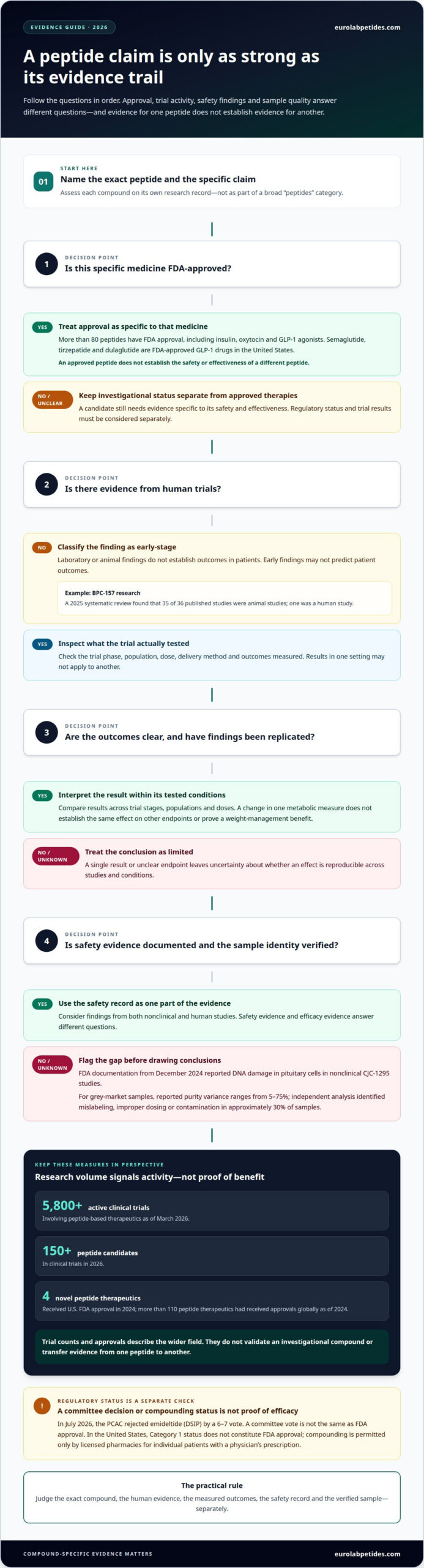
Peptide therapeutics are established medicines as well as active research candidates. More than 80 peptides have FDA approval, including insulin, oxytocin, and GLP-1 agonists. Compared with small-molecule drugs, peptides are chains of amino acids; biologics form a broader class of medicines that includes larger, structurally complex molecules. These categories differ in structure and development, so evidence for one peptide cannot establish efficacy for another.
Approval and clinical adoption depend on evidence for a specific medicine, not on the peptide category as a whole. Four novel peptide therapeutics received U.S. FDA approval in 2024, while more than 110 peptide therapeutics had received approvals globally as of 2024. Those figures show established clinical use, but they don’t mean investigational compounds have passed the same safety and effectiveness assessment. Regulatory status and trial results must be considered separately.
The scale of ongoing work is substantial: more than 5,800 active clinical trials involved peptide-based therapeutics as of March 2026, and more than 150 peptide candidates were in clinical trials in 2026. Trial counts indicate research activity, not proof of benefit. To assess evidence, distinguish laboratory or animal findings from human trials, then examine the trial phase, outcomes measured, and whether results were replicated. Each step answers a different question about safety or effectiveness.
For readers asking which peptide therapies may reach trials or approval in 2026, the outlook anticipates multiple Phase I/II clinical-trial filings in metabolic disease, oncology, and immunology. That is a pipeline forecast, not a list of named approvals. Semaglutide, tirzepatide, and dulaglutide are FDA-approved GLP-1 drugs in the United States; new candidates still require years of clinical trials demonstrating safety and effectiveness. The future of peptide research in 2026 therefore turns on compound-specific evidence, not wellness claims or trial volume alone.
Evidence quality for individual peptides
Evidence and safety vary by compound, so a finding about one peptide cannot establish the clinical value of another. Study design, safety records, and regulatory status all shape what results can tell us about patients.
Safety Evidence and Research Gaps
Safety evidence is the set of findings used to assess a peptide’s potential harms, including results from nonclinical and human studies. Its depth matters because early findings may not predict outcomes in patients. A 2025 systematic review found that 35 of 36 published BPC-157 studies were animal studies, with one human study. FDA documentation from December 2024 reported DNA damage in pituitary cells in nonclinical CJC-1295 studies.
Regulatory consideration also differs by peptide. In July 2026, the PCAC rejected emideltide, also called DSIP, by a 6-7 vote. The committee’s experts proposed not adding reviewed peptides to the 503A Bulks List, citing gaps in effectiveness and safety evidence. A committee vote is not the same as FDA approval, and pharmacies’ compounding status does not establish a treatment’s clinical efficacy.
Efficacy and Drug-Resistance Challenges
Efficacy evidence measures whether a peptide produces a meaningful effect under defined study conditions. Results may vary by population, dose, delivery method, and outcome, so findings in one setting may not apply to another. Evidence for an approved diabetes therapy, for example, does not automatically support claims about a different peptide.
Drug resistance is a separate challenge in antimicrobial peptide science: microbes can adapt in ways that reduce susceptibility, making repeat testing important. For other peptide research, the central concern is whether effects remain reproducible across studies and conditions. Grey-market quality adds another evidence problem: reported purity variance ranges from 5-75%, and independent analysis identified mislabeling, improper dosing, or contamination in approximately 30% of samples. Oversight and demand do not replace compound-specific data; assess study methods and verified sample identity before interpreting a result.
Potential uses in weight management and metabolism
Metabolic disorders were the largest application segment in the peptide therapeutics market in 2025, driven by GLP-1 therapies. That position connects weight-management research with wider questions about metabolic regulation. In 2026, peptide therapeutics are expected to continue advancing in metabolic disease, but each candidate still requires evidence specific to its intended use.
GLP-1 therapies provide an established example of peptide-based medicines used in this area. Research on newer candidates can examine different mechanisms and outcomes, but a metabolic effect in one study does not establish weight-management benefit. Trial designs must define the population, comparison group, and endpoints clearly. Measures may include changes in body weight or metabolic markers, assessed over a stated period.
Clinical trials help distinguish a promising biological signal from a reproducible outcome. Researchers compare results across trial stages, populations, and doses, while evaluating benefits and adverse events. A candidate that affects one metabolic measure may not have the same effect on other endpoints. These distinctions matter when interpreting early findings or comparing compounds.
Compounding and drug approval are also distinct considerations. In the United States, Category 1 status does not constitute FDA approval; compounding is permitted only by licensed pharmacies for individual patients with a physician’s prescription. This regulatory status does not turn investigational research into evidence of effectiveness. Patients and readers should separate legal compounding conditions from clinical-trial results.
For research decisions, assess the exact peptide, study stage, measured outcome, and sample identity. Market demand for metabolic applications can draw attention to compounds whose human evidence remains limited. Previously reported findings should be evaluated against later clinical trials, not treated as settled conclusions. In 2026, the field’s progress depends on whether new metabolic candidates produce consistent, clinically meaningful results under rigorous study conditions.
AI in peptide discovery
AI can help researchers prioritize peptide candidates before laboratory testing. A typical workflow encodes amino acid sequences, predicts structural or functional properties, and ranks candidates for experimental evaluation. Models can also compare proposed sequences with known peptides and approved drugs. These outputs can guide research decisions, but they are not clinical evidence or regulatory approval.
Prediction quality depends on the input data and the question being modeled. A model trained on activity measurements can rank candidates for that endpoint, but inconsistent labels may distort its results. Researchers should document the sequence data, assay conditions, and decision criteria behind each prediction. A predicted interaction, for example, needs testing in a relevant laboratory assay before it can be treated as a biological effect.
Experimental feedback makes AI more useful. Researchers can test selected sequences, record measured outcomes, and use those results to refine later predictions. This cycle connects computation with laboratory science instead of treating an algorithm’s ranking as a result. Licensed laboratories can generate controlled assay data, while independent review can help assess whether selected candidates perform consistently.
AI may also help assess properties relevant to development, such as stability, solubility, or potential interactions. Each property requires appropriate testing: a computational estimate alone does not establish safety, efficacy, or suitability for patients. Global peptide research can benefit from well-described shared datasets, provided researchers account for differences in measurement methods and sample quality.
For researchers, the practical question is how each AI-selected candidate moves from prediction to reproducible testing. Keep model outputs distinct from clinical-trial results, and treat scientific guidance as a framework for evaluation rather than evidence of approval. To connect peptide research questions with relevant study areas, explore EuroLab Peptides research offerings.
EuroLab Peptides: Longevity & Vitality Research
EuroLab Peptides offers Longevity & Vitality Research for studies of peptide applications in longevity. Related research areas include Weight Management Research, Tissue Repair & Recovery Research, and Cognitive Function Research. These offerings are a practical next step when your work moves from evaluating evidence to selecting research-grade peptides for a defined study area.
Quality assessment matters when selecting research materials. EuroLab Peptides uses in-house and independent third-party laboratory testing as part of a multi-level quality control process focused on purity and consistency. These measures support research use; they do not establish clinical efficacy or make products suitable for human consumption.
For information about research offerings, visit EuroLab Peptides.
Turn research questions into a defined next step
The future of peptide research in 2026 will be shaped not only by new computational tools, but by how carefully research teams turn hypotheses into testable questions. Define the biological question, identify the outcome that would address it, and select research materials aligned with that scope. This keeps candidate selection connected to study design rather than broad claims or passing trends.
Before a project advances, define how samples, methods, and results will be documented. Clear records make findings easier to interpret and compare with later work. For AI-assisted discovery, distinguish model-generated predictions from experimentally measured results. This discipline helps keep research decisions transparent as new tools and candidates emerge.
For projects focused on longevity, metabolism, or tissue recovery, EuroLab Peptides offers Longevity & Vitality Research, Weight Management Research, and Tissue Repair & Recovery Research. These offerings align with distinct study areas. To discuss your research needs, contact EuroLab Peptides. A clearly framed research question is a strong starting point for the work ahead.
Frequently Asked Questions
What is The Current Regulatory Peptide Landscape?
In the United States, peptide status depends on whether a compound is an approved drug or considered for compounding. Category 1 status isn’t FDA approval; it permits compounding by licensed pharmacies for individual patients with a physician’s prescription. Category 2 identifies substances on a restricted list. The FDA’s bulk drug substance framework has three categories, so a committee recommendation alone doesn’t establish a peptide’s approval or clinical status.
What could the future look like?
The pipeline could bring more peptide candidates into early clinical testing, particularly for metabolic disease, oncology, and immunology. Progress will depend on whether laboratory findings translate into trial outcomes that support safety and effectiveness. AI may help prioritize candidates, while advances in synthesis could support development. For each compound, the meaningful milestones remain study results and regulatory decisions, not predictions about future applications.
What’s Driving Growth in the Peptide Therapeutics Market?
Metabolic disorders were the largest application segment in 2025, driven by GLP-1 therapies. Peptides are also being studied across areas such as oncology, immunology, and tissue repair, broadening the potential research pipeline. Growth also reflects work on synthesis methods and candidate discovery. Market expansion signals investment and activity, but it doesn’t show that every peptide candidate has proven clinical value.
Which peptides might undergo the biggest regulatory shifts?
BPC-157, MOTS-c, KPV, TB-500, Semax, and epitalon were among peptides considered by the PCAC in July 2026. Committee votes favored adding forms of these peptides to the 503A Bulks List, while emideltide, also called DSIP, was rejected by a 6-7 vote. These recommendations are part of a regulatory process, not equivalent to FDA drug approval.
What are the biggest peptide research trends for 2026?
Three notable trends are continued metabolic-disease research, AI-assisted candidate selection, and exploration of alternative synthesis approaches. Cell-free and enzymatic peptide synthesis is forecast to grow at an 8.40% CAGR. Researchers are also assessing candidates across oncology and immunology. For practical evaluation, distinguish platform or market growth from clinical evidence about a specific peptide and its intended use.
How are AI and machine learning changing peptide discovery and design?
AI and machine learning can analyze peptide sequences, predict properties, and rank candidates for laboratory testing. Researchers can compare predictions with measured results and use them to refine later model outputs. A predicted interaction, for example, needs experimental testing before it can support a biological claim. This workflow helps organize discovery, but an algorithmic prediction is not a clinical result, an approved drug, or evidence of efficacy.
