

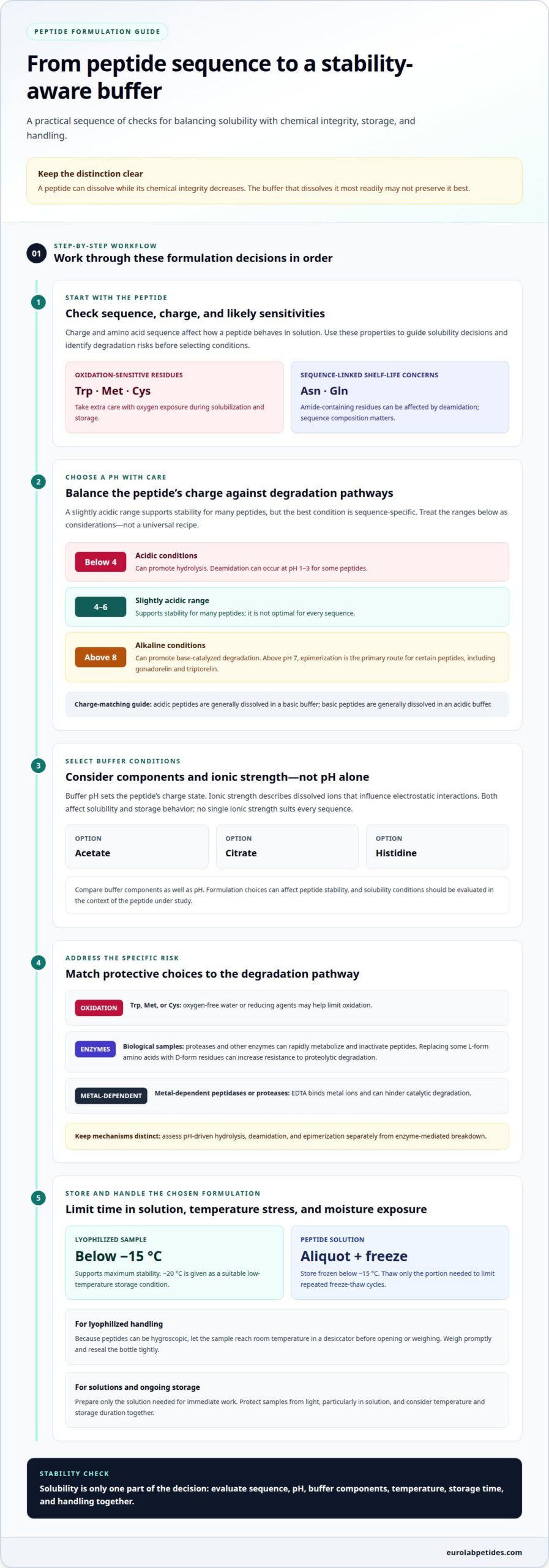
The buffer that dissolves a peptide most readily may not preserve it best. Peptide stability in different buffers depends on pH, sequence, and the degradation pathways those conditions favor. For many peptides, a slightly acidic range around pH 4-6 supports stability, while conditions below pH 4 can promote hydrolysis and conditions above pH 8 can promote base-catalyzed degradation.
Solubility and stability are related, but they are not the same: a peptide’s charge and amino acid sequence affect how it behaves in solution. This article explains how pH can influence peptide structure and degradation, how to match buffer conditions to acidic or basic peptides, and why residues such as Trp, Met, and Cys need particular care because they are susceptible to oxidation. It also covers practical factors in buffer selection and solubilization, so you can evaluate formulation choices in the context of the peptide under study.
Key Takeaways
- Choose buffer pH by considering both peptide solubility and the degradation reactions that condition may promote.
- Lyophilized peptides are generally more stable than peptide solutions, so storage state and handling can affect sample integrity.
- Sequence matters: amino acid composition influences oxidation, deamidation, and susceptibility to enzymatic breakdown.
- Compare buffer components as well as pH when planning solubilization, since formulation choices can affect peptide stability.
What is peptide stability and why is it important?
Peptide stability describes how well a peptide retains its chemical integrity during storage and use. Its physical form, temperature, storage duration, and buffer conditions all matter.
Stability in Lyophilized and Solution Forms
Lyophilization removes water from a peptide sample, leaving a dry form that is generally more stable than a prepared solution. Dissolving a peptide begins a different storage phase, in which temperature and buffer conditions can influence degradation. Peptides containing Trp, Met, Cys, Asn, or Gln may have limited shelf life, so consider the sequence when planning storage.
Peptides can also be hygroscopic: absorbed water may reduce stability and the overall peptide content. Before opening or weighing a lyophilized sample, let it reach room temperature in a desiccator. Weigh it promptly, then reseal the bottle tightly. These steps limit moisture exposure during handling.
Temperature and Storage Time
Lower storage temperatures support peptide stability: store lyophilized samples below -15 °C for maximum stability. For example, -20 °C is a suitable low-temperature storage condition. Peptide solutions should be divided into aliquots and stored frozen below -15 °C. The longer a peptide remains in solution, the more time its sequence and buffer conditions have to influence degradation.
When assessing stability in different buffers, consider temperature and storage time together. A buffer that supports solubility does not, by itself, prevent degradation during prolonged storage. Prepare only the solution needed for immediate work, and keep remaining aliquots frozen.
Aliquoting also limits repeated freeze-thaw cycles: thaw only the portion needed instead of repeatedly warming the full solution. Protect samples from light during handling and storage, particularly in solution. Frozen aliquots, limited thawing, and reduced light exposure help keep sample conditions consistent.
Chemical and enzymatic peptide degradation
Peptide degradation can alter a molecule’s sequence, structure, or biological activity. Buffer pH is a major factor: acidic conditions below pH 4 can promote hydrolysis, while alkaline conditions above pH 8 can promote base-catalyzed reactions. These pathways matter because a peptide may remain dissolved while its chemical integrity decreases.
Deamidation changes amide-containing residues, including asparagine, and depends on both pH and temperature. For some peptides, deamidation can occur at pH 1-3. Changing a formulation from pH 7.4 to pH 5 can slow certain pathways, including asparagine deamidation. Temperature also changes reaction rates: deamidation can proceed faster at 37 °C than at 4 °C.
Other sequences respond through different mechanisms. Above pH 7, base-catalyzed epimerization is the primary degradation route for certain peptides, including gonadorelin and triptorelin. Epimerization changes an amino acid’s configuration, so the resulting peptide can differ from the intended sequence even when its amino acid composition appears unchanged.
Enzymatic breakdown is another risk in biological samples. Proteases and other enzymes in blood or biological matrices can rapidly metabolize and inactivate peptides. Replacing some L-form amino acids with D-form residues can increase resistance to proteolytic degradation, because enzymes may recognize these altered structures less readily.
Metal-dependent enzymes can also be addressed through formulation choices. Ethylenediaminetetraacetic acid, or EDTA, binds metal ions and can form complexes with metal-dependent peptidases or proteases, hindering catalytic degradation. The relevant mechanism depends on the peptide and its environment. When interpreting stability across buffer conditions, assess pH-driven hydrolysis, deamidation, and epimerization separately from enzyme-mediated breakdown.
Buffer selection for peptide solubilization
Effective solubilization requires matching buffer conditions to the peptide’s charge and sequence. The buffer must also support chemical stability.
Buffer pH and Ionic Strength
Buffer pH sets the peptide’s charge state, while ionic strength describes dissolved ions that influence electrostatic interactions. Both properties affect solubility and storage behavior. For many peptides, a slightly acidic pH around 4-6 is identified as an optimal stability range, but this isn’t universal.
Acidic peptides are generally dissolved in a basic buffer, while basic peptides are generally dissolved in an acidic buffer. No single ionic strength suits every sequence; charge distribution and solubility determine appropriate conditions. Acetate, citrate, and histidine are among the buffer options to consider when designing a formulation.
Buffer Components and Degradation
Buffer components can influence degradation as well as dissolution. Peptides containing Trp, Met, or Cys need care because these residues are susceptible to oxidation. Oxygen-free water or reducing agents may help limit this pathway. Assessing peptide stability in different buffers means considering sequence and oxygen exposure alongside pH.
Hydrolysis and deamidation are also shaped by pH. Conditions below pH 4 can promote hydrolysis, while deamidation can affect amide-containing residues. A buffer’s pH, temperature, and storage duration shape the environment in which these reactions occur. A change in pH can therefore alter the balance between solubility and chemical integrity.
Additives and Peptide Stability
Additives can alter specific degradation pathways, so choose them according to the risk being addressed. Reducing agents may help limit oxidation in peptides containing Trp, Met, or Cys. Oxygen-free water is another option for reducing oxygen exposure during solubilization.
Chelators such as ethylenediaminetetraacetic acid bind metal ions and can hinder catalytic degradation by metal-dependent peptidases or proteases. Preservatives require peptide-specific compatibility assessment; their presence alone does not establish stability. Ammonium sulfate, potassium phosphate, and sodium citrate are listed as salts that may promote stability against thermal shock.
Sequence and Modification Compatibility
The sequence determines which chemical risks deserve attention. Trp, Met, and Cys call for oxidation control, while peptides containing Asn or Gln may have limited shelf life. As a result, two peptides can respond differently to the same buffer, even at the same pH.
Modifications also change peptide properties, including charge and susceptibility to enzymes. Replacing some or all L-form amino acids with D-form residues can reduce susceptibility to proteolytic degradation. To assess peptide stability in different buffers, match the buffer’s acidity or basicity to the peptide’s overall character, then consider whether its sequence or modifications introduce specific stability concerns.
Which buffer components can cause peptide oxidation, hydrolysis, or deamidation?
Buffer composition affects peptide integrity through pH, dissolved oxygen, and interactions with sequence-sensitive residues. No buffer name alone predicts degradation: acetate, citrate, or histidine must be considered alongside the formulation’s acidity and the peptide itself. Acidic conditions below pH 4 can promote hydrolysis, while alkaline conditions above pH 8 can promote base-catalyzed reactions. These effects arise from the chemical environment, not simply from using a named buffer.
Oxidation risk is especially relevant for peptides containing tryptophan (Trp), methionine (Met), or cysteine (Cys). Oxygen exposure can contribute to oxidation of these residues and change the peptide’s chemical identity. Oxygen-free water or a suitable reducing agent may help limit this pathway during preparation. For example, a formulation containing Met warrants attention to oxygen exposure as well as buffer pH. Choose a reducing agent that is compatible with the peptide and intended analytical method.
Hydrolysis and deamidation require separate consideration. Acidic conditions below pH 4 can promote hydrolysis, while deamidation can occur for some peptides at pH 1-3. Asparagine-containing sequences are particularly relevant when evaluating deamidation. A buffer’s pH, temperature, and storage duration shape the environment in which these reactions occur. A change in pH can therefore alter the balance between solubility and chemical integrity.
For a practical assessment, link each suspected pathway to a specific formulation feature. First, identify oxidation-sensitive residues such as Trp, Met, or Cys. Then assess whether dissolved oxygen, extreme acidity, or alkalinity could contribute to the observed change. Finally, compare the peptide’s behavior in the selected buffer with its behavior in a compatible alternative. This approach helps distinguish pH-related degradation from oxidation and grounds buffer selection in the peptide sequence and formulation conditions.
EuroLab Peptides
EuroLab Peptides supplies research-grade peptides for scientific work in areas including Longevity & Vitality Research, Weight Management Research, Tissue Repair & Recovery Research, and Cognitive Function Research. When buffer selection and degradation mechanisms inform your study design, the next step is to source research materials suited to your area of investigation.
Product quality is assessed through a multi-level process that includes in-house and independent third-party laboratory testing for purity and consistency. These controls support researchers evaluating peptide materials for defined research applications, while buffer composition and storage conditions remain part of the experimental protocol.
For research-grade peptide supply aligned with your study area, contact EuroLab Peptides.
Build the Next Study Around Stability
Make buffer selection a defined part of experimental design. Record the peptide sequence, formulation conditions, storage state, and analytical readout used to assess change. This creates a consistent basis for comparing future samples and interpreting whether observed differences reflect degradation or another variable.
For studies involving peptide materials, the research objective should guide sourcing as well as formulation decisions. EuroLab Peptides supports Longevity & Vitality Research, Weight Management Research, and Tissue Repair & Recovery Research. Matching the research area to the intended experimental work gives the next stage a clearer focus. A structured approach to peptide stability in different buffers helps keep formulation choices connected to that purpose.
Contact EuroLab Peptides for support with your research requirements and take the next step with a clearly defined study plan.
Frequently Asked Questions
How does pH affect peptide structure and degradation?
pH changes the protonation state of ionizable groups, which can alter a peptide’s charge and molecular interactions. These shifts may affect folding, aggregation, or solubility, as well as chemical reaction rates. For example, a pH change can alter interactions between charged side chains. Assess structural changes separately from chemical degradation, since a peptide can change conformation without its sequence being cleaved.
What are the most common causes of peptide instability?
Common causes of instability include unsuitable pH, temperature exposure, oxidation, hydrolysis, deamidation, enzymatic breakdown, and physical loss through adsorption or aggregation. The dominant cause depends on the sequence and formulation. For example, a sample with less measurable peptide after handling may have experienced surface adsorption rather than chemical degradation. Comparing recovery from different container materials with an analytical control can help distinguish physical loss from chemical change.
What methods are used to measure and improve stability?
Assess stability by tracking intact peptide and degradation products over time with methods such as HPLC and mass spectrometry. For a useful comparison, keep peptide concentration, sample handling, and analytical conditions consistent while varying one formulation factor. Improvement means reducing the measured change under the intended storage or experimental conditions. Include an initial measurement as a baseline so later results can be interpreted against the same sample.
How does buffer pH affect peptide stability?
Buffer pH defines the chemical environment around the peptide and can influence both charge and reaction pathways. A practical evaluation compares candidate pH conditions using the same peptide and analytical method, then tracks changes in the intact-peptide signal. Also consider whether the buffer maintains its target pH during the experiment, since pH drift can make differences between samples difficult to interpret.
How do phosphate, Tris, HEPES, and acetate buffers compare for peptide stability?
No buffer is universally best; suitability depends on peptide behavior, target pH, and the downstream assay. Acetate is one option for peptide formulations, while phosphate, Tris, and HEPES should be evaluated under the intended conditions. For LC-MS, nonvolatile salts such as phosphate can complicate ionization and instrument cleanliness. Compare buffer-only blanks with peptide samples to distinguish analytical interference from instability.
How can peptide stability be measured in different buffers using HPLC or mass spectrometry?
Prepare matched peptide samples in each buffer, then analyze them at baseline and after the selected storage interval. HPLC can compare the intact-peptide peak with new or enlarged peaks; mass spectrometry can help identify mass changes in degradation products. Keep injection conditions consistent and include buffer blanks. If salts interfere with mass spectrometry, use a compatible sample preparation step before analysis.
