

REACH sets the central framework for chemical risk management in the EU: Regulation (EC) 1907/2006, according to the European Union. Substances manufactured or imported above 1 tonne per year per company must be registered with the European Chemicals Agency, although specific exemptions can apply. The European Union regulations on research chemicals therefore depend on more than a compound’s intended research use.
It’s reasonable to expect one EU-wide framework to provide a simple answer, but chemical compliance depends on the substance, its annual volume, the activity involved and national controls. A research and development exemption, for example, has defined conditions and does not automatically remove every obligation.
This article explains how REACH manages chemical risks, which substances may require registration, when research and development provisions may apply, and why country-specific controls matter. It also separates EU-wide rules from national measures, helping you identify the regulatory questions to address before a research chemical is manufactured, imported or used.
Key Takeaways
- Assess a substance’s form, quantity and role to understand which REACH registration duties may apply.
- SR&D provisions have specific conditions; distinguish them from broader exemptions and authorisation or restriction rules.
- EU-wide chemical rules don’t replace national controls, so a compound’s status can differ between countries.
- Separate regulatory analysis from research goals to identify when research-grade offerings in longevity, weight management, tissue repair or cognitive function are relevant.
EU REACH regulation and chemical risk management
The European Union identifies REACH as Regulation (EC) 1907/2006 and CLP as Regulation (EC) No. 1272/2008. Together, they address chemical risk and hazard communication.
REACH Registration Requirements
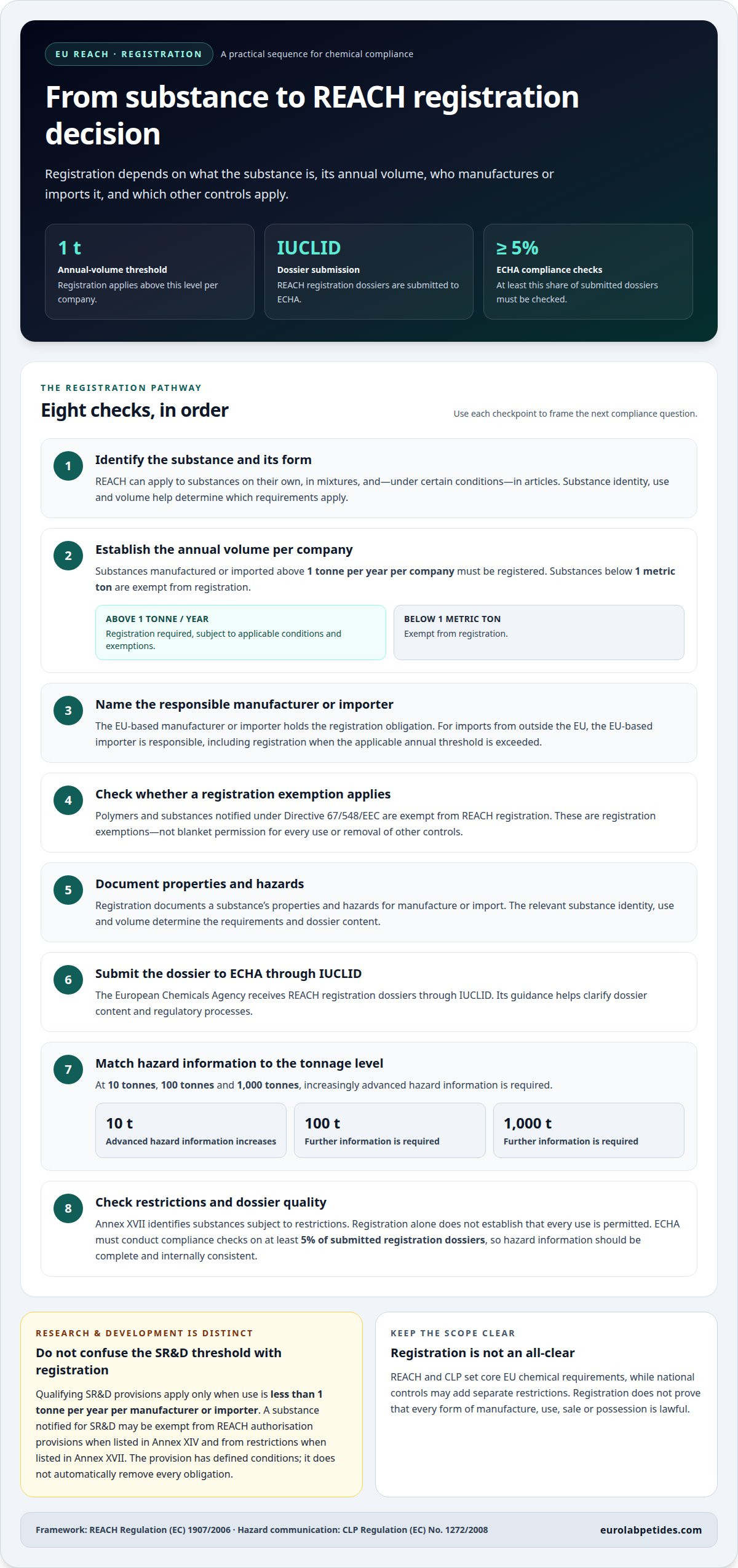
REACH registration documents a substance’s properties and hazards for manufacture or import. Substances exceeding 1 tonne per year per company must be registered, while substances below 1 metric ton are exempt from registration. The EU-based manufacturer or importer holds the registration obligation. These thresholds make annual volume and the responsible entity central to compliance decisions.
Registration applies to substances on their own, in mixtures and, under certain conditions, in articles. Dossiers are submitted to the European Chemicals Agency through IUCLID. At 10 tonnes, 100 tonnes and 1000 tonnes, increasingly advanced hazard information is required. Annex XVII identifies substances subject to restrictions, so registration alone doesn’t establish that every use is permitted.
Regulatory Guidance and Assistance
The European Chemicals Agency provides regulatory guidance and receives REACH registration dossiers through IUCLID. Its guidance helps clarify dossier content and regulatory processes; the relevant substance identity, use and volume determine which requirements apply. ECHA must conduct compliance checks on at least 5% of submitted registration dossiers, making complete, internally consistent hazard information important.
For controlled-substance information, the European Monitoring Centre for Drugs and Drug Addiction tracks new psychoactive substances, while the United Nations Office on Drugs and Crime is involved in international drug scheduling. These sources address different aspects of control. REACH and CLP remain the main EU frameworks for chemical registration and hazard communication.
Nanomaterials have specific REACH provisions. The European Commission adopted Regulation (EU) 2018/1881 to modify technical annexes and introduce nano-specific provisions. The described EU definition covers nanomaterials no larger than 100 nm. The European Commission adopted its nanomaterial definition recommendation in 2011 and reviewed it in 2022, details that help frame substance identification.
For imports from outside the EU, REACH obligations fall on the EU-based importer, including registration when the applicable annual threshold is exceeded. Enforcement also depends on national law, and penalties vary according to the rules in the relevant member state. REACH and CLP set core EU chemical requirements, while national controls may add separate restrictions.
Registration obligations for chemical substances
REACH obligations depend on the substance’s form, regulatory history and intended activity. The rules can apply to substances on their own or in mixtures, and, under certain conditions, to substances in articles. The EU registration framework therefore covers more than a single pure compound or laboratory container.
Some categories have distinct treatment. Polymers are exempt from REACH registration, and substances notified under Directive 67/548/EEC are exempt from registration. These exemptions concern registration specifically; they shouldn’t be read as blanket permission for every use or as removal of other applicable controls.
Registration also differs from market restrictions. REACH Annex XVII lists substances subject to restrictions, so a substance’s presence on the market doesn’t establish that every use is allowed. Substances of Very High Concern, or SVHCs, raise separate communication duties when present in articles. Under Article 33, consumers have a right to know whether products contain harmful chemicals; companies must reply to a consumer inquiry about an SVHC in an article within 45 days.
Germany applies national controls alongside EU chemical rules. Its New Psychoactive Substances Act is known as the NpSG, and 1V-LSD has been controlled in Germany under analogue provisions. This illustrates why a substance’s chemical identity alone may not settle its status: national controls can address compounds through legal categories beyond REACH registration.
There is no single EU-wide permit that automatically authorises the manufacture, sale or possession of every research chemical. Relevant REACH registration duties still apply, and restrictions or national controlled-substance laws may impose further requirements. Obligations depend on the substance, activity and country, so registration alone does not prove that every form of handling or possession is lawful.
SR&D exemptions from restrictions and authorisation
REACH contains specific provisions for scientific research and development (SR&D), but these exemptions have defined limits. Their application depends on the activity, annual quantity and whether the substance appears in a regulated annex.
SR&D Exemptions
SR&D provisions can exempt qualifying research uses from specified REACH requirements, which matters when a substance is subject to authorisation or restriction. The SR&D provision applies only when use is less than 1 tonne/year per manufacturer or importer. A substance notified for SR&D is exempt from REACH authorisation provisions when listed in Annex XIV, and from REACH restrictions when listed in Annex XVII.
Chemical substances used for research and development may be exempt from REACH registration, but that does not exempt every research activity from all controls. Separate PPORD provisions have no tonnage limit, but apply for a specified duration, which may be extended, and to a specified customer list. A supplier may begin manufacture or import for a PPORD after ECHA confirms that the notification dossier has passed its completeness check. The applicable route depends on these criteria, not simply on labelling an activity as research.
Authorisation Requirements
REACH authorisation applies to specified uses of substances of very high concern (SVHCs) listed in Annex XIV. This creates a question separate from registration: whether the planned use is covered by an applicable authorisation or exemption.
For a listed substance, the activity and use determine whether authorisation provisions apply; an SR&D exemption is conditional on notification and the stated criteria. Safety data sheets communicate substance hazards and safe handling information. The European Commission updated REACH Annex II with Regulation (EU) 2020/878, introducing new Safety Data Sheet provisions. Those provisions inform SDS authoring, while an SDS itself does not replace an authorisation where one is required. Research documentation should therefore distinguish the substance’s annex status, the purpose of the work and the relevant notification.
Country-specific controls in Italy, Czech Republic, and Poland
European Union regulations on research chemicals establish shared chemical frameworks, but they do not make national controlled-substance laws identical. For work involving Italy, the Czech Republic or Poland, assess EU chemical obligations separately from each country’s controls. A research purpose alone does not determine whether national restrictions apply.
Begin the country assessment with the exact chemical identity and planned activity. Then distinguish chemical hazard requirements from rules governing possession, supply or research. The same substance may fall under different legal categories, so a conclusion about REACH or CLP alone cannot establish its status under every national law.
The Czech Republic maintains a specific list of controlled substances. This national reference is distinct from EU frameworks, not a substitute for them. For a practical assessment, record the substance identity, destination country and activity, then consider the relevant national category. This helps prevent treating a control in one jurisdiction as automatically applicable elsewhere.
For Italy and Poland, use the same jurisdiction-by-jurisdiction method rather than inferring rules from another member state. European Union regulations on research chemicals provide a common starting point, while national legislation determines additional controls. If the destination or activity changes, reassess the legal position rather than carrying over a conclusion from a different country.
Keep each conclusion tied to the relevant jurisdiction and research plan. Depending on the issue, an agency or national competent authority may have a role in implementing chemical rules. Record which framework supports each conclusion to distinguish EU chemical compliance from country-specific controls and plan cross-border research more precisely.
EuroLab Peptides
EuroLab Peptides supplies research-grade peptides for scientific research, including studies related to longevity, weight management, tissue repair and cognitive function. Its offerings are a relevant next step when you have assessed regulatory requirements separately and your project aligns with these research areas.
A multi-level quality-control process includes in-house and independent third-party laboratory testing for purity and consistency. These measures provide quality-related information, but do not determine whether a substance’s manufacture, import, possession or use complies with EU or national law. Regulatory status depends on the applicable rules for the specific substance and country.
If your research aligns with these areas, contact EuroLab Peptides to discuss its research-grade offerings.
Move from regulatory review to research planning
Regulatory analysis and research-material selection are separate decisions. After assessing the legal requirements for a specific substance and country, define the research objective and identify materials suited to the work. European Union regulations on research chemicals provide a compliance framework, but do not replace a project-specific assessment of applicable national controls.
EuroLab Peptides offers research-grade materials for Longevity & Vitality Research, Weight Management Research and Tissue Repair & Recovery Research. These offerings may suit projects in those areas, but do not determine whether a compound is lawful for a particular activity or jurisdiction.
Keep the regulatory assessment distinct from the scientific question, and base each decision on the information relevant to it. To discuss research-grade offerings for your project, contact EuroLab Peptides. A clear research objective is a practical place to begin.
Frequently Asked Questions
How does the EU classify research chemicals and new psychoactive substances?
EU rules do not create one universal “research chemical” classification. CLP covers chemical hazard classification and communication, while new psychoactive substance controls concern scheduling and national control status. The distinction matters: a hazard classification describes chemical risks but does not establish whether a compound is controlled as a psychoactive substance. The European Monitoring Centre for Drugs and Drug Addiction tracks new psychoactive substances, while national lists inform country-specific controls.
How do REACH and CLP apply to research chemicals in the EU?
REACH governs the management of chemical substances, while CLP covers hazard classification and communication when chemicals are placed on the market. For mixtures, an assessment may need to consider both constituent substances and hazard communication for the mixture. Articles can also trigger REACH obligations under certain conditions. These frameworks address different issues, so compliance with one does not by itself resolve the other.
What rules govern labeling, safety data sheets, packaging, and online sales of research chemicals?
CLP sets the EU framework for communicating chemical hazards through classification and labelling, while REACH Annex II sets out Safety Data Sheet provisions. An online listing does not replace applicable hazard information or an SDS. Packaging and online-sale obligations depend on the product and its classification; a web listing alone does not establish that a substance may be sold or used for a particular purpose.
How do EU research-chemical regulations differ from national laws in member states?
EU frameworks set common chemical requirements, but national controlled-substance laws may impose separate controls. Germany, for example, applies its New Psychoactive Substances Act, while the Czech Republic maintains a specific list of controlled substances. The same compound and research purpose therefore require a country-specific assessment. A rule in one member state does not establish the compound’s legal status in Italy, Poland or another state.
What restrictions apply to research chemicals used for legitimate scientific research?
A scientific purpose doesn’t automatically remove REACH duties or national controls. The SR&D provision applies only when use is less than 1 tonne/year per manufacturer or importer; exemptions related to Annex XIV or Annex XVII depend on notification and the relevant listing. PPORD is a separate route with duration and customer-list conditions. The applicable route depends on the substance, activity, quantity, and country.
