

The agonist with the strongest clinical profile is not automatically the most informative choice for in vitro research. In cell-based experiments, compare each compound’s structure and receptor activity with the assay endpoint and experimental model.
Comparing GLP-1 agonists for in vitro research means separating properties that matter in the dish from clinical outcomes and dosing schedules. This distinction helps keep experimental comparisons focused: a regimen used in patients doesn’t directly establish an appropriate concentration or exposure period for a laboratory model.
This article compares GLP-1 agonists across glucose regulation, weight-management research, comparative effectiveness, molecular features, and clinical dosing context. It also explains how exendin-4-based and human GLP-1-based compounds differ, and why those structural differences may matter when interpreting receptor-response data. The result is a framework for selecting relevant comparators and understanding what each comparison can, and cannot, show.
Key Takeaways
- Separate clinical glucose and weight-management outcomes from the endpoints your in vitro assay measures.
- Use comparative effectiveness evidence to frame differences between agonists, while accounting for dose-related activity and tolerability findings.
- Consider whether an agent is exendin-4-based or human GLP-1-based when interpreting structure and receptor-response results.
- Treat approved clinical dosing schedules as context, not as direct guidance for selecting in vitro concentrations or exposure conditions.
Blood glucose control and weight management
GLP-1 receptor agonists connect glucose regulation with appetite and body-weight outcomes, but these endpoints should be separated in experimental interpretation. Their insulinotropic effect is glucose-dependent, while effects on food intake and gastric emptying can influence weight-related outcomes. In a cell model, insulin secretion and glucose uptake therefore answer different questions from changes in adipocyte lipid storage or hepatocyte metabolism.
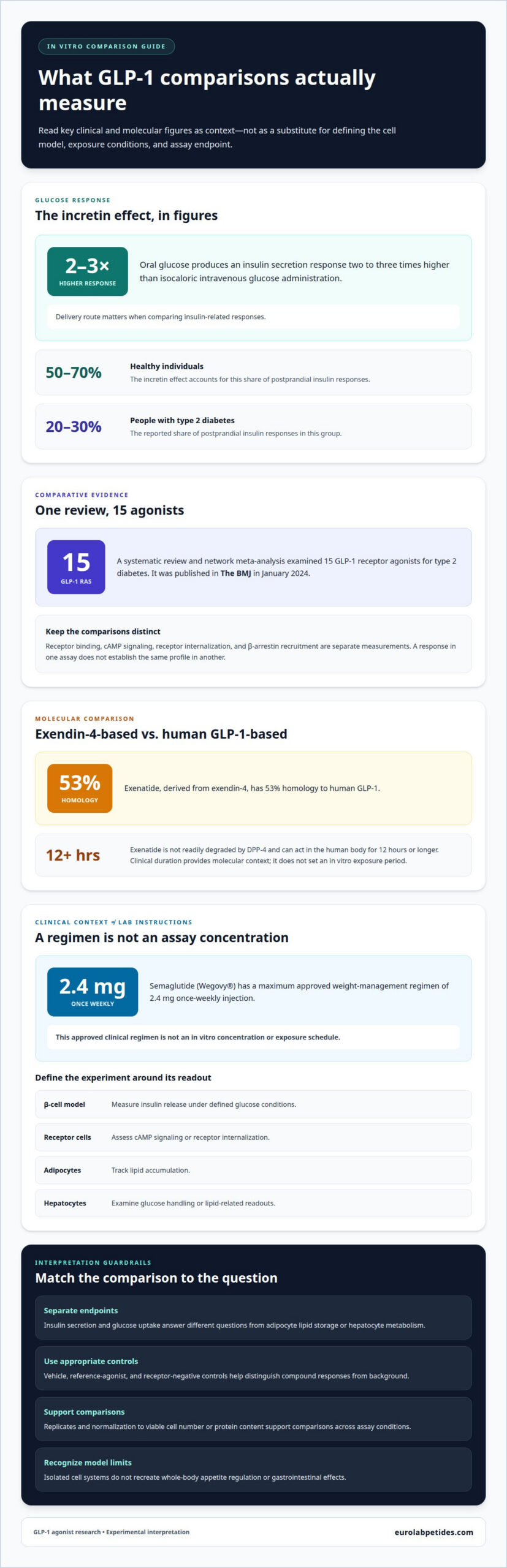
For clinical context, semaglutide (Wegovy®) has a maximum approved weight-management regimen of 2.4 mg once-weekly injection. That regimen is not an in vitro concentration or exposure schedule. In laboratory comparisons, glucose availability, cell type, exposure time, and the measured endpoint shape how responses are interpreted. An adipocyte assay might track lipid accumulation, while a hepatocyte assay could examine glucose handling or lipid-related readouts.
GLP-1 activity may affect adipose tissue and liver metabolism indirectly through altered insulin and glucagon signaling, appetite, and energy balance. These whole-body pathways are not reproduced by an isolated cell system. For example, a change in hepatocyte glucose output cannot by itself establish a weight-management effect. Pairing tissue-specific assays with clear metabolic endpoints helps distinguish direct cellular responses from effects that depend on interactions across organs.
Clinical modeling also frames the difference between initial weight reduction and long-term maintenance. A proposed approach uses GLP-1 receptor agonists first, then transitions patients to lower-cost weight-maintenance alternatives. A study published in Health Affairs Scholar in May 2024 modeled alternative maintenance programs; its conclusion concerned healthcare spending and clinical benefits, not cellular mechanisms. Separately, a study published in Nature Cardiovascular Research in April 2024 modeled four diabetes-medication classes among patients at moderate cardiovascular risk. These models help define clinical context, while in vitro work isolates mechanisms rather than predicting lifetime outcomes.
Oral glucose intake produces an insulin secretion response two to three times higher than isocaloric intravenous glucose administration, making delivery route relevant when comparing insulin-related responses. A Phase II double-blind randomized controlled trial of liraglutide in early Parkinson’s disease lasted 14 months. The researchers’ model suggested that switching from GLP-1 receptor agonists to alternative weight-maintenance programs would reduce lifetime healthcare spending substantially, while decreasing clinical benefits only slightly.
Comparative effectiveness of GLP-1 receptor agonists
Effectiveness depends on the measured endpoint, including receptor signaling, insulin secretion, or appetite-related outcomes. For comparing GLP-1 agonists for in vitro research, define whether the experiment tests a cellular mechanism or places findings in clinical context.
Incretin and Pancreatic Cell Effects
The incretin effect describes increased insulin secretion after oral glucose compared with isocaloric intravenous glucose. Oral intake produces an insulin response two to three times higher; the effect accounts for 50% to 70% of postprandial insulin responses in healthy individuals and 20% to 30% in people with type 2 diabetes.
GLP-1 receptor activation affects pancreatic β-cell insulin secretion and α-cell glucagon signaling. Measure both outputs under defined glucose conditions to distinguish insulinotropic activity from glucagon-related effects. Central nervous system control of appetite and satiety involves systems that isolated pancreatic cell assays don’t reproduce.
Receptor Signaling Comparisons
Compare receptor binding alongside cAMP signaling, receptor internalization, and β-arrestin recruitment. These are distinct measurements, so an observed response in one assay doesn’t establish the same profile in another. A systematic review and network meta-analysis examined 15 GLP-1 receptor agonists for type 2 diabetes and was published in The BMJ in January 2024.
Clinical gastrointestinal effects, such as nausea and vomiting, are not measured by receptor-binding assays. Higher agonist concentrations may increase efficacy while also producing stronger side effects clinically, so keep dose and endpoint distinct when interpreting results.
In Vitro Comparison Methods
Use pancreatic β-cell models to measure insulin release, and receptor-expressing cells to assess cAMP or receptor internalization. Vehicle, reference-agonist, and receptor-negative controls help distinguish compound responses from background. Replicates and normalization to viable cell number or protein content support comparisons across assay conditions.
A disciplined approach to comparing GLP-1 agonists for in vitro research also accounts for limits: cell systems don’t recreate whole-body appetite regulation or gastrointestinal effects. Research-grade prices vary by compound and quantity; supplier differences include analytical documentation and batch consistency. Price alone doesn’t establish potency.
Exendin-4-based and GLP-1-based agents
Exendin-4-based and human GLP-1-based agents differ in molecular sequence, creating a useful structural comparison for receptor studies. Exenatide, derived from exendin-4, has 53% homology to human GLP-1. That distinction can inform assay selection: researchers may compare receptor activation across agents while keeping cell model, exposure conditions, and measured endpoint consistent.
Exendin-4 was identified in Gila monster saliva in 1992 by Dr. John Enn. Exenatide is not readily degraded by dipeptidyl peptidase-4 (DPP-4), and it can act in the human body for 12 hours or longer. These properties provide context for comparing molecular stability and activity, but clinical duration alone doesn’t establish how a compound will behave in a cell assay. In vitro exposure should be interpreted within the model’s design.
Formulation also affects the duration associated with exenatide. The listed duration for exenatide immediate-release (IR) is 2-3 hours, while exenatide extended-release (ER) is listed at 2 weeks. Those regimen-level descriptions differ from the reported 12 hours or longer of activity in the human body. Keep formulation and measurement context distinct rather than treating the values as interchangeable measures of receptor signaling.
For a controlled comparison, identify whether the question concerns sequence, receptor response, or exposure behavior. A receptor assay can compare signaling under matched conditions; a stability-focused experiment addresses degradation; and a formulation comparison asks a different question. Include exenatide IR or ER only when formulation is relevant to the study design. Human GLP-1-based agents provide a contrasting class, but comparisons remain interpretable only when assay conditions and endpoints are aligned. Clinical dosing intervals should not be used as direct substitutes for laboratory exposure schedules.
Structural features and dosing of GLP-1 agonists
Clinical dosing regimens describe patient treatment, not concentrations or exposure periods for cell experiments. Keep those contexts separate when interpreting potency, stability, and assay response.
Agent Potency and Selectivity
Potency describes the concentration-dependent response at a receptor, while selectivity concerns activity across receptor targets. Compare semaglutide, liraglutide, exenatide, dulaglutide, and tirzepatide in matched receptor assays with clearly stated endpoints. Regimen data alone do not establish a potency ranking or selectivity profile. In vitro interpretation depends on assay conditions, including receptor expression and the signaling response measured.
Experimental Concentrations and Durations
Experimental concentrations and treatment durations are assay-design variables, not clinical dosing conversions. Select conditions based on the cell model, endpoint, and response range being measured; keep exposure conditions consistent across compounds. No single concentration range or treatment duration applies to every GLP-1 agonist cell experiment.
For clinical context, listed maximum approved regimens include:
- Exenatide IR (Byetta®): 10 μg twice daily injection; exenatide ER (Bydureon®): 2 mg once weekly injection.
- Dulaglutide (Trulicity®): 4.5 mg once weekly injection; lixisenatide (Adlyxin®): 20 μg once daily injection.
- Liraglutide: 1.8 mg once daily injection for type 2 diabetes (Victoza®), and 3.0 mg once daily injection for obesity (Saxenda®).
- Semaglutide: 2 mg once weekly injection for type 2 diabetes (Ozempic®), 2.4 mg once weekly injection for weight management (Wegovy®), or 14 mg once daily oral (Rybelsus®).
- Tirzepatide (Mounjaro®): 15 mg once weekly injection for type 2 diabetes; albiglutide (Tanzeum®): 50 mg once weekly injection.
Structure, Stability, and Activity
Albumin binding, molecular stability, and protease resistance can affect how much active compound remains available during an assay. Interpret responses in light of these properties and the experimental conditions. Clinical schedules do not specify stock preparation or storage conditions. Follow product-specific instructions for preparing and handling stock solutions, and use consistent procedures across comparison groups.
EuroLab Peptides
EuroLab Peptides supports research programs guided by defined study goals and experimental planning. Its research areas include Longevity & Vitality Research, Weight Management Research, Tissue Repair & Recovery Research, and Cognitive Function Research. These areas offer context for researchers studying peptide-based approaches to broader metabolic or physiological questions.
For studies comparing GLP-1 agonists, distinguish the compounds and assay endpoints from the wider research area. EuroLab Peptides supplies research-grade peptides and uses in-house and independent third-party laboratory testing as part of its quality-control process, supporting attention to purity and consistency. This can be relevant when selecting materials for research applications, while clinical dosing and laboratory assay design remain separate considerations.
Contact EuroLab Peptides to discuss research needs related to its research areas.
Put Your Comparison Framework to Work
Translate the comparison into a study question with a clear answer. Define the response of interest, then align the cell model and assay with that endpoint. This keeps clinical context separate from evidence generated in vitro and gives the experiment a practical foundation.
For teams comparing GLP-1 agonists for in vitro research, a focused plan can also connect peptide research with broader areas, including Longevity & Vitality Research, Weight Management Research, and Tissue Repair & Recovery Research. These research areas provide context, while the experimental design remains specific to each laboratory question.
When a project calls for research-grade peptide support, contact EuroLab Peptides to discuss your research needs. A clearly defined endpoint gives the work a disciplined starting point and helps keep interpretation aligned with the assay. Build the next comparison around the question your model can answer, and move forward with confidence.
Frequently Asked Questions
Which GLP-1 receptor agonists are commonly compared in in vitro research?
Common comparators include semaglutide, liraglutide, exenatide, dulaglutide, and lixisenatide. Depending on the research question and assay system, comparisons may also include albiglutide and tirzepatide. Distinguish immediate-release from extended-release exenatide when formulation is relevant. Select compounds for their relevance to the endpoint rather than treating them as interchangeable.
What are the molecular weights, sequences, and structural modifications of common GLP-1 agonists?
Molecular weight, amino-acid sequence, and structural modifications vary by compound and exact chemical form. For a reliable comparison, identify the specific agent and report its sequence, modifications, and molecular weight using a compound-specific analytical record. A brand name or release formulation is not a complete molecular description. These details help distinguish sequence-level differences from formulation effects when interpreting results.
How do GLP-1 agonists compare for receptor binding, cAMP signaling, internalization, and β-arrestin recruitment?
Measure receptor binding, cAMP signaling, receptor internalization, and β-arrestin recruitment separately under matched assay conditions. A response in one assay does not establish the same profile in another, and the available information does not support a potency ranking.
