

A cGMP-compliant facility can inform supplier assessment, but facility status alone does not establish the identity, purity, or assay suitability of a specific peptide lot. When sourcing peptides for in vitro research, review product-level evidence alongside manufacturing controls. HPLC can profile impurities, while mass spectrometry can help confirm peptide identity.
It is reasonable to expect clear documentation before introducing a peptide into an assay. The practical question is how to interpret that evidence and determine whether it addresses the risks relevant to your work, including purity, analytical testing, and formulation compatibility.
This guide explains how to assess purity results, testing methods, accreditation claims, and purification information, then apply those criteria to supplier suitability. You will have a structured basis for evaluating research-grade peptides and matching documentation to your in vitro requirements.
Key Takeaways
- Assess analytical documents by what they establish for the specific peptide lot, rather than treating facility credentials as a substitute for batch evidence.
- Match peptide formulation, including solvents and salts, to your assay conditions to reduce compatibility issues.
- Compare suppliers on documentation quality, testing transparency, and logistics, then evaluate a small lot before larger procurement.
- Understand how purification and quality-control steps affect the material delivered, and align those controls with your research requirements.
Purity verification by HPLC and mass spectrometry
For peptide analysis, use HPLC to profile impurities and mass spectrometry to confirm identity. Interpret both results in light of the sequence, modifications, and intended assay.
Certificate and Purity Claim Review
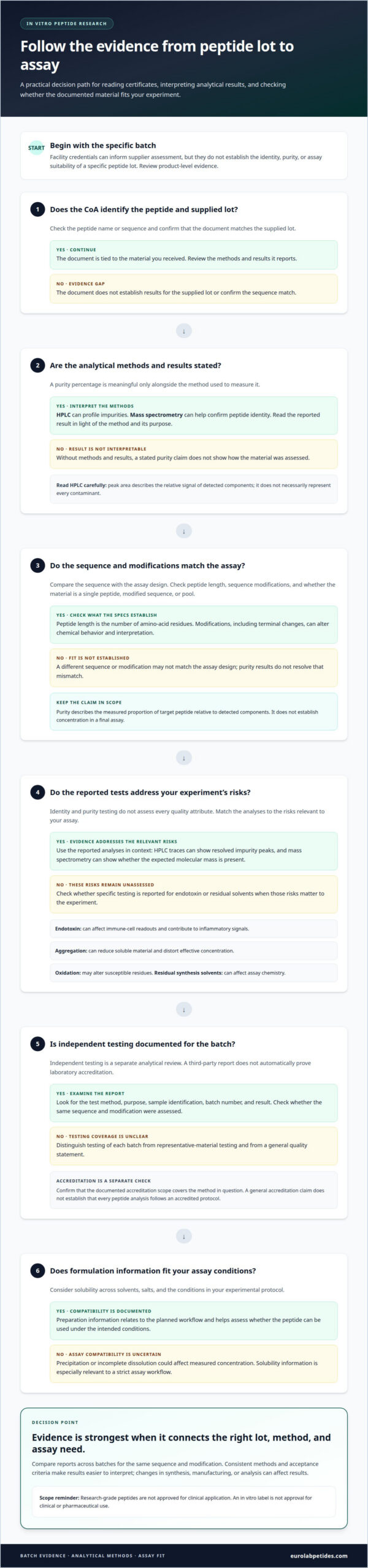
Check that the certificate of analysis (CoA) identifies the peptide and lot, and reports the analytical methods and results. A purity percentage is meaningful only alongside the method used to measure it. For example, HPLC peak area describes the relative signal of detected components, not necessarily every contaminant. Confirm that the document matches the supplied lot and sequence.
What U.S. regulations apply to purchasing peptides labeled for in vitro research? The label alone does not establish regulatory status, and intended use affects which requirements apply. Research-grade peptides are not approved for clinical application, so an in vitro label should not be treated as approval for clinical or pharmaceutical use.
Length, Purity, and Modification Specifications
Peptide length means the number of amino-acid residues in its sequence; compare that sequence with the assay design. Research formats include individual peptides, modified sequences, and peptide pools. For example, the extended CEF peptide pool contains 32 peptides. A custom HBV PepMix example used 15meric peptides overlapping by 10 amino acids.
Purity specifications describe the measured proportion of target peptide relative to detected components, but do not establish the concentration in a final assay. Verify sequence modifications, such as terminal changes, because they can alter chemical behavior and interpretation. What types of research peptides are available for in vitro studies? Researchers use single sequences, modified peptides, and pools for applications such as epitope analysis.
Impurity Profiles and Experiment Risks
Review HPLC traces for resolved impurity peaks and mass spectrometry data for the expected molecular mass. Neither result alone assesses every risk. Endotoxin can affect immune-cell readouts, while aggregation can reduce soluble material and distort effective concentration. Oxidation may alter susceptible residues, and residual synthesis solvents can affect assay chemistry.
What are the risks of endotoxin, aggregation, oxidation, or solvent contamination in in vitro peptide experiments? Each can confound results, from inflammatory signals to reduced solubility or altered activity. Match reported analyses to the experiment, and distinguish identity and purity testing from specific endotoxin or residual-solvent testing.
Third-party testing and laboratory accreditation
Independent testing adds a separate analytical review to a peptide supplier’s internal quality process. It can help assess whether the reported material matches the stated batch, but a third-party report does not automatically prove laboratory accreditation. Treat testing and accreditation as distinct evidence: one describes the analyses performed, while the other concerns a laboratory’s recognized competence within a defined scope.
Start with the test method and its purpose. HPLC can profile components, while mass spectrometry can assess molecular identity; neither result alone establishes every quality attribute. A useful report connects the method, sample identification, batch number, and result. Accreditation is relevant when its documented scope covers the method in question. A general accreditation claim does not establish that every peptide analysis follows an accredited protocol.
Compare reports across batches for the same sequence and modification, noting whether the same methods and acceptance criteria were used. Consistent procedures make differences easier to interpret, while changes in synthesis, manufacturing, or analysis can affect results. Ask whether testing covers each batch or representative material, and distinguish that approach from a general quality statement.
Solubility testing is also relevant because a peptide may behave differently across solvents, salts, and assay conditions. Match the preparation information to your planned experimental protocol, then consider whether precipitation or incomplete dissolution could affect the measured concentration. This matters especially when selecting a peptide for a strict assay workflow. Documentation is most useful when it states what was tested, which batch was tested, and how the result relates to the intended application.
Use a practical evidence sequence: identify the batch, review the independent test method, confirm the laboratory’s relevant accreditation scope, then assess whether solubility information fits the assay. This helps distinguish a robust testing record from broad manufacturing language and supports a more reproducible purchasing decision.
Supplier comparisons for academic and laboratory research
Sourcing peptides for in vitro research means matching supplier evidence and logistics to the assay’s requirements. Compare supply options, documentation, and preparation information against the research target and timeline.
Peptide Grade and Synthesis Options
Research-grade describes intended research use, while catalog peptides are standard listed sequences. Custom-synthesized peptides can meet a specified sequence, modification, or development target. Compare sequence, scale, purification details, and testing records rather than treating these categories as equivalent quality grades. The best fit depends on whether an established assay needs a standard material or a defined custom construct.
What are typical prices for custom-synthesized research peptides in the United States? Cost depends on sequence length, modifications, synthesis scale, purification, and requested testing. These factors determine production requirements, so a single typical price cannot represent every specification.
Supplier Quality Evaluation
Evaluate purity, identity, and quality through batch-linked records and clearly described methods. Mass spectrometry data can support identity assessment, while documentation should connect results to the specific material. Check whether testing protocols apply consistently across batches and whether independent testing is available for the requested product.
How do research-grade, catalog, and custom-synthesized peptides compare? Research-grade indicates intended use, catalog refers to standard listed options, and custom synthesis is tailored to a specified sequence or modification.
Vendor reviews can identify recurring concerns, but weigh them alongside documented evidence. A focused audit examines traceability, testing procedures, and responses to documentation requests. Pilot a small lot before larger procurement to assess its fit within laboratory workflows. This helps evaluate a supplier against the needs of sourcing peptides for in vitro research.
Compare logistics and preparation support as well. Cold-chain options and 2-3 day shipping are features to assess against material handling needs. Reconstitution planning should account for solvent, salt form, assay conditions, and target concentration. Choose supplies and preparation guidance that fit laboratory protocols, since one solvent or tool won’t suit every application.
Peptide purification and quality control
Peptide synthesis can produce the target sequence alongside deletion sequences, incompletely deprotected material, and other byproducts. Purification separates these components, while quality control evaluates whether the final format suits its research application. For teams sourcing peptides for in vitro research, purity is one quality measure, not a complete description of usable material.
Reverse-phase high-performance liquid chromatography (RP-HPLC) separates peptides according to their interaction with the stationary phase. During purification, collected fractions can be assessed for the target peak, then evaluated using mass spectrometry to support molecular identity. This links purification to a separate identity check. A chromatogram alone does not establish the complete composition.
Quality records should distinguish relative purity from peptide content. A sample’s measured mass can include counterions, water, or residual solvent, so the weighed amount may not equal the amount of peptide. This matters when preparing a stock solution: inaccurate concentration can change assay exposure and complicate comparisons. For example, a salt-form peptide may require content information beyond its chromatographic purity result.
Custom orders can specify modifications or a particular format, such as a peptide pool rather than a single sequence. Those requirements affect which purification and identity checks are relevant. A biotech workflow using a modified sequence needs records for that sequence, not merely a generic synthesis description. Quality control should connect the requested structure, purification outcome, and final material.
For sourcing peptides for in vitro research, trace the material from synthesis through release: identify the intended sequence and format, review purification evidence, then match analytical results to the supplied batch. This helps determine whether documentation supports the planned application. For studies focused on longevity, tissue repair, weight management, or cognition, explore research peptide options aligned with those study areas from EuroLab Peptides.
EuroLab Peptides
EuroLab Peptides supplies research-grade peptides for laboratory research, with in-house and independent third-party testing as part of its multi-level quality control process. This is a relevant option when your research requires peptide materials for in vitro work and you are assessing supplier suitability alongside analytical evidence.
Its research areas include Longevity & Vitality Research, Weight Management Research, Tissue Repair & Recovery Research, and Cognitive Function Research. These categories connect peptide research materials with defined study areas, while your experimental design and assay requirements guide selection.
For teams comparing purity, identity, and batch documentation, EuroLab Peptides supplies research materials for laboratory use and uses a multi-level quality control process. Contact EuroLab Peptides to discuss your research requirements.
Move from selection to study planning
Use your experimental design to define what the next procurement decision needs to support. When sourcing peptides for in vitro research, connect material selection to the assay’s purpose, planned conditions, and interpretation criteria. This keeps purchasing decisions aligned with the scientific question rather than treating peptide selection as a separate task. A clear research objective also gives your laboratory team a consistent basis for discussing material requirements and study scope.
EuroLab Peptides offers Longevity & Vitality Research, Weight Management Research, and Tissue Repair & Recovery Research. These research areas provide context when planning studies and considering which peptide research materials fit the investigation.
To discuss your research needs, contact EuroLab Peptides. A well-defined study plan is a strong starting point for rigorous laboratory work.
Frequently Asked Questions
Are Your Peptides Made In cGMP-Compliant Facilities?
EuroLab Peptides uses a multi-level quality-control process that includes in-house and independent third-party laboratory testing. This testing information does not establish that manufacturing occurs in a cGMP-compliant facility. If procurement requires cGMP compliance, facility-specific documentation is the relevant evidence. Distinguish analytical testing from claims about manufacturing conditions or facility status.
Which certificates and analytical documents should I request when sourcing research peptides?
Request a certificate of analysis tied to the supplied lot, along with the underlying analytical reports relevant to your study. Check that the documents identify the peptide sequence and any modifications as ordered. Keep the records with your procurement file and experiment notes so results can be traced to the material used. Resolve any mismatch between labels, order details, and documents before recording the material as received.
How do I choose peptide purity, quantity, and format for an in vitro assay?
Base purity requirements on the assay’s sensitivity to related sequences or synthesis byproducts, then select an amount that supports planned replicates, controls, and repeat experiments. Choose a single peptide for a defined target or a pool when the design requires multiple sequences. Include solubility, sample handling, and the assay’s concentration range in your decision. The right specification follows the experiment, not a universal purity threshold.
What are the steps for ordering custom peptide synthesis, and what are typical lead times?
Define the sequence, modifications, quantity, format, purification needs, and analytical documentation before placing a custom order. Review the final specification for sequence and terminal details, then align delivery timing with the study schedule. Lead time depends on synthesis complexity, requested modifications, purification, and testing. A single typical duration does not apply to every custom peptide order because production requirements vary.
How should research peptides be shipped, stored, reconstituted, and handled?
Follow the product-specific handling and storage instructions, and retain the original vial label throughout preparation. Use a solvent compatible with both the peptide form and assay conditions; record the solvent and preparation details in the experiment log. Prepare solutions using laboratory procedures that limit contamination, and avoid repeated freeze-thaw cycles where they may affect sample integrity. Follow institutional handling and waste procedures.
How can I verify a peptide supplier is reputable and avoid mislabeled or contaminated products?
Use traceable documentation and compare the received vial label with the order and associated analytical records. Inspect packaging for signs of damage or compromised seals, and record any discrepancy before the material enters laboratory inventory. For assays sensitive to endotoxin or other contaminants, confirm that the available evidence includes the relevant test. Maintain an inventory record linking each vial to its supplier and lot.
