

Custom synthesis and catalog selection do not have different fixed limits on peptide length. The sequence and synthesis requirements determine what is feasible. When comparing custom vs catalog peptides, the key question is whether a predefined sequence meets the research specification or a tailored sequence is needed. A catalog peptide may be the more direct fit when its identity and documented attributes align with the study.
Consider more than sequence alone. Modifications, purity testing, analytical documentation, and available chemistry options all affect how well a peptide fits a research design. A purity value alone does not describe every aspect of identity or the evidence available for a specific lot.
This guide compares custom and catalog peptides across these criteria, including how sequence length relates to synthesis choices. It also explains what to look for in purity results and analytical records, then offers a practical way to match the peptide format to your research requirements.
Key Takeaways
- Choose catalog peptides when a predefined sequence and its specifications fit the study; consider custom synthesis when sequence or structural requirements call for a tailored design.
- Assess purity alongside identity testing, since a purity value alone does not establish the full analytical profile of a peptide.
- Use lot-specific documentation to understand what testing was performed and how the reported results relate to the material being evaluated.
- Account for modifications and coupling chemistry early, as these choices shape synthesis complexity and suitability for the research objective.
Purity, identity testing, and analytical signatures
Purity measures one aspect of a peptide sample, while identity analysis assesses whether the material matches its intended structure. Compare both with the experiment’s requirements.
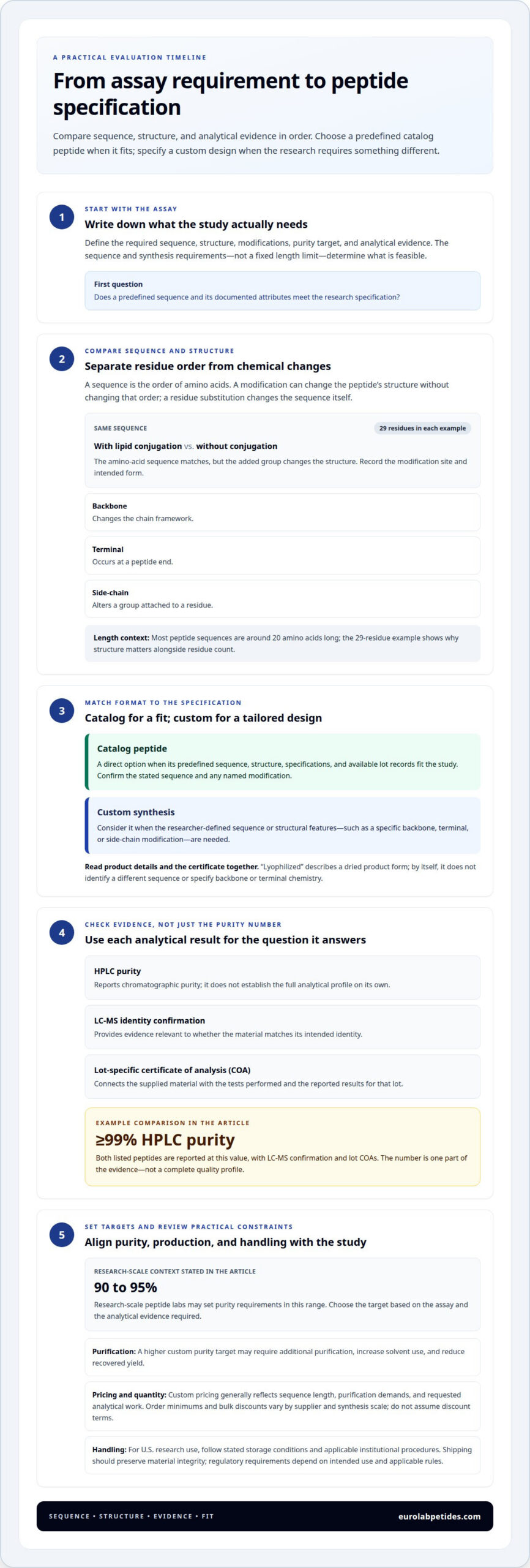
What quality-control data are provided? A useful analytical record can include HPLC purity, LC-MS identity confirmation, and a lot-specific certificate of analysis (COA). In an example comparison, both peptides are listed at ≥99% HPLC purity, with LC-MS confirmation and lot COAs.
Order minimums and bulk discounts vary by supplier and synthesis scale. Quantity affects production planning, but discount terms should not be assumed. Custom pricing generally reflects sequence length, purification demands, and requested analytical work, not purity alone.
For U.S. research use, follow the product’s stated storage conditions and applicable institutional procedures. Shipping should preserve material integrity, while regulatory requirements depend on intended use and applicable rules.
Custom Peptide Purity and Quality Control
Custom synthesis lets researchers specify a sequence and requested purity, but those choices affect purification and analysis. A higher purity target may require additional purification, which can increase solvent use and reduce recovered yield. Solid-phase peptide synthesis builds the requested chain; final HPLC and LC-MS results provide distinct evidence about purity and identity.
Catalog Peptide Purity and Quality Control
Catalog peptides are predefined materials, so evaluation centers on the specifications and analytical records for the offered lot. A catalog label alone doesn’t establish purity or identity. Look for reported HPLC analysis, LC-MS confirmation, and a lot COA; the example comparison reports ≥99% HPLC purity for both listed compounds.
| Option | Sequence | Purity evidence | Production considerations |
|---|---|---|---|
| Custom | Specified for the project | Review requested analysis and lot records | Purification depends on sequence and target |
| Catalog | Predefined | Review available lot records | Selection depends on fit and availability |
Research-scale peptide labs may set typical purity requirements at 90 to 95%; choose the target based on the assay and required analytical evidence.
Comparing peptide sequence, structure, and modifications
A peptide’s sequence specifies the order of its amino acids; structural modifications can change the molecule without changing that order. Define the assay requirement first, then distinguish sequence changes from chemical additions.
Custom Peptide Sequences and Modifications
Custom synthesis suits a researcher-defined peptide sequence, including a specified residue order and structural features. Design specifications can describe backbone, terminal, or side-chain modifications, such as lipid conjugation. Each change can affect molecular mass and analytical interpretation, so document it precisely for the intended assay and study.
A useful comparison is a 29-residue peptide with one lipid conjugation versus the same 29-residue sequence without conjugation. The amino-acid sequence matches, but the added group changes the structure. Record the modification site and intended form in the design specification, then align expected identity data and the certificate with that structure.
Catalog Peptide Sequences and Modifications
Catalog peptides have predefined sequences and structures. Researchers select from established specifications rather than having a new sequence assembled to their design. A catalog entry may suit an assay that requires an existing peptide, while a study requiring a particular terminal group or side-chain change may call for a different design.
Read the product description and certificate together: confirm the stated sequence and any named modification. Lyophilized describes a dried product form, not a different amino-acid sequence. It does not, by itself, identify backbone or terminal chemistry. These distinctions matter when comparing assay materials or interpreting results across studies.
Modification categories refer to different structural locations. A backbone change affects the chain framework; terminal changes occur at the peptide’s ends; side-chain changes alter a group attached to a residue. Lipid conjugation is one example of an added chemical feature. Distinguish these modifications from residue substitutions, which change the sequence itself.
- Sequence: specify each amino acid in order.
- Structure: state the modification type and location.
- Analysis: match expected identity evidence to the modified form.
Most peptide sequences are around 20 amino acids long, while the 29-residue example illustrates that structural comparison also matters beyond residue count. A practical approach to comparing custom vs catalog peptides is to match the defined structure to the assay. When comparing custom vs catalog peptides, choose a catalog form if its sequence and modifications fit; specify a custom design when they differ.
Quality documentation and analytical testing
Analytical records connect a peptide’s stated identity with the material supplied. For custom and catalog orders alike, interpret results in relation to the sequence, intended assay, and lot documentation. Do not treat one purity value as a complete quality profile.
A certificate of analysis (COA) should identify the material and summarize the tests performed. HPLC can report chromatographic purity, while LC-MS can support molecular identity. These analyses answer different questions: a purity result describes the measured sample profile, while identity testing assesses whether the observed material corresponds to the intended peptide.
Useful documentation makes results interpretable. Match the COA to the product lot, confirm that the reported sequence and modifications correspond to the requested material, and note the analytical method. For a modified peptide, the expected mass and sequence details should reflect the specified structure. A powder’s appearance alone does not establish identity, purity, or assay suitability.
- Identity: Compare the reported analytical result with the specified amino acids and structure.
- Purity: Interpret the reported value using the method and assay requirements.
- Traceability: Associate the COA with the material’s lot and study record.
Testing should address a defined question in the research protocol. A study evaluating peptide interaction with an assay component may need identity and purity evidence before use; document the results alongside the protocol and sample handling. For custom synthesis, sequence length and coupling choices affect the material produced, so records should describe the finished peptide, not just the design request.
Continue appropriate monitoring through the experiment’s own controls and documented handling steps. Record the lot, test results, storage conditions, and any deviations relevant to the assay. This creates a traceable link between incoming material and observed results without assuming that one analytical test establishes every quality attribute.
Compare documentation by asking whether it identifies the tested material, describes the analysis, and supports the intended protocol. Evaluate custom and catalog formats using the same evidence-based framework.
Chemistry flexibility and coupling options
Solid-phase peptide synthesis (SPPS) assembles a peptide step by step from protected amino-acid derivatives. The sequence determines each addition, while the requested chemistry defines what must be incorporated during synthesis.
In SPPS, the chain is assembled in the C→N direction, starting with its C-terminal amino acid attached to synthesis resin. Each cycle removes a protecting group, washes the resin, and couples the next protected residue. Typical cycles include two deprotection steps, six DMF washes before coupling, and two DMF washes afterward for each amino-acid addition. Coupling is therefore one part of a larger synthesis workflow.
Custom design lets the target sequence and specified chemistry guide synthesis. A required terminal feature or residue modification can affect which protected building blocks and coupling conditions are appropriate. Define the functional target first, then specify the sequence, modification location, and terminal requirements. These details distinguish a chemical design requirement from a preference for a particular material form.
A catalog peptide follows a predefined specification. Its chemistry matches the listed sequence and structure; it does not offer an open-ended set of coupling options. If the catalog structure matches the experimental target, no additional sequence design is needed. If the target requires a different residue or terminal feature, custom design provides a way to specify that difference.
Coupling is not the only factor that governs synthesis effort. The full cycle includes deprotection and washing, and coupling accounts for less than 10% of touch time in manual or semi-manual peptide synthesis. Sequence length and chemistry determine the number and nature of additions, while purification requirements affect subsequent processing. A custom specification should therefore describe the complete structure, not only the desired coupling.
- Define: Record the sequence and any terminal or residue-level requirement.
- Compare: Match the catalog specification to the functional target.
- Document: Align the finished material’s certificate of analysis with its intended structure.
For work aligned with cognitive research, explore EuroLab Peptides research options.
EuroLab Peptides
EuroLab Peptides supplies research-grade peptides for studies where sequence fit, analytical evidence, and research focus guide selection. Its multi-level quality-control process includes in-house and independent third-party laboratory testing to support assessment of purity and consistency. This is relevant when selecting research materials for work in longevity and vitality, weight management, tissue repair and recovery, or cognitive function. Custom and catalog formats meet different design needs: the right choice depends on whether a predefined peptide fits the study or a specified sequence and modification are required. Consider the experimental objective alongside product information and quality documentation. To discuss research peptide requirements, contact EuroLab Peptides.
Turn your peptide requirements into a research decision
Translate the experimental objective into a clear material specification. Identify whether the study requires a predefined sequence or a particular sequence, modification, or chemistry. Then match those requirements to the analytical evidence needed to interpret results. This gives the selection process a practical endpoint: a peptide choice grounded in the protocol, not convenience alone.
EuroLab Peptides supports research in Longevity & Vitality, Weight Management, and Tissue Repair & Recovery. These areas provide context for research requirements, but do not replace the need to define sequence and analytical criteria for a specific study. If your work aligns with these fields, use the project’s research focus and material requirements to guide your selection.
Contact EuroLab Peptides to discuss your research requirements and take the next step with a clearly defined specification.
Frequently Asked Questions
Is there any limitation on the length of peptides that can be achieved?
There is no universal length cutoff; feasibility depends on the sequence and requested chemistry. Longer chains require more sequential amino-acid additions, and each coupling step creates another opportunity for incomplete reaction or byproducts. A sequence with challenging residues or modifications can therefore be harder to produce than a simpler sequence of similar length. The research objective, synthesis approach, and purification target all influence the practical design.
What are custom peptides and catalog peptides?
Custom peptides are synthesized to a defined research specification, while catalog peptides are selected from predefined products. For example, a catalog peptide can suit a study if its listed structure fits the experimental design; a custom sequence is relevant when the design requires a different residue order or chemical feature. When comparing custom vs catalog peptides, the central question is whether a standard product fits the protocol.
How do custom and catalog peptides compare in sequence options and modifications?
Custom synthesis can be specified around a study’s required sequence and structural features. Catalog options are limited to their established product specifications. For example, if an assay requires a particular terminal chemistry absent from the standard product, that points toward a custom design. A substitution changes the sequence, so record whether the requirement is a residue change or a modification to the existing structure.
What are typical prices for catalog peptides versus custom peptide synthesis?
There is no reliable like-for-like typical price because a catalog purchase and custom synthesis cover different scopes. A catalog quote relates to a predefined item and quantity; custom work depends on the requested sequence, chemistry, purification target, synthesis scale, and analytical requirements. Compare the specifications included in each quote, not just the headline amount. This separates material cost from project-specific synthesis and testing needs.
How do turnaround times compare for custom and catalog peptides?
Catalog selection can avoid sequence design and synthesis, but fulfillment still depends on product availability and handling. Custom synthesis requires production, followed by any requested purification and analytical testing. A sequence with complex chemistry may need a different workflow from a standard design. For planning, align the required material and documentation with the study schedule rather than assuming either format has a fixed delivery time.
What factors affect custom peptide synthesis cost and feasibility?
Sequence length, amino-acid composition, modifications, synthesis scale, purification requirements, and requested testing all affect feasibility and project scope. For example, a design combining a long sequence with a specialized terminal feature can require different synthesis and purification decisions than an unmodified sequence. The intended assay also matters: it determines which structural attributes and analytical evidence are essential for the research material.
