

A high review count is not a trust score. Online forums for peptide supplier reviews in 2026 can help flag recurring shipping or documentation concerns, but those accounts are anecdotal, so no supplier can be identified as the most trusted from forum sentiment alone. Independent, batch-specific testing offers a more objective basis for comparison.
It’s reasonable to look for a clear consensus before assessing a supplier, but ratings and review totals need context: a large volume of posts doesn’t establish product quality. This guide explains how to weigh review counts and selection criteria alongside third-party testing, including what a certificate of analysis can and can’t demonstrate. You’ll also see how to distinguish repeatable quality signals from individual experiences, so your comparison rests on documented evidence rather than popularity alone.
Key Takeaways
- Use forum posts to spot patterns in shipping and documentation, not as proof of peptide identity or quality.
- Compare suppliers using consistent criteria, including transparent documentation and the traceability of the testing to a specific batch.
- Assess a certificate of analysis by its analytical methods, reported results, and laboratory credentials rather than its appearance alone.
- Interpret vendor rankings alongside review volume and review detail, then weigh them against independent quality evidence.
What is the most trusted peptide company?
No single supplier can be identified as the most trusted based on forum reviews alone. Before treating reputation as evidence, compare intended use, regulatory context, and verifiable product documentation.
Research-Use-Only Sellers and Safety
Research-use-only sellers market materials for laboratory research, not as products for human consumption. That differs from a licensed pharmacy operating within the U.S. human drug compounding framework. In August 2026, the FDA sent warning letters to five U.S. research peptide sellers and rejected research-use-only labeling as a legal defense. Between March and August 2026, it warned eight sellers that products were intended for human use despite those labels.
| Option | Intended context | Key evidence | Review signal |
|---|---|---|---|
| Research-chemical seller | Laboratory research | Batch documentation and testing | Anecdotal reports |
| 503A pharmacy | Human drug compounding framework | Pharmacy identity and prescription context | Not a research-vendor ranking |
| 503B pharmacy | Human drug compounding framework | Facility identity and documentation | Not proof of research-material quality |
Choose the route that matches the intended use; forum popularity cannot establish that fit.
Research-Chemical Seller Red Flags
Warning signs include unmarked vials, unclear product identity, and claims that a research-use-only label settles legal questions. The FDA had issued more than 50 warning letters across the peptide industry by September 2025. A seller’s published claims and a forum reputation cannot replace a batch record or independent laboratory evidence. BPC-157 and TB-500 are not FDA-approved, so avoid treating seller language as approval.
Forum Activity and Supplier Reports
In U.S. discussions, readers encounter Reddit threads, Trustpilot reviews, and peptide-focused forums, but verified activity data does not establish which is most active. These sources can flag reported shipping or documentation issues, but posts remain anecdotal and do not confirm a material’s identity.
Reports may describe shipping delays, packaging, or customer-service interactions, but they do not provide a dependable standard for delivery times or packaging quality. Treat an individual account as a lead, not a performance benchmark, and compare repeated, dated reports with published records.
Supplier comparison and selection criteria
In 2026, peptide supplier discussions appear across Reddit threads, Trustpilot reviews, and dedicated forums; none alone establishes a reliable ranking. Compare channels by whether posts identify dated orders, specific catalog entries, and evidence that can be assessed independently.
Online Peptide Provider Comparisons
Online peptide vendors differ in intended use, documentation, catalog scope, and ordering terms. Assess a research supplier’s catalog as research material; a prescription provider’s process, by contrast, centers on a pharmacy and prescription. Compare like with like: a forum comment about payment says nothing about whether a material meets a laboratory specification. Keep each comparison tied to the same peptide and intended use.
Supplier Selection Criteria
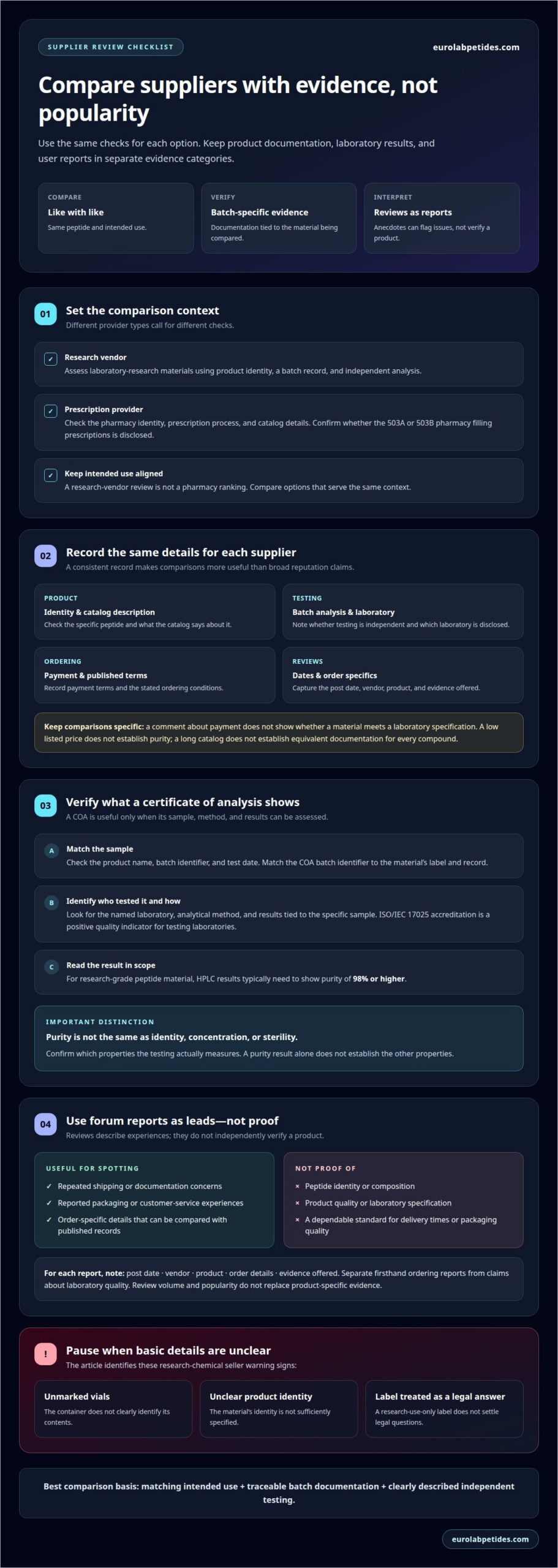
Use a consistent record for each peptide company: product identity, batch-specific analysis, disclosed testing laboratory, catalog description, payment terms, and published ordering conditions. For prescription providers, check whether the 503A or 503B pharmacy filling prescriptions is disclosed. This makes the comparison more useful than broad reputation claims. A low listed price cannot establish purity, and a long catalog cannot establish that every compound has equivalent documentation.
| Option | Intended context | Comparison criteria |
|---|---|---|
| Research vendor | Laboratory research | Product identity, batch record, independent analysis |
| Prescription provider | Prescription and pharmacy context | Pharmacy identity, ordering process, catalog details |
| Forum or review page | User-reported experience | Post dates, order specifics, repeated reports |
Forums Discussing Supplier Reviews
Reddit threads, Trustpilot reviews, and specialist forum discussions serve different purposes. Review pages can make reported service patterns easier to scan, while forum threads may add order-specific detail. Neither format independently verifies a product. Record the post date, vendor, product, and evidence offered, then separate firsthand ordering reports from claims about laboratory quality.
Choose the option whose intended use and documentation match your decision. Price and popularity comparisons cannot substitute for product-specific evidence.
Third-party testing and certificate verification
Forum reviews and consumer reports describe experiences or summarize findings; independent laboratory testing produces analytical results for a sample. For research peptides, a review cannot confirm composition or purity. A certificate of analysis (COA) is useful only if it identifies the tested batch and method.
Start with the COA’s product name, batch identifier, test date, laboratory, and analytical method. High-performance liquid chromatography (HPLC) results for research-grade peptide material typically need to show purity of 98% or higher. Purity is not the same as identity, concentration, or sterility, so confirm which properties the testing actually measures. ISO/IEC 17025 accreditation is a positive quality indicator for testing laboratories.
- Match the COA batch identifier to the material’s label and record.
- Check that the laboratory and test method are named, with results tied to the specific sample.
- Separate a purity result from claims about identity, dosage, or other properties.
A 2024 independent testing roundup cited by WuXi AppTec reported significant discrepancies in roughly 15-20% of supplier certificates of analysis. That finding supports examining the report itself rather than relying on a supplier’s summary. It does not establish that a particular COA is inaccurate.
Testing costs depend on the laboratory, method, sample, and scope of analysis, so a supplier’s product price does not show how much independent testing was performed. Chainalysis estimated that independent peptide testing spend fell 88% to about $8 per buyer as peptide sales climbed. This market estimate concerns testing spend, not a peptide price or a supplier’s laboratory fee.
A prescription or pharmacy context answers a different question from a research-material COA. Assess each record according to its purpose, then compare reported results with batch-specific documentation and laboratory details.
Peptide vendor rankings and review counts
A vendor ranking is a sorting method, not an analytical result. Review counts measure posted opinions, while purity and product identity require batch-specific evidence. Treat a high position as a reason to examine the underlying reports, not as proof that a vendor’s catalog is consistent or its claims are substantiated. Readers using online forums for peptide supplier reviews 2026 should treat rankings as starting points for comparison, not final verdicts.
Start by separating the signals a ranking combines. Record the platform, review date, number of reviews, product discussed, and whether the post describes a specific order. Distinguish comments about delivery or payment from claims about testing and material quality. A detailed account tied to an identifiable batch offers more context than a brief rating, but still does not replace laboratory analysis.
Counts need context. Compare vendors on the same platform and within the same time period, then look for repeated, independent accounts rather than treating each post as separate confirmation. Similar wording, missing order details, or reviews that discuss no specific product make the total harder to interpret. Transparency about how ratings are collected matters as much as the displayed number. In online forums for peptide supplier reviews 2026, weigh the detail behind each count, not just its size.
Catalog breadth also affects comparisons. A vendor with a long catalog may have reviews concentrated on only a few products, so an overall score will not show whether a specific peptide was discussed. Match each review to its product and stated purpose. Separate research-use claims from medical claims, and do not infer approval or suitability from a ranking position.
Between 15 and 22 October 2026, a comparison checked 14 published certificates across the companies. That count describes certificates reviewed, not supplier quality or forum activity. Apply the same discipline to review totals: document what was counted and what each record supports.
For a practical decision, use rankings to discover suppliers, compare review detail and recency, then weigh those signals against transparent, product-specific documentation. If rankings and evidence conflict, prioritize the evidence over the order of the names.
EuroLab Peptides
EuroLab Peptides supplies research-grade peptides for scientific work where documented quality matters more than forum rankings. Its multi-level quality control includes in-house and independent third-party laboratory testing to support assessment of product purity and consistency. This gives researchers a more relevant basis for supplier evaluation than review volume alone.
Research interests include Longevity & Vitality Research, Weight Management Research, Tissue Repair & Recovery Research, and Cognitive Function Research. These offerings are for research applications, not medical advice, medicines, or human consumption. Consider EuroLab Peptides when your work calls for research materials and quality-control information alongside a review of supplier trust signals.
For research-related questions, contact EuroLab Peptides.
Make your next supplier decision repeatable
Make supplier assessment part of a documented research-procurement process. Set a decision standard for your team, retain the rationale for each selection, and revisit it when a project’s scope or material requirements change. This creates a consistent basis for future decisions and keeps assessments aligned with research needs rather than a supplier’s visibility online.
Use online forums for peptide supplier reviews in 2026 as one input to that process, while anchoring your requirements in the work being conducted. When research needs align with EuroLab Peptides’ focus, consider how its research offerings fit the project context. A focused discussion can help clarify the relevant next step without replacing your scientific criteria.
Move forward with a defined research objective and a clear basis for evaluation. Discuss your research needs with EuroLab Peptides.
Frequently Asked Questions
Where is the safest place to buy peptides?
The appropriate source depends on intended use. Research materials are for laboratory research, not human consumption or clinical use. For prescription-related compounding in the United States, 503A and 503B pharmacies operate within the FDA’s human drug compounding framework. Since October 28, 2026, an HHS interim policy covers six named peptides compounded for a named patient by a state-licensed pharmacy on prescription, subject to conditions.
Which peptide suppliers are frequently reviewed or recommended on forums in 2026?
Reddit, Trustpilot, and peptide-focused forums host supplier discussions, but they do not establish a dependable list of recommended vendors. Posts and rankings change, and a frequently mentioned name is not a quality endorsement. For a current comparison, note the platform and post date, then distinguish firsthand ordering accounts from recommendations without product-specific evidence.
What do forum users report about peptide purity, testing, and certificates of analysis?
Forum posts may describe a supplier’s certificate, testing claims, or a user’s own analysis, but these reports vary in detail and aren’t equivalent to a controlled assessment. A 2024 independent testing roundup cited by WuXi AppTec reported significant discrepancies in roughly 15-20% of supplier certificates of analysis. Treat that finding as a reason to assess each document’s batch and laboratory details, not as proof about every supplier.
How do buyers verify peptide supplier reviews and identify fake or biased posts?
Look for a dated, product-specific account that describes an order and separates firsthand experience from claims about laboratory quality. Compare posts across platforms, but do not count copied wording as independent confirmation. Check whether the reviewer discloses a commercial relationship and whether the account has a consistent history. A review can inform a decision, but it cannot authenticate a product or certificate.
What prices do forum users report for research peptides from different suppliers?
Forum prices are not directly comparable unless the peptide, stated amount, product format, shipping, and included testing are alike. A low figure may omit costs or refer to a different catalog item, so avoid treating individual posts as a market benchmark. Compare like-for-like offers without assuming price signals purity, identity, or test quality. No forum price establishes the value of a specific batch.
What are the risks of buying peptides from online suppliers in the United States?
Risks include unclear product identity, inadequate documentation, and research materials being misrepresented for human use. FDA warning letters have addressed sellers whose products were intended for human use despite research-only labels. Import can also be disrupted: 11.8% of declared peptide imports in early 2026 were stopped. A research-use label alone doesn’t establish that a product is appropriate for clinical use.
