

A low price does not demonstrate quality. A peptide supplier with transparent testing policies provides batch-specific certificates of analysis, identifies the methods used to assess purity and identity, and explains its quality controls. These records give researchers a clearer basis for assessing quality than price alone.
It is reasonable to expect evidence tied to the specific batch, rather than a generic document that leaves testing unclear.
This article explains what to look for in batch-specific COAs, how testing methods and quality controls inform an assessment, and why price should be considered alongside that evidence. It also outlines how supplier practices can help researchers assess peptides intended for research use.
Key Takeaways
- Assess a COA by its connection to the specific batch and the clarity of its reported results.
- Use HPLC purity data and mass spectrometry identity confirmation as complementary evidence, not interchangeable tests.
- ISO/IEC 17025 is the international standard for testing and calibration laboratories, according to the International Organization for Standardization.
- Consider price alongside testing evidence and supplier quality controls; a low figure alone doesn’t establish product quality.
Batch-specific certificates of analysis
A certificate of analysis (COA) records test results for identified peptide material. Its value depends on whether the report can be traced to the supplied batch.
Batch-Level Documentation
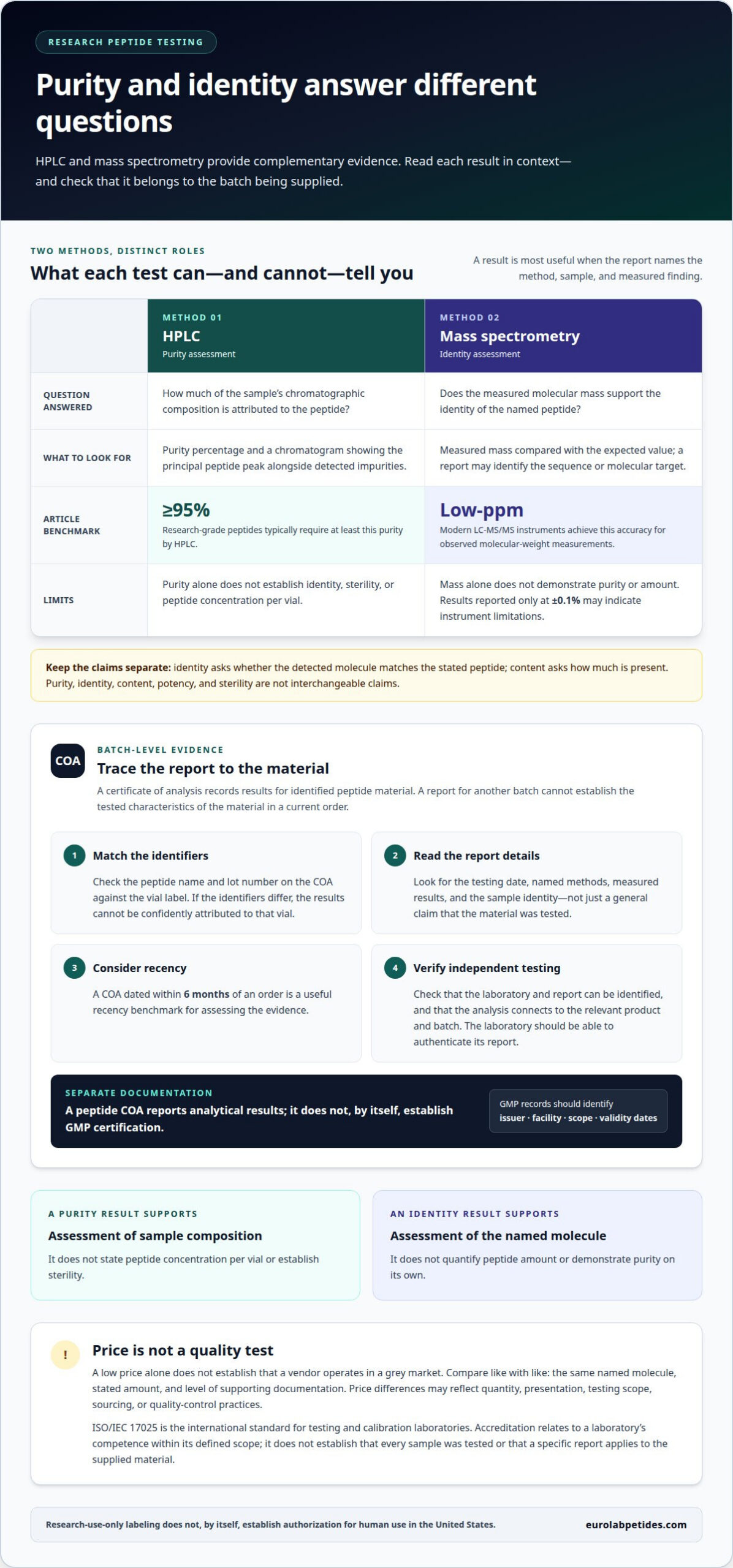
A batch-level COA links an analysis to material produced or processed together. It should identify the peptide, batch, testing date, methods, and measured results. This connection matters because a report for another batch cannot establish the tested characteristics of the material in a current order. A COA dated within 6 months of an order is a useful recency benchmark for assessing the evidence.
Lot-Specific Documentation
A lot number identifies a particular production lot and links its vial label to the corresponding certificates. The lot number on the COA should match the number on the vial. If the identifiers differ, the results cannot be confidently attributed to that vial. Suppliers support traceability by keeping lot records with product and shipment documentation.
Verifying COA Records
Suppliers verify COA records by matching the peptide name, lot identifier, test date, and reported results against product records. For example, a report for a different lot does not document the vial being supplied, even if both list the same peptide. Testing methods should be named, not replaced by a general claim that material was tested. HPLC can report purity, while mass spectrometry can support identity assessment. A reported 99% result is meaningful only alongside the method, sample identity, and batch details. Independent laboratory reports add useful context when the laboratory and report can be identified.
Verifying GMP Certification
Good Manufacturing Practice (GMP) claims require documentation separate from a peptide COA. A COA reports analytical results; it does not, by itself, establish GMP certification. Documentation should identify the certificate’s issuing organization, covered facility, scope, and validity dates. The issuing body and certificate details can then be assessed. A certificate covering a different site or activity does not show that the relevant production process falls within its scope. This distinction keeps quality claims tied to verifiable records.
HPLC purity and mass spectrometry identity testing
A research-use-only label does not, by itself, establish authorization for human use in the United States. These peptides are for research, not human consumption; analytical testing does not establish regulatory authorization.
HPLC Purity Testing
HPLC separates components in a sample to estimate peptide purity. Research-grade peptides typically require at least 95% purity by HPLC. The chromatogram shows the principal peptide peak alongside detected impurities. That result helps assess sample composition, but it doesn’t establish identity or sterility. Nor does a purity percentage alone state the peptide concentration per vial. Those are separate checks.
Mass Spectrometry Identity Testing
Mass spectrometry measures molecular mass and compares it with the expected value for the named peptide. That comparison supports identity assessment, especially when the report identifies the sequence or molecular target. Modern LC-MS/MS instruments achieve low-ppm accuracy for observed molecular-weight measurements. Results reported only at ±0.1% may indicate instrument limitations, so method detail matters. Mass alone doesn’t demonstrate purity or amount.
Identity and Content Testing
Product naming should connect the label, molecular target, and test record without relying on a marketing name alone. An identity result asks whether the detected molecule corresponds to the stated peptide; content testing asks how much is present. These questions are distinct. For example, a correctly identified molecule can still have an uncertain concentration if the analysis measures identity only. Transparent sourcing records can link the tested sample to the named material.
Potency, identity, and sterility are not interchangeable claims. A purity percentage measures chromatographic composition, while a content assay quantifies peptide amount; neither alone demonstrates sterility. Testing records are most useful when they state the sample tested, method, result, and applicable acceptance criteria. This detail helps research teams understand what each check supports and where its limits lie for the intended analysis.
Is a low price always a sign of a grey-market vendor?
A low price alone does not establish that a peptide vendor operates in a grey market. There is no single typical price for peptides from suppliers with transparent testing policies; the amount depends on the molecule, order format, sourcing, and documented quality controls.
Independent laboratory testing adds evidence beyond a vendor’s own records. ISO/IEC 17025 is the international standard for testing and calibration laboratories, according to the International Organization for Standardization. Accreditation relates to a laboratory’s competence within its defined scope. It doesn’t establish that every peptide sample was tested, or that a particular result applies to the material supplied. The report must connect the laboratory’s analysis to the relevant sample.
For third-party verification, the vendor should identify the independent laboratory and provide a report associated with the product and batch. Useful details include the sample identifier, testing date, analytical method, and results. A report naming mass spectrometry or liquid chromatography provides more context than a general “independently tested” claim. The laboratory should be able to authenticate its report, rather than relying only on a vendor’s copy. This helps distinguish independent analysis from testing conducted by the vendor.
Quality protocols can affect price: synthesis, handling, analytical checks, and repeat testing may contribute to operating costs. Price differences can also reflect peptide quantity, presentation, testing scope, or sourcing, rather than quality alone. Compare like with like: the same named molecule, stated amount, and level of supporting documentation. Sparse detail alongside a substantially lower price merits closer scrutiny, but price does not prove a product’s identity or purity. Independent laboratory evidence and clearly defined procedures provide a stronger basis for assessment than cost alone.
Prices vary with the molecule, order format, sourcing, and documented quality controls, so there is no single typical price.
Supplier quality control
Supplier quality control is a connected system, not just a final purity result. It links peptide synthesis, sample handling, testing, and release documentation. Each stage should produce records that make deviations traceable. For example, a changed synthesis parameter should be linked to the affected batch and its disposition. This record trail helps research teams assess whether measured results represent the supplied compounds.
Specifications define what a supplier measures and the acceptance criteria applied to results. ICH Topic Q6B, dated 1999, addresses specifications, test procedures, and acceptance criteria. In practice, controlled procedures should define sample identification, analytical review, and how out-of-range results are handled. Weight or fill checks answer a different question from molecular identity; neither replaces an appropriate assay. Sterility claims also require relevant testing, not an inference from purity data.
Strong documentation connects each control to a record: material receipt, synthesis, sampling, analysis, review, and release. A sample’s identifier should remain traceable through those records, while deviations should show investigation and resolution. A certificate of analysis dated more than 12 months ago is a vendor red flag. Two or more red flags warrant walking away. These criteria make quality control assessable through evidence, rather than assurances about accuracy or process discipline.
EuroLab Peptides uses a multi-level quality control process that includes in-house and independent third-party laboratory testing for purity and consistency. Review the documentation as a connected record set, from synthesis controls through sample analysis and release. Quality control is strongest when each claim has a corresponding, traceable record.
Explore Weight Management Research at EuroLab Peptides for research-focused supply aligned with this area.
EuroLab Peptides
EuroLab Peptides supplies research-grade peptides and emphasizes quality control through in-house and independent third-party laboratory testing for purity and consistency. Researchers assessing supplier testing and documented controls can explore EuroLab Peptides as a source for research use.
Research areas include longevity and vitality, weight management, tissue repair and recovery, and cognitive function. Each supports a distinct research interest, but the same principle applies: interpret analytical evidence according to what was tested and what the results establish. EuroLab Peptides supplies peptides for these areas of scientific inquiry, not medical advice or products for human consumption.
For research-focused peptide supply supported by testing and quality-control processes, contact EuroLab Peptides.
Set a Clear Evidence Standard for Your Next Order
Make documented quality part of the research plan from the outset. This creates a consistent basis for evaluating peptide supply beyond price alone.
A peptide supplier with transparent testing policies can support an evidence-led selection process. EuroLab Peptides offers Longevity & Vitality Research, Weight Management Research, and Tissue Repair & Recovery Research. These areas offer a starting point for planning studies that require research-grade peptide supply and documented quality controls.
Use your research objectives to guide the next conversation, including the area of study and the evidence you consider relevant. For research-focused supply, contact EuroLab Peptides to discuss your research needs. A clear evidence standard gives your next decision a stronger foundation.
Frequently Asked Questions
What About Peptides From Online Suppliers?
Online availability does not make a peptide appropriate for human use. EuroLab Peptides states that its products are intended strictly for in-vitro research and laboratory development, not clinical use or consumption. For a research order, consider whether the product’s stated purpose and identifying information fit the planned laboratory work. Research-use labeling describes intended use; it does not establish suitability for other purposes.
Does the supplier match each COA to the specific lot number on the vial?
A supplier should associate the certificate with the specific lot supplied, not merely with the same named compound. The lot identifier on the vial and its record should match exactly; otherwise, traceability is interrupted. Results from one lot do not automatically describe another. Lot-level documentation helps establish which material the reported analysis covers.
What’s the single most important vendor signal?
A useful record identifies the tested sample and the laboratory responsible for the analysis. That connection helps research teams distinguish results tied to particular material from general quality statements. Claims are more meaningful when supporting records can be associated with the material being considered.
Do suppliers provide batch-specific certificates of analysis (COAs) with each product?
Some suppliers provide COAs electronically or by batch instead of including a paper copy in every package. What matters is whether the available certificate corresponds to the product batch supplied. A general document that names only a peptide provides less specific evidence. Before ordering, establish how batch documentation is provided and whether it pertains to the material in the order.
What information should a peptide supplier provide before you order?
Before ordering, product information should clearly state the research-use designation, peptide identity, supplied quantity, and available analytical documentation. The supplier should distinguish what each test measures, so a purity result is not mistaken for evidence of sterility or concentration. Clear descriptions help research teams determine whether the material and its documented attributes align with their planned laboratory work.
