

In any rigorous scientific inquiry, the integrity of experimental data is non-negotiable. This standard of excellence begins with the precise preparation of research compounds, a critical step where a minor miscalculation can compromise an entire study, invalidate results, and lead to the irreversible loss of valuable, high-purity peptides. Uncertainty regarding unit conversions, sterile technique, and compound stability introduces variables that are unacceptable in a controlled laboratory setting. To eliminate such risks and ensure uncompromising accuracy, a validated peptide reconstitution calculator is an indispensable tool for the serious researcher.
This guide provides more than a simple calculation utility; it delivers a comprehensive laboratory protocol engineered to uphold the stringent standards required for valid scientific outcomes. We will detail the correct, aseptic procedures for reconstituting lyophilized peptides, from selecting the appropriate bacteriostatic or sterile water diluent to ensuring the final solution’s concentration is precisely what your experimental design demands. By following this systematic approach, you will gain absolute confidence in your dosing, safeguard peptide integrity, and achieve the methodological rigor necessary for repeatable, verifiable results.
Key Takeaways
- Grasp the fundamental principles of peptide reconstitution and why precision is non-negotiable for achieving valid, reproducible experimental outcomes.
- Utilize the integrated peptide reconstitution calculator to eliminate calculation errors and ensure your dosing protocol is based on precise, verifiable figures.
- Implement a detailed, step-by-step laboratory protocol for reconstituting lyophilized peptides, ensuring aseptic technique and solution integrity.
- Recognize how the integrity of your source material directly impacts the efficacy of your reconstitution protocol and the validity of subsequent results.
The Critical Importance of Accurate Peptide Reconstitution in Research
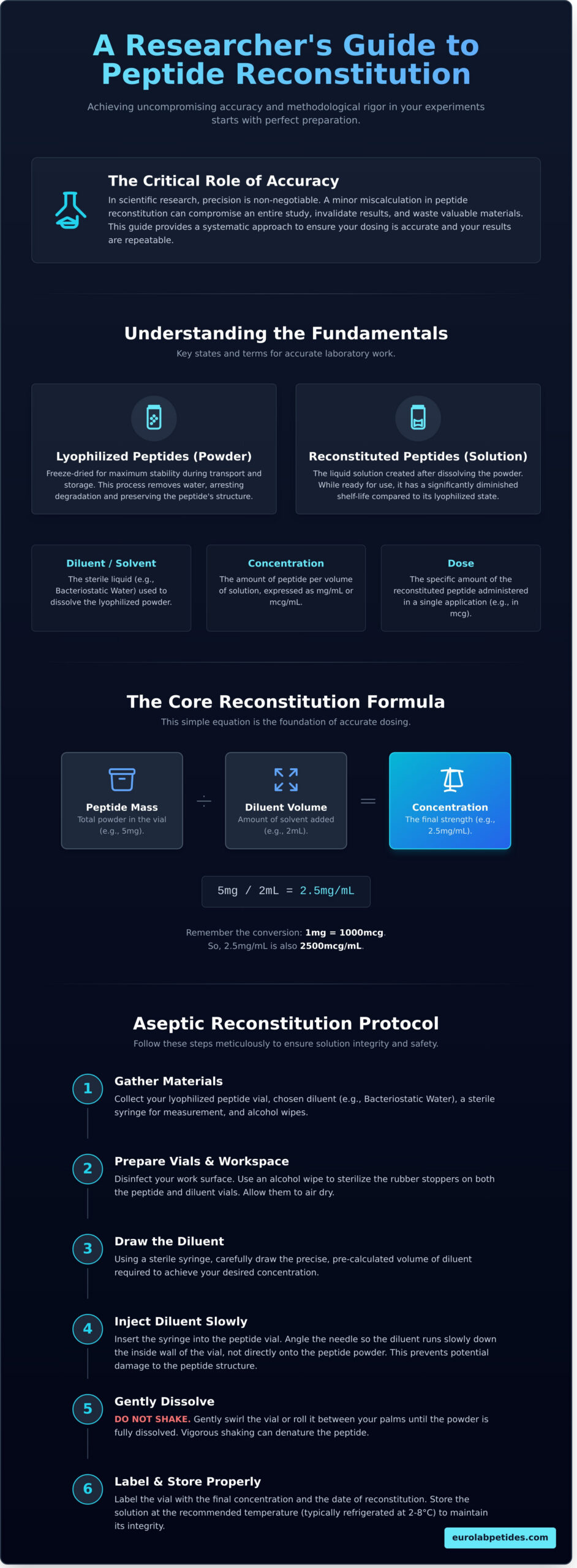
In the context of rigorous scientific inquiry, precision is non-negotiable. Peptide reconstitution—the process of dissolving a lyophilized (freeze-dried) peptide powder into a sterile liquid diluent—is the foundational step upon which the validity of an entire experiment rests. The objective is singular and absolute: to create a solution of a precise, known concentration to enable accurate and repeatable dosing. Any deviation from this standard introduces variables that can compromise study integrity, leading to inaccurate results, wasted materials, and a loss of reproducibility.
Failure to perform this step with meticulous accuracy invalidates subsequent data. An incorrectly calculated concentration means every administered dose is incorrect, rendering the experimental outcome unreliable. This is why a precise peptide reconstitution calculator is an indispensable tool for ensuring that research protocols are executed with the highest degree of fidelity.
Lyophilized vs. Reconstituted Peptides
Peptides are supplied in a lyophilized state to ensure maximum stability and integrity during transport and storage. This freeze-drying process removes water, arresting degradation and preserving the complex structure of these molecules. For a foundational overview of their biochemical properties, researchers can consult this guide on what are peptides?. Once reconstituted into a liquid solution, however, their shelf-life diminishes significantly. This transition from a stable powder to a less stable liquid is the first critical point where experimental error can be introduced, demanding uncompromising attention to detail.
Essential Terminology for Researchers
A clear understanding of fundamental terms is essential for using a peptide reconstitution calculator and for performing the procedure correctly. These terms form the language of accurate laboratory work.
- Diluent/Solvent: The sterile liquid used to dissolve the lyophilized powder. The most common diluent is Bacteriostatic Water (BW), which contains 0.9% benzyl alcohol as a preservative.
- Concentration: The amount of peptide present in a given volume of solution, typically expressed as milligrams per milliliter (mg/mL) or micrograms per milliliter (mcg/mL).
- Dose: The specific amount of the reconstituted peptide administered in a single application, usually measured in micrograms (mcg).
Researchers must be fluent in the following units of measurement:
- Mass: Milligrams (mg) and micrograms (mcg). Conversion: 1 mg = 1000 mcg.
- Volume: Milliliters (mL).
- Activity (for certain peptides): International Units (IU), which measure a substance by its biological effect.
Understanding the Reconstitution Formula: Key Variables Explained
At the core of accurate peptide preparation is a fundamental mathematical relationship. The concentration of a reconstituted peptide solution is determined by dividing the total mass of the peptide by the volume of the solvent added. While our peptide reconstitution calculator automates this process to ensure precision, a foundational understanding of each variable is critical for protocol integrity. The core formula is expressed as:
Concentration = Peptide Mass / Solvent Volume
Understanding these components is essential for maintaining the stringent standards required in laboratory settings. Below is a breakdown of each key variable in this calculation.
Variable 1: Total Peptide Quantity (mg)
This value represents the total mass of the lyophilized peptide powder contained within the vial, specified in milligrams (mg). It is the absolute starting point for all subsequent calculations. The quantity, for example 5mg or 10mg, is precisely measured and verified during manufacturing and must be read directly from the product label to ensure calculation accuracy. Any deviation from this certified value will invalidate the final concentration determination.
Variable 2: Diluent Volume (mL)
The diluent volume is the specific amount of sterile solvent, measured in milliliters (mL), that you introduce into the vial to dissolve the lyophilized peptide. The choice of solvent, typically bacteriostatic water, and its volume directly dictates the final concentration; a larger volume results in a lower concentration, and vice versa. The chemical properties of the peptide can influence solvent selection, a topic covered in established Peptide Solubility Guidelines. For simplified manual calculations, researchers often utilize 1mL or 2mL of diluent, which creates straightforward concentration ratios.
Variable 3: Desired Peptide Dose (mcg)
The desired dose, expressed in micrograms (mcg), is the specific quantity of peptide required for a single administration as dictated by the experimental design. This value is not arbitrary; it is determined by stringent research protocols to achieve a specific biological effect. Once the final concentration (e.g., mg/mL) of the solution is known, it is used to calculate the precise volume that must be drawn into a syringe to deliver this exact microgram dose.
These three variables are intrinsically linked. The total peptide mass and diluent volume establish the solution’s potency, which then determines the draw volume needed to achieve the desired dose. Executing these calculations manually introduces risk. The primary function of a reliable peptide reconstitution calculator is to mitigate this risk by performing the conversions and calculations instantaneously, thereby safeguarding the accuracy and reproducibility of research outcomes.
Interactive Peptide Reconstitution Calculator & Worked Examples
To ensure precision and reproducibility in research, accurate dosing is paramount. This interactive peptide reconstitution calculator is engineered to eliminate calculation errors, providing the exact volume required for administration based on your specific protocol parameters. Input your vial specifications and desired dose to determine the precise volume to draw into an insulin or tuberculin syringe.
Peptide Dosing Calculator
0.05 mL (or 5 units on a U-100 syringe)
Disclaimer: This tool is provided for in-vitro laboratory research purposes only. All calculations should be independently verified before use. Eurolab Peptides is not liable for any errors resulting from the use of this calculator.
Example 1: Standard Reconstitution Protocol
A common research scenario involves reconstituting a 5mg vial of lyophilized peptide with 1mL of bacteriostatic water for a target dose of 250mcg.
- Total Peptide in Vial: 5 mg
- Amount of Water Added: 1 mL
- Desired Dose: 250 mcg
The calculator output indicates a draw volume of 0.05 mL (5 units). The manual calculation confirms this: first, determine the concentration (5mg = 5000mcg; 5000mcg / 1mL = 5000mcg/mL). Then, divide the desired dose by the concentration (250mcg / 5000mcg/mL = 0.05mL).
Example 2: Higher Dilution for Precision Dosing
In protocols requiring smaller or more finely titrated doses, a higher dilution may be preferable. Consider a 10mg vial reconstituted with 2mL of water for a 500mcg dose. This reduces the concentration per unit, allowing for larger, more manageable volumes to be drawn.
- Total Peptide in Vial: 10 mg
- Amount of Water Added: 2 mL
- Desired Dose: 500 mcg
Entering these values into the peptide reconstitution calculator yields a draw volume of 0.10 mL (10 units). This demonstrates how adjusting diluent volume is a critical variable for achieving precise dosing in sensitive experimental models.
Step-by-Step Protocol for Reconstituting Lyophilized Peptides
After determining the correct diluent volume using a peptide reconstitution calculator, the next critical phase is the physical reconstitution. This Standard Operating Procedure (SOP) outlines the stringent, aseptic technique required to preserve peptide integrity and ensure the accuracy of subsequent experimental dosing. Adherence to this protocol is non-negotiable for achieving valid and reproducible research outcomes.
Prior to initiating the procedure, assemble all necessary materials within a sterile field to prevent contamination.
- Vial containing the lyophilized peptide, such as those verified for 99%+ purity by Eurolab Peptides.
- Appropriate sterile solvent (e.g., Bacteriostatic Water, Sterile Water for Injection).
- Sterile, graduated syringe for accurate measurement and administration.
- Sterile 70% isopropyl alcohol wipes.
Step 1: Preparation and Sterilization
The integrity of the final solution is contingent upon a meticulously prepared environment. Vigorously wipe the rubber stoppers (septums) of both the peptide vial and the solvent vial with a sterile alcohol wipe. It is imperative to allow the alcohol to air dry completely before proceeding; this action ensures maximum antimicrobial efficacy and prevents solvent contamination.
Step 2: Adding the Diluent
Using a sterile syringe, precisely draw the volume of solvent determined by your calculations. Carefully insert the needle through the center of the peptide vial’s stopper. Angle the needle so that the tip rests against the interior glass wall. Depress the plunger slowly, allowing the diluent to run gently down the side of the vial. This technique minimizes mechanical stress and prevents foaming, which can denature the delicate peptide structure.
Step 3: Dissolving the Peptide and Storage
To facilitate solubilization, gently roll the vial between your fingers or swirl it with a light, consistent motion. Under no circumstances should the vial be shaken vigorously. Once the lyophilized powder is fully dissolved, the solution must be visually inspected. A properly reconstituted peptide will yield a clear solution, free of any particulate matter. Any discoloration or cloudiness may indicate degradation or contamination. Store the reconstituted peptide solution according to the manufacturer’s specific guidelines, typically under refrigeration at 2-8°C.
Ensuring Research Integrity: From Sourcing to Solution
The precision of any scientific protocol is fundamentally limited by the quality of its constituent materials. While a meticulous reconstitution process is essential for experimental validity, it cannot rectify inaccuracies inherent in the starting compound. An impure or incorrectly quantified peptide will yield unreliable data, regardless of the diligence applied during its preparation. The integrity of the final solution begins long before the solvent is introduced; it begins with an uncompromising commitment to purity at the source.
Proper handling and reconstitution, therefore, represent the final, critical step in a comprehensive quality assurance process that starts with synthesis and verification. This methodical approach is non-negotiable for achieving reproducible and meaningful scientific outcomes.
The Role of Third-Party Testing
Independent verification is the cornerstone of product integrity. At EuroLab Peptides, each batch is subjected to stringent analysis via High-Performance Liquid Chromatography (HPLC) and Mass Spectrometry (MS). These analytical techniques confirm not only the peptide’s identity and sequence but also its purity, which consistently meets or exceeds a 99% threshold. This third-party verification ensures the Total Peptide Quantity stated on the vial is an accurate representation of the active compound, providing the foundational accuracy required for any reliable peptide reconstitution calculator.
Sourcing High-Purity Peptides in Europe
The sourcing of research compounds is a critical factor in quality assurance. Manufacturing within the European Union adheres to stringent regulatory and quality control standards, ensuring a superior and consistent product. Furthermore, our EU-based logistics network guarantees a stable and efficient supply chain, minimizing transit time and protecting the lyophilized peptide from degradation. This commitment to excellence provides researchers with compounds of the highest verifiable quality. Browse our catalog of third-party tested research peptides to review the analytical data for each product.
Ultimately, by utilizing a peptide reconstitution calculator with accurate inputs derived from a verified, high-purity product, researchers uphold the integrity of their work from its molecular origins to the final experimental solution.
From Calculation to Application: Ensuring Research Integrity
The integrity of any research endeavor is fundamentally linked to the precision of its execution. This guide has established that accurate dosing is a non-negotiable prerequisite for valid outcomes, a process that begins with the correct use of a peptide reconstitution calculator and extends through meticulous sterile technique. The mathematical accuracy of your preparation must be matched by the chemical purity of the starting compound to eliminate confounding variables and ensure the reproducibility of your data.
Ultimately, the validity of your results depends on the quality of your reagents. For researchers who demand uncompromising quality, Eurolab Peptides provides a verifiable standard of excellence. Source high-purity, third-party tested peptides for your research, where every batch is confirmed for 99%+ Purity Verified by HPLC & MS through Independent Third-Party Laboratory Testing. With our secure, EU-Based Manufacturing and Shipping, you can proceed with absolute confidence in your materials. Your commitment to meticulous preparation is the foundation of impactful scientific discovery.
Frequently Asked Questions About Peptide Reconstitution
What is the best liquid to use for peptide reconstitution?
The standard diluent for peptide reconstitution is Bacteriostatic Water (BAC). This solution contains 0.9% benzyl alcohol, which acts as a bacteriostatic agent to inhibit microbial growth and preserve the peptide’s integrity during refrigerated storage. For research protocols requiring immediate use of the entire reconstituted volume, sterile water for injection is a viable alternative. However, BAC water is unequivocally recommended for multi-use vials to maintain sterility and prevent degradation over time, ensuring the consistency of experimental data.
How long can a reconstituted peptide be stored in the refrigerator?
The storage stability of a reconstituted peptide is sequence-dependent, but a general guideline for peptides reconstituted with Bacteriostatic Water is approximately two to four weeks when stored at 2-8°C. For optimal preservation, the vial should be sealed and protected from light. Researchers must consult the specific Certificate of Analysis or technical data sheet for the peptide in question, as certain complex sequences may exhibit shorter or longer stability profiles. Adherence to these parameters is critical for maintaining peptide integrity.
Why should I avoid shaking the vial after adding the solvent?
Vigorous shaking or agitation introduces shear stress that can denature the delicate three-dimensional structure of the peptide. Peptides are complex chains of amino acids, and this mechanical force can disrupt critical bonds, leading to aggregation or fragmentation and a subsequent loss of biological activity. To ensure the compound’s structural integrity, gently swirl or roll the vial between the palms until the lyophilized powder is fully dissolved. This method facilitates dissolution without compromising the peptide’s efficacy for research.
Can I pre-load syringes with doses for future use?
Pre-loading syringes is a practice that is strongly discouraged in a laboratory setting. Storing reconstituted peptides in syringes exposes the compound to potential contamination and chemical interactions with the syringe material, which can lead to adsorption and reduced efficacy. For reproducible outcomes, each dose, precisely measured with the help of a peptide reconstitution calculator, must be drawn from the sterile vial immediately prior to administration to ensure stability and purity are maintained throughout the experiment.
What should I do if the reconstituted solution is cloudy or has particles?
A properly reconstituted peptide solution should be completely clear and free of visible particulates. The presence of cloudiness, suspended particles, or discoloration indicates a potential issue, such as bacterial contamination, improper reconstitution, or peptide degradation and aggregation. Under no circumstances should such a solution be used for research, as it signifies a compromised product whose purity and activity cannot be guaranteed. The vial must be discarded according to standard laboratory waste disposal protocols to maintain experimental integrity.
What is the difference between an insulin syringe and a tuberculin syringe for dosing?
The primary distinction lies in their calibration and intended application. Insulin syringes are calibrated in “International Units” (IU) specific to insulin concentrations and are not designed for the precise volumetric measurements required in peptide research. In contrast, tuberculin syringes are calibrated in milliliters (mL), enabling accurate measurement and administration of specific volumes calculated for a desired peptide dosage. For research purposes requiring stringent dose accuracy, only a tuberculin or similar laboratory-grade syringe calibrated in mL should be utilized.
Is it necessary to use a new sterile syringe for every draw?
Yes, it is an absolute requirement of aseptic technique to use a new, sterile syringe for every withdrawal from the vial. Re-introducing a used needle compromises the sterility of the stock solution, creating a significant risk of bacterial contamination that will degrade the peptide and invalidate all subsequent research data derived from that vial. Employing a new syringe for each draw ensures the integrity of the remaining peptide and the accuracy of each dose administered in your research protocol.
