

In scientific research, the integrity of an experiment is predicated on the integrity of its constituent compounds. The use of a peptide with questionable purity not only compromises the validity of experimental data but also results in an irrecoverable loss of budget, resources, and time. For the discerning researcher, understanding how to verify peptide purity is therefore not a procedural formality but a foundational pillar of sound scientific practice. The ambiguity of supplier-provided data and the analytical complexity of lab reports create significant risks. This guide is engineered to eliminate that uncertainty, providing a stringent protocol for quality validation.
Herein, a comprehensive framework is presented for the meticulous interpretation of a Certificate of Analysis (CoA). This guide provides the technical instruction required to deconstruct High-Performance Liquid Chromatography (HPLC) chromatograms and Mass Spectrometry (MS) reports, enabling you to identify the definitive markers of 99%+ purity. By mastering these analytical methods, you will develop an uncompromising standard for vetting peptide suppliers. The objective is to equip you with the expertise to move beyond trusting a label and instead achieve verifiable certainty, ensuring the reproducibility and integrity of your research findings for 2026 and beyond.
Key Takeaways
- Learn why peptide purity is a critical variable for experimental validity and how impurities can directly compromise your research outcomes.
- Master the interpretation of HPLC and Mass Spectrometry reports, the two complementary analytical methods required to confirm both purity and molecular identity.
- Understand how to verify peptide purity by systematically decoding a batch-specific Certificate of Analysis (CoA), from the chromatogram to the final percentage.
- Implement a researcher’s checklist for sourcing peptides, ensuring every supplier provides complete, verifiable analytical data for each batch procured.
Why Peptide Purity Is a Non-Negotiable Metric in Research
In analytical chemistry and biomedical research, peptide purity is an uncompromising measure of quality. It is defined as the percentage of the target peptide sequence relative to all other peptide-related species present in the final lyophilized product. The presence of impurities, even in minute quantities, can critically impact experimental outcomes, leading to irreproducible results, wasted resources, and incorrect scientific conclusions. Therefore, a comprehensive understanding of how to verify peptide purity is essential for any researcher.
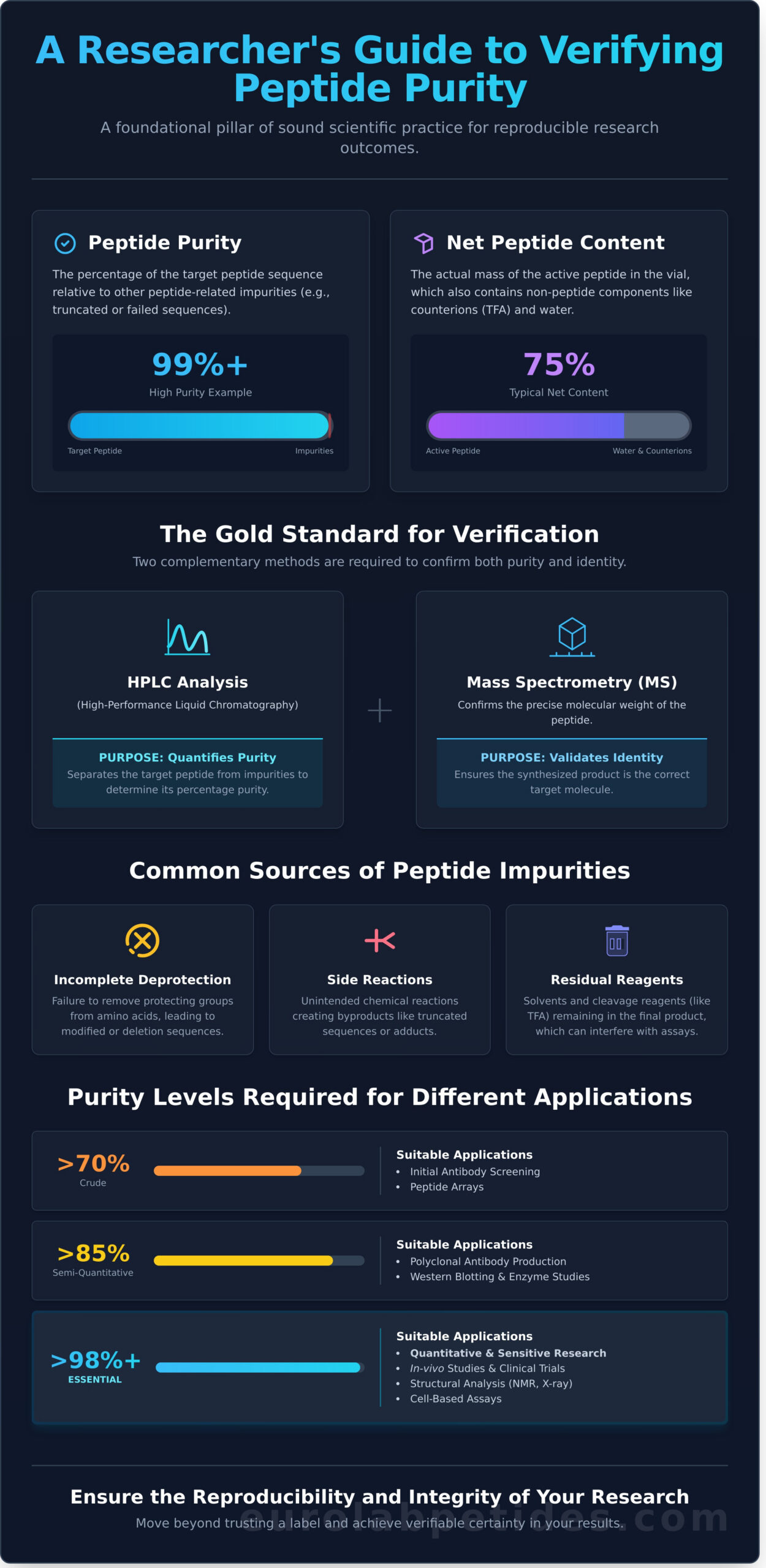
It is critical to differentiate peptide purity from net peptide content. Purity assesses the identity and homogeneity of the peptide itself, identifying contaminants like truncated or failed sequences. Net peptide content, conversely, quantifies the actual mass of the active peptide in the vial, which also contains non-peptide components such as counterions (e.g., TFA) and water. A peptide can have 99% purity but only 75% net peptide content, a distinction vital for accurate dosing and concentration calculations.
Common Sources of Peptide Impurities
Impurities are inherent byproducts of the chemical synthesis process, demanding stringent purification protocols and subsequent analysis. The complexity of modern Peptide synthesis, particularly Solid-Phase Peptide Synthesis (SPPS), introduces several potential sources of contamination that must be removed. The most common sources include:
- Incomplete Deprotection: Failure to completely remove protecting groups from amino acid side chains during synthesis cycles can lead to modified or deletion sequences.
- Side Reactions: Unintended chemical reactions can result in byproducts such as truncated sequences (shorter peptides) or adducts, which may possess their own biological activity.
- Residual Reagents: Solvents and cleavage reagents used during synthesis and purification, most notably trifluoroacetic acid (TFA), can remain in the final product and interfere with cellular assays.
Purity Levels Required for Different Applications
The required purity level is dictated by the sensitivity and nature of the intended application. Using a peptide with insufficient purity for a demanding experiment is a primary cause of failed research. The generally accepted standards are as follows:
- Crude & >70% Purity: Suitable only for non-sensitive, preliminary applications such as initial antibody screening or peptide arrays where a high signal-to-noise ratio is not required.
- >85% Purity: Considered appropriate for semi-quantitative applications, including polyclonal antibody production, Western blotting, and enzyme-substrate studies.
- >95-98%+ Purity: Essential for all quantitative and sensitive research. This includes in-vivo studies, clinical trials, structural analysis (NMR, X-ray crystallography), and cell-based assays where off-target effects must be eliminated. High purity ensures that observed biological activity is attributable solely to the target peptide.
The integrity of research data is directly correlated to the purity of the reagents used. The introduction of unknown peptide species can lead to off-target effects and a complete failure to reproduce findings. This reality underscores why knowing how to verify peptide purity is not a procedural formality but a foundational pillar of rigorous scientific investigation.
The Gold Standard Methods: Understanding HPLC and Mass Spectrometry
In the uncompromising domain of scientific research, peptide quality is not a subjective measure; it is a verifiable metric. For any researcher asking how to verify peptide purity, the answer resides in a mandatory, two-pronged analytical approach. The two indispensable techniques for this validation are High-Performance Liquid Chromatography (HPLC) and Mass Spectrometry (MS). These methods are not interchangeable but are fundamentally complementary. HPLC quantifies purity by separating the target peptide from synthesis-related impurities, while MS validates identity by confirming the precise molecular weight. This dual-validation protocol is the cornerstone of stringent quality control, aligning with the principles outlined in established Regulatory Guidelines for Therapeutic Peptides and ensuring that the product in the vial is exactly what is specified.
High-Performance Liquid Chromatography (HPLC)
The primary function of HPLC is to separate, identify, and quantify each component in a mixture. In peptide analysis, a sample is passed through a column under high pressure, and its components are separated based on their distinct physicochemical properties. The output, an HPLC chromatogram, displays a series of peaks where each peak represents a different compound. The largest peak corresponds to the target peptide. Purity is calculated as a percentage by comparing the area of the main peptide peak to the total area of all peaks detected. For most synthetic peptides, Reversed-Phase HPLC (RP-HPLC) is the standard, with detection typically performed at a UV wavelength of 214-220nm where the peptide bond absorbs light.
Mass Spectrometry (MS)
While HPLC confirms purity, Mass Spectrometry confirms identity. This technique is non-negotiable for verifying that the correct peptide sequence was successfully synthesized. The fundamental principle of MS involves ionizing the peptide molecules and measuring their mass-to-charge (m/z) ratio. This analysis yields an observed molecular weight that must precisely match the calculated theoretical molecular weight based on the peptide’s amino acid sequence. Any significant deviation indicates a synthesis error or modification. Common ionization techniques employed for peptides include Matrix-Assisted Laser Desorption/Ionization (MALDI-TOF) and Electrospray Ionization (ESI-MS), each providing definitive proof of molecular identity.
How to Read a Certificate of Analysis (CoA): A Practical Walkthrough
A Certificate of Analysis (CoA) is the primary document that substantiates a supplier’s quality claims. It provides objective, quantitative data from analytical testing. For researchers asking how to verify peptide purity, a systematic review of the CoA is the most direct and reliable method. The following steps provide a standardized protocol for interpreting this critical document and ensuring the integrity of your research materials.
Interpreting the HPLC Chromatogram
The first and most critical data point is the purity percentage determined by High-Performance Liquid Chromatography (HPLC). This value is typically displayed prominently, often as “Purity (HPLC): >99%”. This figure is derived directly from the corresponding chromatogram, a graph plotting substance concentration over time. A high-purity sample is characterized by a single, sharp, and dominant peak. The area under this main peak, calculated as a percentage of the total area of all peaks, yields the final purity value. A ‘clean’ baseline with minimal secondary peaks is the unambiguous hallmark of a meticulously purified peptide. Conversely, the presence of multiple significant peaks or a noisy, irregular baseline is a definitive red flag, indicating contamination with synthesis byproducts or degraded fragments.
Validating Identity with Mass Spectrometry Data
While HPLC confirms purity, Mass Spectrometry (MS) validates molecular identity. The CoA must include MS data comparing the peptide’s theoretical molecular weight with its observed molecular weight. The “Theoretical Mass” (or Calculated Mass) is derived from the peptide’s amino acid sequence. The “Observed Mass” is the result measured by the instrument. For a valid product, these two figures must align precisely or within a negligible margin of error (e.g., +/- 0.1 Da). This confirmation is non-negotiable; it ensures the product is the correct molecule, not merely a ‘pure’ but incorrect substance. A fundamental understanding of the complexities involved in modern peptide synthesis and purification methods underscores why this dual verification is essential. A significant discrepancy between observed and theoretical mass indicates a catastrophic synthesis failure.
Finally, a comprehensive CoA includes essential administrative details that ensure traceability and compliance. Always verify the following data points:
- Batch Number: This unique identifier must match the number on the product vial.
- Analysis Date: Confirms the recency of the quality control testing.
- Appearance: The physical state (e.g., “White lyophilized powder”) should match the received product.
Scrutinizing these elements provides a complete picture of product quality and is a fundamental step in how to verify peptide purity before commencing any research protocol.
A Researcher’s Checklist for Sourcing High-Purity Peptides
The integrity of research data is directly correlated with the quality of the reagents utilized. A stringent supplier validation protocol is therefore a fundamental component of scientific rigor. Understanding how to verify peptide purity begins not in the laboratory, but with the meticulous evaluation of the source. The following checklist provides a framework for this critical assessment process.
An uncompromising supplier will not only meet these standards but will present them as a matter of course. Your due diligence should include:
- Demand a Batch-Specific Certificate of Analysis (CoA): A CoA must be provided for the exact batch you intend to purchase. This document is the primary evidence of quality and is non-negotiable.
- Verify Raw Analytical Data: The CoA is incomplete without the inclusion of both High-Performance Liquid Chromatography (HPLC) and Mass Spectrometry (MS) data. A stated purity percentage without the supporting chromatogram and mass spectrum is an unsubstantiated claim.
- Assess Supplier Transparency: Reputable suppliers provide unobstructed access to lab results and quality control documentation. Information should be readily available, reflecting a culture of accountability. Our commitment to uncompromising quality standards ensures all data is transparently provided.
- Prioritize Third-Party Verification: The gold standard for quality assurance is independent, third-party laboratory testing. This provides unbiased confirmation of purity, identity, and quantity, removing any potential for internal bias.
- Confirm Handling and Synthesis Protocols: Information regarding the synthesis method, lyophilization process, and recommended storage and reconstitution protocols should be clear and scientifically sound.
Key Questions to Ask a Peptide Supplier
Direct inquiry is a crucial part of the vetting process. The supplier’s response, both in content and timeliness, is indicative of their operational standards. Your questions should be specific and technical, leaving no room for ambiguity. Insist on clear answers to the following before committing to a purchase.
- ‘Can I see the HPLC and MS data for the specific batch I will receive?’
- ‘Do you perform third-party testing, and can I see those reports?’
- ‘What is the net peptide content of this batch?’
Red Flags to Watch For
Identifying potential issues early is essential for mitigating risks to your research. Certain supplier behaviors are clear indicators of substandard quality control or a lack of transparency. The presence of any of these red flags warrants immediate disqualification of the vendor from consideration, as they directly impact the reliability of your work.
- Unwillingness to provide batch-specific CoAs before purchase.
- Provision of generic or outdated CoAs not specific to the current lot.
- Purity claims made without accessible, verifiable HPLC and MS data.
- Anomalously low pricing compared to established, reputable vendors.
EuroLab Peptides’ Protocol: Ensuring Uncompromising Purity
Theoretical knowledge of purity verification is essential, but a supplier’s protocol provides the ultimate assurance. At EuroLab Peptides, our quality control is not merely a process; it is a systemic guarantee built on multi-level validation. This protocol is the practical embodiment of how to verify peptide purity at the highest industry standard, ensuring that every product meets the stringent demands of scientific research.
Our dual-validation system is uncompromising. Every synthesized batch is subjected to rigorous in-house analysis using High-Performance Liquid Chromatography (HPLC) and Mass Spectrometry (MS). This initial stage verifies that the peptide meets our internal standard of 99%+ purity. Only after passing this critical threshold is the batch sent for a second, independent analysis by a certified third-party European laboratory. This provides unbiased confirmation of both its molecular identity and purity profile, guaranteeing that the product you receive is unequivocally verified.
The Importance of Third-Party Verification
Independent third-party testing is a non-negotiable component of our quality assurance. This critical step completely eliminates the potential for internal bias and provides researchers with an objective, verifiable layer of confidence. By submitting our products to external scrutiny, we adhere to the gold standard of the industry-a key differentiator that distinguishes premium, research-grade suppliers from mere distributors.
Transparency and Accessibility
We believe that verifiable data is the cornerstone of trust. For this reason, all Certificates of Analysis, including both in-house and third-party lab results, are made available on the relevant product page for review prior to purchase. This radical transparency allows you to perform your own due diligence with complete ease. Our European-based operations further guarantee adherence to the world’s most stringent quality and regulatory standards.
This comprehensive protocol ensures that every vial we ship provides a foundation of absolute certainty for your research. The question of how to verify peptide purity is answered definitively through our documented and independently confirmed process. View our commitment to quality and examine the data that underpins our promise of unrivaled product integrity.
Upholding Research Integrity Through Purity Verification
In the high-stakes environment of scientific research, the validity of experimental data is directly contingent upon the purity of the reagents employed. Therefore, mastering analytical methods such as HPLC and Mass Spectrometry, and meticulously interpreting a Certificate of Analysis, are no longer optional skills. These competencies form the core protocol of how to verify peptide purity and ultimately safeguard the integrity of your findings.
At EuroLab Peptides, this uncompromising standard of verification is not a recommendation; it is our foundational protocol. Every peptide synthesized and supplied is guaranteed to possess a purity level of 99% or higher. This metric is rigorously confirmed through stringent, independent third-party laboratory analysis, ensuring objective, unbiased validation. For complete transparency, batch-specific Certificates of Analysis are readily accessible online, providing the verifiable data your research demands.
Equip your laboratory with materials that meet the highest European standards. Browse our catalog of third-party tested research peptides and proceed with your research, confident in the absolute integrity of your materials.
Frequently Asked Questions About Peptide Purity Verification
What does ‘>99% peptide purity’ actually mean?
A purity level of >99% quantifies the percentage of the target peptide sequence relative to other peptide-related impurities within the sample. This metric is determined by High-Performance Liquid Chromatography (HPLC), which separates the desired full-length peptide from contaminants such as deletion or truncated sequences. It is a critical measure of synthetic fidelity but does not account for non-peptidic materials like water or counter-ions, which are measured separately as part of the net peptide content analysis.
What is the difference between peptide purity and net peptide content (NPC)?
Peptide purity, determined via HPLC, specifically measures the target peptide’s percentage against other peptide-related impurities. In contrast, Net Peptide Content (NPC) quantifies the actual mass of the peptide relative to all components in the lyophilized powder, including residual water, salts, and counter-ions like TFA. NPC is essential for calculating precise concentrations for experimental solutions, ensuring accurate and reproducible dosing. Both metrics are required for a complete characterization of the final product.
Why is Trifluoroacetic acid (TFA) present in my peptide sample?
Trifluoroacetic acid (TFA) is a necessary and standard residual component from the reverse-phase HPLC purification process. It functions as a counter-ion, pairing with positively charged amino acid residues to maintain the peptide’s stability and solubility in its lyophilized state. While stringent purification and lyophilization protocols are employed to minimize its final concentration, trace amounts are inherent to the manufacturing process and are critical for preserving the integrity of the peptide during storage and handling.
Can I test the purity of a peptide myself in my own lab?
Independent verification is possible if the laboratory is equipped with the appropriate analytical instrumentation, primarily an HPLC system and a mass spectrometer. The process of how to verify peptide purity requires developing a validated analytical method specific to the peptide’s properties. For laboratories without this capability, the most reliable and standard protocol is to depend on the comprehensive Certificate of Analysis provided by the manufacturer, which must include data from independent, third-party verification.
How does improper storage affect peptide purity over time?
Improper storage conditions will invariably lead to the degradation of the peptide, compromising its purity. Exposure to atmospheric moisture can cause hydrolysis, while elevated temperatures accelerate chemical modifications like deamidation and oxidation of susceptible residues (e.g., Met, Cys, Trp). To maintain the certified purity and structural integrity, lyophilized peptides must be stored at or below -20°C in a sealed, desiccated environment, shielded from light until reconstitution for immediate use.
Is a higher purity percentage always better for every type of research?
For research applications demanding the highest degree of precision and reproducibility-such as in vivo studies, cell-based assays, or structural analyses-a purity of >99% is non-negotiable. Using a lower-purity product introduces confounding variables from contaminating peptide sequences, which can produce ambiguous or artifactual data. While less sensitive applications might tolerate >95% purity, utilizing the highest available grade is the most stringent approach to ensuring uncompromising data integrity and scientific validity.
What is a ‘failed sequence’ and how is it detected?
A ‘failed sequence,’ also known as a truncated or deletion sequence, is an incomplete peptide chain resulting from inefficient coupling during solid-phase peptide synthesis (SPPS). These impurities are identified and quantified during HPLC analysis, where they typically appear as separate peaks that elute before the main peak of the full-length target peptide. The identity of these contaminants is then unequivocally confirmed using mass spectrometry, which verifies their lower molecular weight relative to the correct sequence.
