

The validity of a research outcome is contingent upon the purity of its constituent reagents. In a market saturated with unsubstantiated claims, the procurement of low-purity or incorrectly synthesized peptides represents a critical risk, jeopardizing not only significant financial investment but the very integrity of a study’s findings. This risk necessitates a stringent, evidence-based approach to sourcing. Consequently, the reliance on third party tested peptides for research is no longer a preference but a fundamental requirement for reproducible science, demanding a level of scrutiny equal to the research itself.
This 2026 verification guide provides a definitive clinical framework to navigate these challenges. Here, we will deconstruct the Certificate of Analysis (CoA), detailing the methodologies behind HPLC and Mass Spectrometry data, and establish a clear protocol for validating supplier claims. The objective is to empower your laboratory to confidently source peptides of uncompromising quality-with documented purity exceeding 99%-ensuring your results are built upon a foundation of verifiable chemical integrity.
Key Takeaways
- Differentiate between independent third-party analysis and potentially biased in-house Quality Control to establish the gold standard for peptide verification.
- Master the interpretation of a Certificate of Analysis (CoA), enabling you to identify critical data points required for comprehensive purity validation.
- Implement a clinical due diligence checklist to confidently select suppliers of third party tested peptides for research, ensuring the integrity of your materials.
- Correlate peptide purity directly with experimental validity by understanding how impurities can introduce confounding variables and compromise research reproducibility.
Defining the Gold Standard: Third-Party vs. In-House Peptide Testing
In the rigorous domain of scientific research, the provenance and purity of reagents are paramount. The term “third-party testing” has a precise clinical definition: the comprehensive analysis of a product batch by an independent, unaffiliated laboratory. This process provides an unbiased, objective verification of a peptide’s identity, purity, and concentration, typically utilizing advanced analytical methods such as High-Performance Liquid Chromatography (HPLC) and Mass Spectrometry (MS). This stands in stark contrast to in-house Quality Control (QC), where testing is conducted by the manufacturer themselves. While internal QC is a necessary step in production, it carries an inherent potential for bias, whether intentional or subconscious.
For research applications, this distinction is fundamental to experimental integrity. The use of improperly identified or contaminated compounds can invalidate results, leading to wasted resources, retracted publications, and a compromised scientific record. Therefore, sourcing third party tested peptides for research is not a preference but a procedural necessity. Verifiable, independent analysis is the only uncompromising method to guarantee that the product in the vial precisely matches the specifications on its label, ensuring the reproducibility and validity of experimental data.
The Role of Independent Laboratories
Independent analytical laboratories function as impartial arbiters of quality. By operating outside the manufacturer’s commercial interests, they deliver unbiased data on a product’s chemical profile. Reputable testing facilities are often accredited, adhering to stringent international standards such as ISO/IEC 17025, which governs the general requirements for the competence of testing and calibration laboratories. A transparent chain of custody for submitted samples is also critical, ensuring the sample analyzed is from the same batch being sold to researchers. This external validation confirms that sophisticated peptide purification techniques employed during synthesis have yielded the required level of purity.
Common Misconceptions About ‘Lab-Tested’ Claims
The descriptor “lab-tested” is frequently employed by suppliers but remains dangerously ambiguous. This claim often refers to nothing more than the manufacturer’s own internal quality checks. Without explicit documentation from an external source, such a statement provides no objective assurance of quality. Researchers must exercise stringent due diligence by demanding a current Certificate of Analysis (CoA) for their specific product batch. This document should clearly name the third-party laboratory that performed the analysis, present the HPLC and MS data, and be signed by an authorized analyst. Anything less is an unacceptable risk to scientific rigor.
Decoding the Certificate of Analysis (CoA): A Researcher’s Guide
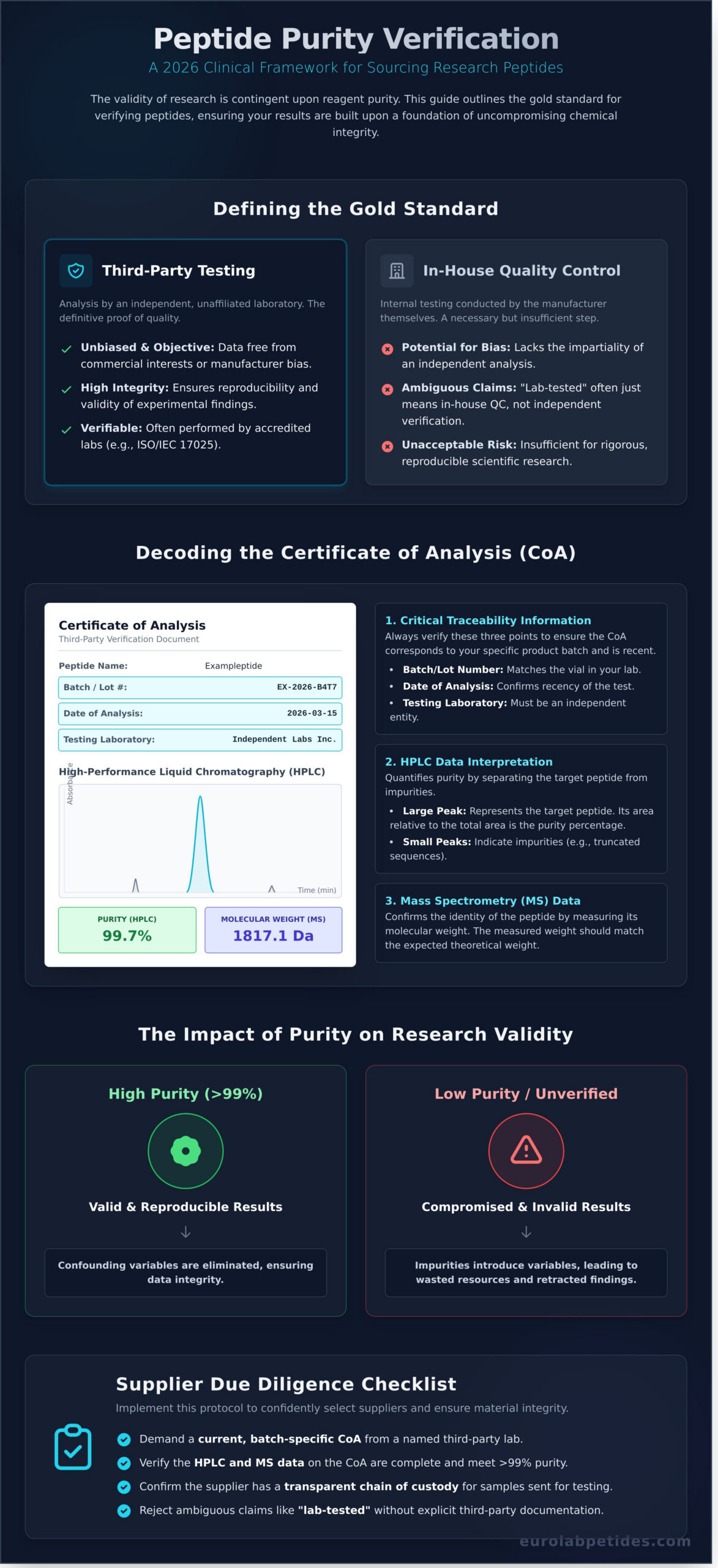
The Certificate of Analysis (CoA) is not a marketing document; it is the cornerstone of empirical validation in peptide procurement. This document provides an unbiased, quantitative assessment of a peptide’s purity and identity, serving as the definitive proof of quality. For any serious investigation, sourcing third party tested peptides for research requires meticulous review of the accompanying CoA for each specific batch. A legitimate CoA will always contain critical traceability information, including:
- Batch/Lot Number: Ensures the data corresponds directly to the vial in your possession.
- Date of Analysis: Confirms the recency and relevance of the quality control testing.
- Testing Laboratory Details: Verifies that the analysis was performed by an independent, unbiased entity.
An example CoA with key data points-Purity (HPLC), Molecular Weight (MS), and Batch Number-highlighted.
Interpreting High-Performance Liquid Chromatography (HPLC) Data
HPLC is the industry-standard analytical method for quantifying peptide purity. The technique separates the fully synthesized peptide from any residual impurities, such as truncated or deletion sequences. The resulting chromatogram displays a prominent peak representing the target peptide, with significantly smaller peaks indicating contaminants. Purity is calculated as the area of the main peak relative to the total peak area. For research applications where data integrity is paramount, an uncompromising purity standard of 99% or greater is required.
Validating Peptide Identity with Mass Spectrometry (MS)
While HPLC confirms purity, Mass Spectrometry (MS) validates identity. This analysis determines the molecular weight of the peptide, which must precisely match its theoretical weight calculated from the amino acid sequence. A discrepancy between the observed mass on the MS report and the expected mass indicates a critical synthesis error. Both data sets are indispensable; as outlined in official FDA guidance on peptide quality, comprehensive characterization is fundamental to ensuring product integrity. Purity without correct identity is scientifically invalid, underscoring why both HPLC and MS results are required for complete verification.
A Due Diligence Checklist for Vetting Peptide Suppliers
Procuring high-purity, third party tested peptides for research requires a systematic validation process. The integrity of experimental data is directly dependent on the quality of the reagents used; therefore, a meticulous approach to vendor qualification is not optional, but essential. This checklist provides a standardized framework for evaluating potential suppliers and ensuring the acquisition of verifiably pure compounds.
Follow this four-step protocol to mitigate risks and secure materials that meet stringent scientific standards:
- Step 1: Request Batch-Specific, Third-Party CoAs. Before any financial transaction, demand a Certificate of Analysis (CoA) for the specific batch you intend to purchase. A supplier’s refusal or inability to provide this is a primary disqualifier.
- Step 2: Verify the Independent Laboratory. The CoA must originate from a credible, independent analytical laboratory. Conduct a brief search to confirm the lab’s existence, location, and professional standing. In-house testing is a necessary first step, but it is not a substitute for objective, third-party verification.
- Step 3: Scrutinize the Analytical Data. A legitimate CoA will contain detailed data from High-Performance Liquid Chromatography (HPLC) and Mass Spectrometry (MS). Assess the reported purity levels against established benchmarks like the USP standards for peptide purity to ensure the material meets rigorous quality criteria.
- Step 4: Assess Manufacturing and Handling Transparency. Inquire about the supplier’s synthesis and purification methods. A commitment to proper lyophilization (freeze-drying) is a critical indicator of a supplier’s understanding of peptide stability and long-term viability.
Red Flags to Watch For on a Certificate of Analysis
The CoA is the primary evidence of quality, but it must be critically examined. Be vigilant for common indicators of substandard or fraudulent documentation. Warning signs include generic reports lacking a specific batch or lot number, missing contact details for the testing laboratory, and suspiciously “perfect” results (e.g., 100.00% purity), which are analytically improbable. Any visible signs of digital alteration or a supplier’s reluctance to provide the CoA pre-purchase are definitive grounds for rejection.
Beyond the CoA: Other Indicators of Quality
While the CoA is paramount, other operational factors signal a supplier’s commitment to uncompromising quality. Proper lyophilization is non-negotiable, as it ensures the peptide’s structural integrity and stability during shipping and storage. Furthermore, suppliers operating from and shipping within the EU often adhere to stricter regulatory and quality control standards. Finally, a professional vendor will provide clear protocols for product handling and offer knowledgeable customer support capable of addressing technical inquiries, positioning themselves as a reliable scientific partner.
The Impact of Purity on Research Validity and Reproducibility
In any scientific investigation, the ultimate objective is the acquisition of reliable, unambiguous data. The purity of a peptide reagent is not a secondary detail; it is a critical determinant of experimental validity. Impurities, which can range from truncated or modified sequences to residual solvents from synthesis, act as uncontrolled confounding variables. These contaminants can elicit off-target biological effects, inhibit the intended activity of the primary peptide, or produce false positives in sensitive assays, leading to erroneous conclusions and misinterpretation of results.
This issue directly contributes to the well-documented crisis of reproducibility in science. An experiment cannot be replicated if the reagents used are not identical. Consider a scenario where months of research into a specific cell signaling pathway are invalidated; the observed cellular response was not due to the target peptide but to an unidentified contaminant present in a low-purity batch. This outcome undermines the entire study, rendering the data useless.
Case Study: The Unseen Costs of Impurity
The use of a contaminated peptide batch incurs significant and quantifiable costs. Financially, it results in wasted high-value reagents, cell culture media, and consumables, compounded by irrecoverable personnel hours. Scientifically, the cost is far greater: invalid conclusions can lead to retracted publications, loss of funding, and substantial damage to a laboratory’s reputation. The marginal initial savings on a cheaper, unverified peptide are eclipsed by the immense risk to data integrity. Procuring high-purity, third party tested peptides for research is an investment in the certainty of your results.
The Mandate for Lot-to-Lot Consistency
For longitudinal studies or experiments requiring multiple peptide orders over time, lot-to-lot consistency is non-negotiable. A reported purity of >99% must be maintained across every batch to ensure that observed effects are consistent and comparable. Only suppliers with stringent, documented quality control protocols, including batch-specific HPLC and Mass Spectrometry analysis, can guarantee this standard. This level of verification is fundamental for replicating one’s own findings and for enabling other researchers to validate and build upon published work. Without it, the continuity of scientific inquiry is broken.
At EuroLab Peptides, our commitment to uncompromising quality standards ensures that every batch is rigorously verified, providing the consistency your critical research demands.
The EuroLab Peptides Protocol: Multi-Level Purity Verification
The principles of analytical integrity and verifiable purity are not abstract concepts; they are the foundation of our operational mandate. At EuroLab Peptides, our quality assurance protocol is engineered to provide an unrivaled level of confidence, directly addressing the critical need for reliable reagents in scientific inquiry. This system is a tangible application of the standards discussed throughout this article, representing our unwavering commitment to the research community.
Our verification process is a multi-level, sequential protocol designed for absolute certainty. It is not enough to rely on a single point of analysis. Therefore, every peptide undergoes a rigorous two-stage validation:
- Stage 1: In-House Synthesis & Quality Control. Following synthesis in our European facilities, each batch is subjected to internal analysis to confirm correct sequence and preliminary purity. This initial screen ensures the product meets our baseline production standards before proceeding.
- Stage 2: Independent Third-Party Validation. The peptide is then sent to an independent, unaffiliated European laboratory. Here, comprehensive analysis via High-Performance Liquid Chromatography (HPLC) and Mass Spectrometry (MS) is conducted to definitively verify identity, concentration, and a purity level of over 99%.
This dual-verification model eliminates the potential for internal bias and provides objective, reproducible data. For researchers demanding the highest caliber of third party tested peptides for research, this protocol ensures that the material received is precisely what the data sheet specifies. Every batch is accompanied by its corresponding, downloadable Certificate of Analysis (CoA) from the independent lab, offering complete transparency.
Our Uncompromising European Standards
Operating exclusively within the European Union ensures our processes adhere to the world’s most stringent regulatory and quality manufacturing frameworks. Our advanced lyophilization process is optimized to guarantee maximum peptide stability, ensuring extended shelf-life and consistent performance upon reconstitution. This commitment culminates in our guarantee: every peptide is verified to possess a purity of >99% by an independent laboratory, a standard we consider non-negotiable for reproducible research.
Sourcing with Confidence for Your Research
To facilitate complete transparency, the third-party CoA for each batch is available directly on its respective product page. We invite you to scrutinize our data and validate our commitment to quality for yourself. When the integrity of your results depends on the purity of your reagents, there can be no compromise. Procure your third party tested peptides for research with the documented assurance only a rigorous, transparent protocol can provide.
Review our catalog of peptides, each verified for >99% purity.
The Mandate for Verifiable Purity in Advanced Research
The integrity of scientific inquiry is contingent upon the quality of its foundational materials. As this guide has established, the critical distinction between in-house claims and independent verification defines the standard for reliable reagents. A researcher’s ability to meticulously decode a Certificate of Analysis and comprehend the direct impact of purity on experimental reproducibility is paramount. Sourcing third party tested peptides for research is therefore not a preference, but a fundamental requirement for generating credible, high-impact data.
At EuroLab Peptides, this principle is the core of our protocol. Our EU-based manufacturing and quality control systems ensure an uncompromising purity standard, guaranteed to exceed 99% for every product. We provide complete transparency through independent, batch-specific CoAs available for direct download, empowering your work with verifiable quality. This commitment ensures that your results are built upon a foundation of absolute analytical certainty.
To equip your laboratory with reagents that meet these stringent standards, browse our catalog of research peptides, each with independent third-party verification. Advance your next discovery with the confidence that only validated purity can provide.
Frequently Asked Questions
What is the difference between purity and concentration in peptides?
Purity refers to the percentage of the target peptide sequence relative to all other substances in the lyophilized powder, as determined by High-Performance Liquid Chromatography (HPLC). Concentration, conversely, is the mass of the peptide per unit volume of solvent (e.g., mg/mL) after it has been reconstituted. A product can have 99%+ purity but be prepared at various concentrations for experimental use. Purity is an intrinsic quality metric, while concentration is a user-defined variable.
How can I verify the third-party laboratory that tested a peptide?
An authentic Certificate of Analysis (CoA) will explicitly name the independent laboratory that performed the analysis. Researchers must verify this by contacting the laboratory directly, using publicly available information, and providing the batch number listed on the CoA. The laboratory should be able to confirm the authenticity of the report. An inability to independently validate the testing source is a critical failure in a supplier’s transparency protocol and should be treated with extreme caution.
Why is a batch-specific Certificate of Analysis so important?
Peptide synthesis is a complex chemical process with inherent variability between production runs. A batch-specific CoA provides empirical evidence-typically HPLC and Mass Spectrometry data-that pertains to the exact vial of peptide you receive, not a previous or “representative” batch. This documentation is the only verifiable assurance of identity, purity, and quality for your specific sample, which is a non-negotiable prerequisite for achieving reproducible and valid research outcomes.
What do I do if a supplier refuses to provide a third-party CoA before purchase?
A supplier’s refusal to provide a current, batch-specific CoA is an unequivocal indicator of substandard quality control or a lack of confidence in their own product. This lack of transparency is unacceptable for any serious research application. The only scientifically sound course of action is to disqualify that supplier immediately. Sourcing peptides for research requires absolute, verifiable proof of quality, and withholding such data constitutes a critical failure of due diligence.
Does ‘Made in the EU’ guarantee higher peptide quality?
While European Union manufacturing is often governed by stringent regulatory standards, the geographic origin itself is not an absolute guarantee of peptide quality. The ultimate arbiter of quality is not a label but empirical, verifiable data. The integrity of any peptide, regardless of origin, must be substantiated by a batch-specific, third-party Certificate of Analysis. Uncompromising quality is demonstrated through transparent analytical data, not through manufacturing location alone.
How does EuroLab Peptides ensure the integrity of the sample sent for third-party testing?
To ensure unbiased analysis, a sample is randomly selected from the final, lyophilized batch post-synthesis. This sample is assigned the same batch number that will be sold and is then sealed and sent directly to our independent laboratory partner. This strict chain-of-custody protocol guarantees that the material analyzed is identical to the product the researcher receives, eliminating any possibility of sample misrepresentation and ensuring the CoA data is a true reflection of the entire batch.
What is the acceptable margin of error between observed and theoretical mass on an MS report?
For Mass Spectrometry (MS) analysis, the industry standard for confirming peptide identity is a deviation of ±1.0 Dalton (Da) between the observed mass and the theoretical (calculated) mass. A result within this narrow margin provides high confidence that the correct amino acid sequence was successfully synthesized. Deviations exceeding this tolerance suggest significant errors, such as incorrect amino acid incorporation or post-synthesis modifications, rendering the peptide unsuitable for precise research.
Are third-party tested peptides more expensive, and is the cost justified?
The acquisition of third party tested peptides for research carries a higher price point due to the costs of independent analytical chemistry services. This additional expense is not only justified but essential. It represents a critical investment in the validity of your experimental data and the reproducibility of your results. The financial cost of using an unverified, impure, or incorrect compound-leading to failed experiments and wasted resources-far exceeds the marginal price increase for guaranteed quality.
