

For the research scientist, precision is not an objective; it is a prerequisite. In a field where the fundamental distinction between peptides and larger proteins can dictate the entire trajectory of an experiment, foundational knowledge is the primary variable for success. The proliferation of non-scientific information creates significant challenges, making it difficult to source reliable data on biochemical structures, classifications, and mechanisms of action-all critical components for valid study design and the procurement of compounds with verifiable purity.
This comprehensive guide is engineered to address these challenges directly. We provide a systematic, scientific overview of peptide science, from fundamental amino acid sequences to complex signaling pathways. The following analysis will equip researchers with a functional framework for classifying these compounds and understanding their primary functions in a laboratory setting. This knowledge is essential for the confident selection and handling of research materials where integrity and reproducibility are non-negotiable.
Key Takeaways
- Acquire a systematic framework for classifying peptides by source, structure, or function to enhance experimental precision and comparability.
- Delineate the primary biochemical mechanisms of action, from receptor binding to signal transduction, that underpin peptide activity in laboratory models.
- Connect foundational peptide biochemistry to its application in major contemporary research fields, including endocrinology, neurology, and oncology.
- Understand the critical impact of compound purity and analytical verification on the validity and reproducibility of your research outcomes.
Defining Peptides: The Building Blocks of Biology
In the precise lexicon of biochemistry, peptides are short polymers composed of amino acids linked in a defined sequence by peptide bonds. These molecules are fundamental to nearly all biological processes, acting as endogenous signaling agents that regulate functions from metabolism and cell growth to neurotransmission. A comprehensive understanding of their molecular structure is foundational to any rigorous scientific inquiry. For a broader overview of their classification and chemical nature, see this reference on what are peptides. It is imperative to emphasize that all synthetic peptides supplied by EuroLab Peptides are produced under stringent conditions exclusively for in-vitro laboratory research and are not approved or intended for human or veterinary use.
Peptides vs. Proteins: A Structural and Functional Comparison
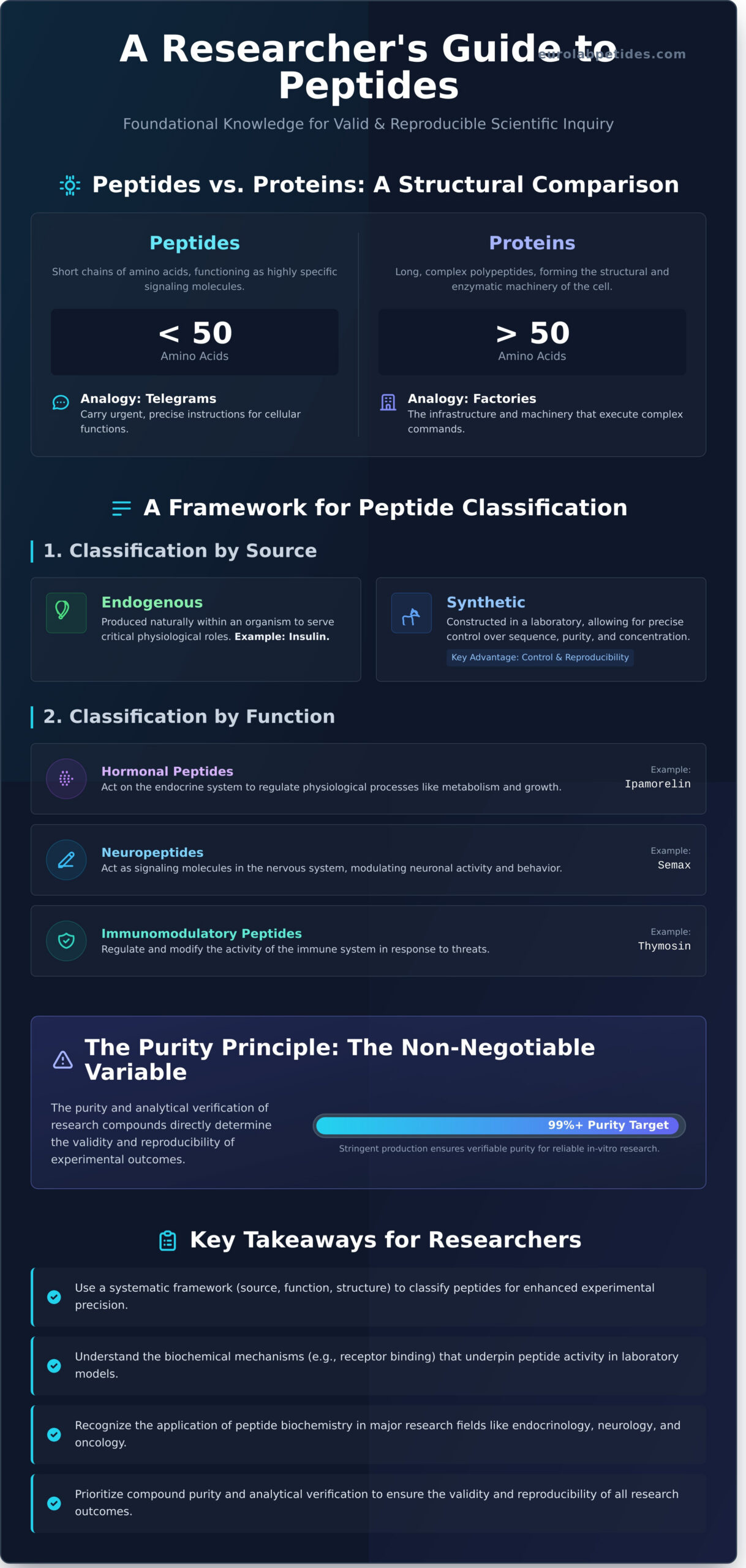
The principal distinction between peptides and proteins is one of scale and complexity. Conventionally, molecules with chains of fewer than 50 amino acids are classified as peptides, while longer polypeptides are designated as proteins. This size difference is directly correlated with their divergent biological roles. Proteins often serve structural (e.g., collagen) or enzymatic (e.g., amylase) functions, forming the complex machinery of the cell. In contrast, peptides function primarily as highly specific signaling molecules-the biological equivalent of precise messages. An analogy can be drawn where peptides are the telegrams carrying urgent instructions, and proteins are the factories and infrastructure that execute those commands. In a research setting, this smaller size can significantly influence a peptide’s diffusion, stability, and interaction with cellular receptors in an experimental model.
The Significance of the Amino Acid Sequence
The biological identity and function of a peptide are encoded entirely within its primary structure: the linear sequence of its amino acids. This sequence dictates the molecule’s folding into a specific three-dimensional conformation, which is critical for its ability to bind with high affinity and specificity to its target receptor. The substitution, deletion, or addition of even a single amino acid can dramatically alter a peptide’s biological activity, either enhancing, diminishing, or completely nullifying its intended effect. This high degree of specificity is what allows for the existence of peptide families-groups of structurally related peptides with sequence homology that may interact with a common class of receptors, enabling researchers to systematically investigate complex signaling pathways.
A Framework for Peptide Classification in Research
For rigorous scientific inquiry, a systematic classification of peptides is essential. The vast and expanding landscape of these molecules necessitates a structured framework to guide experimental design, comparison of findings, and interpretation of results. Understanding the fundamental Peptide definition as a short chain of amino acids is the starting point. From there, these compounds can be logically categorized along three primary axes: their origin (source), their biological role (function), and their molecular architecture (structure). This framework provides a logical map for researchers navigating this complex field.
Classification by Source: Endogenous vs. Synthetic
Peptides are first distinguished by their origin. Endogenous peptides are produced naturally within an organism to serve physiological roles, such as the hormone insulin, which is critical for glucose metabolism. In contrast, synthetic peptides are constructed in a laboratory setting through chemical synthesis. The primary advantage of synthetic peptides in a research context is control; variables such as amino acid sequence, purity, and concentration can be precisely defined and manipulated. This level of control is non-negotiable for achieving reproducible and verifiable experimental outcomes.
Classification by Function: Key Research Categories
Categorization by biological function allows researchers to isolate compounds based on their mechanism of action. This is particularly relevant in weight management studies, where multiple physiological systems are targeted. Key functional classes include:
- Hormonal Peptides: These molecules act on the endocrine system to regulate physiological processes. Examples include Growth Hormone Releasing Peptides (GHRPs) like Ipamorelin, which are studied for their influence on metabolism and body composition.
- Neuropeptides: These act as signaling molecules within the nervous system, modulating neuronal activity and influencing behaviors such as appetite and satiety. Semax is an example investigated for its nootropic and neurorestorative properties.
- Immunomodulatory Peptides: This class, which includes compounds like BPC-157, is investigated for its capacity to regulate inflammatory responses and promote tissue repair, processes often dysregulated in metabolic disorders.
- Antimicrobial Peptides (AMPs): AMPs are components of the innate immune system, and their interaction with gut microbiota is an emerging area of metabolic research.
Classification by Structure: Linear, Cyclic, and Beyond
The three-dimensional structure of a peptide dictates its stability and interaction with biological targets. The most basic form is the linear peptide, a simple, unbranched chain of amino acids. More complex are cyclic peptides, where the amino acid chain is covalently bonded to form a ring. This cyclization often confers significant advantages, such as increased resistance to enzymatic degradation and higher binding affinity for specific receptors due to a more constrained conformation. Advanced research also explores further structural modifications, such as stapling or PEGylation, to enhance therapeutic potential.
Fundamental Mechanisms of Action in a Laboratory Context
To comprehend the investigative potential of peptides, one must move beyond their amino acid sequence to their functional dynamics at a cellular and molecular level. The following mechanisms, observed within controlled in-vitro cell cultures and in-vivo animal models, form the basis of their study in metabolic research. These interactions are not claims of effect but rather foundational biochemical principles under rigorous scientific examination.
Receptor Binding and Signal Transduction
The primary mechanism for many biologically active peptides is their function as ligands. They exhibit high specificity and affinity for cell-surface receptors, binding to them with precision. This interaction can elicit two distinct outcomes:
- Agonist Activity: The peptide binds to and activates the receptor, initiating a cascade of intracellular events. This process, known as signal transduction, often involves second messengers like cAMP to amplify the initial signal and trigger a specific cellular response.
- Antagonist Activity: The peptide occupies the receptor’s binding site without activating it, thereby blocking the endogenous ligand from binding and preventing a biological signal from being transmitted.
This agonist or antagonist action is fundamental to modulating cellular pathways in a controlled research setting.
Enzyme Modulation
Certain peptides can directly influence enzymatic activity. They may function as competitive inhibitors by binding to an enzyme’s active site, physically obstructing the substrate from binding and halting the catalytic reaction. Alternatively, they can act as allosteric modulators, binding to a secondary site to either enhance (activate) or reduce (inhibit) the enzyme’s efficacy. This precise control over metabolic enzymes is a cornerstone of pharmacological and biochemical peptide research, allowing investigators to isolate and study the function of specific pathways.
Ion Channel Interaction
A distinct class of peptides interacts directly with ion channels embedded in the cell membrane. By binding to specific sites on these protein channels, they can physically gate them-forcing them open or holding them closed. This action directly alters the flux of ions (e.g., Na⁺, K⁺, Ca²⁺) across the membrane, which in turn modifies the cell’s electrochemical gradient and membrane potential. Such modulation of cellular excitability is a critical area of investigation in disciplines like neuroscience and cardiology, where electrical signaling is paramount to function.
Primary Areas of Modern Peptide Research
Building upon the foundational science of amino acid sequencing and receptor interaction, modern biochemical investigation has focused on several distinct areas where peptides serve as highly specific molecular tools. These inquiries leverage the precise signaling capabilities of these compounds to probe complex biological systems. It is critical to underscore that the following applications exist strictly within a research context and do not represent established clinical uses.
Metabolic Regulation and Weight Management Studies
A primary focus of current research involves the intricate endocrine pathways governing metabolism. Investigators utilize specific peptides to study appetite signaling, energy expenditure, and nutrient partitioning. Preclinical models often examine how these compounds influence glucose homeostasis and insulin sensitivity. Compounds classified as GLP-1 receptor agonists, for example, are instrumental in research aimed at elucidating the mechanisms of satiety and glycemic control.
Cellular Senescence and Longevity Research
The processes of cellular aging, or senescence, represent another significant frontier in peptide research. Laboratory investigations explore how certain peptide structures may influence key markers of aging, such as telomere length, oxidative stress, and mitochondrial function. In these in-vitro models, compounds like Epitalon are studied for their potential effects on the molecular clocks that regulate cellular lifespan and function.
Tissue Repair and Recovery Models
The potential for peptides to modulate healing processes is an area of intense scientific interest. Research is actively being conducted on compounds that appear to regulate inflammatory responses and promote angiogenesis-the formation of new blood vessels. Molecules such as BPC-157 and TB-500 are frequently the subjects of these preclinical studies, which aim to understand their mechanisms of action in various tissue repair models.
Cognitive Function and Neurological Research
In the field of neuroscience, neuropeptides are investigated for their effects on neuronal pathways and synaptic plasticity. Research models are designed to assess the impact of these molecules on processes like memory formation, cognitive focus, and neuroprotection. Nootropic research compounds, exemplified by Semax, are employed in laboratory settings to explore their potential interactions with central nervous system signaling.
For research institutions requiring compounds of verifiable purity for these advanced lines of inquiry, access to meticulously synthesized and third-party-tested materials is non-negotiable. The integrity of scientific discovery depends on the quality of the tools used. You can review a comprehensive catalog of high-purity research compounds at eurolabpetides.com.
The Critical Importance of Purity and Verification in Research
The most significant variable threatening the integrity of metabolic research is compound quality. Inconclusive or erroneous data can often be traced back to impure, degraded, or improperly identified reagents. Therefore, understanding the journey from chemical synthesis to a verifiable, research-grade product is not an academic exercise-it is a fundamental requirement for producing valid, reproducible scientific outcomes.
Synthesis and Lyophilization Processes
The foundation of a high-quality compound is its synthesis. The vast majority of research peptides are constructed using Solid-Phase Peptide Synthesis (SPPS), a meticulous process of sequentially adding amino acids to a growing chain. Following synthesis and initial purification, the compound undergoes lyophilization. This critical freeze-drying step removes water and solvents under vacuum, converting the peptide into a stable, powdered state that ensures long-term integrity and prevents degradation during transport and storage.
Purity Analysis: The Role of HPLC and Mass Spectrometry
A synthesized product is merely a raw material until its identity and purity are quantitatively confirmed. This is achieved through a two-stage analytical process:
- High-Performance Liquid Chromatography (HPLC) is employed to separate the target peptide from any residual impurities from the synthesis process, providing a precise percentage of purity.
- Mass Spectrometry (MS) subsequently verifies that the molecular weight of the primary compound precisely matches the theoretical weight of the desired peptide sequence, confirming its identity.
For research applications where outcomes are dose-dependent and precision is paramount, a purity level of 99% or greater is the uncompromising standard required for reliable data.
Why Independent, Third-Party Testing is Non-Negotiable
While in-house analysis provides a baseline, unbiased verification is the definitive hallmark of a trustworthy supplier. Independent, third-party laboratory testing serves as an impartial audit, confirming the supplier’s claims regarding a compound’s purity, amino acid sequence, and concentration. Researchers must demand a current Certificate of Analysis (COA) for every batch to ensure the material meets these stringent criteria. This documentation is the ultimate proof of quality and the basis for sound scientific inquiry. View our commitment to multi-level quality control.
The Imperative of Purity in Peptide Research
This guide has established the foundational role of short-chain amino acid polymers, from their diverse classifications and mechanisms of action to their application across vanguard areas of scientific inquiry. The central tenet that emerges is unequivocal: the integrity of any research outcome involving peptides is directly contingent upon the verifiable purity of the compounds utilized. In a laboratory context where reproducibility is the gold standard, this principle cannot be overstated. Without this assurance, experimental data remains fundamentally compromised, invalidating otherwise rigorous methodologies.
For researchers for whom data integrity is paramount, sourcing is a critical variable. At Eurolab Peptides, this standard is non-negotiable. We provide a guaranteed 99%+ purity verified by HPLC on all batches, a claim substantiated by independent third-party laboratory testing. As a premier European-based supplier, we ensure uncompromising quality and compliance. Explore our catalog of third-party tested peptides for your research needs.
We remain committed to facilitating the advancement of your critical scientific investigations.
Frequently Asked Questions
What is the difference between research-grade and pharmaceutical-grade peptides?
Research-grade peptides are synthesized for in vitro laboratory investigation and are not intended for human administration. Their production follows quality control protocols focused on purity and sequence accuracy for experimental validity. In contrast, pharmaceutical-grade compounds are manufactured under stringent cGMP guidelines mandated by regulatory bodies. This ensures their safety and suitability for clinical use, a standard that research-grade materials are not required to meet, and are thus designated for research purposes only.
How are lyophilized peptides properly stored to ensure maximum stability?
For maximum long-term stability, lyophilized peptides must be stored in a controlled environment at or below -20°C, preferably in a desiccated, light-proof container. This protocol minimizes degradation from moisture and UV light, thereby preserving the compound’s structural integrity. Before reconstitution, the vial should be allowed to equilibrate to room temperature to prevent condensation, which can introduce moisture and compromise the sample’s purity and shelf-life post-reconstitution.
What is peptide reconstitution and why is it necessary for laboratory use?
Peptide reconstitution is the process of solubilizing a lyophilized (freeze-dried) powder into a liquid solution for experimental use. This step is critical because the lyophilized state ensures maximum shelf-life and stability during transport and storage. For laboratory applications, such as cell culture assays or analytical procedures, the peptide must be in an aqueous solution to be accurately measured and administered, and to interact with biological systems. The choice of solvent is dictated by the peptide’s specific amino acid sequence.
Why is a peptide’s purity percentage so critical for experimental outcomes?
A peptide’s purity, verified via High-Performance Liquid Chromatography (HPLC), is paramount for ensuring the validity and reproducibility of experimental data. Impurities, such as deletion sequences or residual synthesis reagents, can introduce unintended variables, leading to confounded results or cytotoxic effects. An uncompromising purity standard of 99%+ ensures that the observed biological activity is attributable solely to the target compound, which is a non-negotiable requirement for generating reliable scientific outcomes.
What are the key indicators of a reputable peptide supplier for research purposes?
A reputable supplier is distinguished by its commitment to verifiable quality. Key indicators include providing a unique, batch-specific Certificate of Analysis (CoA) for every product, complete with third-party HPLC and Mass Spectrometry (MS) data. Furthermore, adherence to stringent European manufacturing standards, transparent communication regarding synthesis and purification methods, and reliable, temperature-controlled logistics are hallmarks of a supplier dedicated to supporting rigorous scientific inquiry and ensuring product integrity upon delivery.
Does the net weight of a peptide vial include fillers or just the active compound?
The stated net weight on a vial, for example 5 mg, refers exclusively to the mass of the active peptide compound. While the lyophilized powder may contain trace, non-active counter-ions from the purification process (e.g., TFA), these are not included in the specified net peptide weight. The total mass of the powder may appear greater due to these non-active components, but the quantitative value listed represents the precise amount of the synthesized molecule available for research.
