
The integrity of months, or even years, of meticulous research can be compromised by a single, substandard vial. For the serious researcher, the question is not merely where to buy peptides online, but how to secure compounds of verifiable, uncompromising purity. The proliferation of suppliers has created a landscape where claims of quality often lack the backing of empirical data, placing the burden of due diligence squarely on the scientist. This introduces unacceptable risks: invalidated results, depleted funding, and catastrophic delays to critical projects. The potential for receiving counterfeit or low-purity materials is a variable that no rigorous study can afford.
This guide provides a clinical framework for mitigating these risks. We will move beyond marketing assertions to establish a protocol for supplier evaluation grounded in the language of the laboratory. You will learn to scrutinize Certificates of Analysis, interpret HPLC and Mass Spectrometry reports, and demand the third-party verification that is the non-negotiable standard for legitimate research materials. The objective is to empower you to source peptides with confidence, ensuring every purchase reinforces the validity and reproducibility of your scientific work.
Key Takeaways
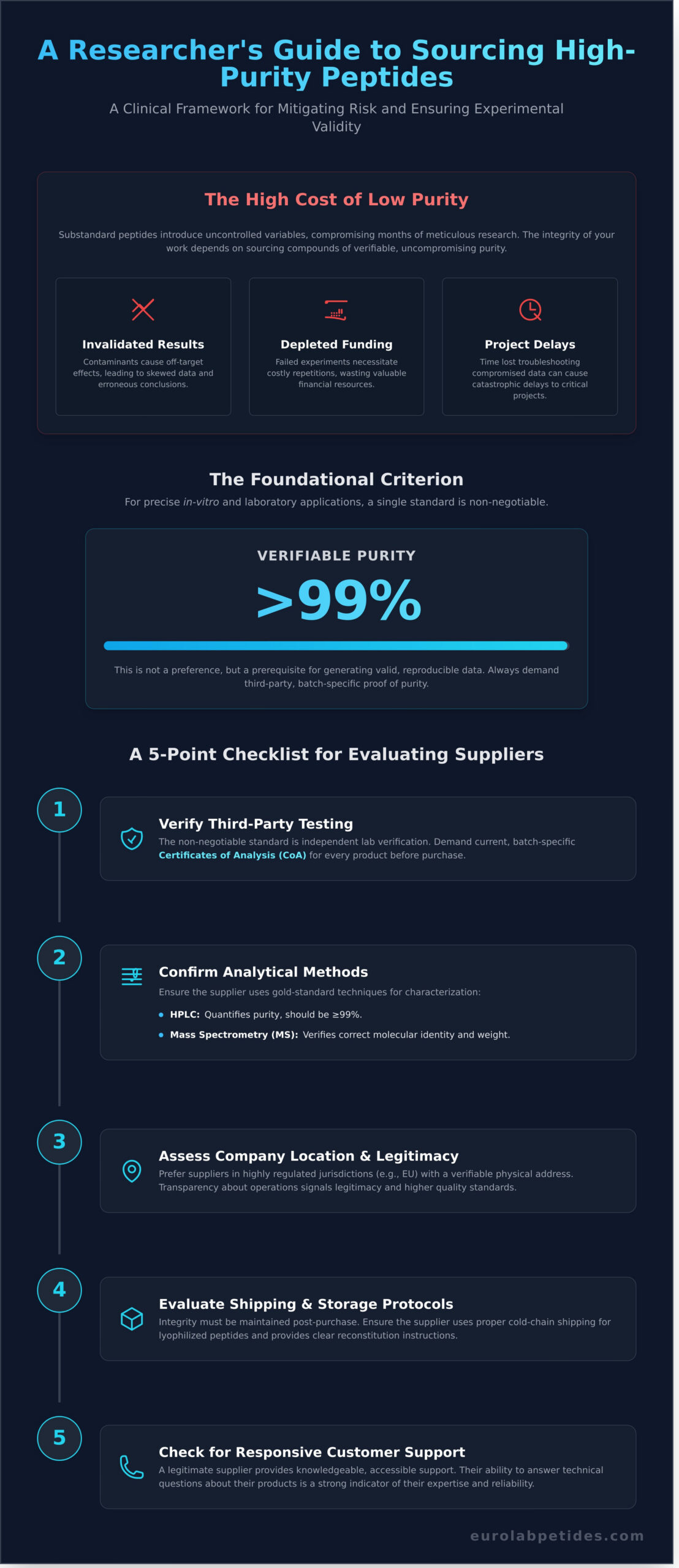
- Understand the foundational criterion for all research peptides: verifiable purity exceeding 99% is non-negotiable to ensure experimental validity.
- Implement a systematic 5-point evaluation checklist to critically assess suppliers when determining where to buy peptides online.
- Acquire the technical skill to decode a Certificate of Analysis (CoA), enabling you to independently verify product specifications and supplier transparency.
- Master the critical post-purchase protocols for shipping, storage, and reconstitution to maintain peptide integrity from the supplier to your laboratory.
The Foundational Criterion: Verifiable Purity in Research Peptides
In the expansive digital marketplace, the question of where to buy peptides online has become a paramount concern for the serious researcher. The integrity of any scientific investigation hinges on the quality of its primary materials. Research-grade peptides, which are synthetically constructed short chains of amino acids (for a detailed chemical background, see what are peptides?), demand an uncompromising purity standard, typically exceeding 99%. This is not a preferential attribute but a prerequisite for generating valid, reproducible data. All legitimate suppliers must provide verifiable, batch-specific proof of purity, usually in the form of third-party HPLC and Mass Spectrometry analysis. This guide provides an objective framework to systematically evaluate suppliers on this foundational criterion.
Why Purity is Non-Negotiable in a Laboratory Setting
The presence of impurities, even in minute quantities, introduces uncontrolled variables into an experiment. These contaminants can induce off-target effects, leading to skewed data and erroneous conclusions. Such compromised results undermine data integrity, threaten the validity of published findings, and erode the principle of scientific reproducibility. Furthermore, the downstream consequences include significant financial and temporal costs associated with failed experiments, necessitating costly and time-consuming repetitions to isolate the source of the error.
Understanding Different Purity Grades
Not all peptides are synthesized to the same stringent standard. It is critical to distinguish research grade (>99%) from other classifications, such as cosmetic or USP grade, which are formulated for different applications and possess different impurity profiles. For precise in-vitro and laboratory applications, only research-grade purity ensures that the observed biological activity is attributable solely to the target peptide. Any supplier that fails to explicitly state its product’s purity grade should be viewed with extreme caution, as ambiguity in this area is a significant indicator of substandard quality control.
A 5-Point Checklist for Evaluating Online Peptide Suppliers
In the unregulated digital marketplace, the burden of due diligence falls upon the researcher. Sourcing substandard reagents compromises experimental integrity, invalidates data, and results in significant loss of time and resources. This checklist serves as a systematic, risk-mitigation protocol for any scientist determining where to buy peptides online. A refusal from any supplier to provide evidence for these points should be considered an immediate disqualification.
1. Is Third-Party Testing Data Readily Available and Current?
In-house quality control data is a baseline, not a guarantee. The non-negotiable standard is independent, third-party laboratory verification. A legitimate supplier must provide current, batch-specific Certificates of Analysis (CoA) for every product. These documents are the ultimate proof of identity and purity. Transparency in this area is the primary indicator of a supplier’s integrity and commitment to Verifiable Purity in Research Peptides, a principle that underpins reproducible scientific outcomes. Demand to see the data before committing to a purchase.
2. What Analytical Methods Are Used for Quality Control?
A CoA is only as reliable as the methods used to generate its data. Researchers must confirm that suppliers utilize the gold-standard analytical techniques for peptide characterization. These include:
- High-Performance Liquid Chromatography (HPLC): This method is essential for quantifying the purity of the sample, reported as a percentage. An uncompromising standard is a purity level of ≥99%.
- Mass Spectrometry (MS): This analysis verifies that the molecular weight of the synthesized peptide matches its theoretical weight, confirming the correct molecular identity.
Additional tests, such as Amino Acid Analysis (AAA), provide further validation of the peptide’s composition and concentration.
3. Where Is the Company Based and From Where Do They Ship?
A company’s physical location is a critical logistical and regulatory consideration. Suppliers based and operating within highly regulated jurisdictions, such as the European Union, are often subject to more stringent quality and business standards. A verifiable physical address and transparent corporate information signal legitimacy. Conversely, sourcing from less-regulated regions can introduce significant risks, including customs seizures, unpredictable shipping delays, and a lack of accountability.
4. How Are Peptides Stored and Shipped?
The chemical stability of a peptide is finite and highly dependent on its handling. The industry standard for ensuring long-term stability and accurate dispensing is lyophilization (freeze-drying). Peptides must be shipped in this powdered form. Reputable suppliers utilize secure, insulated packaging to protect the product during transit. Be extremely cautious of any vendor offering pre-mixed or liquid peptide solutions as a standard product, as this practice severely compromises the compound’s stability and introduces a high risk of degradation before it even reaches your laboratory.
5. What Is the Level of Technical Support and Documentation?
A professional supplier functions as a scientific partner, not merely a transactional vendor. Beyond the CoA, they should provide access to further technical documentation, such as solubility notes or stability data upon request. Furthermore, their support staff must be qualified to answer technical questions regarding the product’s chemical properties, not just inquiries about order status. This level of support is a hallmark of a company that truly understands the research it serves and is another crucial factor when deciding where to buy peptides online.
Decoding Lab Reports: How to Verify a Certificate of Analysis (CoA)
For the discerning researcher, a supplier’s claims are secondary to verifiable data. The Certificate of Analysis (CoA) is the primary document of quality assurance, representing the empirical evidence of a peptide’s identity and purity. Understanding this document is not merely a suggestion; it is an essential component of due diligence. The standards for analytical validation are uncompromising, a principle underscored by regulatory bodies like the U.S. Food and Drug Administration. The official FDA guidance on synthetic peptide quality details the stringent requirements necessary to confirm the structure and purity of these complex molecules, setting a benchmark that should be expected from any reputable source.
Anatomy of an HPLC Report
High-Performance Liquid Chromatography (HPLC) is the gold standard for assessing peptide purity. The resulting chromatogram displays peaks corresponding to different compounds in the sample. The largest, most prominent peak should represent the target peptide. Purity is calculated as the area of this main peak relative to the total area of all peaks detected. Any secondary peaks indicate impurities—such as truncated or modified sequences—which must be minimal for a high-quality product.
Validating Mass Spectrometry (MS) Data
While HPLC confirms purity, Mass Spectrometry (MS) confirms identity. This technique measures the mass-to-charge ratio of the molecule, producing a value that must correspond to the calculated molecular weight of the specified peptide sequence. This verification is non-negotiable; it proves that the correct compound was synthesized. A legitimate CoA must include both HPLC and MS data, as one without the other provides an incomplete and unreliable picture of product quality for anyone researching where to buy peptides online.
Red Flags on a Certificate of Analysis
A meticulous review of the CoA can reveal signs of substandard or fraudulent practices. Researchers must remain vigilant for inconsistencies that compromise the data’s integrity. Key warning signs include:
- Missing Information: The absence of a batch or lot number, analysis date, or the name and location of the testing laboratory is a significant red flag.
- Poor Quality Documentation: Low-resolution scans, blurry text, or data that appears digitally altered suggest a lack of professionalism and potential deception.
- Generic Reports: The CoA must be specific to the batch you are purchasing. A generic or undated report is not valid proof of quality for your specific vial.
If the authenticity of a third-party report is in doubt, a direct inquiry to the issuing laboratory is the final step in absolute verification.
Logistical Considerations: Shipping, Storage, and Reconstitution
Identifying a reputable source is the foundational step, but the integrity of a research peptide is contingent upon stringent post-purchase handling. The viability of your results depends on the molecule’s stability from the supplier’s facility to your laboratory’s freezer and, finally, to its dissolution in a solvent. A supplier’s commitment to quality must extend to its logistical support and handling guidelines.
International Shipping and Customs
The transit phase presents a significant risk variable. For researchers within the European Union, procuring from an EU-based supplier like eurolabpeptides.com eliminates customs-related delays and potential seizures, ensuring an uninterrupted cold chain and faster delivery. When assessing where to buy peptides online for international projects, verify that the supplier guarantees:
- Discreet and Compliant Labeling: Shipments must be clearly marked “For Research Use Only. Not for human consumption.” to meet regulatory standards.
- Transparent Shipping Policies: The supplier should provide clear terms regarding delivery times, shipping couriers, and procedures for handling customs issues or lost packages.
Proper Storage of Lyophilized Peptides
Upon receipt, lyophilized (freeze-dried) peptides require immediate and correct storage to prevent degradation. Standard laboratory protocol dictates that peptides be stored under the following conditions to maximize long-term stability:
- Temperature: Store frozen at -20°C for short-to-medium-term storage or at -80°C for long-term archival.
- Moisture: Keep in a desiccated environment. Moisture initiates hydrolysis, which irreversibly damages the peptide structure.
- Light: Protect vials from direct light exposure to prevent photodegradation.
Failure to adhere to these conditions compromises the peptide’s purity, rendering subsequent experimental data unreliable.
Best Practices for Reconstitution
Reconstitution is the process of dissolving the lyophilized peptide into a liquid solution for use. This step must be performed with precision. Use only sterile, high-purity solvents, such as bacteriostatic water or a buffer appropriate for the specific peptide sequence. It is critical to understand that once reconstituted, a peptide’s shelf life is drastically reduced, often to a matter of weeks, even when refrigerated. To mitigate degradation from repeated freeze-thaw cycles, it is advisable to aliquot the solution into single-use volumes. For a detailed methodology, see our guide on peptide reconstitution for detailed instructions.
EuroLab Peptides: A Commitment to Uncompromising Quality and Transparency
The preceding sections have established a rigorous framework for evaluating suppliers. For the researcher investigating where to buy peptides online, the final step is to identify a source that not only claims to meet these standards but provides verifiable proof. EuroLab Peptides was founded on the principle that scientific integrity demands empirical evidence. Our entire operational model is designed to answer the critical requirements of purity, transparency, and logistical reliability.
We operate not as a mere reseller but as a dedicated partner to the scientific community, ensuring that every compound we provide meets the uncompromising standards necessary for reproducible research outcomes. The following outlines how our internal protocols directly align with the best practices for vetting a premier peptide supplier.
Our Multi-Level Quality Control Protocol
Quality assurance at EuroLab Peptides is a systematic, multi-stage process. Following in-house synthesis, every single batch is subjected to independent, third-party laboratory analysis. This crucial step removes any possibility of internal bias. Identity and purity are verified using the industry’s most trusted analytical techniques: High-Performance Liquid Chromatography (HPLC) and Mass Spectrometry (MS). Our unwavering commitment is to a minimum purity level of 99% on all research peptides, a standard that is confirmed and documented for every product we offer.
European Standards and EU-Based Logistics
Operating exclusively from within the European Union provides our clients with two distinct advantages. First, all synthesis and quality control procedures adhere to the stringent manufacturing standards mandated within the EU. Second, our EU-based logistics ensure that researchers within the region receive their materials rapidly and without the customs-related delays and import complexities often associated with suppliers from other continents. This provides a predictable and efficient supply chain, which is critical for time-sensitive research projects.
Full Transparency for the Scientific Community
We believe that trust is earned through radical transparency. For this reason, all batch-specific Certificates of Analysis (CoA) detailing the HPLC and MS test results are made available for review on our website. We invite and encourage every researcher to scrutinize this data before making a purchase, ensuring complete confidence in the identity and purity of the materials. This dedication to verifiable data is the cornerstone of our reputation and resolves the challenge of finding where to buy peptides online with absolute certainty.
Examine our catalog of third-party tested research peptides.
Final Mandate: Sourcing Peptides with Uncompromising Integrity
The integrity of your research is directly contingent upon the quality of your reagents. This guide has established that the critical question of where to buy peptides online is answered not by marketing claims, but by a stringent evaluation of objective data. The foundational criteria remain verifiable purity, confirmed through a meticulous analysis of third-party Certificates of Analysis (CoAs), and a comprehensive assessment of a supplier’s logistical and manufacturing protocols. These non-negotiable standards ensure the validity and reproducibility of your experimental outcomes.
EuroLab Peptides was founded on these principles of absolute transparency and analytical rigor. Our commitment is to provide the scientific community with research materials of the highest caliber. Every batch of our EU-manufactured peptides is subjected to independent, third-party HPLC and Mass Spectrometry testing to guarantee a purity level exceeding 99%. View our catalog of research peptides, each verified by independent third-party analysis. Your critical work demands precision at every stage; ensure your foundational compounds meet that same uncompromising standard.
Frequently Asked Questions
Is it legal to buy peptides online for research purposes?
In most jurisdictions, the acquisition of peptides for legitimate, in-vitro scientific research is legally permissible. When determining where to buy peptides online, it is critical to select suppliers who explicitly state their products are for research use only. These compounds are not for human consumption, and their legality is strictly contingent upon this application. Reputable suppliers operate within these stringent legal and ethical frameworks to ensure compliance and support valid scientific inquiry.
What is the difference between research-grade and USP-grade peptides?
Research-grade peptides are synthesized for in-vitro laboratory applications, with purity levels typically exceeding 99% as verified by HPLC and Mass Spectrometry. However, they are not intended for therapeutic use. In contrast, USP-grade signifies a compound that meets the stringent public standards of identity, strength, quality, and purity set by the United States Pharmacopeia. This classification is reserved for substances approved for pharmaceutical manufacturing and clinical use, a distinct category from research chemicals.
How can I identify a fraudulent or unreliable peptide supplier website?
A fraudulent supplier can often be identified by a lack of verifiable data. Critical red flags include the absence of current, batch-specific third-party lab reports, such as HPLC and Mass Spectrometry analyses. Be wary of websites using hyperbolic marketing language or referencing non-research applications. Unreliable vendors may also lack transparent contact information or offer pricing that is incongruent with the high costs of proper chemical synthesis and quality assurance protocols. Rigorous vetting is non-negotiable.
Why are some peptides so much more expensive than others?
Peptide pricing is a direct function of molecular complexity and the rigor of the manufacturing process. Factors influencing cost include the length and intricacy of the amino acid sequence, the difficulty of synthesis, and the required purity level. Achieving purity in excess of 99% necessitates multiple, resource-intensive purification steps, primarily through preparative HPLC. Consequently, longer or more complex peptides subjected to stringent quality control protocols will have a commensurately higher production cost than simpler sequences.
What does ‘lyophilized’ mean and why is it important?
Lyophilization, or freeze-drying, is a dehydration process used to preserve a substance by freezing it and then reducing the surrounding pressure to allow the frozen water to sublimate directly from a solid to a gas. This technique is critical for peptides as it removes water without the use of heat, which could denature the compound. The resulting lyophilized powder exhibits superior long-term stability and shelf-life, ensuring the peptide’s structural integrity is maintained during transport and storage.
Should I be concerned about the country of origin for my research peptides?
The country of origin is a critical variable when vetting where to buy peptides online. Manufacturing facilities in regions with stringent regulatory oversight, such as the European Union, are held to uncompromising standards for synthesis and quality control. This provides insight into adherence to Good Manufacturing Practices (GMP). Sourcing from jurisdictions with less rigorous oversight can introduce unacceptable risks regarding purity, contaminants, and batch-to-batch consistency, compromising the integrity of research data.
