
In scientific research where outcomes are measured by precision, the integrity of an experiment is predicated on the verifiable purity of its constituent reagents. Yet, the process is frequently undermined by inconsistent batch quality, opaque third-party testing, and the risk of chemical degradation during international transit. The decision to buy research peptides is therefore not a simple procurement task but a critical variable that can directly influence the validity of your results. Navigating this landscape requires an uncompromising standard of due diligence, where unsubstantiated claims are dismissed in favor of empirical data.
This 2026 technical guide provides a systematic framework for the stringent evaluation of research peptide suppliers. We will detail the protocols for interpreting a Certificate of Analysis (COA), with a specific focus on validating chemical sequence and purity through HPLC and mass spectrometry data. Furthermore, this document will address the critical logistical advantages of securing reliable EU-to-EU shipping and outline the laboratory standards required for proper storage and reconstitution. The objective is to equip researchers with the knowledge to maintain absolute chemical integrity from sourcing to application, ensuring every experiment is built upon a foundation of verifiable excellence.
Key Takeaways
- Understand how to interpret HPLC and Mass Spectrometry data to independently verify peptide purity and sequence identity before purchase.
- Learn the critical laboratory protocols for peptide reconstitution and storage to maintain chemical integrity and ensure experimental validity.
- Navigate the European market by evaluating the strategic differences between catalog compounds and custom synthesis when you buy research peptides.
- Establish a non-negotiable quality standard by demanding third-party verification that confirms a purity level of 99% or higher for all compounds.
Understanding the Research Peptide Landscape in 2026
The acquisition of research peptides requires a stringent, evidence-based approach. These compounds are synthetic short-chain amino acids designed exclusively for in-vitro laboratory development and analysis. For a foundational understanding of what are peptides and their biochemical classifications, it is vital to recognize their distinction from larger protein structures. A critical delineation must be made between research-grade peptides, which are not intended for therapeutic use, and clinical-grade compounds manufactured under Good Manufacturing Practice (GMP) protocols. The legal framework governing their sale is unambiguous: all research peptides are supplied under the strict protocol of ‘not for human consumption’.
By 2026, the European market has undergone a significant maturation, moving decisively toward mandatory third-party verification as the industry standard. Researchers who buy research peptides now demand more than in-house certificates of analysis; they require independent, verifiable data from accredited laboratories. This shift prioritizes purity, correct sequence, and net peptide content, typically confirmed via High-Performance Liquid Chromatography (HPLC) and Mass Spectrometry (MS). This uncompromising standard for quality assurance is the single most important factor in ensuring the validity and reproducibility of experimental outcomes.
The Role of Peptides in Modern Scientific Inquiry
Research peptides are indispensable tools for investigating complex biological pathways. Their applications are extensive, serving as key agents in studies of metabolic regulation and weight management models. Furthermore, they are utilized to explore mechanisms of cellular repair and the biochemical underpinnings of longevity. For longitudinal in-vitro studies, the chemical stability and purity of a peptide are paramount, as any degradation or contamination can invalidate months or even years of meticulous research.
Identifying High-Quality Research Suppliers
Selecting a primary chemical vendor demands rigorous due diligence. The essential criteria include transparent manufacturing processes, verifiable 99%+ purity levels, and comprehensive analytical documentation for every batch. The ‘Made in Europe’ designation often serves as a benchmark for regulatory consistency and adherence to stringent quality control standards. It is imperative to avoid ‘grey market’ suppliers with opaque manufacturing origins, as their products frequently lack the purity and stability required for serious scientific inquiry.
Verifying Chemical Integrity: HPLC, Mass Spectrometry, and Sequence Validation
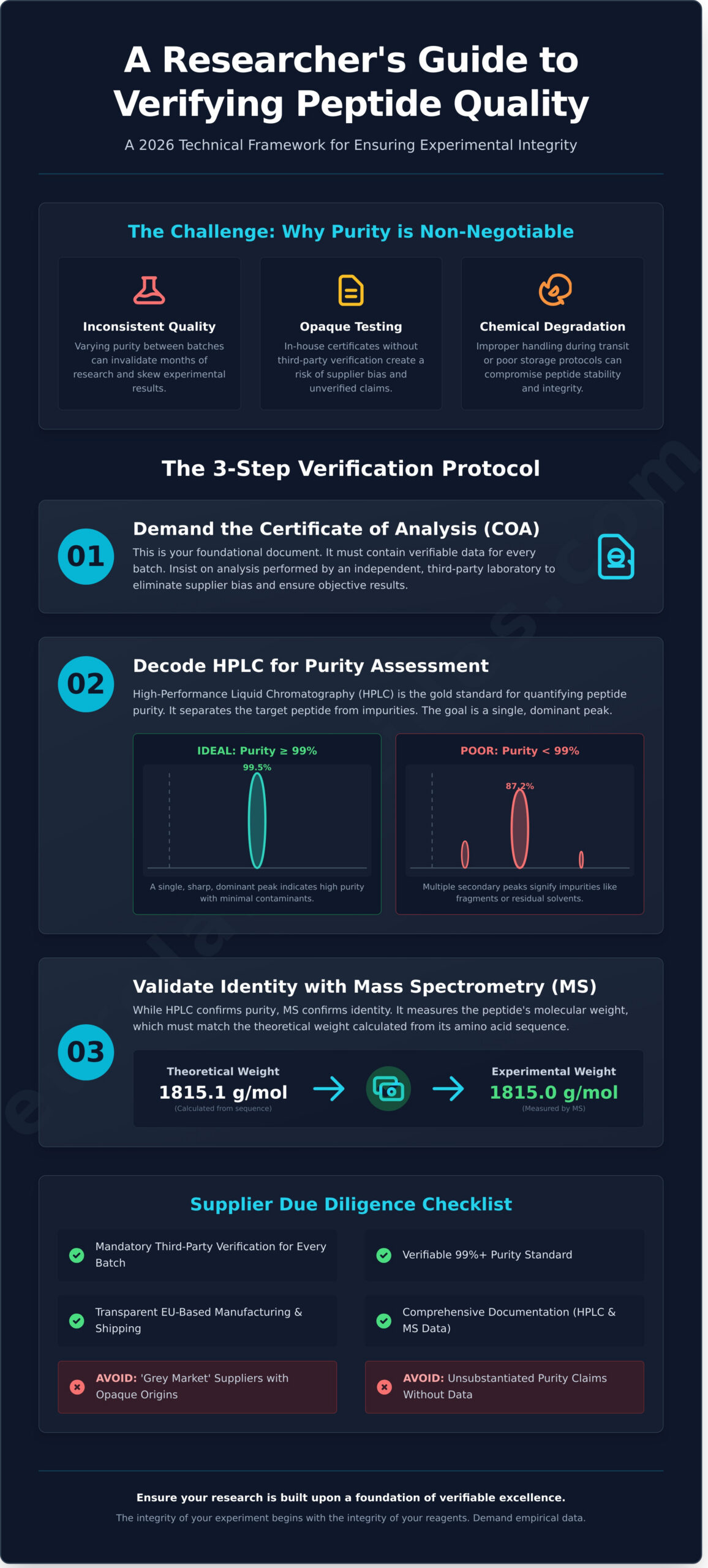
When you buy research peptides in Europe, the chemical integrity of the product is the single most critical variable. Claims of quality are meaningless without empirical, verifiable data. The foundation of this verification rests on two core analytical techniques: High-Performance Liquid Chromatography (HPLC) for purity assessment and Mass Spectrometry (MS) for identity and sequence validation. A legitimate supplier must provide a Certificate of Analysis (COA) for every batch, detailing the results of these uncompromising tests.
The necessity of independent, third-party laboratory verification for every batch cannot be overstated. This practice removes any potential for supplier bias and provides the researcher with an objective, unimpeachable guarantee of both purity and identity. This documentation is not a luxury; it is a prerequisite for reproducible scientific outcomes.
Decoding the HPLC Chromatogram
HPLC is the industry gold standard for quantifying peptide purity. This method separates the target peptide from synthesis byproducts and impurities. On the resulting chromatogram, an ideal sample presents as a single, sharp, dominant peak. Purity is calculated via peak integration-the area of the target peptide peak relative to the total area of all detected peaks. For research applications, a purity of 99%+ is the non-negotiable requirement. Any secondary peaks indicate impurities, such as incompletely synthesized fragments or residual solvents like Trifluoroacetic acid (TFA), which must be quantified and minimized to ensure experimental validity.
Sequence Validation and Molecular Weight Verification
While HPLC confirms purity, Mass Spectrometry confirms identity. This technique measures the mass-to-charge ratio of molecules, providing a precise molecular weight for the synthesized peptide. This experimental weight is then compared to the theoretical weight calculated from its amino acid sequence. The precision of modern peptide analysis via mass spectrometry allows for exceptionally low tolerance for molecular weight variance. Any significant deviation suggests sequence errors or unintended modifications. This level of sequence validation is absolutely critical for receptor-binding studies, where even a single incorrect amino acid can render the peptide biologically inactive or produce confounding results. Before you buy research peptides, ensure the supplier provides both HPLC and MS data as standard.
Navigating the European Market: Catalog Peptides vs. Custom Synthesis
An investigator’s choice between catalog and custom-synthesized peptides is a critical determinant of experimental trajectory and outcome. The European market offers robust solutions for both pathways, each governed by stringent quality control and logistical efficiency. When you buy research peptides within the EU, the sourcing model aligns directly with specific research requirements, from foundational studies to novel biochemical explorations.
Catalog Peptides for Standardized Research
For research involving established biochemical pathways, catalog peptides provide pre-synthesized, high-purity sequences that have been extensively validated. This category includes high-demand molecules for longevity and metabolic studies, such as BPC-157 and Epitalon. Sourcing these from a catalog ensures uncompromising batch-to-batch consistency, a non-negotiable requirement for reproducible scientific results. Researchers engaged in long-term projects can leverage these standardized compounds to eliminate variables in their experimental models. Explore our Longevity Research Stack for a curated selection of these critical research tools.
The European Sourcing Advantage
Opting for an EU-based supplier provides significant logistical and regulatory benefits that safeguard research integrity. The primary advantage is the circumvention of international customs, which mitigates the risk of transit delays and potential package seizures that can compromise time-sensitive experiments. This localized framework directly impacts product stability through:
- Cold-Chain Integrity: Minimized transit times within the European logistics network significantly reduce the risk of temperature fluctuations, ensuring that lyophilized peptides maintain their specified structure and purity upon arrival.
- Regulatory Compliance: European chemical manufacturing operates under rigorous safety and handling standards. This adherence to established protocols, which often reflects the analytical principles found in global Regulatory Guidelines for Therapeutic Peptides, translates to a verifiable and consistent end-product.
Ultimately, when European researchers buy research peptides from a domestic source, they are investing in a supply chain optimized for scientific precision, where both chemical purity and logistical reliability are held to an unrivaled standard.
This focus on an EU-based supply chain to ensure product integrity is a principle that extends to other regulated sectors, such as food and beverage exports. To see how these complex logistics are managed in a different context, you can learn more.
Laboratory Best Practices: Storage, Handling, and Reconstitution
The acquisition of high-purity peptides is the foundational step in rigorous scientific inquiry. However, the integrity of these compounds is contingent upon stringent post-purchase laboratory protocols. The value of a meticulously synthesized peptide is nullified by improper storage, handling, or reconstitution. This section outlines the non-negotiable best practices required to maintain the validated purity and biological activity of your research materials.
All research-grade peptides are supplied in a lyophilized (freeze-dried) state. This industrial process involves freezing the peptide solution and then reducing the surrounding pressure to allow the frozen water to sublimate directly from a solid to a gas. The result is a stable, powdered compound with a significantly extended shelf-life, primed for precise reconstitution.
Maintaining Stability in Lyophilized Peptides
Once you buy research peptides, their stability is subject to environmental factors. Lyophilized peptides are hygroscopic and susceptible to degradation from light and oxidation. Vials must be stored in a dark, dry environment, away from direct sunlight. The vacuum-sealed vials used by reputable European suppliers prevent atmospheric oxidation. For optimal preservation, adhere to the following thermal protocols:
- Short-Term Storage (1-3 months): Refrigeration at 2-8°C is sufficient.
- Long-Term Storage (up to 24 months): A laboratory freezer at -20°C to -80°C is required to prevent degradation over extended periods.
Precision Reconstitution and Aliquoting
Aseptic technique is paramount during reconstitution to prevent bacterial contamination. The choice of diluent depends on the intended experimental timeline. Bacteriostatic water, containing 0.9% benzyl alcohol, is recommended for vials that will be stored and used over several days. For immediate, single-use applications, sterile water or sterile saline is appropriate.
To reconstitute, slowly inject the chosen diluent down the side of the vial to avoid agitating the powder. Do not shake or vortex the vial, as this mechanical shear stress can fracture delicate peptide bonds. Instead, employ a gentle swirl or roll the vial between the palms until the peptide is fully dissolved. To minimize the damaging effects of repeated freeze-thaw cycles, it is best practice to aliquot the reconstituted solution into single-use volumes for storage at -20°C.
Accurate dosing is critical for reproducible results. To eliminate calculation errors when preparing your desired concentration, the use of a professional peptide reconstitution calculator is strongly advised. Meticulous laboratory practice is the final, essential step in leveraging the high-purity compounds you buy research peptides for.
EuroLab Peptides: Uncompromising Standards for European Scientific Inquiry
For institutions and independent researchers across Europe, the decision to buy research peptides is a critical inflection point where experimental integrity is established. EuroLab Peptides operates on the principle that verifiable quality is not a feature, but a prerequisite for meaningful scientific advancement. Our entire operational framework is built upon three non-negotiable pillars: uncompromising purity, logistical excellence, and absolute data transparency. We provide the European scientific community with reagents that meet and exceed the most stringent laboratory standards, ensuring that your results are built upon a foundation of chemical integrity.
Our commitment extends beyond synthesis to include a meticulously managed supply chain. All products are dispatched from our EU-based facility, ensuring discreet, expedited, and regulatory-compliant shipping that mitigates the risks of customs delays and product degradation often associated with international suppliers.
The EuroLab Quality Protocol
We prioritize the ‘Language of the Laboratory’ over marketing claims. Every assertion of quality is substantiated by empirical data. Each batch is subjected to a multi-level validation process, beginning with in-house analysis and culminating in independent, third-party verification. This protocol guarantees that every vial meets our baseline standard of 99%+ purity. We provide the full HPLC and Mass Spectrometry (MS) reports for your review, because transparency is fundamental to scientific trust. Read our Case Study on Multi-Level Quality Protocol to understand the depth of our process.
A Partner in Scientific Discovery
Sourcing superior reagents is only the first step. EuroLab Peptides functions as a dedicated partner, supporting diverse and critical research areas from cellular regeneration and tissue repair to metabolic regulation and cognitive function. When you choose to buy research peptides from us, you gain access to a team offering dedicated technical support for all sourcing and handling inquiries. We are invested in the success of your work. Secure your research reagents with EuroLab Peptides today.
Final Protocol: Sourcing Peptides with Verifiable Integrity
As we have established, the acquisition of research peptides in 2026 is contingent upon a stringent evaluation of chemical integrity and supplier transparency. The critical takeaways are clear: independent verification via HPLC and Mass Spectrometry is non-negotiable, and adherence to correct laboratory handling protocols is paramount for preserving peptide stability and ensuring data accuracy.
For the European scientific community ready to buy research peptides without compromise, EuroLab Peptides provides the definitive solution. Every batch is subjected to independent, third-party HPLC/MS verification, guaranteeing a minimum of 99%+ purity. Combined with our dedicated EU-based shipping for maximum stability, we ensure your materials meet the most demanding standards for scientific inquiry. Secure high-purity research peptides from EuroLab Peptides to empower your next discovery.
Advance your research with the confidence that comes only from unimpeachable chemical integrity.
Frequently Asked Questions About Buying Research Peptides
What is the difference between research-grade and pharmaceutical-grade peptides?
The primary distinction lies in regulatory oversight and intended application. Pharmaceutical-grade peptides are manufactured under stringent Good Manufacturing Practices (GMP) for use in human clinical trials and therapeutics. Research-grade peptides, conversely, are synthesized for laboratory and in-vitro studies only. While they can achieve high purity levels (e.g., 99%+), they are not intended for human consumption and do not undergo the same rigorous regulatory validation required for pharmaceutical products.
How do I verify the purity of the peptides I buy online?
Purity verification is exclusively achieved through analysis of current, batch-specific testing documentation. A reputable supplier must provide a Certificate of Analysis (CoA) featuring High-Performance Liquid Chromatography (HPLC) and Mass Spectrometry (MS) data for the exact batch you are purchasing. Researchers should always cross-reference the batch number on the vial with the corresponding lab report to ensure the data is relevant and authentic, confirming the product’s identity and purity before use in any experiment.
Why is third-party testing essential for research peptides?
Third-party testing provides an independent, unbiased validation of a supplier’s quality claims. It serves as a critical control measure, confirming that the purity and identity data presented by the manufacturer are accurate and have not been manipulated. This external verification by an unaffiliated laboratory ensures the integrity of the product, which is paramount for achieving reproducible and valid experimental results. It is a non-negotiable standard for any serious research endeavor.
Can research peptides be stored at room temperature?
Lyophilized (freeze-dried) peptides possess a degree of stability at room temperature for short durations, such as during shipping. However, for long-term storage and to prevent degradation, they must be stored at -20°C or colder. Once reconstituted into a liquid solution, the peptide’s stability is significantly reduced. The solution must be refrigerated at approximately 4°C for short-term use (days) or frozen at -20°C for longer-term preservation to maintain its structural integrity.
How do I use a peptide reconstitution calculator for my study?
A peptide reconstitution calculator is a fundamental tool for ensuring accurate dosing in research. To use it, you must input known variables: the total mass of the lyophilized peptide in the vial (e.g., 10mg), the desired final concentration for your solution (e.g., 5mg/mL), and the total volume of the final solution. The calculator then computes the precise volume of diluent (e.g., bacteriostatic water) required to achieve your target concentration, eliminating calculation errors.
What are the shipping risks when buying peptides outside of Europe?
When you buy research peptides from vendors outside your region, you can introduce risks like customs seizures, long transit times, and temperature changes that degrade the product. This is why sourcing from a European-based supplier is often preferred for researchers in the EU. The same principle applies elsewhere; for example, researchers in Australia can mitigate these shipping risks by sourcing from a domestic supplier like peptideresearchau.com.au, which offers laboratory-grade compounds with local logistical benefits.
What does 99%+ purity actually mean in an HPLC report?
In an HPLC analysis, a purity level of 99%+ signifies that the peak corresponding to the target peptide accounts for 99% or more of the total area under all detected peaks in the chromatogram. The remaining percentage consists of minor impurities, which are typically closely related peptide fragments from the synthesis process (e.g., deletion sequences). This metric is a direct measure of chemical purity and is essential for ensuring that research outcomes are not influenced by unintended contaminants.
Are research peptides legal to buy in Europe for laboratory use?
Yes, it is generally legal to buy research peptides within the European Union, provided they are purchased and used strictly for scientific and laboratory research purposes. These compounds are not approved for human or veterinary use, and their sale is predicated on this “for research use only” condition. Researchers are individually responsible for complying with all laws and institutional guidelines governing the acquisition, handling, and application of such chemical reagents within their specific member state.
