
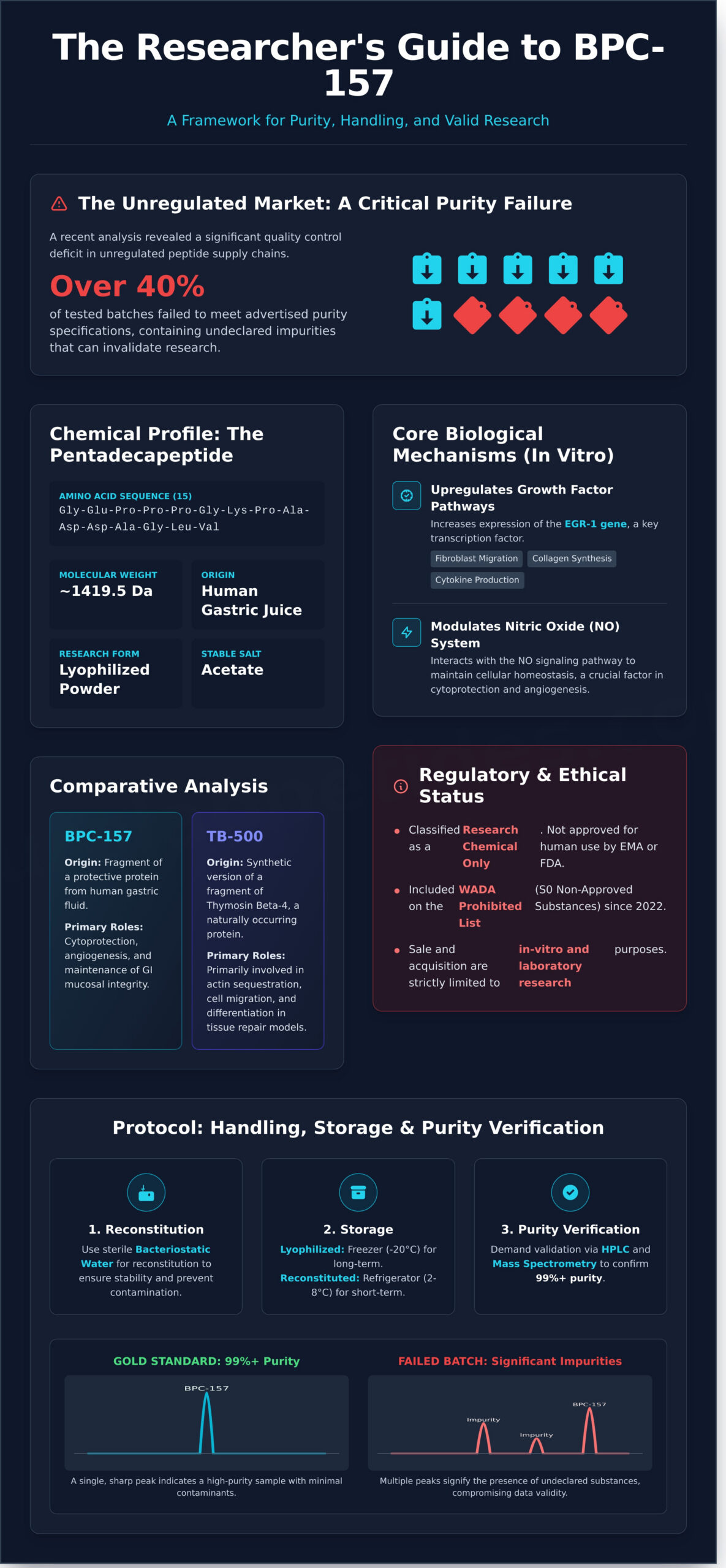
A recent analysis of unregulated peptide suppliers revealed a critical failure in quality control: over 40% of tested batches failed to meet their advertised purity specifications, with many containing significant, undeclared impurities. This deficit in chemical integrity represents a direct threat to reproducible scientific inquiry. Researchers understand the immense frustration of sourcing materials where inconsistent purity and the absence of clear handling protocols for compounds like bpc 157 can invalidate an entire experimental model. This guide is engineered to rectify these systemic issues.
It delivers a complete scientific framework, detailing the angiogenic and cytoprotective pathways of BPC-157, establishing a standardized protocol for reconstitution and storage, and outlining the HPLC verification methods required to source peptides of uncompromising 99%+ purity. This document will equip your laboratory with the technical precision necessary for valid, repeatable research outcomes.
Key Takeaways
- Understand the core biological mechanisms of BPC-157, including its influence on growth factor expression and the nitric oxide signaling pathway in vitro.
- Differentiate the primary mechanisms of action between BPC-157 and TB-500 by contrasting their origins and roles in tissue repair models.
- Master the standardized protocols for reconstituting and storing lyophilized bpc 157 to ensure peptide integrity and stability for experimental use.
- Learn to interpret HPLC and Mass Spectrometry validation data to confirm the 99%+ purity required for reproducible scientific inquiry.
BPC-157 Chemical Profile: Defining the Pentadecapeptide
BPC-157 is a synthetic pentadecapeptide, a sequence of 15 amino acids, derived from a larger protective protein identified in human gastric juice. Its primary structure is defined by the specific amino acid sequence: Gly-Glu-Pro-Pro-Pro-Gly-Lys-Pro-Ala-Asp-Asp-Ala-Gly-Leu-Val. This precise arrangement gives the compound a molecular weight of approximately 1419.5 Daltons. As an experimental compound, the full chemical and biological profile of BPC-157 (Body Protection Compound-157) is the subject of extensive preclinical investigation. Its structural integrity is a critical factor in research applications; in aqueous solutions, its stability is pH-dependent, with optimal stability observed under physiological pH conditions, a key consideration for in-vitro experimental design.
The compound’s potential mechanisms of action are multifaceted and not yet fully elucidated, though preliminary studies suggest interactions with the nitric oxide (NO) system and modulation of various growth factor pathways. For laboratory purposes, understanding its fundamental chemical properties is the first step toward designing valid and reproducible experiments. The purity of any research-grade bpc 157 sample, verified through High-Performance Liquid Chromatography (HPLC) and Mass Spectrometry (MS), is paramount to ensure that observed effects are attributable to the peptide itself and not to synthesis-related impurities.
The Origin of Body Protection Compound 157
First isolated from human gastric fluid, BPC-157 is a fragment of a larger, naturally occurring protein. Its physiological role is believed to involve cytoprotection and the maintenance of gastrointestinal mucosal integrity. For research applications, the peptide is produced via solid-phase peptide synthesis (SPPS), a controlled, stepwise process that allows for the creation of a high-purity product with a verified amino acid sequence. This method ensures that each batch meets stringent quality standards exceeding 99% purity, a non-negotiable requirement for serious scientific inquiry.
Research-grade BPC-157 is typically supplied as a lyophilized (freeze-dried) powder in its stable acetate salt form. This salt form demonstrates superior chemical stability and a longer shelf-life compared to the free base peptide, which is more susceptible to degradation. Upon reconstitution with bacteriostatic water, the acetate salt readily dissolves, forming a clear solution suitable for precise administration in experimental protocols.
Regulatory Status for Laboratory Use
It is critical for all researchers to understand the regulatory framework governing BPC-157. Globally, including within the European Union, this peptide is classified as a research chemical. It has not been approved for human therapeutic use by the European Medicines Agency (EMA), the U.S. Food and Drug Administration (FDA), or any other major international regulatory body. Consequently, its sale and acquisition are strictly limited to in-vitro and laboratory research purposes.
Furthermore, the World Anti-Doping Agency (WADA) has included BPC-157 on its Prohibited List since 2022, classifying it under the S0 category of “Non-Approved Substances.” This classification holds significant implications for researchers working with athletic models or in sports science, reinforcing that the compound has no place in human performance enhancement. This distinction between legitimate preclinical investigation and unauthorized application is absolute; all handling and experimentation must occur within the confines of established laboratory safety and ethical guidelines.
Investigating the Biological Mechanisms: How BPC-157 Interacts In Vitro
The therapeutic potential of the pentadecapeptide BPC-157 is primarily attributed to its pleiotropic effects on cellular and molecular pathways integral to tissue repair and homeostasis. Laboratory investigations have elucidated several core mechanisms through which this peptide exerts its influence, providing a foundation for its application in research models. Central to its activity is the upregulation of key growth factors and their corresponding receptors, which initiates a cascade of regenerative processes.
Initial studies identified that BPC-157 administration leads to an increased expression of the Early Growth Response 1 (EGR-1) gene. EGR-1 is a critical transcription factor that, in turn, activates downstream genes responsible for cytokine production, fibroblast migration, and extracellular matrix deposition. This interaction directly impacts the rate of collagen synthesis in cultured fibroblasts, with research demonstrating accelerated collagen deposition, a finding corroborated by a comprehensive Systematic Review of BPC-157 which analyzed numerous preclinical studies on musculoskeletal repair. Concurrently, the peptide modulates the nitric oxide (NO) signaling pathway, appearing to maintain NO homeostasis rather than simply increasing its production. This stabilization is critical for preventing the cytotoxic effects of excessive NO while preserving its vasodilatory and cytoprotective functions.
Angiogenesis and Vascular Research
In vitro models of angiogenesis reveal that BPC-157 promotes the formation of new blood vessels, a process essential for delivering oxygen and nutrients to damaged tissues. This pro-angiogenic effect is largely mediated through its interaction with the vascular endothelial growth factor (VEGF) system. Specifically, studies show that the peptide increases the expression and activation of VEGF receptor 2 (VEGFR2) on endothelial cells, even in the absence of VEGF itself. This VEGFR2 activation, observed in endothelial cell proliferation assays, triggers cell migration and the formation of capillary-like tube structures, which are hallmarks of neovascularization.
Cytoprotective Properties in Gastric and Neurological Models
The peptide’s organ-protective effects are well-documented, particularly within the context of the brain-gut axis. In gastric mucosal cell lines, bpc 157 demonstrates a marked protective effect against chemical insults, such as those induced by ethanol or non-steroidal anti-inflammatory drugs (NSAIDs). This cytoprotection is linked to its ability to maintain endothelial integrity and modulate local blood flow. Neurological research indicates an influence on GABAergic and serotonergic systems, where it has been observed to counteract imbalances induced by pharmacological agents, suggesting a stabilizing role in neurotransmitter function. Investigating these intricate cellular pathways requires a peptide of uncompromising purity. Researchers can verify the specifications of our BPC-157 to ensure analytical precision and reproducibility in their experiments.
Comparative Analysis: BPC-157 vs. TB-500 in Tissue Repair Models
In the context of regenerative research, BPC-157 and TB-500 represent two distinct yet frequently compared investigative compounds. Their differentiation begins at their origins: BPC-157 is a synthetic pentadecapeptide derived from a protective gastric protein, whereas TB-500 is a synthetic fragment of the naturally occurring 43-amino-acid polypeptide, Thymosin Beta-4. This fundamental difference dictates their primary mechanisms of action and informs their specific applications in laboratory models of tissue repair, creating separate yet potentially complementary avenues for scientific inquiry.
Distinct Pathways for Regeneration Research
The selection of either peptide is contingent upon the specific tissue engineering objective. BPC-157 demonstrates a pronounced affinity for structural repair, particularly in tissues with poor vascularity like ligaments and tendons. Its mechanism is strongly linked to the upregulation of Vascular Endothelial Growth Factor (VEGF) receptors, promoting angiogenesis and enhancing the expression of growth hormone receptors. This localized action directly supports the formation of granulation tissue, a critical step in healing dense connective tissue. Given its unapproved status for human consumption, understanding the BPC-157 regulatory status is imperative for any institution conducting research to ensure full compliance with scientific and ethical guidelines.
In contrast, TB-500’s primary function is mediated through its actin-sequestering properties. By binding to G-actin monomers, it promotes the polymerization of the actin cytoskeleton, a critical process for cellular motility, migration, and differentiation. This mechanism facilitates a more systemic response, encouraging cells like keratinocytes and endothelial cells to migrate to injury sites across a broader range of tissues, including muscle, skin, and ocular surfaces. The choice between them often depends on the research focus:
- BPC-157: Optimal for models investigating localized, avascular tissue repair, such as tendon-to-bone healing or ligament reconstruction.
- TB-500: Suited for studies on widespread or systemic tissue damage where rapid cellular mobilization and anti-inflammatory action are the primary endpoints.
In Vitro Synergies: Combining Peptides
The divergent mechanisms of BPC-157 and TB-500 create a strong rationale for their combined use in complex metabolic and recovery studies. This combination, often termed a “Recovery Research Stack,” isn’t redundant. Instead, it offers a multi-pronged approach: the bpc 157 peptide initiates localized vessel formation and structural integrity, while TB-500 facilitates the migration of reparative cells to the site of injury. This synergistic action allows for a more comprehensive investigation of the healing cascade from both a structural and cellular perspective. Further complexity can be introduced by incorporating GHK-Cu, a copper peptide known for its role in extracellular matrix remodeling and collagen synthesis. In dermal repair models, for instance, GHK-Cu’s ability to modulate metalloproteinases complements the angiogenic and migratory effects of the other two peptides. Researchers can analyze the Recovery Research Stack components here for a detailed breakdown of their individual and combined biochemical properties.
Finally, a critical logistical consideration for any long-term study is compound stability. Both peptides are supplied in lyophilized form for maximum shelf life. However, once reconstituted, their stability profiles differ. BPC-157 demonstrates notable stability in solution when refrigerated at 2-8°C, often remaining viable for study up to 30 days. TB-500, a larger and more complex polypeptide, is generally considered more fragile and may exhibit a shorter window of optimal potency post-reconstitution, necessitating more stringent handling and storage protocols to ensure experimental integrity and reproducibility.
Technical Handling: Reconstitution and Storage Protocols
The experimental validity of any research involving BPC-157 is contingent upon the molecular integrity of the peptide itself. While supplied in a highly stable lyophilized state, its viability is determined by meticulous handling during reconstitution and subsequent storage. Improper technique can introduce contaminants, cause mechanical shearing of the peptide sequence, or accelerate degradation, compromising the reproducibility of results. Adherence to stringent laboratory protocols is not merely recommended; it is a prerequisite for generating reliable data.
The transition from a stable powder to a bioactive solution is the most critical phase in the peptide’s handling lifecycle. This process dictates the final concentration, purity, and ultimately, the efficacy of the compound in any given assay.
Optimal Reconstitution Procedures
Reconstitution must be performed with precision to preserve the pentadecapeptide’s complex structure. The standard diluent for multi-use applications is Bacteriostatic Water for Injection (0.9% benzyl alcohol), which inhibits microbial growth. For single-use preparations, sterile saline (0.9% NaCl) is a suitable alternative. Calculating the exact solvent volume is foundational for achieving desired molar concentrations. Utilize our Peptide Reconstitution Calculator to ensure accuracy down to the microgram.
The reconstitution process must follow a standardized sequence:
- Step 1: Equilibration. Allow the sealed vial of bpc 157 to reach ambient laboratory temperature (approximately 20-25°C) before opening. This prevents atmospheric moisture from condensing inside the cold vial, which can compromise the lyophilized powder.
- Step 2: Solvent Introduction. Using a sterile syringe, slowly inject the calculated volume of solvent into the vial. The needle should be aimed at the interior glass wall, allowing the liquid to run down gently rather than spraying directly onto the peptide cake. This technique minimizes mechanical stress.
- Step 3: Dissolution. Gently swirl the vial with a light wrist motion or roll it between the palms. Do not shake or vortex the solution. Vigorous agitation can cause peptide aggregation and denaturation, irreversibly damaging the compound and reducing its biological activity. The solution should be clear and free of particulates once fully dissolved.
Storage and Stability Standards
Differential storage conditions are required for lyophilized and reconstituted peptides to maximize shelf-life and maintain purity. These protocols are based on extensive stability testing and are non-negotiable for serious research applications.
- Lyophilized Form: For long-term storage, the unopened vial must be maintained at -20°C in a dark, dry environment. Under these conditions, the peptide maintains over 99% purity for a minimum of 36 months. Protection from UV light and moisture is critical to prevent photo-oxidation and hydrolysis.
- Reconstituted Solution: Once in liquid form, the peptide solution must be refrigerated at 2-8°C. Do not freeze a reconstituted peptide, as the freeze-thaw cycle is known to degrade its structural integrity. When stored properly, the solution remains stable for up to 30 days.
Based on current stability data and synthesis advancements, research-grade peptides produced in 2024 are projected to maintain specified purity and activity well into 2026 when these stringent storage conditions are met. The uncompromising quality of your research begins with materials that meet these exacting standards. To ensure your protocols are founded on verifiable purity, procure third-party tested BPC-157 for your laboratory.
Sourcing High-Purity BPC-157 for Scientific Inquiry
The reproducibility of scientific research is contingent upon the absolute quality of its constituent materials. In peptide research, the introduction of impurities can invalidate entire data sets, leading to erroneous conclusions and wasted resources. For any study involving bpc 157, sourcing a compound with a verified purity of 99% or higher is not an optional benchmark; it’s a fundamental prerequisite for generating reliable and publishable findings. The presence of contaminants, even at levels as low as 2-3%, can introduce confounding variables that alter cellular responses and obscure the true mechanism of action under investigation.
This necessity for uncompromising quality demands a rigorous, multi-faceted approach to verification. The industry standards for this verification are High-Performance Liquid Chromatography (HPLC) and Mass Spectrometry (MS). HPLC separates the components of a mixture, providing a quantitative measure of purity by identifying the target peptide’s peak in relation to any impurities. Mass Spectrometry complements this by confirming the peptide’s identity, measuring its molecular weight to ensure the correct amino acid sequence has been synthesized. Without both data points, a researcher cannot be certain of what is in their vial.
Verifying Peptide Purity
A legitimate Certificate of Analysis (CoA) is the cornerstone of quality assurance. When reviewing a CoA for any research peptide, researchers must identify the HPLC chromatogram, which should display a single, dominant peak corresponding to the target peptide, accounting for over 99% of the total integrated area. Common contaminants in low-grade batches often include truncated sequences (incomplete peptides), residual synthesis reagents like trifluoroacetic acid (TFA), or failed sequences. Crucially, sequence validation via MS is non-negotiable. It confirms the peptide’s molecular mass matches the theoretical mass of Gly-Glu-Pro-Pro-Pro-Gly-Lys-Pro-Ala-Asp-Asp-Ala-Gly-Leu-Val, ensuring the compound is indeed BPC-157 and not a structurally similar but functionally distinct molecule.
The EuroLab Quality Protocol
Our commitment to scientific integrity is reflected in a stringent, multi-level quality protocol for every batch of BPC-157 we synthesize. Each batch is first subjected to in-house HPLC and MS analysis to confirm it meets our internal purity and identity standards of over 99%. Following this, the batch is sent to an independent, third-party European laboratory for unbiased re-verification. This dual-testing process provides an unrivaled layer of quality assurance. All logistics are managed from within the EU, utilizing secure, temperature-controlled handling to protect the peptide’s stability from our laboratory to yours. This ensures the product that arrives for your research is identical in purity and structure to the one documented in its CoA. View our 99%+ Purity BPC-157 for research purposes and examine the corresponding third-party lab reports for yourself.
Advancing Research with Verifiable Peptide Integrity
This technical guide has established the foundational knowledge for incorporating BPC-157 into rigorous scientific inquiry. From its distinct 15-amino acid sequence and complex biological mechanisms to the critical reconstitution protocols, every detail impacts experimental validity. The data presented consistently underscore that achieving reproducible outcomes is contingent not only upon meticulous handling but, most importantly, on the verifiable purity of the starting material. Without this assurance, research findings remain inconclusive.
For laboratories where results can’t be compromised, sourcing is the definitive variable. Eurolab Peptides supplies research-grade bpc 157 with a guaranteed purity of 99% or higher. This isn’t a mere claim; it’s a standard confirmed for every single batch by independent, third-party HPLC and Mass Spectrometry analysis. With secure, EU-based shipping, your project’s integrity is protected from initial procurement all the way to final application.
Order Research-Grade BPC-157 with 99%+ Purity and equip your next study with a compound that meets the most stringent standards of scientific validation. Your next discovery awaits.
Frequently Asked Questions about BPC-157
Is BPC-157 legal for research purposes in Europe?
Yes, BPC-157 is legally available for purchase and use in laboratory research applications across Europe. It’s classified strictly as a research chemical. This designation means it is not approved by the European Medicines Agency (EMA) or any national regulatory body for human or veterinary use. All acquisition and handling must conform to local regulations governing research compounds and be exclusively for in vitro studies or other non-clinical experimental protocols.
How long does reconstituted BPC-157 remain stable?
Reconstituted BPC-157 maintains optimal stability for up to 4 weeks when stored at 2-8°C. The peptide solution must be protected from light and kept refrigerated to prevent degradation of its molecular structure. Stability past this 4-week window decreases significantly, compromising the integrity of research data. For this reason, preparing fresh solutions from lyophilized powder according to project timelines is the recommended laboratory protocol to ensure valid, reproducible results.
What is the difference between BPC-157 and BPC-157 Arginate?
The primary difference lies in the stabilizing salt attached to the peptide chain. Standard BPC-157 is an acetate salt, while BPC-157 Arginate is an arginine salt. This structural modification grants the arginate form superior stability, particularly in aqueous solutions and at ambient temperatures. While both forms are chemically identical in their core peptide sequence, the arginate version offers an extended pre-reconstitution shelf life and greater resilience to temperature fluctuations, making it a more robust compound for certain research logistics.
Can BPC-157 be used for human consumption?
No, BPC-157 is not approved for human consumption and must not be used for any therapeutic or diagnostic purposes. It is supplied exclusively for in vitro and laboratory research applications. The compound has not undergone the stringent clinical trials required by regulatory authorities like the EMA to establish safety and efficacy in humans. Any application outside of a controlled laboratory setting is prohibited and represents a serious misuse of a research-grade chemical.
What is the correct reconstitution ratio for BPC-157 5mg vials?
A standard reconstitution protocol for a 5mg vial of BPC-157 involves using a precise volume of bacteriostatic water. For example, injecting 2mL of bacteriostatic water into the vial creates a solution with a concentration of 2.5mg/mL, which is equivalent to 2500mcg/mL. This concentration allows for accurate and consistent dosing for experimental models. Researchers should always use sterile techniques and appropriate diluents to maintain the compound’s purity and prevent contamination.
How does BPC-157 influence the VEGF pathway?
BPC-157 exerts a significant pro-angiogenic effect by directly modulating the Vascular Endothelial Growth Factor (VEGF) pathway. It has been demonstrated in in vitro studies to upregulate the expression of VEGF receptor 2 (VEGFR2) on endothelial cells. This upregulation enhances cellular response to VEGF, promoting angiogenesis, cell migration, and the formation of new blood vessels. The mechanism of bpc 157 makes it a subject of intense research in tissue repair and vascularization models.
What are the storage requirements for lyophilized BPC-157?
Lyophilized BPC-157 requires specific temperature-controlled storage to ensure its long-term integrity. For optimal stability, vials should be stored at -20°C, which preserves the peptide for over 24 months. For short-term storage of up to 6 months, refrigeration at 2-8°C is an acceptable alternative. The lyophilized powder is highly stable but must be protected from direct light and moisture until it is ready for reconstitution to prevent premature degradation.
Why is third-party testing essential for research peptides?
Third-party testing provides independent, unbiased verification of a peptide’s identity, purity, and concentration. This process is non-negotiable for ensuring the validity of scientific research. Analyses like High-Performance Liquid Chromatography (HPLC) confirm purity, typically aiming for a standard of 99% or higher, while Mass Spectrometry (MS) validates the correct molecular weight and amino acid sequence. Without this objective verification, a researcher cannot be certain that impurities or synthesis errors won’t compromise their experimental outcomes. Exploring suppliers who are transparent about their testing protocols is a good practice; for instance, you can learn more about 405peptides and their approach to providing high-quality research compounds.
