

What if the perceived ambiguity in neuropeptide synergy is not a failure of biochemistry, but a direct consequence of inconsistent laboratory protocols and unverified peptide integrity? For researchers investigating complex neuropeptide interactions, this question is critical. The pursuit of reproducible data is frequently obstructed by concerns over batch-to-batch consistency and the lack of standardized methods for multi-peptide studies, introducing unacceptable levels of experimental noise.
This technical profile provides a definitive analysis of the Cognitive Research Stack, specifically examining the biochemical relationship between Semax and Delta-Sleep-Inducing Peptide (DSIP) in controlled laboratory models. We will establish the precise molecular mechanisms underpinning their potential synergy and deliver a standardized, verifiable protocol for their preparation and in-vitro application. The following analysis details the mass spectrometry and HPLC data verifying the 99%+ purity of each compound, outlines a step-by-step reconstitution procedure, and evaluates the stack’s experimental utility for advanced neuropeptide studies.
Key Takeaways
- Acquire a foundational knowledge of the distinct molecular structures and biochemical pathways of Semax and DSIP in neuroendocrine regulation models.
- Review a comprehensive technical analysis of the Cognitive Research Stack to differentiate its synergistic neuropeptide signaling from standard metabolic precursors.
- Examine the concept of ‘signaling synergy’ to understand how neuropeptide combinations can yield distinct outcomes compared to isolated compound studies.
- Implement standardized laboratory protocols for the reconstitution and handling of lyophilized peptides to ensure experimental integrity and reproducibility.
The Role of Neuropeptides in Advanced Cognitive Research Models
Modern neurological inquiry has pivoted from the analysis of isolated compounds toward the examination of synergistic systems. This evolution is exemplified by the emergence of specialized neuropeptide pairings, designed to model complex biological interactions with greater fidelity. The Cognitive Research Stack, a defined investigational model comprising Semax and Delta-Sleep Inducing Peptide (DSIP), represents a significant advancement in this field. Its application is governed by a stringent focus on elucidating specific biochemical mechanisms rather than observing generalized outcomes.
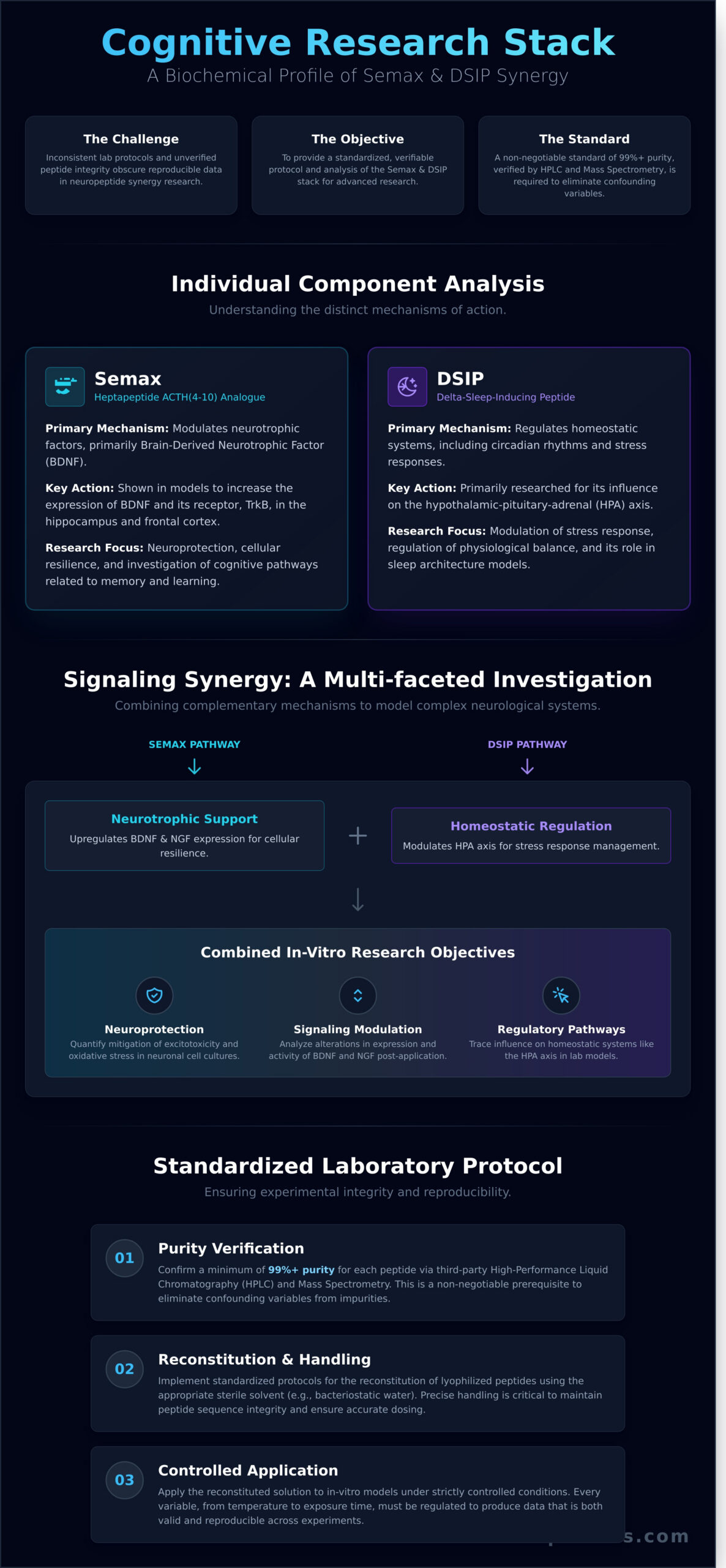
The primary research objectives established for in-vitro and laboratory development through 2026 are highly specific. They are not aimed at broad cognitive enhancement but at mapping discrete molecular processes. Key investigative priorities include:
- Neuroprotection: Quantifying the capacity of the combined peptides to mitigate excitotoxicity and oxidative stress in neuronal cell cultures under controlled adverse conditions.
- Signaling Modulation: Analyzing alterations in the expression and activity of critical signaling molecules, such as Brain-Derived Neurotrophic Factor (BDNF) and Nerve Growth Factor (NGF), post-application.
- Regulatory Pathways: Tracing the influence of the peptide combination on homeostatic systems, particularly the hypothalamic-pituitary-adrenal (HPA) axis, within established laboratory models.
Adherence to these focused objectives ensures that research remains within the rigorous, verifiable confines of preclinical development. It is a framework built on precision, where every variable is controlled to produce reproducible data.
Neuropeptide Signaling in Neurological Inquiry
Neuropeptides function as highly specific chemical messengers, modulating synaptic transmission and neuronal activity with a precision that small-molecule neurotransmitters often lack. In research models, their efficacy is directly contingent on peptide sequence integrity. A single amino acid substitution can render a peptide biologically inert or alter its binding affinity, invalidating experimental results. This is why sequence validation via mass spectrometry is a non-negotiable step in producing research-grade materials for studies involving memory formation, stress response modulation, and neuroplasticity.
The Rationale for Component Selection
The pairing of Semax and DSIP within a contemporary Cognitive Research Stack is not arbitrary; it is based on their complementary, yet distinct, mechanisms of action observed in preclinical studies. Single-agent experimental designs are often limited, failing to account for the intricate, networked nature of the central nervous system. The documented neurotrophic and neuroprotective properties of Semax (heptapeptide), which has been studied for its effects on BDNF expression, provide a strong foundation for investigating cellular resilience. DSIP, conversely, is primarily researched for its role in regulating circadian rhythms and stress responses. Together, they allow for a multi-faceted investigation into how different neuropeptidergic systems interact. For such a complex model to yield valid data, uncompromising purity is paramount. A minimum purity of 99%+, verified by third-party HPLC analysis, is the required standard to eliminate confounding variables and maintain absolute experimental control.
Biochemical Profile: Mechanisms of Semax and DSIP
An effective investigation into any Cognitive Research Stack depends on a granular understanding of its constituent compounds. The biochemical profiles of Semax and DSIP (Delta Sleep-Inducing Peptide) are fundamentally different, yet their mechanisms present complementary pathways for neurobiological inquiry. Both are peptides, synthetic chains of amino acids, whose research utility is directly proportional to their molecular integrity and purity. A precise analysis of their structure, stability, and interaction with biological systems is not just academic; it’s a prerequisite for reproducible experimental outcomes.
Semax: Investigating Neurotrophic Factors
Semax is a synthetic heptapeptide analogue of the adrenocorticotropic hormone (ACTH) fragment, ACTH(4-10). Its primary mechanism of interest involves the modulation of neurotrophic factors, particularly Brain-Derived Neurotrophic Factor (BDNF). Foundational research from 2006 documented the neurotropic action of Semax, demonstrating its capacity to increase the expression of BDNF and its receptor, TrkB, in the rat hippocampus and frontal cortex within three hours of administration. This upregulation is a critical area of study for its potential implications in synaptic plasticity and neuronal survival. In laboratory settings, Semax has also exhibited neuroprotective properties against oxidative stress, shielding neuronal cultures from damage induced by agents like hydrogen peroxide.
DSIP: Modulating Regulatory Pathways
DSIP’s biochemical role centers on neuroendocrine regulation. As a naturally occurring nonapeptide, its influence on circadian rhythms and sleep-related neuropeptide signaling has been the focus of extensive research. In controlled models, DSIP has been observed to interact directly with the hypothalamic-pituitary-adrenal (HPA) axis, the body’s central stress response system. This interaction can modulate the release of key hormones like cortisol and ACTH. The biochemical stability of its nonapeptide structure (Trp-Ala-Gly-Gly-Asp-Ala-Ser-Gly-Glu) is a key parameter during experimental observation, as its integrity determines its ability to cross the blood-brain barrier and exert its regulatory effects in preclinical studies.
The metabolic stability and half-life of these peptides are critical variables in experimental design. In-vitro studies indicate that Semax has a rapid degradation profile, with a half-life of only several minutes in human serum. This necessitates precise timing in research protocols. The structural integrity and purity of each batch must be beyond reproach. Third-party verification using High-Performance Liquid Chromatography (HPLC) is the industry standard for confirming purity, ensuring it exceeds 99%. Simultaneously, mass spectrometry is employed to validate the precise molecular weight and amino acid sequence, guaranteeing the compound’s identity. For any serious research involving a Cognitive Research Stack, these analytical reports are non-negotiable. Researchers can review the certificates of analysis for each peptide to ensure their materials meet these uncompromising quality standards.
Synergistic Mechanisms: Neuropeptide Signaling vs. Standard Compounds
In advanced neurological research, the distinction between direct neuropeptide signaling and the administration of metabolic precursors is fundamental. Standard compounds, such as choline precursors like Alpha-GPC, function by increasing the systemic availability of a neurotransmitter-in this case, acetylcholine. While effective for elevating baseline levels, this mechanism is indirect and lacks the receptor-level specificity required for targeted investigations. In contrast, neuropeptide-based models operate through direct, high-affinity binding to specific receptor sites, initiating precise intracellular signaling cascades. This allows for the study of discrete physiological effects, a level of control that broad-spectrum precursors cannot provide.
The concept of ‘signaling synergy’ emerges from this distinction. A multi-variable design, such as one employing the Semax and DSIP stack, allows for the simultaneous investigation of interacting pathways. Semax, an analogue of the ACTH(4-10) fragment, is known to stimulate the expression of Brain-Derived Neurotrophic Factor (BDNF) and Nerve Growth Factor (NGF) by interacting with melanocortin receptors. This creates an excitatory, neurotrophic environment. Concurrently, the Delta-sleep-inducing peptide (DSIP) provides a regulatory counterbalance, modulating homeostatic processes linked to stress adaptation and circadian rhythm. The combined administration allows researchers to model the dynamic interplay between cognitive potentiation and neurological equilibrium, a far more sophisticated paradigm than could be achieved with a single agent.
Neuropeptide Synergy vs. Isolated Nootropic Precursors
The primary advantage of targeted neuropeptide fragments lies in their biochemical precision. Unlike metabolic precursors that create a systemic flood of raw material, neuropeptides act as keys to specific molecular locks. This specificity is critical in neurological modeling, where isolating the function of a single receptor subtype, such as the MC4 receptor in the case of Semax, can yield unambiguous data on its role in synaptic plasticity or memory consolidation. Peptide-based tools offer a direct route to modulating cellular function with minimal off-target metabolic effects.
Experimental Utility of Multi-Peptide Bundles
A pre-formulated Cognitive Research Stack provides unparalleled logistical and scientific efficiency for laboratories. It streamlines comparative studies by eliminating the need to independently source, verify, and quantify multiple research compounds. This consolidation drastically reduces experimental variables, particularly those related to batch-to-batch purity and concentration discrepancies, which can otherwise confound results in neuropeptide interaction studies. The economic benefit is also clear, reducing procurement costs and man-hours dedicated to preparation.
Evaluating the reproducibility of results is a primary concern in any synergistic research model. The complexity of interacting pathways demands an uncompromising standard for reagent quality. Reproducibility is contingent upon the absolute purity and verified identity of each constituent peptide. When each component of the Cognitive Research Stack is guaranteed to possess 99%+ purity, confirmed via third-party HPLC and Mass Spectrometry analysis, researchers can proceed with confidence. This stringent quality control transforms a theoretical model into a reliable, standardized tool for generating high-integrity, reproducible data.
Laboratory Protocols: Reconstitution, Stability, and Handling
The validity of any experimental outcome is contingent upon the uncompromising integrity of the research compounds used. Strict adherence to standardized laboratory protocols for peptide handling isn’t merely a best practice; it’s a fundamental requirement for ensuring the bioactivity and purity of each component within a complex study. From initial reconstitution to long-term storage, every step directly impacts the molecular stability and, consequently, the reliability of the collected data. These procedures ensure that the performance of a given peptide aligns with its verified certificate of analysis.
Reconstitution and Concentration Calculations
The initial and most critical phase of preparation involves the precise reconstitution of lyophilized peptides. Accurate concentration is achieved through a straightforward calculation. For a vial containing 5 mg of a peptide, introducing exactly 1 mL of sterile diluent will yield a stock solution with a concentration of 5 mg/mL. For more complex dilutions or to verify calculations, the EuroLab Peptides peptide reconstitution calculator offers a tool for precision dosing.
Once the diluent is introduced, the method of mixing is paramount. High-shear mixing, such as vortexing, must be avoided as the mechanical stress can denature the peptide’s tertiary structure and induce aggregation, rendering it inactive. The correct procedure involves gentle agitation, such as slowly rolling the vial between the palms or inverting it several times until the lyophilized powder is fully dissolved. This low-energy method preserves the delicate peptide bonds and ensures complete solubilization without compromising structural integrity.
Storage and Long-term Stability
A clear distinction exists between the storage requirements for lyophilized and reconstituted peptides. Lyophilized powders exhibit high stability and are suitable for shipping at ambient temperatures for several days, but for archival purposes, they must be stored at or below -20°C. Once reconstituted into a liquid solution, the peptide becomes significantly more susceptible to degradation. These solutions must be refrigerated at 2-8°C and protected from direct light exposure. Repeated freeze-thaw cycles on reconstituted solutions are a primary cause of sample degradation, as ice crystal formation can physically shear peptide chains and alter solution pH, leading to a cumulative loss of purity with each cycle. For unparalleled long-term stability, lyophilization and subsequent storage at -20°C is the gold standard for preserving peptide integrity before reconstitution.
The choice of diluent is equally critical for multi-use preparations. Bacteriostatic water, containing 0.9% benzyl alcohol, is the industry standard for reconstituting peptides intended for multiple administrations. The benzyl alcohol acts as a bacteriostatic preservative, inhibiting microbial growth and maintaining the sterility of the solution for up to 28 days when stored under proper refrigerated conditions. This extends the viable window for experimentation with the Cognitive Research Stack and prevents contamination that could confound results.
To prevent cross-contamination and protect the fidelity of your experimental setup, a stringent aseptic technique is non-negotiable. Key practices include:
- Utilizing a new, sterile syringe and needle for each individual peptide.
- Disinfecting the rubber septum of each vial with a 70% isopropyl alcohol wipe prior to every puncture.
- Never using the same reconstitution solvent vial to prepare different peptides.
- Physically separating and labeling all reconstituted vials to prevent handling errors.
The integrity of your research data begins with uncompromising materials. Acquire our EU-certified bacteriostatic water to ensure the stability and sterility of your research compounds.
EuroLab Peptides: Precision Sourcing for Cognitive Research
The validity of any cognitive study is contingent upon the molecular purity of its constituent compounds. A single, unidentified impurity can compromise data integrity and invalidate months of rigorous investigation. EuroLab Peptides directly addresses this foundational risk with an uncompromising standard: every batch of neuropeptides is synthesized to achieve a minimum 99% purity. This is not an internal metric; it’s a figure confirmed through independent, third-party laboratory analysis.
This commitment to verifiable quality transforms a simple chemical supply into a precision scientific instrument. For European researchers, this assurance is augmented by significant logistical advantages. EU-based synthesis and shipping streamline procurement, eliminate customs-related delays, and ensure compliance with regional transport regulations. The result is a reliable, efficient supply chain that supports the demanding timelines of modern research. Every order is accompanied by its corresponding Certificate of Analysis (COA), providing radical transparency and empowering researchers with the complete analytical data required for their records and publications.
European Standards in Chemical Synthesis
Operating within the European Union means adhering to some of the world’s most stringent chemical safety and manufacturing regulations, including the framework established by REACH. This regulatory oversight is not a bureaucratic hurdle; it’s a built-in quality control mechanism that mandates a level of process integrity and product consistency often absent in other markets. For high-stakes scientific inquiry, this compliance ensures that the materials used are not only pure but also produced and handled responsibly, minimizing unforeseen variables from the very start of the experimental process.
The EuroLab Quality Protocol
Our quality assurance is built upon a non-negotiable principle of double validation. The process is systematic and transparent:
- In-House Verification: Upon synthesis, each batch undergoes a comprehensive internal analysis using High-Performance Liquid Chromatography (HPLC) and Mass Spectrometry (MS). This initial step confirms the correct molecular weight, sequence, and preliminary purity profile.
- Independent Third-Party Analysis: After passing internal review, a sample from the exact same batch is dispatched to an unaffiliated, independent laboratory. This facility conducts its own HPLC analysis, providing an objective, unbiased confirmation of the purity data.
This dual-layered protocol guarantees that the COA accompanying your shipment is an accurate and impartial representation of the product’s quality. This meticulous process provides the scientific community with neuropeptides of unrivaled integrity, making the Cognitive Research Stack a professional-grade tool for institutions that demand absolute certainty in their foundational materials. Secure the analytical tools necessary for your work.
Access the Cognitive Research Stack for your next investigation
Advancing Neurological Inquiry with Validated Peptides
The technical analysis presented confirms the distinct yet potentially synergistic mechanisms of Semax and DSIP. For researchers investigating these advanced neuropeptide models, experimental integrity is paramount. It’s contingent not only on stringent laboratory protocols but, most critically, on the verifiable purity of the foundational research compounds. Any study of a Cognitive Research Stack is only as reliable as its constituent peptides.
Eurolab Peptides ensures this foundational integrity. Each peptide batch achieves a purity of 99% or greater, a standard verified by High-Performance Liquid Chromatography (HPLC) and confirmed through independent third-party laboratory analysis. All compounds are dispatched via secure, EU-based shipping to maintain stability from our facility to yours. Secure high-purity peptides for your laboratory research and proceed with absolute confidence in your data.
Your next discovery depends on the quality of the tools you use. Equip your laboratory with compounds that meet the highest standards of scientific inquiry.
Frequently Asked Questions About the Cognitive Research Stack
What are the primary components of the Cognitive Research Stack?
The stack comprises two distinct neuropeptides: Semax and Delta-Sleep Inducing Peptide (DSIP). Semax is a synthetic analogue of the adrenocorticotropic hormone fragment ACTH (4-10), while DSIP is a nonapeptide. Both are supplied in a lyophilized (freeze-dried) state to ensure maximum stability for laboratory applications. Each component is synthesized to a minimum purity of 99%, a standard verified by High-Performance Liquid Chromatography (HPLC) analysis for every batch.
Is the Cognitive Research Stack intended for human consumption?
No, the Cognitive Research Stack is supplied strictly for in-vitro research and laboratory experimentation only. These compounds are not drugs or medicines and have not been approved by any regulatory body for human or veterinary use. The purchase and use of these materials are restricted to qualified scientific professionals in controlled research environments. Any application outside of its intended laboratory purpose is a misuse of the product and is strictly prohibited.
How should the Semax and DSIP stack be stored for maximum stability?
Lyophilized peptides should be stored in a freezer at -20°C for long-term stability, maintaining their integrity for up to 24 months. After reconstitution with bacteriostatic water, the resulting solution must be kept refrigerated at 2°C to 8°C and used within 30 days to prevent molecular degradation. It’s critical to avoid repeated freeze-thaw cycles, as this process can fracture the peptide chains and compromise experimental validity.
What is the purity level of EuroLab Peptides’ research stacks?
Every research stack supplied by EuroLab Peptides is guaranteed to possess a purity level of 99% or greater. This figure isn’t an estimate; it’s a verifiable metric confirmed through a stringent analytical process. Each batch undergoes both High-Performance Liquid Chromatography (HPLC) and Mass Spectrometry (MS) testing to confirm its identity and quantify its purity. The precise percentage is documented on the batch-specific Certificate of Analysis available to every client.
Can Semax and DSIP be reconstituted in the same vial?
It’s not recommended to reconstitute Semax and DSIP in the same vial for any research protocol requiring precise dosage and control. Co-reconstitution can introduce variables related to differential peptide solubility and potential interactions, which may compromise the accuracy of the experiment. For optimal data integrity, each peptide should be reconstituted in a separate sterile vial according to its specific molecular weight and desired research concentration.
What is the typical lead time for EU-based shipping of research peptides?
The standard lead time for all EU-based shipping is 2-5 business days following order dispatch. Orders are processed and dispatched from our central European facility within 24 hours of payment confirmation, Monday through Friday. A shipment tracking number is issued via email upon dispatch, allowing for precise monitoring. We utilize established couriers like GLS to ensure secure, efficient, and reliable delivery of all research materials.
Are Certificates of Analysis available for the Cognitive Research Stack?
Yes, a comprehensive Certificate of Analysis (CoA) is available for every batch of the Cognitive Research Stack. This document provides transparent, verifiable data confirming the product’s identity, purity, and concentration as determined by third-party laboratory analysis. Researchers can access the CoA corresponding to their specific lot number via our website or by contacting our support team, ensuring full traceability and quality assurance for their research materials.
Why is third-party testing critical for neuropeptide research?
Third-party testing provides objective, unbiased verification of a neuropeptide’s chemical structure, purity, and quantity. This independent analysis is critical for ensuring the validity and reproducibility of scientific findings, as it removes any possibility of internal bias from the manufacturer. For researchers, a third-party CoA serves as an absolute guarantee that the material is precisely what it claims to be, free from contaminants that could confound experimental results.
