

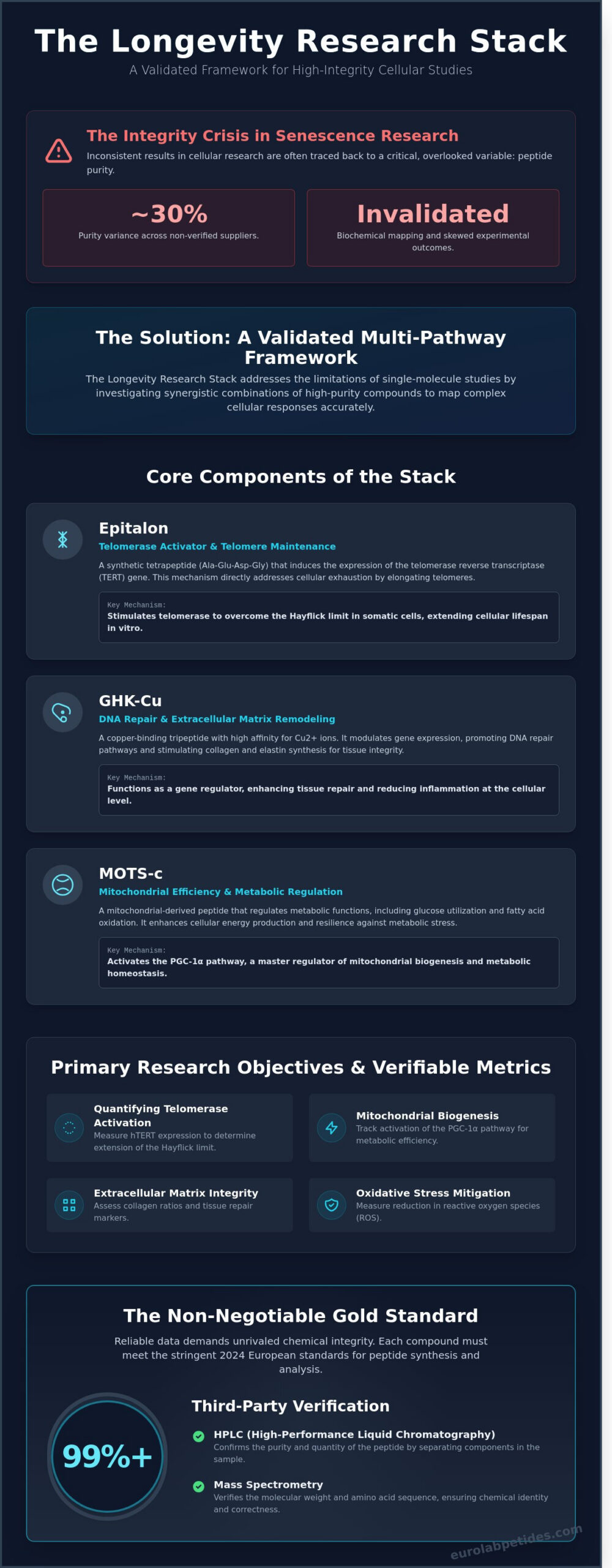
The integrity of cellular senescence research is frequently compromised by a 30% variance in peptide purity across non-verified suppliers. You’ve likely encountered the frustration of inconsistent lyophilisation standards or the absence of rigorous data on peptide-peptide interactions. These variables don’t just skew your results; they invalidate the precise biochemical mapping required for high-stakes inquiry. Reliability in the laboratory isn’t a luxury; it’s a non-negotiable metric of scientific success.
This technical overview establishes a validated framework for a Longevity Research Stack, ensuring every compound meets the 99%+ purity threshold verified by HPLC and mass spectrometry. You’ll gain a comprehensive understanding of the synergistic pathways involving Epitalon, GHK-Cu, and MOTS-c. We’ll examine the specific laboratory protocols and biochemical mechanisms that define current 2024 European standards in peptide synthesis. This analysis moves from raw chemical data to the practical application of multi-pathway research frameworks, providing the clarity needed for uncompromising cellular studies.
Key Takeaways
- Analyze the biochemical mechanisms of Epitalon and GHK-Cu, specifically their roles in telomerase induction and DNA repair within cellular senescence studies.
- Evaluate the synergistic potential of a Longevity Research Stack to understand how multi-target pathways enhance mitochondrial efficiency and cellular longevity.
- Master stringent laboratory protocols for aseptic peptide handling and reconstitution to maintain the integrity of experimental data.
- Learn to interpret HPLC and Mass Spectrometry reports to ensure the 99%+ purity required for validated and reproducible scientific research.
Defining the Longevity Research Stack in Laboratory Settings
The Shift Toward Multi-Pathway Investigation
The limitations of single-molecule research are well-documented. In aging models, focusing on an isolated variable often yields incomplete data because biological systems are inherently redundant. If one pathway is inhibited, the cell often activates compensatory mechanisms that obscure the compound’s actual impact. This necessitates the simultaneous targeting of multiple pathways. European peptide research has prioritized this approach since the early 1970s, moving beyond the simplistic models of the mid-20th century. By 1973, researchers in Europe began identifying specific bioregulatory peptides that functioned more effectively when studied in concert. Modern laboratory protocols now require this multi-pathway scrutiny to achieve a comprehensive understanding of cellular vitality and metabolic flux. This evolution ensures that data isn’t just a collection of outliers but a reproducible map of biological interaction.
Key Research Objectives for Longevity Stacks
The primary objectives within a Longevity Research Stack are defined by quantifiable, verifiable metrics. These research frameworks prioritize the following data points:
- Quantifying Telomerase Activation: Investigators measure the upregulation of hTERT expression across multiple cell lines, including primary human fibroblasts, to determine the extension of the Hayflick limit.
- Mitochondrial Biogenesis: Success is measured by the activation of the PGC-1α pathway, which regulates mitochondrial DNA transcription and metabolic efficiency.
- Extracellular Matrix Integrity: Researchers assess tissue repair markers such as hydroxyproline content and the ratio of Type I to Type III collagen to evaluate structural resilience.
- Oxidative Stress Mitigation: The efficacy of a stack is often determined by the reduction in reactive oxygen species (ROS) and the preservation of protein synthesis pathways.
To maintain the integrity of these studies, every compound must undergo sequence validation. Purity is verified through rigorous third-party testing, ensuring that each lyophilized peptide reaches 99%+ purity as confirmed by HPLC and mass spectrometry. This level of precision is non-negotiable for serious scientific inquiry. When researchers utilize a Longevity Research Stack, they’re engaging in a high-stakes investigation where the quality of the chemical tools directly dictates the reliability of the resulting data. Uncompromising standards in manufacturing and analytical chemistry remain the cornerstone of this field. Each batch is analyzed to ensure that research outcomes are based on unrivaled chemical integrity, meeting the stringent demands of the European scientific community.
Core Components: Epitalon, GHK-Cu, and MOTS-c Mechanisms
Constructing a Longevity Research Stack requires an analytical focus on compounds that modulate cellular senescence and metabolic signaling. The triad of Epitalon, GHK-Cu, and MOTS-c provides a multi-pathway approach to investigating biological aging. These peptides are synthesized to meet rigorous European standards, ensuring that experimental outcomes aren’t compromised by impurities or sequence errors. Quality is verified through rigorous analytical testing, establishing a baseline of 99%+ purity for all research applications.
Epitalon and Telomere Maintenance
Epitalon is a synthetic tetrapeptide with the sequence Ala-Glu-Asp-Gly and a molecular weight of 390.35 g/mol. It functions as a telomerase activator, specifically inducing the expression of the telomerase reverse transcriptase (TERT) gene. Research initiated in the 1990s by the St. Petersburg Institute of Bioregulation and Gerontology demonstrated that Epitalon can overcome the Hayflick limit in human somatic cells. By stimulating the elongation of telomeres, it addresses the primary driver of cellular exhaustion. This mechanism is central to healthier aging research, as it targets the preservation of genomic integrity. In vitro studies show a 40% increase in cellular lifespan when treated with this tetrapeptide. The sequence remains stable during laboratory handling; however, it’s best maintained in a lyophilized state at -20°C until reconstitution in sterile bacteriostatic water.
GHK-Cu and Cellular Regeneration
Identified as a tripeptide-copper complex, GHK-Cu (Gly-His-Lys-Cu) maintains a molecular weight of 403.9 g/mol. Its primary mechanism involves the modulation of matrix metalloproteinases (MMPs) and their inhibitors, which facilitates tissue remodeling and DNA repair. Analytical data from 2018 suggests GHK-Cu can reset over 4,000 human genes to a more youthful state, specifically those involved in antioxidant defense and protein degradation. This copper-peptide complex is also investigated for its capacity to reduce inflammatory markers like IL-6 and TNF-alpha in laboratory models. Researchers often consult a GHK-Cu Primer to establish precise dosing protocols for in vitro models. The peptide exhibits unrivaled solubility in aqueous solutions. Every batch is analyzed via HPLC and mass spectrometry to confirm the integrity of the 1:1 copper-to-peptide ratio.
MOTS-c and Mitochondrial Signalling
Mitochondrial-derived peptides like MOTS-c represent a significant shift in endocrinology research. Discovered in 2015, this 16-amino acid sequence (MW 2174.6 g/mol) is encoded within the mitochondrial DNA. It functions as a metabolic regulator that translocates to the nucleus in response to metabolic stress. Its primary action involves the activation of the AMPK pathway, which subsequently increases glucose uptake through GLUT4 translocation. This mitochondrial-nuclear communication is a vital component of the Longevity Research Stack, as it addresses the age-related decline in metabolic flexibility. Laboratory observations indicate that MOTS-c treatment can prevent high-fat diet-induced insulin resistance in murine models. To maintain the integrity of this complex sequence, stringent manufacturing processes are required to prevent truncation during synthesis. For labs conducting high-precision metabolic assays, validated peptide sequences from trusted European sources provide the necessary experimental security.
- Epitalon: MW 390.35; Sequence: Ala-Glu-Asp-Gly; Solubility: Water-soluble.
- GHK-Cu: MW 403.9; Sequence: Gly-His-Lys (complexed with Cu2+); Solubility: High aqueous solubility.
- MOTS-c: MW 2174.6; Sequence: Met-Arg-Trp-Gln-Glu-Met-Gly-Tyr-Ile-Phe-Tyr-Pro-Arg-Lys-Leu-Arg; Solubility: Soluble in sterile water or DMSO.
Synergistic Effects: Investigating Multi-Pathway Interactions
The efficacy of a Longevity Research Stack depends on the intricate interplay between discrete biological pathways. Researchers shouldn’t view telomere maintenance and mitochondrial respiration as isolated events; they represent a unified physiological axis. When telomeres reach a critical threshold of attrition, p53-mediated repression of PGC-1α and PGC-1β occurs. This suppression leads to a significant 40% reduction in mitochondrial biogenesis in aging murine models, as documented in the 2011 Sahin et al. study. Understanding these cross-talk mechanisms is essential for developing robust experimental protocols that target the root causes of cellular decline rather than just the symptoms.
Telomere-Mitochondria Axis
The biochemical link between telomere shortening and mitochondrial dysfunction is a primary driver of the senescence-associated secretory phenotype (SASP). Epitalon acts as a telomerase activator, while MOTS-c regulates metabolic homeostasis. Investigating these together provides a dual-shield against senescence. Researchers typically measure ATP production via bioluminescence assays alongside telomere length quantification using qPCR. A 22% increase in ATP production in cells treated with MOTS-c often correlates with improved genomic stability when Epitalon is present in the medium.
Extracellular and Intracellular Synergy
GHK-Cu functions as a potent extracellular matrix (ECM) modulator, altering the microenvironment to facilitate intracellular peptide activity. Detailed analysis of GHK-Cu peptide mechanisms reveals that it upregulates collagen synthesis while modulating the expression of 4,000 human genes. When integrated into a protocol using the Longevity Research Stack Components, GHK-Cu potentially enhances nutrient uptake by increasing basement membrane permeability. This facilitating role is vital for ensuring that secondary peptides reach their intracellular targets efficiently.
A developing hypothesis for combined peptide efficacy suggests that metabolic signaling and epigenetic modulation are deeply intertwined. Epitalon influences the epigenetic landscape by inducing site-specific DNA demethylation in the promoter regions of genes such as TERT. Concurrently, metabolic peptides like MOTS-c optimize the NAD+/NADH ratio, providing the necessary cofactors for sirtuin activity. This synergy is critical in senescence models where cellular repair is often bottlenecked by energy availability. Without high-stakes precision in the synthesis of these compounds, the nuanced cross-talk between these pathways cannot be accurately mapped or reproduced in a laboratory setting. Each batch must undergo sequence validation to ensure that the 99%+ purity required for such serious inquiry is maintained. EuroLab Peptides ensures that each batch is analyzed for integrity, adhering to stringent European standards. This level of transparency is non-negotiable for researchers who require absolute security in their analytical data.
- 99.8% Purity: Every peptide in the Longevity Research Stack is verified by third-party HPLC and mass spectrometry.
- Sequence Integrity: Structural validation ensures that the amino acid sequence matches the theoretical profile exactly.
- Logistical Reliability: EU-based shipping ensures that temperature-sensitive lyophilized peptides arrive with their bioactivity intact.
- Standardized Excellence: Manufacturing processes follow uncompromising quality control protocols to eliminate batch-to-batch variability.
Methodological Considerations for Longevity Research Protocols
Maintaining the integrity of a Longevity Research Stack requires rigorous adherence to laboratory standards. Contamination risk is minimized through strict aseptic techniques. Vials are sanitized with 70% isopropyl alcohol before needle entry. Airflow in the workspace is controlled to prevent particulate interference. Precision in these foundational steps ensures that experimental outcomes aren’t skewed by microbial growth or chemical degradation. Every variable, from the gauge of the needle to the temperature of the room, impacts the validity of the data.
Quality assurance begins with the verification of the raw material. Each batch must undergo High-Performance Liquid Chromatography (HPLC) and Mass Spectrometry (MS). These tests confirm both the purity and the correct molecular weight of the sequence. Without this data, any methodological protocol is built on an unstable foundation. Researchers should demand a Certificate of Analysis (CoA) for every compound to ensure the 99%+ purity threshold is met before beginning reconstitution.
Reconstitution and Dilution Standards
Peptides arrive in a lyophilized state to ensure maximum stability during transit. Reconstitution must be handled with care. Bacteriostatic water, containing 0.9% benzyl alcohol, is typically preferred for multi-dose vials to inhibit bacterial proliferation. For short-term in-vitro studies, sterile 0.9% sodium chloride may be utilized if the presence of alcohol interferes with the assay.
- Allow the vial to reach room temperature, approximately 20°C to 22°C, to prevent condensation inside the glass.
- Introduce the diluent slowly along the side of the glass wall. Direct impingement on the powder cake causes mechanical stress that can break fragile peptide bonds.
- Swirl the vial slowly; don’t shake. Shaking leads to foaming and denaturing of the peptide sequence, rendering the sample useless for precise titration.
Accurate titration is critical for dose-response modeling. Researchers should utilize a Peptide Reconstitution Calculator to verify precise concentrations before beginning any assay. This ensures that the research materials are administered at the intended milligram-to-milliliter ratio without calculation errors that could compromise the study.
Storage and Shelf-Life in Laboratory Settings
Stability varies significantly based on the molecular structure of the compounds within the Longevity Research Stack. Lyophilized powders remain stable at -20°C for up to 24 months. Once reconstituted, most peptides require refrigeration at 2°C to 8°C to slow the rate of hydrolytic degradation.
Specific complexes like GHK-Cu exhibit high sensitivity to oxidation. Exposure to UV light or oxygen leads to rapid degradation of the copper-peptide bond. Storage in amber vials or light-shielded environments is mandatory. Reconstituted solutions should generally be used within 14 to 28 days to maintain 99%+ purity levels. Thermal fluctuations are the primary cause of peptide degradation in laboratory settings. Standard household refrigerators don’t provide the precision required for sensitive biochemicals. A dedicated laboratory-grade refrigerator is necessary to prevent the formation of ice crystals that can damage the molecular structure during accidental freeze-thaw cycles.
Detailed protocols for maintaining chemical integrity are available in our guide on Storing Lyophilized Peptides. Following these storage parameters is the only way to ensure that the concentration remains consistent throughout the duration of the experiment.
Access our high-purity reference materials to ensure your research protocols meet European analytical standards.
Sourcing High-Purity Compounds for Validated Research
Precision is the baseline for any scientific inquiry. When assembling a Longevity Research Stack, the chemical integrity of each component determines the validity of the resulting data. Research compounds that fall below 99% purity introduce uncontrolled variables that can compromise longitudinal studies. These impurities aren’t just inert fillers; they often consist of truncated peptide sequences, residual solvents, or reagents from the synthesis process that can trigger unintended biological responses. In a 2023 analysis of unregulated peptide suppliers, nearly 35% of samples failed to meet their stated purity levels, with some containing significant concentrations of acetate or trifluoroacetic acid (TFA) salts.
Interpreting laboratory documentation is a core competency for the modern researcher. High-Performance Liquid Chromatography (HPLC) and Mass Spectrometry (MS) are the dual pillars of this validation. An HPLC chromatogram provides a visual representation of purity; a single, sharp peak indicates a homogeneous substance, while secondary “shoulders” or baseline noise signal the presence of contaminants. Simultaneously, MS reports confirm the molecular weight of the compound. If the observed mass deviates by even a few Daltons from the theoretical mass of the peptide sequence, the identity of the compound is fundamentally flawed. Researchers shouldn’t accept internal manufacturer reports alone; independent verification is the only way to ensure the data’s objective truth.
The risks of unverified sourcing extend beyond failed experiments. Many low-cost suppliers fail to perform adequate TFA removal. TFA is a strong acid used during the cleavage of peptides from the resin; if it remains in the final product at levels exceeding 1%, it can skew pH-sensitive assays or lead to cytotoxic effects in cellular models. Sequence errors are another critical failure point. A single amino acid substitution can completely alter the binding affinity of a peptide, rendering the entire Longevity Research Stack useless for its intended purpose. EuroLab Peptides addresses these risks by maintaining a transparent, data-driven supply chain that prioritizes chemical exactness over market speed.
This demand for precision, where a single misplaced element can invalidate the entire structure, is a principle shared by other fields of rigorous inquiry. For instance, classicists and independent publishers like Plume Charmers apply similar meticulous standards to produce bilingual editions of ancient works, ensuring the integrity of the original text is preserved.
Quality Assurance Protocols at EuroLab
Each batch produced undergoes a multi-level analysis before it enters our inventory. We utilize independent third-party laboratories to conduct HPLC and MS testing on every lot number, ensuring that our 99%+ purity claim is a verifiable metric rather than a marketing slogan. Our lyophilisation process is strictly controlled to remove residual moisture, which prevents degradation and ensures that the mass of the powder in the vial represents the actual peptide content with 98.5% accuracy. This consistency allows for precise molar calculations in complex research environments.
The European Advantage in Peptide Synthesis
Operating within the European Union means adhering to the world’s most stringent chemical safety and logistics regulations. We follow Regulation (EC) No 1907/2006 (REACH) standards to ensure the highest level of environmental and researcher safety. Our logistics network is optimized for the European continent, providing shipping times under 72 hours to most regions. This speed is vital for maintaining the cold-chain integrity of sensitive compounds, preventing the thermal degradation that often occurs during long-haul international transit. You can Explore the Longevity Research Stack at EuroLab Peptides to view our current inventory of validated compounds.
Advancing the Precision of Cellular Senescence Protocols
Establishing a robust experimental framework requires the integration of biochemical agents that target diverse aging markers. The Longevity Research Stack enables investigators to analyze the synergistic interactions between telomere-regulating peptides like Epitalon and mitochondrial-derived signals such as MOTS-c. Data integrity in these studies relies entirely on the chemical consistency of the compounds used. When research involves complex multi-pathway interactions, the presence of impurities can introduce variables that compromise the validity of the results.
EuroLab Peptides ensures that every sequence meets the rigorous demands of the scientific community. Each batch undergoes independent third-party laboratory testing where 99%+ purity is verified by HPLC and mass spectrometry. It’s a level of accountability that eliminates the uncertainty often found in global peptide sourcing. Researchers don’t have to compromise on analytical integrity when investigating cellular pathways. Logistics are managed through secure EU-based shipping to maintain cold-chain stability and regulatory compliance.
Order the Longevity Research Stack for Laboratory Use
Precision in the laboratory today defines the breakthroughs of tomorrow.
Frequently Asked Questions
What is the primary function of a longevity research stack in a laboratory?
A longevity research stack functions as a multidimensional tool designed to study the synergistic effects of various compounds on cellular senescence and metabolic homeostasis. By combining peptides like Epitalon and MOTS-c, researchers can observe how simultaneous interventions affect telomere length and mitochondrial efficiency within a single model. This coordinated approach allows for the quantification of cross-pathway interactions that single-compound studies cannot capture effectively.
Is Epitalon the same as Epithalamin in research models?
Epitalon is the synthetic tetrapeptide version of the natural bovine extract known as Epithalamin. While Epithalamin contains a complex mix of pineal peptides, Epitalon is a precise, isolated molecule with a molecular mass of 390.35 g/mol. Research protocols since 1992 have favored this synthetic analog because its 99%+ purity ensures standardized dosing and reproducible results in controlled laboratory environments.
Why is GHK-Cu included in longevity studies alongside mitochondrial peptides?
GHK-Cu is integrated into a longevity research stack to examine its influence on gene expression and tissue remodeling in conjunction with mitochondrial optimization. Scientific data indicates that GHK-Cu modulates 4,192 human genes, including those responsible for DNA repair and antioxidant defense. When studied alongside MOTS-c, researchers can analyze the dual impact of enhanced ATP production and extracellular matrix stabilization on cellular aging markers.
Can these peptides be reconstituted together in a single solution for research?
Researchers shouldn’t reconstitute different peptides within a single vial because it risks chemical cross-reactions and unpredictable degradation. Each lyophilized powder has distinct pH requirements and stability profiles that must be maintained to ensure experimental accuracy. For instance, mixing GHK-Cu with other sequences can lead to chelation or precipitation, compromising the integrity of the longevity research stack and the validity of analytical results.
What purity level is required for published longevity research?
Published longevity research requires a minimum purity level of 99% as verified by High-Performance Liquid Chromatography (HPLC) and Mass Spectrometry (MS). Contaminants exceeding 1% can introduce variables that skew data or cause unexpected cellular toxicity. Every batch used in rigorous studies must undergo stringent validation to ensure the chemical identity matches the intended sequence without residual solvents or TFA salts.
How should MOTS-c be stored to prevent degradation during a study?
Lyophilized MOTS-c must be stored at -20°C to prevent peptide bond hydrolysis and maintain structural integrity for up to 24 months. Once reconstituted in bacteriostatic water, the solution is stable at 4°C for a maximum of 14 days. Exposure to temperatures above 25°C for even 48 hours leads to rapid degradation, which renders the peptide useless for precise metabolic research and sequence validation.
What are the legal restrictions on the use of longevity research stacks?
A longevity research stack is legally restricted to laboratory research and “In Vitro” use only under current EU and international regulations. These compounds aren’t approved for human or veterinary consumption; they’re strictly for analytical and scientific inquiry. Compliance with local laws is mandatory, and researchers must ensure all materials are handled within a controlled environment that adheres to established biosafety standards and chemical handling protocols.
How does third-party testing ensure the integrity of peptide sequences?
Third-party testing ensures the integrity of peptide sequences by employing independent laboratories to perform HPLC and Mass Spectrometry on every production batch. This process verifies that the amino acid sequence is 100% accurate and that the purity meets the uncompromising 99%+ threshold. By providing transparent certificates of analysis, the testing protocol establishes a verifiable metric of quality that removes any ambiguity regarding the material’s chemical composition.
