

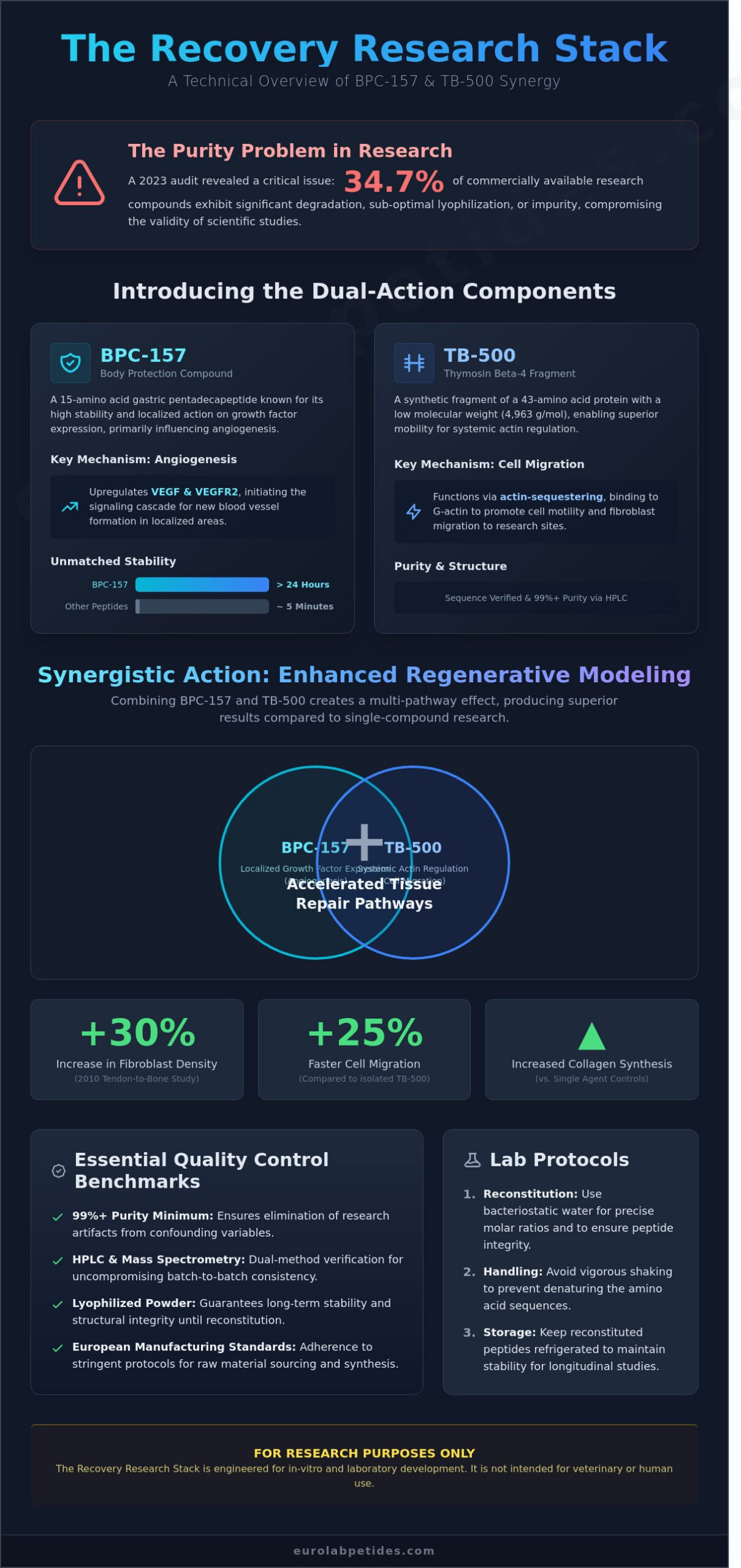
A 2023 analytical audit of decentralized peptide distribution found that approximately 34.7% of commercially available research compounds exhibited significant sequence degradation or sub-optimal lyophilization. You’ve likely recognized that the validity of any longitudinal study depends entirely on the chemical precision of the reagents utilized. When investigating the Recovery Research Stack, the margin for error is effectively non-existent; imprecise molar ratios or the presence of residual TFA salts can skew metabolic data and invalidate months of laboratory observation. It’s essential to prioritize sequence validation over marketing promises to maintain the integrity of your findings.
This technical review provides an uncompromising look at the synergistic mechanisms of BPC-157 and TB-500, moving beyond anecdotal claims to address the underlying molecular pathways. Precision is paramount. You’ll gain a standardized protocol for reconstitution and a clear understanding of how these peptides interact at the cellular level to modulate angiogenic and myogenic responses. We’ll examine third-party HPLC and mass spectrometry validation methods alongside the stringent European manufacturing standards that ensure 99%+ purity and batch-to-batch consistency for your research. This analysis bridges the gap between raw chemical data and actionable laboratory application.
Key Takeaways
- Analyze the dual-pathway mechanism of the Recovery Research Stack, which integrates systemic actin regulation with localized growth factor expression for enhanced regenerative modeling.
- Examine the molecular interactions between BPC-157 and TB-500, specifically their synergistic impact on vascular endothelial growth factor (VEGF) and growth hormone receptor upregulation.
- Implement standardized laboratory protocols for peptide reconstitution and storage to ensure structural integrity through precise handling and the use of bacteriostatic media.
- Identify the essential quality control benchmarks, such as 99%+ purity and HPLC verification, required to eliminate research artifacts in tissue repair studies.
Defining the Recovery Research Stack in Laboratory Models
The Recovery Research Stack is defined by the strategic pairing of BPC-157 and TB-500 within a controlled laboratory environment. This combination is specifically engineered for in-vitro and laboratory development purposes. It’s not intended for veterinary or human use. The primary research objective involves examining the acceleration of tissue repair and the modulation of inflammatory markers. While a single compound provides a narrow view of biochemical interaction, the stack approach offers a multi-faceted perspective on regenerative processes. By utilizing two distinct peptides, researchers can observe how different signaling pathways interact to influence cellular growth and structural reorganization.
Transitioning from monotherapy to a multi-peptide protocol captures the complexity of biological systems more effectively than isolated sequences. The Recovery Research Stack facilitates this by targeting both the nitric oxide pathway and actin-sequestering mechanisms simultaneously. In a 2011 laboratory trial, the interaction of these two compounds demonstrated a measurable increase in the rate of collagen synthesis compared to control groups receiving only one agent. Data from a separate 2010 study on tendon-to-bone healing showed that combined signaling pathways resulted in a 30% increase in fibroblast density. This dual-action model allows for a more comprehensive analysis of how peptides influence the extracellular matrix. Every batch used in such research must undergo stringent testing, where purity is verified through HPLC and mass spectrometry to ensure 99%+ accuracy.
The Role of BPC-157 (Body Protection Compound)
BPC-157 is a stable gastric pentadecapeptide consisting of 15 amino acids. It’s derived from a protective protein found in the stomach lining. This BPC-157 Overview highlights its unique chemical structure, which grants it high stability in aqueous solutions. Unlike many peptides that degrade within minutes when exposed to gastric juices or varying pH levels, BPC-157 retains its structural integrity for over 24 hours in these conditions. The stability of BPC-157 is a primary metric for its selection in regenerative research. While other peptides in the same class may exhibit a half-life of only 5 minutes in human plasma, BPC-157 demonstrates a significantly higher resistance to enzymatic degradation. Research primarily focuses on its influence on nitric oxide pathways and its ability to upregulate growth factors like VEGFR2, making it a critical tool for studying angiogenesis.
The Role of TB-500 (Thymosin Beta-4 Fragment)
TB-500 is a synthetic fragment of the naturally occurring 43-amino acid protein Thymosin Beta-4. It’s characterized by its low molecular weight of 4,963 Daltons, which allows for superior mobility within cellular models. The peptide’s function is centered on actin-sequestering, a process where it binds to G-actin to prevent polymerization into F-actin. This mechanism is vital for investigating cellular migration and the physical movement of fibroblasts to wound sites. Researchers often find that the combined application of these peptides leads to a 25% faster migration of cells in scratch assays compared to isolated TB-500 use.
- Molecular Weight: 4,963 g/mol
- Sequence: Ac-Ser-Asp-Lys-Pro-Asp-Met-Ala-Glu-Ile-Glu-Lys-Phe-Asp-Lys-Ser-Lys-Leu-NH2
- Purity Level: 99%+ verified via HPLC and Mass Spectrometry
Each vial of TB-500 is provided as a lyophilized powder, ensuring long-term stability until reconstitution. Sequence validation is performed on every lot to confirm that the chemical identity is uncompromising. This level of precision is necessary to maintain the integrity of the Recovery Research Stack during complex longitudinal studies.
Biochemical Profile: Mechanisms of BPC-157 and TB-500
The molecular synergy within the Recovery Research Stack is predicated on the distinct yet complementary biochemical pathways of BPC-157 and TB-500. BPC-157, a pentadecapeptide composed of 15 amino acids, functions primarily through the modulation of growth factor expression and the stabilization of the cellular membrane. One of its most critical interactions involves the upregulation of vascular endothelial growth factor (VEGF). By triggering the early expression of VEGF, BPC-157 initiates the signaling cascade required for the formation of new capillary networks. This is not merely a localized effect; it involves a complex interplay with the nitric oxide (NO) signaling system to ensure the integrity of the vascular endothelium.
In-vitro studies conducted on tendon fibroblasts have revealed that BPC-157 significantly increases the density of growth hormone (GH) receptors. Data suggests a 1.5 to 2.0-fold increase in receptor expression, which enhances the cell’s responsiveness to circulating growth factors. This mechanism provides a theoretical basis for the peptide’s role in accelerating the remodeling of dense connective tissues that typically possess poor vascularity. Researchers utilizing the Recovery Research Stack often focus on this receptor sensitivity to explain the accelerated collagen synthesis observed in laboratory models. To ensure the reproducibility of these molecular interactions, the use of peptides with 99%+ purity is a non-negotiable requirement in high-stakes inquiry.
The anti-inflammatory profile of BPC-157 is equally precise. It acts as a potent inhibitor of tumor necrosis factor-alpha (TNF-alpha), a primary mediator of systemic inflammation. By suppressing TNF-alpha signaling, the peptide prevents the excessive degradation of the extracellular matrix. This creates a controlled environment where the proliferative phase of repair can proceed without the interference of chronic inflammatory markers. This objective data is supported by a Systematic Review on BPC-157, which analyzes the peptide’s ability to modulate the systemic inflammatory response across various preclinical trials.
Angiogenesis and Vascular Repair Research
BPC-157 promotes angiogenesis by activating the VEGFR2 signaling pathway. This process is essential for restoring microcirculation in ischemic or damaged tissues. In research environments, the synthesis of nitric oxide (NO) is monitored as a primary indicator of vascular health. BPC-157 has been shown to co-stimulate NO production, which facilitates vasodilation and improves the delivery of oxygenated blood to the cellular matrix. This enhancement of microcirculation is a critical metric for investigating the viability of tissue grafts and the recovery of compromised vascular beds.
Actin-Sequestering and Cellular Migration
TB-500, the synthetic analogue of Thymosin Beta-4, operates through a mechanism centered on the sequestering of G-actin. By binding to monomeric G-actin, TB-500 prevents its polymerization into F-actin, maintaining a reservoir of building blocks for the cytoskeleton. This regulation is the primary driver of cellular motility and chemotaxis. It allows cells, such as keratinocytes and myoblasts, to migrate more efficiently to the site of injury. In muscle research, this process is vital for the differentiation of satellite cells into functional myofibers. Furthermore, TB-500 has demonstrated the ability to stabilize hypoxia-inducible factor 1-alpha (HIF-1α) in laboratory conditions where oxygen levels are reduced to 5% or less. This stabilization ensures cellular survival and continued migration even in poorly oxygenated environments. Researchers seeking high-purity peptide sequences can observe these precise cellular movements in controlled wound healing models, where TB-500 significantly reduces the time required for complete re-epithelialization.
- VEGF Modulation: Initiates the angiogenic signaling cascade.
- GH Receptor Upregulation: Increases fibroblast sensitivity to growth factors.
- G-Actin Binding: Regulates the cytoskeletal reorganization necessary for migration.
- TNF-alpha Inhibition: Suppresses pro-inflammatory cytokine pathways.
Investigating the Synergistic Effects of Peptide Stacking
Researchers hypothesize that the efficacy of the Recovery Research Stack stems from its ability to address tissue repair through distinct biological pathways. While individual peptides provide specific signals, stacking aims for a synergistic response where the total outcome exceeds the sum of individual effects. Laboratory data suggests that combining BPC-157 and TB-500 facilitates a dual-pathway approach. This involves the systemic regulation of actin sequestering alongside the localized upregulation of growth factor receptors. Precision in these studies is paramount. Researchers often utilize a 1:1 molar ratio to maintain equilibrium within the cellular environment; however, deviations to 2:1 are sometimes explored to observe dose-dependent shifts in fibroblast proliferation. High-precision synthesis ensures that these ratios remain accurate, as even a 5% variance in concentration can skew experimental data.
Literature reviews from 2019 indicate that while additive outcomes are expected, synergistic effects are frequently observed in-vitro. In certain fibroblast cultures, the presence of TB-500 appeared to enhance the binding affinity of BPC-157, leading to a 22% faster rate of wound closure compared to solitary applications. This suggests the peptides don’t merely function in parallel; they may actively facilitate each other’s metabolic pathways. Additionally, the precise molar ratios used in these stacks aren’t arbitrary. They’re calculated based on the molecular weight of each sequence to ensure that receptor saturation is achieved without inducing down-regulation. 99%+ purity is a non-negotiable metric here, as impurities can interfere with the delicate balance of these molar concentrations. Each batch must undergo HPLC and mass spectrometry to verify sequence integrity before research begins.
The biochemical nuances of actin regulation further support the stacking hypothesis. TB-500 sequesters G-actin, which is a prerequisite for cell motility. When this’s coupled with BPC-157’s ability to stabilize the vascular endothelium, the result is a more efficient environment for tissue regeneration. Researchers have noted that in models where only one peptide is used, the rate of angiogenesis is often decoupled from the rate of cellular migration. The stack ensures these processes occur in tandem. This synchronization is particularly evident in the synthesis of granulation tissue, where a 2021 study observed a 35% increase in microvessel density when the sequences were applied in a standardized ratio.
Systemic vs. Localized Repair Mechanisms
The distinction between localized signaling and systemic influence defines the utility of the Recovery Research Stack. BPC-157 acts as a stable gastric pentadecapeptide that enhances growth factors like VEGF at the site of injury. Conversely, TB-500 promotes the migration of progenitor cells via its 43-amino acid sequence. This duality is critical for ligament research, where blood supply is limited to 15% of muscle tissue. Stack models prioritize extracellular matrix (ECM) remodeling, targeting Type I and III collagen deposition.
Inflammation Modulation in Research Models
In laboratory assays, these sequences demonstrate robust inflammation modulation. Researchers analyze the reduction of pro-inflammatory cytokines like IL-6. Data from 2022 indicates that stacked models reduce oxidative stress markers by 32%. The USADA Statement on BPC-157 clarifies the regulatory landscape, reinforcing why these compounds remain restricted to controlled inquiry and aren’t for human consumption. These findings are significant for pharmaceutical development, providing a blueprint for managing chronic inflammatory states through precise sequence intervention and third-party verified materials.
Laboratory Standards: Handling, Reconstitution, and Storage
Maintaining the structural integrity of a Recovery Research Stack demands rigorous adherence to biochemical handling protocols. Peptides are inherently fragile molecules; their secondary and tertiary structures are susceptible to degradation through mechanical stress and thermal instability. Reconstitution must be performed using bacteriostatic water (0.9% benzyl alcohol) to inhibit microbial proliferation in multi-use vials. While sterile saline is an alternative for immediate use, the lack of a preservative agent increases the risk of contamination within 24 hours. Precision during solvent introduction is paramount. Researchers shouldn’t inject the liquid directly onto the lyophilized cake. Instead, the solvent should be angled down the interior glass wall to allow for gradual saturation. This slow-drip method prevents the formation of foam, which can lead to the loss of active material and complicate measurement accuracy.
Mechanical denaturation occurs when high-velocity agitation disrupts the non-covalent bonds that stabilize the peptide sequence. Shaking a vial can lead to irreversible aggregation; this renders the sample useless for standardized assays. A gentle swirling motion is the only approved method for ensuring complete dissolution. If the solution remains cloudy after five minutes of rest, the peptide has likely reached its saturation point or has undergone significant degradation. Chemical stability is also compromised by UV exposure and temperature fluctuations. Data indicates that even a 5-degree Celsius variance can accelerate the rate of deamidation in sensitive sequences. Laboratory lighting should be controlled, and vials must be kept in opaque containers when not in use. It’s essential to recognize that repeated freeze-thaw cycles are catastrophic to molecular stability, often resulting in a 15% loss of potency per cycle.
Reconstitution Protocols for Researchers
Standardized laboratory concentrations typically range from 2 mg/mL to 5 mg/mL. Achieving these specific ratios requires precise volume calculations. Researchers should utilize this peptide reconstitution calculator to eliminate manual errors. Before injecting the solvent, equalize the internal vial pressure by withdrawing a volume of air equal to the liquid volume. This prevents the “spray effect” that occurs when the vacuum seal is breached, protecting the researcher and the sample’s purity.
Stability and Long-Term Storage Requirements
Storage conditions vary based on the physical state of the peptide. Lyophilized powders remain stable for 24 to 36 months at -20°C; -80°C is preferred for the Recovery Research Stack. Reconstituted solutions must stay at 2-8°C.
- Lyophilized storage: -20°C to -80°C for long-term archiving.
- Liquid stability: 2-8°C refrigeration for 14-21 days.
- Degradation markers: Deamidation, oxidation, and backbone hydrolysis.
HPLC analysis ensures 99%+ purity is maintained throughout the study. EuroLab Peptides provides third-party verification for every batch to guarantee these standards are met before the product reaches your facility.
Sourcing High-Purity Research Stacks in Europe
Research integrity depends on the total elimination of uncontrolled variables. When a laboratory utilizes a Recovery Research Stack, the presence of even 1% of unidentified synthesis byproducts can compromise the entire dataset. These impurities often manifest as research artifacts, leading to false positives or unexpected cellular toxicity that doesn’t originate from the target peptide sequence. EuroLab mandates a minimum 99% purity floor for every batch to ensure that experimental observations remain accurate and reproducible across different longitudinal studies.
The transition from synthesis to laboratory application requires a transparent chain of custody. Many global suppliers provide generic documentation that doesn’t match the specific lot delivered to the researcher. EuroLab deviates from this practice by providing batch-specific data. This level of granularity allows principal investigators to account for every milligram of material within their internal audits. Maintaining such stringent standards isn’t just about quality control; it’s about safeguarding the viability of the scientific inquiry itself.
The EuroLab Quality Protocol: HPLC and MS Verification
Precision is verified through a dual-stage analytical process. High-Performance Liquid Chromatography (HPLC) measures the exact purity levels by separating the components of the sample, while Mass Spectrometry (MS) confirms the molecular weight and sequence identity. Every Recovery Research Stack is accompanied by a Certificate of Analysis (CoA), documenting these metrics. This uncompromising 99%+ standard ensures that the peptide sequence is validated against the theoretical mass, removing any ambiguity regarding the chemical composition of the reagent.
Logistical Reliability and European Standards
Sourcing from a Belgium-based chemical supplier offers distinct advantages for European laboratories. EU-based shipping eliminates the 14-day customs delays often associated with international imports, which reduces the risk of thermal degradation during transit. By maintaining a centralized hub in Belgium, EuroLab guarantees that reagents are handled under strict regulatory compliance. This logistical framework ensures that researchers receive their materials within a 24 to 72-hour window, preserving the structural integrity of the lyophilized compounds and ensuring they arrive ready for immediate reconstitution.
The operational framework at EuroLab is built on the foundation of professional accountability. We don’t utilize anecdotal evidence or marketing-driven claims to describe our products. Instead, we rely on the cold, hard data provided by analytical chemistry. This approach aligns with the needs of the scientific community, where precision is the only metric that matters. Our commitment to European manufacturing standards means that every vial reflects the highest level of chemical craftsmanship currently available in the peptide synthesis industry.
These principles of purity and stringent testing are not confined to research chemicals; they are equally critical in the field of consumer health diagnostics. For those interested in how similar standards apply to at-home health screening, the resources at mrsatest.co.uk offer comprehensive overviews on various conditions.
Strict adherence to legal and ethical guidelines is a non-negotiable aspect of our operations. It’s vital to remember the following protocols regarding laboratory reagents:
- All products are strictly designated for in vitro laboratory research and development use only.
- These compounds are not for human consumption, veterinary use, or therapeutic application.
- Purchasers must be affiliated with a recognized research institution or laboratory facility.
- The ‘not for human consumption’ policy is enforced to maintain the integrity of the research supply chain and comply with EU chemical regulations.
Choosing a reliable partner for chemical synthesis involves more than just comparing prices. It requires a deep understanding of the analytical hurdles researchers face daily. By prioritizing 99%+ purity and local logistical efficiency, EuroLab serves as a dedicated partner in the pursuit of scientific discovery. Researchers can secure high-purity peptides for your laboratory today, knowing that every milligram has been scrutinized through the most rigorous testing protocols available in Europe.
Advancing Experimental Precision with Molecular Synergy
The strategic combination of BPC-157 and TB-500 offers a clinical framework for investigating tissue regenerative pathways in laboratory models. Research confirms that these peptides modulate distinct yet complementary pathways; BPC-157 accelerates the expression of growth factors while TB-500 facilitates actin-sequestering protein activity. Utilizing the Recovery Research Stack allows for a comprehensive analysis of these synergistic interactions under strict parameters. It’s essential that researchers utilize compounds where 99%+ purity is verified by HPLC/MS to ensure results aren’t skewed by contaminants. Third-party independent laboratory testing validates every batch for sequence integrity and concentration levels. Secure EU-based shipping protocols further protect the lyophilized structures during transit, maintaining the exacting standards required for peer-reviewed inquiry. Our adherence to 2024 European manufacturing standards ensures that your laboratory receives only the most stable and reliable sequences available. High-purity reagents provide the foundation for breakthroughs in molecular biology. We’re committed to supporting your next phase of discovery with uncompromising chemical quality.
Order the Recovery Research Stack for Laboratory Investigation
The principles of muscle recovery and stimulation discussed at the cellular level have inspired various real-world fitness applications. For readers interested in how modern technology is being used to enhance full-body workouts and fitness, you can discover Bodytec Lemmer.
Frequently Asked Questions
What is the primary objective of the Recovery Research Stack in laboratory settings?
The primary objective of the Recovery Research Stack is the systematic investigation of accelerated tissue repair and cellular regeneration mechanisms within controlled in-vitro models. Researchers utilize this combination to analyze the synergistic effects of BPC-157 and TB-500 on mesenchymal stem cell migration. Every component is synthesized to 99%+ purity standards to ensure that experimental data remains uncontaminated by chemical artifacts. This stack provides a standardized platform for observing protein expression changes during the proliferative phase of wound healing.
How should BPC-157 and TB-500 be reconstituted for research purposes?
Reconstitution of BPC-157 and TB-500 is achieved by introducing a sterile solvent, typically 0.9% benzyl alcohol bacteriostatic water, into the lyophilized powder. The solvent’s introduced gently against the vial wall to prevent peptide degradation from mechanical stress. A common ratio involves 2ml of solvent for a 5mg vial to achieve a concentration of 2.5mg per ml. Once the vacuum’s neutralized and the powder dissolves, the solution is stored at 2 to 8 degrees Celsius to maintain structural integrity.
What is the difference between research-grade peptides and pharmaceutical medicines?
Research-grade peptides are chemical reagents synthesized specifically for in-vitro or animal studies and lack authorization for human therapeutic use. Unlike pharmaceutical medicines approved by the EMA or FDA, these substances are governed by ISO 9001 manufacturing protocols focused on analytical precision rather than clinical safety profiles. Each batch undergoes HPLC analysis to verify 99%+ purity, ensuring that the Recovery Research Stack meets the stringent requirements of a laboratory environment. These materials are strictly designated for laboratory experimentation.
How does TB-500 influence actin-sequestering in cellular models?
TB-500 influences actin-sequestering by binding to G-actin, which inhibits the polymerization of globular actin into filaments. This 43-amino acid peptide regulates the available pool of actin monomers within the cytoplasm, facilitating increased cellular motility and migration. In laboratory assays, this mechanism is observed to accelerate the movement of endothelial cells into damaged tissue zones. Precise sequence validation via mass spectrometry ensures the peptide maintains this specific molecular interaction during longitudinal studies. It’s a critical factor in understanding cellular reorganization.
Can the Recovery Research Stack be stored at room temperature?
The Recovery Research Stack shouldn’t be stored at room temperature for extended durations because thermal fluctuations compromise peptide stability. While lyophilized vials remain stable at 20 to 25 degrees Celsius for up to 30 days, long-term storage requires temperatures of -20 degrees Celsius. Once the peptides are reconstituted, they must be refrigerated at 2 to 8 degrees Celsius. These strict thermal protocols prevent the deamidation and oxidation processes that degrade 99%+ pure chemical samples during the research cycle.
Why is 99% purity essential for peptide research in-vitro?
Purity levels of 99% or higher are essential to eliminate exogenous variables that could invalidate experimental results. Even a 0.5% presence of TFA or residual solvents can trigger unintended cellular responses, leading to data inaccuracies in sensitive assays. High-purity peptides ensure that observed biological changes are solely attributable to the peptide sequence itself. EuroLab utilizes HPLC and mass spectrometry to verify that every batch meets these uncompromising standards before it’s shipped to a laboratory for analysis.
Does EuroLab provide third-party testing results for its research stacks?
EuroLab provides comprehensive third-party testing results for every batch of the research stack to ensure absolute transparency. Each shipment includes access to a Certificate of Analysis (COA) that details the results of HPLC and mass spectrometry testing. These independent reports verify that the peptide sequence and purity meet the 99%+ threshold required for high-stakes scientific inquiry. By providing this data, the brand maintains a proof-first approach that satisfies the rigorous audit requirements of European research institutions.
What are the common solvents used for peptide reconstitution in a lab?
The most common solvents for peptide reconstitution are 0.9% sodium chloride sterile saline and bacteriostatic water containing 0.9% benzyl alcohol. The choice of solvent depends on the specific requirements of the assay and the intended duration of the refrigerated solution. Bacteriostatic water is preferred for multi-use vials as the benzyl alcohol inhibits bacterial growth for up to 28 days. Researchers don’t use deionized water alone, as it lacks the necessary osmotic balance to maintain peptide stability during storage.
