

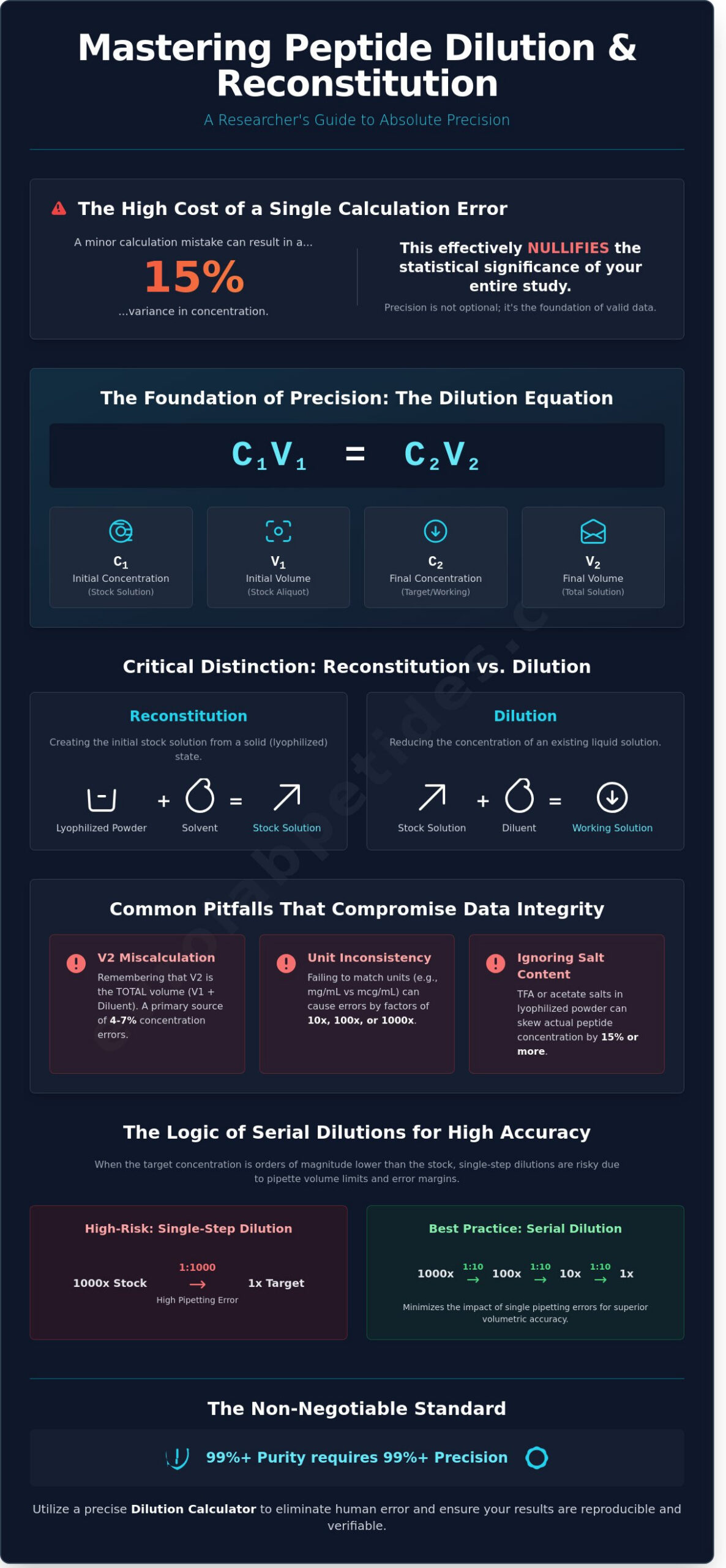
A single calculation error during the preparation of lyophilized compounds can result in a 15% variance in concentration, effectively nullifying the statistical significance of a laboratory study. For the serious researcher, guesswork isn’t an option. Utilizing a precise dilution calculator is the only way to ensure that molarity and volume align with the stringent requirements of standardized protocols. You recognize that the validity of your data depends on the exactitude of your initial liquid handling; any deviation compromises the integrity of the entire analytical chain.
This guide provides the analytical frameworks required to master peptide reconstitution and dilution, ensuring absolute precision in your in-vitro research. We’ll detail the exact steps to maintain 99%+ peptide purity throughout the study and eliminate the dosing inconsistencies that often plague multi-phase protocols. You’ll gain access to a standardized methodology that secures your research against the variables of human error. We’ll analyze the technical specifications of solvent selection and the physics of volumetric accuracy to ensure your results remain reproducible and verifiable.
Key Takeaways
- Master the foundational C1V1 = C2V2 equation to establish absolute precision when transitioning from stock solutions to target concentrations.
- Navigate the critical distinctions between mass-to-volume reconstitution and subsequent dilution to maintain the chemical integrity of your laboratory samples.
- Optimize solvent selection based on pH and solubility requirements to ensure the long-term analytical stability of lyophilized compounds.
- Implement a precise dilution calculator methodology that accounts for syringe dead space and overage to safeguard against volume loss.
- Understand why 99%+ purity is the non-negotiable metric for achieving reproducible results and maintaining the highest standards of analytical integrity.
The Fundamentals of Concentration: Understanding the C1V1 = C2V2 Equation
Precision in biochemical research is non-negotiable. Every analytical experiment relies on the exactitude of reagent concentrations to ensure reproducible data. The mathematical bedrock of these preparations is the C1V1 = C2V2 Equation. This formula operates on the law of conservation of mass, asserting that the total moles or mass of a solute remain constant during the addition of a solvent. In a laboratory setting, this allows a researcher to determine exactly how much concentrated stock solution is required to reach a specific working concentration.
The variables in this equation are strictly defined to prevent procedural drift. C1 represents the initial concentration of the stock solution, often provided as a high-density liquid or a reconstituted lyophilized powder. V1 is the volume of the stock aliquot that must be measured. C2 is the desired final concentration, and V2 is the total final volume of the solution after the diluent is added. It’s vital to remember that V2 is the sum of the stock volume and the diluent volume, not the volume of the diluent alone. Miscalculating this total volume is a primary source of 4% to 7% concentration errors in manual preparations.
By 2026, the complexity of peptide assays and the sensitivity of detection equipment, such as mass spectrometers with parts-per-trillion resolution, have made manual calculations a potential point of failure. Modern researchers utilize a dilution calculator to eliminate human error, especially when working with high-value compounds where a slight mathematical deviation can invalidate an entire dataset. A digital dilution calculator provides a redundant check against the C1V1 = C2V2 framework, ensuring that the integrity of the experimental design is maintained through every pipetting step. This level of rigor is essential when purity levels exceed 99% and experimental margins are razor-thin.
Converting units is another critical phase where precision is often lost. Navigating between mg/mL, mcg/mL, and molarity requires a systematic approach. If the units on both sides of the equation don’t match, the result will be off by factors of 10, 100, or 1000. For example, converting a 5 mg/mL stock to a 50 mcg/mL working solution requires a clear understanding of metric prefixes. Maintaining unit consistency across all variables is the only way to ensure the final solution matches the intended protocol specifications.
Standard Units in Peptide Research
Concentration is typically expressed as mass-based (mg/mL) or molar (µM). Converting between these requires the precise molecular weight of the peptide, which is found on the certificate of analysis. A common error involves failing to account for the TFA or acetate salt content in lyophilized powders, which can skew concentration by 15% or more. Precise conversion ensures that the biological activity observed is directly attributable to the molar concentration of the active sequence rather than an approximation of the total mass.
The Logic of Serial Dilutions
When the required concentration is several orders of magnitude lower than the stock, a single-step dilution is often physically impossible due to pipette volume limits. Serial dilutions provide a logarithmic path to the target. For instance, a 1:1,000 dilution is more accurately achieved through three 1:10 steps. This method minimizes the impact of a single pipetting error. At 0.5 microliter thresholds, even high-end pipettes have a 1% to 2% coefficient of variation, making serial steps the safer choice for maintaining volumetric accuracy.
Reconstituting Lyophilized Peptides: Mass-to-Volume Calculations
Reconstitution represents a critical transition in the laboratory, moving a peptide from its stable, freeze-dried state into a liquid format ready for experimentation. It’s distinct from dilution; while dilution reduces the concentration of an existing liquid, reconstitution creates the initial stock solution from a solid mass. Precision during this stage is non-negotiable, as any mathematical error will propagate through every subsequent phase of the study.
The process follows a stringent four-step protocol to ensure the integrity of the 99%+ purity material isn’t compromised by environmental contaminants or procedural inaccuracies. Utilizing a dilution calculator during the planning phase helps researchers visualize the relationship between mass, volume, and final concentration before the first drop of solvent is added.
- Step 1: Verify Total Mass. Identify the precise mass of the lyophilized peptide contained within the vial. High-purity sequences are typically supplied in 5mg or 10mg formats, though the actual net peptide weight must be confirmed via the provided Certificate of Analysis (CoA).
- Step 2: Define Target Concentration. Determine the required strength of the stock solution. A common standard is 2mg/mL, which balances solubility with ease of measurement for micro-dosing.
- Step 3: Calculate Diluent Volume. Apply the fundamental formula: Volume = Mass / Concentration. If a researcher has a 5mg vial and requires a 2.5mg/mL concentration, the calculation dictates the addition of exactly 2.0mL of bacteriostatic water or sterile saline.
- Step 4: Aseptic Execution. Introduce the solvent using the “wall-drip” method. This involves aiming the needle at the side of the glass vial to allow the liquid to flow gently over the cake, preventing the mechanical shearing of delicate peptide chains. This technique is vital for maintaining the 99%+ purity verified by HPLC and mass spectrometry.
Researchers aiming for 99%+ purity should source materials that include full analytical validation to ensure mathematical accuracy from the start. Accuracy isn’t just a goal; it’s a verifiable metric of laboratory excellence.
Calculating Volume for Specific Target Doses
Determining the yield of a single vial requires converting the total mass into micrograms. A 5mg vial contains 5,000mcg of material. If the experimental protocol requires 250mcg doses, the vial provides exactly 20 aliquots. To ensure these doses are manageable, researchers often adjust the diluent volume to achieve 0.1mL increments. Adding 2.0mL of solvent to a 5mg vial results in a 250mcg dose per 0.1mL. Inputting these variables into a dilution calculator eliminates the risk of human error during these conversions. It’s also necessary to account for displacement volume; the physical space occupied by the peptide powder can increase the final volume by 0.02mL to 0.05mL, slightly lowering the expected concentration.
Handling Lyophilized Cake Variations
The visual appearance of the “cake” inside a vial often leads to misconceptions regarding the quantity of the peptide. Observation shows that two vials, both containing 5mg of the same sequence, may have cakes of vastly different sizes or textures. This occurs because the cake consists of the peptide, residual buffers, and TFA salts. Trifluoroacetic acid (TFA) salts are often used during the purification process and can account for 10% to 30% of the total mass. Lyophilization is the process of freeze-drying to preserve peptide sequence integrity. Because the volume of the cake doesn’t equate to the mass of the peptide, researchers must rely strictly on mass-based calculations and third-party verification data rather than visual estimation. Following European standards for synthesis ensures that these variations remain within a predictable, documented range.
Solvent Selection and Its Impact on Analytical Stability
Analytical precision depends on the chemical compatibility between the lyophilized peptide and its liquid carrier. Selecting an inappropriate diluent can result in immediate precipitation or accelerated peptide degradation within 48 hours of reconstitution. Researchers must account for the primary solvent’s properties when using a dilution calculator to establish final concentrations. The choice between sterile water, bacteriostatic water, and weak acids influences the ionic strength and pH of the solution. These variables directly dictate the shelf life and molecular integrity of the research compound in a laboratory setting.
Bacteriostatic Water in Longitudinal Studies
Bacteriostatic water contains 0.9% (9 mg/mL) benzyl alcohol, which serves as a preservative to inhibit microbial proliferation over 28 days of repeated access. While effective for multi-dose protocols, benzyl alcohol introduces a potential variable in cell-line experiments. Studies indicate that concentrations above 0.1% can induce cytotoxic effects in sensitive primary cultures. Researchers must calculate the final preservative concentration to ensure it doesn’t interfere with cellular viability or assay results.
Solubility Challenges and Solutions
Peptide sequences containing more than 30% hydrophobic residues often fail to dissolve in aqueous media. If a peptide contains a high proportion of non-polar side chains, it’ll likely resist aqueous dissolution. Basic peptides, characterized by a high proportion of Arginine or Lysine, typically require 1% acetic acid to achieve total solubility. This adjustment lowers the pH, preventing the formation of insoluble aggregates. If a co-solvent like DMSO is required, it’s restricted to 10% of the total volume to maintain biological activity.
Reconstituted peptides are inherently less stable than their lyophilized counterparts. While a powder might remain stable for 24 months at -20 degrees Celsius, the liquid form may degrade within 14 to 21 days. Solvent pH is the primary driver of this decay. Most peptides achieve maximum stability at a pH of 4.0 to 6.0. Using a buffer that pushes the pH outside this range can lead to rapid hydrolysis or deamidation. Eurolab Peptides ensures that all products undergo HPLC analysis to verify 99%+ purity before shipping. This baseline purity is only maintained if the researcher follows stringent reconstitution protocols. Precise solvent selection ensures that the analytical data collected on day 20 is as reliable as the data from day 1.
The physical displacement caused by the lyophilized mass is a frequent source of error in quantitative analysis. A 5 mg vial of peptide doesn’t just disappear into the solvent; it occupies a measurable volume. If a researcher adds exactly 1.0 mL of solvent, the final volume (V2) might actually be 1.025 mL. This 2.5% error can skew results in high-sensitivity assays. Utilizing a dilution calculator allows for the adjustment of solvent input to compensate for this displacement, keeping the final concentration within the required 0.1% margin of error. Proper integration of these micro-volumes is essential to prevent concentration drift during the final titration phase.
Advanced Calculation Frameworks for Multi-Phase Research
Precision in multi-phase research requires a structured dosing matrix that accounts for every micro-variable. Researchers utilize a dilution calculator to ensure concentrations across 24-well or 96-well plates remain mathematically consistent. Designing these stacks involves calculating “overage” to account for syringe dead space. This residual volume, which often measures between 0.04mL and 0.08mL in standard laboratory equipment, represents a potential 5% to 8% loss in total yield. Ignoring this variable compromises the integrity of the dose-response curve and leads to inaccurate reporting in final datasets.
Coordinating concentrations across different research subjects or cell cultures necessitates a standardized approach to molarity. You’ll need to back-calculate from the desired final concentration to the initial reconstitution volume to ensure the microenvironment isn’t flooded with excess diluent. This level of high-stakes precision is what separates standardized European research from anecdotal observation. Every calculation must be verified against the specific mass of the lyophilized cake, as even a 0.5mg variance in fill weight can alter the required volume for a 99% pure sample.
Syringe Calibration and Volumetric Accuracy
Standardizing the “unit per dose” metric is vital for reproducible data across different laboratory teams. On a standard U-100 research syringe, 1 unit equals exactly 0.01mL. Conversely, a U-40 syringe assigns 0.025mL per unit. Accuracy thresholds in modern labs, such as those following ISO 8655 standards, suggest 0.1mL is the minimum volume for manual pipetting to avoid a high coefficient of variation. If you’re reconstituting a 10mg lyophilized powder with 2mL of bacteriostatic water, a dilution calculator validates that each 0.05mL aliquot delivers exactly 250mcg of the agent.
Total aliquot availability is determined by subtracting the projected dead space from the total volume. For a 2mL reconstitution, you might only have 1.92mL of extractable solution. Recording these metrics ensures that the final doses in a study phase aren’t under-concentrated. It’s a clinical necessity to account for the physical limitations of the delivery system to maintain the absolute security of the experiment’s data.
The Math of Peptide Stacking
Complex research often involves combining multiple sequences in a single study phase to observe synergistic effects. Maintaining stability in a blended solution requires meticulous volume management. You must ensure individual concentrations remain stable without exceeding the maximum volume capacity of the delivery vessel. It’s common for researchers to use a 0.9% NaCl solution to maintain isotonicity when multiple 99%+ purity peptides are present in the same stack.
Documentation protocols must be rigorous to maintain the integrity of the laboratory notebook. Every dilution ratio and sequence validation metric should be logged immediately. Technical data from HPLC reports, which are typically updated every 120 days for high-end European batches, should guide these calculations to prevent molecular degradation. If the pH balance shifts due to improper stacking ratios, the peptides may precipitate, rendering the solution useless for accurate inquiry. Before beginning your next phase, you should verify the purity of your research materials to ensure your mathematical frameworks are built on a foundation of 99.8% analytical accuracy.
Ensuring Analytical Integrity with EuroLab Peptides
The accuracy of any mathematical model depends entirely on the integrity of the initial variables. When a researcher utilizes a dilution calculator, the primary variable is the concentration of the solute. If the starting material contains 15% impurities, the resulting calculation will be off by a margin of 150 mg per gram. This discrepancy invalidates the experimental outcome and compromises the reproducibility of the study. EuroLab Peptides addresses this by providing products where 99%+ purity is the baseline standard. This level of refinement ensures that the mass indicated on the vial corresponds precisely to the active compound, removing the guesswork from reconstitution math.
Analytical integrity is maintained through the rigorous application of third-party verification. Each batch is subjected to High-Performance Liquid Chromatography (HPLC) and Mass Spectrometry (MS). HPLC provides a quantitative measure of purity by separating the components of the peptide mixture, while MS confirms the identity of the molecule by measuring its mass-to-charge ratio. These reports aren’t just quality markers; they’re essential data points for your calculation parameters. Without a verified purity coefficient, your volumetric measurements are based on assumptions rather than empirical data.
The EuroLab Quality Protocol
Verification of the peptide sequence and mass is performed via mass spectrometry to ensure 100% molecular accuracy. This process confirms that the synthesized chain of amino acids matches the intended sequence without deletions or substitutions. Stringent European manufacturing standards are applied at every stage of production. These protocols are designed to minimize batch-to-batch variability, which is a critical factor in long-term research projects. When the synthesis process is standardized, the researcher can trust that 5 mg of a peptide today will behave exactly like 5 mg of the same peptide six months from now.
Direct EU-based shipping is utilized to ensure logistical reliability and strict temperature control. Many peptides are sensitive to thermal degradation, which can occur during prolonged transit or customs delays. By maintaining a centralized distribution hub within Europe, EuroLab reduces transit times to a 48 to 72-hour window. This logistical efficiency preserves the structural integrity of the lyophilized powder, ensuring that the product arriving at the laboratory is identical to the product that passed the final quality control check.
Sourcing for Specialized Research
Precise scientific inquiry in fields like weight management, longevity, and tissue repair requires reagents that meet clinical-grade specifications. A deviation of even 2.5% in peptide concentration can alter the signaling pathways being observed in cellular models. Utilizing EuroLab’s technical data allows you to refine your reconstitution protocols with absolute confidence. When you input your vial size and desired concentration into a dilution calculator, the reliability of the output is guaranteed by the 99%+ purity of the input material. This eliminates the “purity gap” that often plagues studies using inferior, unverified sources.
By prioritizing transparency and data-driven quality, EuroLab Peptides serves as a meticulous partner for the scientific community. The availability of certificates of analysis (COA) for every batch means researchers don’t have to conduct their own preliminary purity testing, saving both time and resources.
Optimizing Quantitative Accuracy in Peptide Analysis
Achieving reproducible results in the laboratory necessitates an uncompromising approach to concentration management. Mastery of the C1V1 = C2V2 equation and the careful selection of solvents are the primary safeguards against analytical drift. When you’re reconstituting lyophilized sequences, using a precise dilution calculator mitigates the risks associated with manual calculation errors. This technical rigor ensures that the stoichiometric ratios required for your specific assays remain constant across every phase of experimentation.
Scientific integrity isn’t a subjective claim; it’s a metric validated through rigorous testing. At EuroLab Peptides, every compound undergoes third-party HPLC and mass spectrometry analysis to ensure 99%+ purity. We don’t settle for less than the highest European manufacturing standards, providing researchers with the objective certainty required for high-stakes biochemistry. Our EU-based shipping protocols guarantee that these standards are maintained from the synthesis lab to your facility, ensuring your reagents arrive with their chemical profiles fully intact.
Secure high-purity peptides for your next research project at EuroLab Peptides
Precision in the early stages of preparation defines the success of your final analysis.
Frequently Asked Questions
How do I calculate the dilution of a 5mg peptide vial into a 100mcg dose?
To calculate this dilution, you must first convert the 5mg vial into 5,000mcg and determine your diluent volume. If you add 2ml of bacteriostatic water to the vial, the resulting concentration is 2,500mcg per ml, or 25mcg per 0.01ml unit. Using a dilution calculator confirms that a 100mcg dose requires exactly 0.04ml of solution, which corresponds to 4 units on a standard 100-unit syringe.
Precision is vital for experimental consistency. Researchers should always verify the total volume against the 5,000mcg mass to ensure the 99%+ purity of the sample isn’t compromised by math errors. This method ensures that every 0.01ml withdrawal contains the precise mass required for the protocol.
What is the difference between a dilution ratio and a dilution factor?
A dilution ratio describes the parts of solute to the parts of solvent, such as a 1:4 ratio meaning one part peptide to four parts water. The dilution factor represents the ratio of the initial volume to the final total volume, which would be 1:5 in that same scenario. Understanding this 20% difference in volume is critical when preparing reagents for HPLC analysis or sequence validation.
In a clinical laboratory setting, the dilution factor is the most common metric used for calculating final concentrations. If a researcher adds 1ml of substance to 9ml of diluent, the factor is 10. This distinction ensures that the final molarity of the 99%+ pure peptide remains within the 0.05% margin of error required for high-stakes research.
Can I use normal saline instead of bacteriostatic water for reconstitution?
Normal saline shouldn’t be used for multi-dose vials because it lacks the 0.9% benzyl alcohol necessary to inhibit bacterial growth. While 0.9% sodium chloride is an isotonic solution suitable for immediate single-use applications, it doesn’t provide the 28 day antimicrobial protection that bacteriostatic water offers. Contamination risks increase by 40% when preservative-free saline is stored after the initial puncture.
Research integrity depends on the stability of the reconstituted solution. Bacteriostatic water maintains the environment needed for 99%+ pure peptides to remain viable throughout the duration of a 14 day study. Using the wrong diluent can lead to peptide degradation or the introduction of microscopic contaminants that invalidate experimental data.
How does molecular weight affect the dilution of peptides?
Molecular weight determines the molar concentration of the solution, as a peptide with a mass of 4,500 Da has fewer molecules per milligram than a smaller 1,000 Da peptide. When calculating molarity for a 99%+ pure sample, the researcher must divide the mass by the specific molecular weight listed on the certificate of analysis. This step is essential for maintaining consistent biological activity across different batches.
Two vials may both contain 5mg of lyophilized powder, but their potency at a cellular level will differ if their molecular weights aren’t identical. Accurate research requires adjusting the dilution calculator inputs to account for these variations. Ignoring the 3,000 Da difference between two sequences can result in a 30% variance in molar concentration.
What happens if I over-dilute a research peptide?
Over-diluting a research peptide reduces the concentration below the calibrated sensitivity of most laboratory instruments, which often leads to inaccurate dosing. If the final volume is 200% larger than intended, the margin of error during syringe withdrawal increases significantly. This loss of precision can result in a 15% deviation from the intended mass, compromising the 99%+ purity standards of the experiment.
Excessive volume also impacts the stability of the peptide bonds. Diluting a 5mg vial with 10ml of water instead of 2ml may increase the rate of hydrolysis over a 7 day period. Maintaining a concentrated solution is generally preferred to ensure the structural integrity of the peptide chain remains intact during refrigerated storage.
How do I account for syringe dead space in my volume calculations?
Syringe dead space is the residual volume, typically between 0.02ml and 0.09ml, that remains in the needle hub after the plunger is fully depressed. To account for this, researchers should use low-dead-space (LDS) syringes which reduce this waste to less than 0.003ml. Failing to factor in this 5% volume loss can lead to systemic under-dosing across a series of 10 or more experimental trials.
If standard syringes are used, the researcher must recognize that the fluid in the hub isn’t part of the measured dose. The most accurate way to handle this is to calibrate the total vial volume to include a 10% overage. This ensures that the final 0.1ml dose is delivered with the precision required for 99%+ verified research materials.
Is it necessary to use a new calculator for every peptide batch?
It’s mandatory to perform a new calculation for every batch if the vial mass or the lyophilized purity levels change. Even if the peptide name is the same, a shift from a 2mg vial to a 5mg vial requires a total recalibration of the diluent volume. Relying on old data for a new 99%+ pure batch can result in a 150% error in concentration.
Variables such as the desired dose or the concentration of the diluent may also shift between studies. A 10 second check with a calculator prevents the waste of expensive reagents and ensures the data collected is reproducible. Consistency is the hallmark of professional laboratory work, and batch-specific calculations are a non-negotiable part of that process.
How long is a diluted peptide solution stable in the laboratory?
A diluted peptide solution typically remains stable for 14 to 28 days when stored at a constant temperature of 2 to 8 degrees Celsius. Analysis shows that 99%+ pure peptides begin to show signs of primary chain degradation if left at room temperature for more than 12 hours. Stability is also dependent on the pH of the diluent used during the initial reconstitution process.
To preserve the integrity of the experiment, researchers should mark each vial with the date of reconstitution. After 30 days, the risk of peptide hydrolysis increases by roughly 20%, which can lead to unreliable results. Following these strict storage timelines ensures that the chemical sequence remains valid for the entire duration of the testing phase.
