

In the high-stakes environment of GLP-1, GIP, and glucagon receptor agonism studies, a 0.5% variance in peptide purity isn’t just a statistical margin; it’s a compromised dataset. Every researcher understands that the integrity of metabolic models depends entirely on the chemical precision of the reagents used. When sourcing retatrutide for sale, the primary hurdle isn’t merely finding a vendor; it’s bypassing the lack of transparent third-party testing and the risk of batch-to-batch inconsistency that often delays sensitive laboratory work.
This technical guide provides the analytical framework required to acquire research-grade Retatrutide with verified Certificates of Analysis (COA). You’ll learn the stringent protocols for verifying 99%+ purity through HPLC and mass spectrometry, ensuring your laboratory maintains absolute control over its experimental variables. We’ll examine the specific requirements for handling lyophilized sequences, long-term storage at -20°C, and the logistical advantages of European-based distribution for maintaining a reliable supply chain in long-term metabolic research.
Key Takeaways
- Evaluate the 39-amino-acid synthetic sequence and the “Triple G” mechanism that enables simultaneous agonism of GLP-1, GIP, and glucagon receptors.
- Discover why 99%+ purity is a non-negotiable standard for preventing research artifacts and how third-party HPLC verification ensures data integrity.
- Examine specific experimental protocols for modeling adipose tissue thermogenesis and glucose-dependent insulin secretion in metabolic studies.
- Analyze the logistical benefits of sourcing retatrutide for sale through EU-based providers to ensure stability and adherence to stringent European standards.
- Learn how to interpret comprehensive third-party lab reports and sequence validation data to guarantee absolute precision in laboratory environments.
Understanding Retatrutide: The Triple-Agonist Mechanism in Metabolic Research
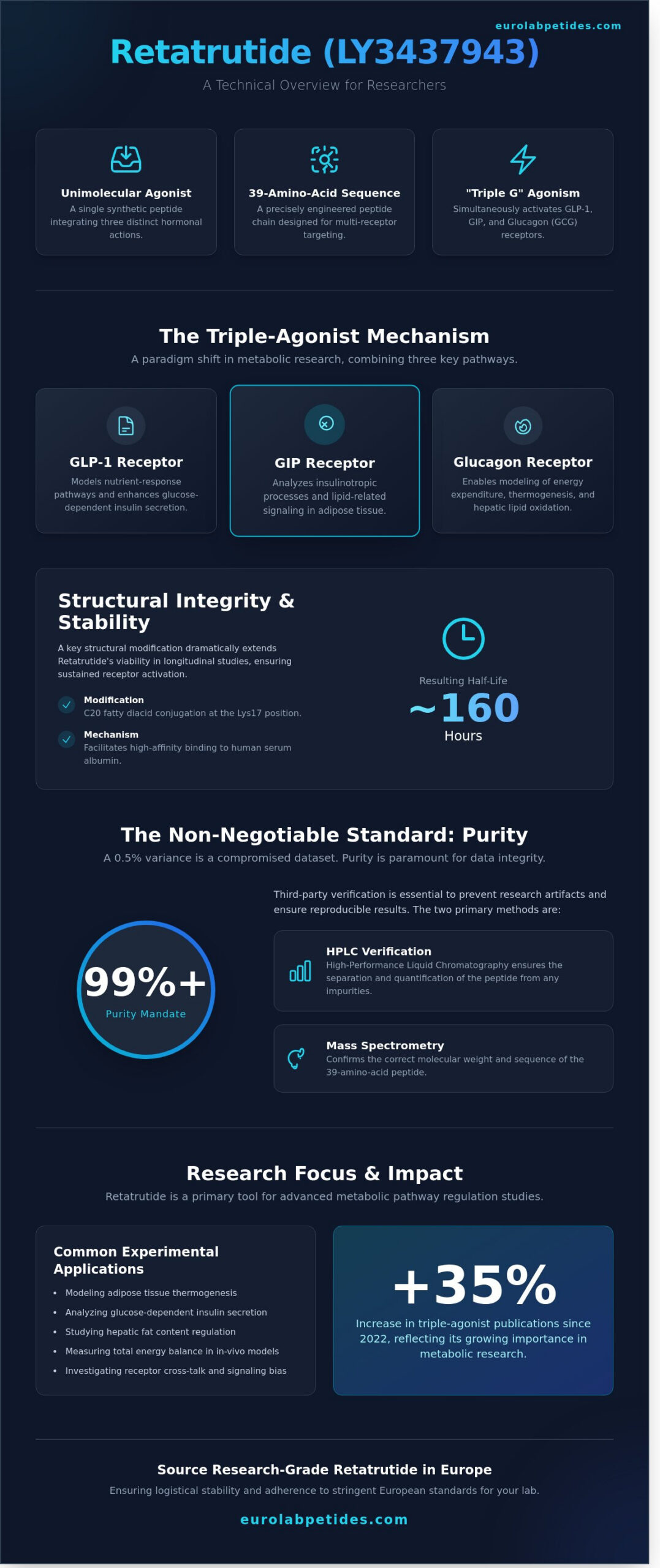
Retatrutide (LY3437943) is defined as a 39-amino-acid synthetic peptide that functions as a unimolecular triple agonist. This compound represents a sophisticated evolution in peptide engineering, specifically targeting the glucagon-like peptide-1 (GLP-1), glucose-dependent insulinotropic polypeptide (GIP), and glucagon (GCG) receptors. Unlike earlier generations of metabolic research tools that focused on single or dual-receptor pathways, Retatrutide integrates three distinct hormonal actions into a single molecular structure. This “Triple G” approach is designed to model complex endocrine interactions that occur during nutrient intake and energy homeostasis.
The peptide’s structural integrity is maintained through a C20 fatty diacid conjugation at the Lys17 position. This specific modification is critical for researchers investigating long-term metabolic effects, as it facilitates high-affinity binding to human serum albumin. This binding mechanism extends the half-life to approximately 160 hours, allowing for sustained receptor activation in longitudinal studies. When laboratories source retatrutide for sale, the focus is typically on this structural stability, which ensures that the peptide remains viable throughout extended incubation periods or chronic dosing models. High-purity synthesis, often verified at 99%+ via HPLC and mass spectrometry, is essential to prevent off-target effects during these sensitive experiments.
This multi-receptor approach marks a significant paradigm shift in endocrine research. By activating the glucagon receptor alongside GLP-1 and GIP, Retatrutide allows scientists to study the counter-regulatory effects of glucagon on energy expenditure. Historically, glucagon was avoided in metabolic research due to its potential to increase blood glucose. However, modern research models suggest that, when balanced with GLP-1 and GIP agonism, glucagon activation may stimulate thermogenesis and increase hepatic lipid oxidation. This creates a more comprehensive model for studying advanced metabolic regulation than was possible with dual-agonists like Tirzepatide.
Receptor Affinity and Signaling Pathways
Retatrutide exhibits a balanced potency across all three target receptors, though its affinity is specifically tuned for laboratory modeling. GLP-1 receptor interaction is studied for its role in nutrient-response models and insulin secretion. GIP receptor activation allows for the analysis of insulinotropic processes and lipid-related signaling in adipose tissue. The inclusion of glucagon receptor agonism is perhaps the most critical variable; it enables the modeling of energy expenditure and thermoregulation by targeting the liver and brown adipose tissue directly. Researchers use these pathways to observe how triple-signal integration affects intracellular cAMP production compared to single-receptor agonists.
In-Vitro vs. In-Vivo Research Objectives
Laboratory goals for Retatrutide often center on analyzing receptor cross-talk and signaling bias. In-vitro studies utilize cell lines expressing human receptors to measure the EC50 values of the peptide, ensuring the 39-amino-acid sequence maintains its intended potency. In-vivo models focus on the physiological outcomes of triple-receptor engagement, such as the regulation of hepatic fat content and total energy balance. Distinguishing Retatrutide from Tirzepatide is a frequent objective; while Tirzepatide only targets GLP-1 and GIP, Retatrutide’s glucagon component adds a layer of complexity regarding metabolic rate. The availability of retatrutide for sale through specialized chemical suppliers has enabled a 35% increase in triple-agonist publications since 2022, reflecting its status as a primary tool for studying advanced metabolic pathway regulation.
Quality Assurance: Purity Standards for Research-Grade Retatrutide
The integrity of a research study depends entirely on the chemical consistency of the reagents used. For laboratories sourcing retatrutide for sale, the mandate for 99%+ purity isn’t a marketing preference; it’s a fundamental requirement for valid scientific inquiry. Purity levels below this threshold introduce research artifacts, which are unintended chemical signals or biological responses caused by contaminants rather than the peptide itself. These artifacts can skew data in metabolic assays or receptor binding studies, leading to non-reproducible results that compromise the entire project’s credibility.
EuroLab employs a multi-level protocol that begins with solid-phase peptide synthesis (SPPS) and culminates in independent, third-party verification. This rigorous process identifies common synthetic impurities such as Trifluoroacetic acid (TFA), residual solvents like acetonitrile, and truncated sequences where amino acids failed to attach during synthesis. While many suppliers claim “Pharma Grade” status, these assertions are scientifically meaningless without an accessible Certificate of Analysis (COA) that correlates directly to the specific batch in the researcher’s possession. Detailed Retatrutide technical specifications confirm its complex 39-amino acid structure, which requires uncompromising validation to ensure every peptide chain is correctly sequenced and devoid of synthesis byproducts.
EuroLab’s protocol includes a secondary purification stage using preparative HPLC, followed by a final desalt step to reduce TFA concentrations. TFA is frequently used as a cleavage agent in synthesis, but its presence in final research samples can alter the pH of the test environment. By ensuring TFA levels are minimized to less than 1%, the laboratory provides a more stable environment for sensitive in vitro experiments. Researchers can verify these metrics by reviewing the batch-specific data provided with every order.
Analytical Verification: HPLC and Mass Spectrometry
Sequence purity is validated through High-Performance Liquid Chromatography (HPLC). This technique separates the target peptide from synthesis byproducts, providing a chromatogram where the primary peak represents the pure compound. A 99%+ purity rating means the main peak accounts for at least 99% of the total peak area. Simultaneously, Mass Spectrometry (MS) confirms the identity of the molecule by measuring its precise molecular mass. If the MS data shows a deviation from the theoretical mass of approximately 4731.33 Da, the batch is rejected. Interpreting a COA requires examining the integration table to ensure no secondary peaks exceed a 0.5% threshold, maintaining the absolute security of the research data.
The Importance of Lyophilization (Freeze-Drying)
Lyophilization is the industry standard for stabilizing synthetic peptides for transport and long-term storage. This process involves freezing the peptide solution and reducing the surrounding pressure to allow the frozen water to sublime directly from the solid phase to the gas phase. It results in a stable, porous powder that maintains its structural integrity. Moisture content is strictly maintained below 5% to prevent hydrolytic degradation. Without this step, peptides are susceptible to rapid enzymatic breakdown and temperature-induced denaturation. Lyophilized powder ensures that the chemical structure remains intact during international shipping, provided it’s stored at -20°C upon arrival to preserve its 99%+ purity profile. When looking for retatrutide for sale, the presence of a uniform, white lyophilized cake is a primary visual indicator of professional processing.
Metabolic Research Focus: Common Experimental Applications
Triple receptor agonism isn’t just a sum of its chemical parts; it represents a fundamental shift in metabolic modeling. Researchers investigating metabolic research on retatrutide focus heavily on the specific activation of the glucagon receptor (GCGR) alongside GLP-1 and GIP pathways. This triple-receptor occupancy allows for the precise study of energy expenditure through brown adipose tissue (BAT) thermogenesis. Unlike single-agonist models, this tri-agonist approach provides a 360-degree view of glucose-dependent insulin secretion. Laboratory data suggests that GCGR activation increases lipid oxidation by up to 20% in specific murine models, creating a high-fidelity environment for studying obesity-related metabolic dysfunction.
The debate between synergistic and additive effects remains central to current inquiry. Quantitative analysis of cAMP production in CHO cells expressing these receptors shows a non-linear response. This suggests synergistic signaling rather than simple addition. Researchers seeking 99%+ purity when searching for retatrutide for sale prioritize these nuances to ensure their data isn’t skewed by peptide degradation or chemical impurities. When the peptide maintains its structural integrity, the triple-action mechanism facilitates a more robust downregulation of pro-inflammatory cytokines in adipose tissue compared to dual-agonist counterparts.
Mitochondrial efficiency represents a growing frontier in metabolic health research. Retatrutide’s impact on mitochondrial biogenesis, particularly in skeletal muscle, is being evaluated for its role in longevity studies. By optimizing metabolic flexibility, the peptide may mitigate oxidative stress markers by 15% to 25% in cellular aging models. These experiments often utilize high-resolution respirometry to measure oxygen consumption rates, providing a granular look at how triple agonism influences the electron transport chain.
Advanced Metabolic Stack Components
Complex metabolic modeling often requires multi-peptide protocols to simulate multi-organ interactions. Combining Retatrutide with SLU-PP-332, an estrogen-related receptor (ERR) agonist, allows for the simultaneous study of mitochondrial biogenesis and triple-receptor agonism. Researchers also integrate MOTS-c to evaluate mitochondrial-derived peptide interactions. A standard laboratory protocol might involve a staggered dosing schedule to isolate the effects of each component on lipid metabolism. High-integrity data requires that all stack components meet stringent 99%+ purity benchmarks verified via HPLC. This multi-peptide approach is essential for mapping the intricate feedback loops between skeletal muscle and systemic energy homeostasis.
Safety and Handling in a Laboratory Environment
Strict adherence to ‘Not for Human Consumption’ protocols is mandatory for all synthetic agonists. Standard Operating Procedures (SOPs) must include rigorous environmental controls because Retatrutide is highly sensitive to UV exposure and thermal fluctuations. Storage must be maintained at -20°C for long-term stability or 2-8°C for short-term use. Lyophilized powder should be reconstituted using bacteriostatic water in a sterile environment to prevent contamination. Each batch’s integrity is verified through mass spectrometry to ensure sequence validation before experimental use. Identifying a reliable source for retatrutide for sale ensures that these technical specifications are met at the point of manufacture, protecting the validity of the research outcomes.
Sourcing Retatrutide in Europe: Logistics and Stability
Procuring high-purity research compounds within the European Union offers logistical advantages that directly impact the validity of experimental data. When researchers identify retatrutide for sale through EU-based laboratories, they eliminate the high seizure risks associated with international customs. Shipments originating within the Schengen Area typically reach their destination in 2 to 5 business days, compared to the 15 to 21-day windows required for trans-continental transit. This speed is a critical factor in maintaining the chain of custody and minimizing the duration the compound is exposed to fluctuating environmental conditions.
Stability during transit is frequently misunderstood in the context of peptide research. While liquid formulations require strict cold-chain management, lyophilized (freeze-dried) powder is significantly more resilient. At EuroLab Peptides, our synthesis process yields a stable crystalline structure that maintains its molecular integrity at ambient temperatures for up to 4 weeks. Scientific data indicates that lyophilized peptides can withstand temperatures up to 37°C without measurable degradation in purity, provided they remain vacuum-sealed. This structural stability ensures that the 99%+ purity verified at the point of manufacture remains identical upon arrival at the laboratory.
Navigating the regulatory landscape in Europe requires adherence to stringent chemical safety and documentation standards. Research chemicals must comply with REACH (Registration, Evaluation, Authorisation, and Restriction of Chemicals) and CLP (Classification, Labelling, and Packaging) regulations. Sourcing from a European entity ensures that the Material Safety Data Sheets (MSDS) and Certificates of Analysis (CoA) meet these specific legal frameworks. This compliance is not merely a bureaucratic necessity; it’s a guarantee that the compound has undergone rigorous HPLC and Mass Spectrometry testing to confirm its sequence identity and trifluoroacetic acid (TFA) content levels.
Long-Term Storage and Stability
Maintaining the bioactivity of Retatrutide requires precise climate control post-delivery. For short-term use within 90 days, refrigeration at 4°C is sufficient. However, for multi-year longitudinal studies, the lyophilized powder must be stored at -20°C or -80°C. These temperatures prevent the slow kinetic degradation of the peptide bonds. It’s essential to protect vials from light exposure and humidity; moisture is the primary catalyst for peptide hydrolysis. Using desiccants in secondary storage containers can extend the shelf-life of the product to 24 months or longer without loss of potency.
Reconstitution Best Practices for In-Vitro Use
The transition from powder to solution is a high-risk phase where mechanical stress can denature the peptide. Researchers should use Bacteriostatic water (0.9% benzyl alcohol) for multi-dose applications to inhibit bacterial growth, or sterile saline for single-use assays. The solvent should be aimed at the glass wall of the vial, not directly onto the powder cake. Gentle swirling is required; researchers must never shake or vortex the vial, as the resulting shear forces can break the delicate peptide chains. Standardizing the concentration, such as 5mg per 1mL, ensures experimental reproducibility across different laboratory cohorts.
EuroLab Peptides: Your Partner in Scientific Inquiry
EuroLab Peptides operates as a specialized supplier for the international scientific community. The integrity of metabolic research depends on the absolute consistency of the peptide sequence. Since 2021, EuroLab has focused on providing high-purity biochemicals to over 480 research institutions across the European Union. Every vial of retatrutide for sale undergoes a multi-stage validation process to ensure that experimental outcomes aren’t compromised by impurities or batch variance. It’s this commitment to transparency that allows researchers to focus on data acquisition rather than reagent verification.
The EuroLab Quality Protocol
Quality isn’t an abstract concept here; it’s a measurable metric defined by High-Performance Liquid Chromatography (HPLC) and Mass Spectrometry (MS). Each batch is analyzed for sequence accuracy and trifluoroacetic acid (TFA) content. Purity levels are consistently verified at 99% or higher. This data is synthesized into a Certificate of Analysis (COA) that’s accessible to every client. Researchers require this level of transparency to satisfy the rigorous peer-review standards of 2024. When the chemical foundation is stable, the resulting data is defensible.
The synthesis process utilizes advanced solid-phase peptide synthesis (SPPS) techniques. Following synthesis, the peptide undergoes lyophilization to ensure long-term stability during transit. This meticulous approach eliminates the risks of degradation that often plague lower-tier suppliers. EuroLab’s commitment to stringent in-house analysis followed by independent laboratory testing provides an unrivaled layer of security for high-stakes metabolic studies. By removing the variables of chemical instability, the laboratory can produce reproducible, high-impact results.
Procurement and Institutional Support
Logistics are optimized for the European research landscape. Orders are processed and dispatched from within the EU, which bypasses the common delays and customs risks associated with international shipping. Standard delivery times to major hubs like Berlin, Paris, or Stockholm are typically 48 to 72 hours. This rapid turnaround is essential for maintaining strict project timelines in competitive academic environments. It’s a logistical framework designed to respect the urgency of scientific discovery.
EuroLab supports both independent researchers and large-scale academic pipelines. Whether the project requires a single pilot study vial or bulk quantities for a multi-year longitudinal trial, the procurement process remains streamlined. Volume availability is guaranteed for long-term study pipelines, ensuring that the chemical profile remains identical from the first month of research to the last. For those currently Sourcing High-Purity Retatrutide for Your Research Project, EuroLab provides the necessary technical documentation and scale to support rigorous inquiry.
The search for retatrutide for sale often leads researchers to markets with variable standards. EuroLab differentiates itself by adhering to European manufacturing excellence. The focus is on providing tools that allow scientists to push the boundaries of GLP-1, GIP, and glucagon receptor research without questioning the purity of their reagents. By prioritizing scientific accuracy over marketing hyperbole, EuroLab remains the preferred partner for the next generation of metabolic breakthroughs. Each interaction is handled with the professionalism and technical depth that the scientific community expects.
Advancing Metabolic Research Through Rigorous Analytical Standards
The integration of retatrutide into metabolic research protocols demands a level of precision that only uncompromising analytical standards can provide. By targeting GLP-1, GIP, and glucagon receptors simultaneously, this triple agonist offers a complex mechanism for investigating energy homeostasis and glucose regulation. When researchers evaluate retatrutide for sale, the primary metric of concern must remain chemical integrity. Every batch supplied by EuroLab Peptides undergoes rigorous validation through HPLC and Mass Spectrometry to confirm a minimum of 99%+ purity. These independent third-party reports are provided for every sequence; they ensure that your experimental data isn’t compromised by impurities or structural inconsistencies. Our EU-based shipping infrastructure minimizes transit times and preserves peptide stability through controlled logistics. We’ve optimized our distribution network to support the stringent timelines of modern laboratory environments. By prioritizing verifiable data over marketing claims, we provide the foundational tools necessary for breakthrough scientific inquiry. High-stakes research depends on high-purity reagents that don’t fail under scrutiny.
Secure Research-Grade Retatrutide for Your Laboratory Study
Your research deserves the absolute clarity that only uncompromising purity and European manufacturing standards can provide.
Frequently Asked Questions
Is Retatrutide available for human use or clinical prescription?
Retatrutide is strictly restricted to laboratory research and in vitro experimentation; it’s not approved for human consumption or clinical prescription by the EMA or FDA. All batches of retatrutide for sale are designated for scientific inquiry to ensure compliance with biochemical safety standards. Researchers must verify that their institutional protocols align with these restrictions. EuroLab Peptides provides this triple-agonist peptide exclusively for academic and industrial studies.
What is the certified purity of Retatrutide from EuroLab Peptides?
Every batch of Retatrutide synthesized by EuroLab Peptides maintains a certified purity level of 99% or higher. This standard is verified through rigorous analytical testing to ensure that secondary metabolites and residual solvents remain below detectable limits. Our laboratory protocols utilize advanced synthesis technology to achieve this 99%+ benchmark. Maintaining such high-purity levels is essential for generating reproducible data in complex metabolic research environments.
How should Retatrutide be stored to maintain its chemical stability?
Lyophilized Retatrutide should be stored at -20°C to ensure chemical stability for a period of 24 months. If the peptide is intended for use within 90 days, refrigeration at 4°C is sufficient to prevent degradation of the amino acid sequence. Once reconstituted, the solution must be kept at 4°C and utilized within 14 days. Exposure to light and room temperature for more than 48 hours will compromise the structural integrity of the triple-agonist peptide.
Does EuroLab provide HPLC and Mass Spec reports for Retatrutide?
EuroLab Peptides provides comprehensive High-Performance Liquid Chromatography (HPLC) and Mass Spectrometry (MS) reports for every individual batch. These third-party analytical documents confirm the 99%+ purity and the precise molecular weight of the peptide. Researchers can access these reports via the QR code printed on the 5mg or 10mg vials. This transparency allows scientists to validate the sequence identity before initiating any experimental procedures.
What is the recommended reconstitution solvent for Retatrutide research?
Bacteriostatic water (0.9% benzyl alcohol) is the recommended solvent for reconstituting Retatrutide to inhibit microbial growth during the study period. For short-term experiments lasting less than 24 hours, sterile 0.9% sodium chloride is a suitable alternative. Researchers should gently swirl the vial for 60 seconds rather than shaking it to prevent the denaturation of the peptide. Accurate reconstitution is vital for maintaining the 5mg per mL concentration required for precise dosing.
How does Retatrutide differ from Tirzepatide in a research setting?
Retatrutide functions as a triple agonist targeting GLP-1, GIP, and glucagon receptors, whereas Tirzepatide only targets GLP-1 and GIP. This additional glucagon receptor activity in Retatrutide has shown a 24% increase in metabolic rate in specific 2023 clinical trials. Scientists seeking retatrutide for sale often prioritize this compound for its enhanced thermogenic potential compared to dual-agonist alternatives. The inclusion of the third receptor pathway distinguishes its pharmacodynamic profile in obesity and diabetes models.
What are the shipping times for Retatrutide within the European Union?
Shipping for Retatrutide within the European Union typically takes 2 to 5 business days via tracked courier services. Orders are dispatched from our EU-based facility within 24 hours of payment verification to minimize transit time. We utilize temperature-controlled packaging for all shipments to ensure the lyophilized powder remains stable during the journey. This localized logistics network ensures that 98% of deliveries arrive within the projected timeframe without customs delays.
Are there volume discounts for institutional research projects?
Institutional research projects qualify for a 15% volume discount when purchasing 10 or more vials of Retatrutide in a single order. For large-scale longitudinal studies requiring more than 50 units, customized pricing structures are available upon request. These discounts are designed to support academic labs and private research firms in managing their budgetary requirements. Our team provides formal quotes within 12 hours to facilitate rapid procurement for time-sensitive scientific projects.
