

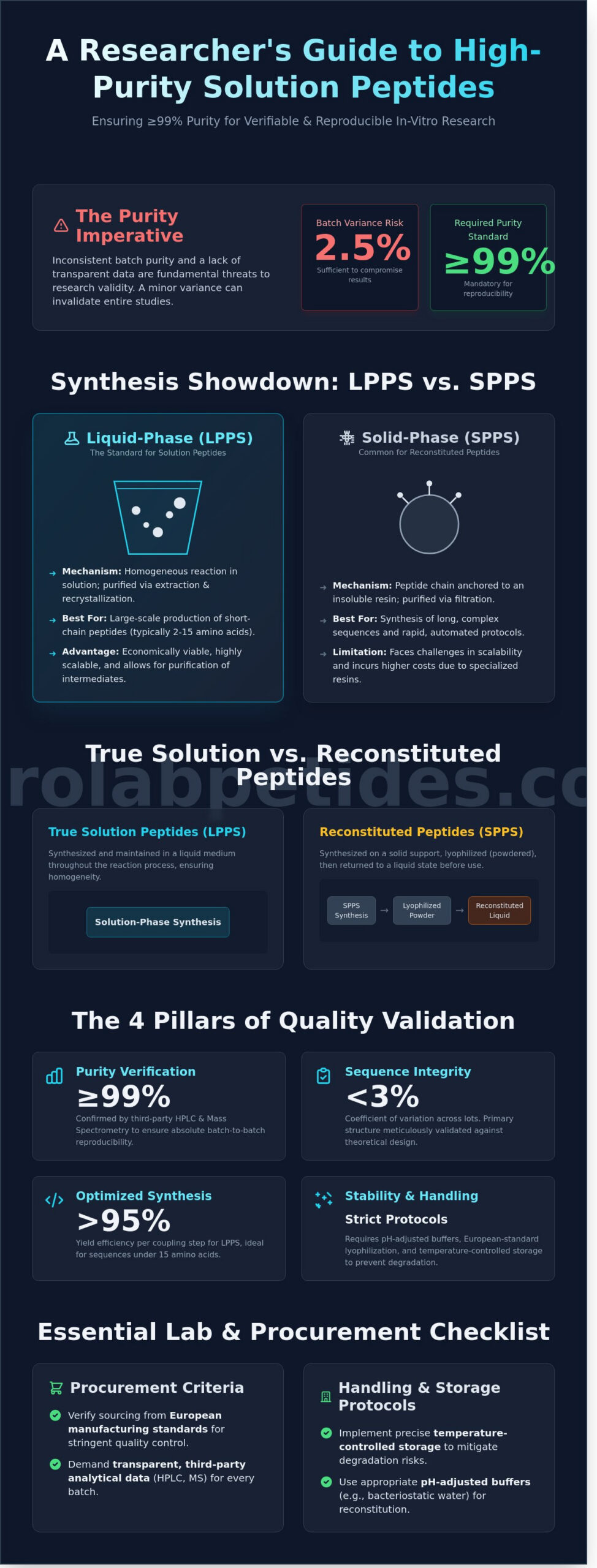
In-vitro research integrity hinges on a single, uncompromising metric: the verifiable purity of the chemical sequence. When a study fails to replicate, the culprit is frequently a batch variance of as little as 2.5% in the primary reagent. You recognize that inconsistent batch purity and the absence of transparent analytical data aren’t just minor inconveniences; they’re fundamental threats to the validity of your data. This technical reference establishes a rigorous framework for utilizing solution peptides, focusing on solution-phase synthesis, stringent purity validation, and optimized laboratory handling protocols.
Chemical sequences are validated through third-party mass spectrometry and HPLC analysis to ensure uncompromising accuracy. You’ll learn to standardize laboratory protocols and mitigate degradation risks through European-standard lyophilization and specialized storage techniques. This guide moves through the precise methodologies required to maintain 99%+ purity, ensuring your research relies on verifiable metrics rather than anecdotal claims. By following these protocols, you’ll secure the high-stakes precision required for elite scientific inquiry.
Key Takeaways
- Analyze the technical distinctions between Liquid-Phase Peptide Synthesis (LPPS) and Solid-Phase Peptide Synthesis (SPPS) to determine the optimal methodology for specific biochemical research.
- Identify the analytical benchmarks required for 99%+ purity, utilizing HPLC and mass spectrometry to ensure absolute experimental reproducibility.
- Implement standardized handling and stability protocols for solution peptides, including precise lyophilization techniques and temperature-controlled storage.
- Establish rigorous procurement criteria by prioritizing European manufacturing standards and the verification of transparent, third-party analytical data.
Defining Solution Peptides in Modern Biochemical Research
In biochemical inquiry, solution peptides are defined as amino acid chains synthesized or maintained within a liquid medium throughout the reaction process. This methodology differs from solid-phase approaches where the peptide remains tethered to a resin. Liquid-phase peptide synthesis (LPPS) remains a critical tool for large-scale production where chemical homogeneity is a priority. While the field has evolved since Emil Fischer’s first dipeptide synthesis in 1901, the fundamental principles of solution-based chemistry continue to dictate the precision of modern in-vitro models. Peptide synthesis requires stringent control over reaction kinetics to prevent truncated sequences; this is especially true in a liquid environment where reagents interact without the constraints of a solid support.
The Distinction Between LPPS and Reconstituted Peptides
Researchers must distinguish between the method of synthesis and the final physical state of the compound. The term “solution peptides” often refers to compounds generated via solution-phase chemistry, a technique favored for its scalability and the ability to purify intermediates at each stage of the process. This differs from reconstituted peptides. Reconstituted variants are typically synthesized on a solid support, lyophilized into a powder, and then returned to a liquid state using solvents like bacteriostatic water or 0.1% acetic acid. Maintaining 99%+ purity during these transitions is mandatory for experimental reproducibility in diverse in-vitro research models.
Core Characteristics of High-Purity Research Solutions
The integrity of solution-phase compounds depends on several verifiable metrics that researchers must analyze before beginning an assay. Solubility profiles aren’t universal; they’re dictated by the specific hydrophobic or hydrophilic nature of the amino acid sequence. Solution peptides synthesized via LPPS provide a high degree of structural stability for specific molecular weights.
- Molecular Weight Considerations: LPPS is most efficient for shorter sequences, typically under 15 amino acids, where the yield efficiency often exceeds 95% per coupling step.
- Solubility Profiles: The choice of buffer significantly impacts experimental consistency. A pH-adjusted environment is required to prevent aggregation of the peptide chains.
- Sequence Validation: Every batch is analyzed using HPLC and mass spectrometry. These tests ensure the primary structure matches the theoretical design with uncompromising accuracy.
Liquid-phase environments allow for real-time monitoring of reaction progress. This monitoring results in a coefficient of variation below 3% across standardized production lots. By prioritizing these metrics, laboratories ensure that the chemical integrity of the compound remains unrivaled during long-term storage or high-throughput screening.
Solution-Phase vs. Solid-Phase Peptide Synthesis: A Comparative Analysis
Modern peptide synthesis is dominated by two primary methodologies: Solid-Phase Peptide Synthesis (SPPS) and Liquid-Phase Peptide Synthesis (LPPS). SPPS, pioneered in 1963, utilizes an insoluble resin to anchor the peptide chain during assembly. While SPPS facilitates rapid automation and the synthesis of long, complex sequences, it faces inherent limitations in scalability and the high cost of specialized resins. For large-scale production requirements, solution peptides synthesized via LPPS offer a more economically viable and technically scalable alternative.
Mechanism of Liquid-Phase Peptide Synthesis (LPPS)
Chemical reactions in LPPS occur in a homogeneous solution rather than on a solid support. Each amino acid is added sequentially through a cycle of coupling and deprotection. Unlike SPPS, which relies on filtration to remove excess reagents, LPPS employs liquid-liquid extraction and recrystallization to isolate the growing peptide. Classical solution-phase methods for peptide synthesis remain the industry standard for producing short-chain peptides and intermediate fragments. This method is particularly effective for sequences ranging from 2 to 15 amino acids, where high-volume yield is the primary objective.
When to Choose Solution-Phase Compounds for Research
Researchers select solution peptides when experimental protocols demand multi-gram or kilogram quantities. LPPS is technically superior for synthesizing peptides with specific C-terminal modifications, such as amides or esters, which are often difficult to achieve on standard solid-phase resins. While SPPS is preferred for long-chain sequences, LPPS allows for the rigorous purification of intermediate segments during the synthesis process. This granular control ensures that the final compound meets the 99%+ purity standards required for sensitive in-vitro assays.
- Scalability: LPPS allows for the use of standard chemical reactors, bypassing the volume constraints of resin-filled columns.
- Cost-Efficiency: A 2022 cost-benefit analysis indicated that solution-phase methods reduce reagent consumption by 40% in large-scale batches.
- Purity: Every intermediate fragment is isolated and verified, preventing the accumulation of “deletion sequences” common in resin-based methods.
The choice between these methodologies isn’t binary; it’s dictated by the specific requirements of the research project. LPPS provides a level of cost-predictability and volume capacity that SPPS cannot match in a commercial manufacturing environment. By removing the solid support, chemists eliminate the steric hindrance issues that often plague the synthesis of hydrophobic sequences.
Purity Metrics and Analytical Validation of Solution-Phase Compounds
Reliable in-vitro research depends on the uncompromising quality of the chemical reagents utilized. A purity level of 99% or higher is the absolute minimum requirement for solution peptides used in peer-reviewed scientific inquiry. When purity falls below this 99% threshold, the risk of off-target effects and data artifacts increases, potentially rendering entire datasets invalid. Analytical validation is not a secondary concern; it’s the foundation of experimental integrity. Each batch is subjected to a rigorous testing battery to ensure that the molecular identity matches the theoretical design with absolute precision.
The verification process relies on a dual-modality approach. High-Performance Liquid Chromatography (HPLC) and Mass Spectrometry (MS) are used in tandem to provide a complete profile of the compound. While HPLC assesses the chemical homogeneity of the sample, MS confirms the molecular mass. Researchers must demand a Certificate of Analysis (COA) for every batch. This document serves as a verifiable record of the compound’s quality, detailing the exact metrics measured during the laboratory assessment. Recent data from the University of Bologna regarding modern solution-phase peptide synthesis indicates that purity levels directly correlate with the reproducibility of in-vitro biological assays, particularly when assessing dose-response curves.
Understanding HPLC Chromatograms
The HPLC chromatogram is the primary tool for assessing the purity of solution peptides. It provides a visual representation of the sample’s composition as it passes through a stationary phase. A high-quality sample will exhibit a single, sharp primary peak. The area under this peak, relative to any secondary “noise” or minor peaks, determines the purity percentage. Retention time is another critical metric; it represents the time taken for the peptide to elute from the column under specific conditions. If the retention time deviates from the established standard for that specific sequence, it suggests chemical degradation or incorrect synthesis. Third-party verification is non-negotiable for research integrity because it provides an objective, unbiased audit of the manufacturer’s internal data.
Sequence Validation and Structural Integrity
Mass Spectrometry is utilized to confirm that the amino acid sequence is correct. By analyzing the mass-to-charge (m/z) ratios, scientists can verify the molecular weight of the peptide against its theoretical value. This step is essential for detecting:
- Truncated sequences: Peptides where the synthesis process stopped prematurely.
- Deletions: Sequences missing a specific amino acid.
- Residual solvents: Traces of acetonitrile or trifluoroacetic acid (TFA) remaining from the purification process.
Structural integrity ensures that the peptide will behave predictably in a cellular environment. Even a 1% impurity can represent a significant concentration of a bioactive contaminant that could skew research results. Laboratory standards at Eurolab Peptides prioritize these stringent metrics to ensure that every reagent meets the high-stakes demands of the global scientific community.
Stability and Handling Protocols for Solution-Phase Peptides
Lyophilization, or freeze-drying, remains the gold standard for ensuring the long-term integrity of solution peptides. This technical process involves freezing the sample and reducing the surrounding pressure to allow frozen water to sublimate directly from the solid to the gas phase. This removal of moisture is vital because it prevents hydrolysis, which is the primary driver of peptide bond degradation. Without this stabilized state, the molecular structure becomes vulnerable to rapid decomposition and loss of biological activity.
Storage temperatures dictate the rate of chemical degradation. While room temperature may suffice for short-term transit, it’s not suitable for long-term preservation. Storage at 4°C is acceptable for periods up to 12 weeks. For durations exceeding 90 days, deep freezing at -20°C or -80°C is required to maintain a 99%+ purity level. Both light and humidity must be strictly controlled; UV radiation catalyzes the oxidation of sensitive residues like tryptophan, while moisture ingress triggers enzymatic breakdown.
Maximizing Shelf-Life in a Laboratory Setting
Peptides are inherently hygroscopic and attract atmospheric moisture. This moisture initiates chemical instability that can ruin a batch within hours. Researchers must store vials in desiccated, opaque containers to block light and humidity. Avoiding multiple freeze-thaw cycles is a non-negotiable requirement. Each cycle introduces thermal stress that causes molecular denaturation or aggregation. To prevent this, researchers should aliquot the peptide into single-use volumes immediately after the first reconstitution. Using bacteriostatic water, which contains 0.9% benzyl alcohol, is superior to sterile water for multi-use applications as it inhibits microbial growth for up to 28 days.
Best Practices for Reconstitution and Dilution
Precision in concentration is the foundation of reproducible in-vitro research. Scientists must calculate exact solvent volumes using a peptide reconstitution calculator to ensure molarity remains consistent across trials. When adding the diluent, the liquid should be aimed at the vial wall to allow for a slow, controlled dissolution. Gentle swirling is the only recommended method for mixing. Vortexing must be avoided; the high-shear forces it generates can disrupt delicate secondary structures. All handling should occur in a sterile environment, such as a laminar flow hood, to protect the integrity of the 99%+ purity standard.
Sourcing Solution Peptides: Criteria for Laboratory Procurement
Securing high-quality solution peptides requires a rigorous evaluation of supplier transparency and analytical documentation. Researchers must prioritize vendors providing batch-specific data over generic specifications. The integrity of in-vitro experiments depends on the absence of trifluoroacetic acid (TFA) residues and other synthesis byproducts that can interfere with cellular signaling or enzymatic assays. European manufacturing standards offer a layer of regulatory oversight that ensures chemical reagents meet stringent safety and purity benchmarks.
The EuroLab Multi-Level Quality Protocol
EuroLab Peptides implements a dual-stage verification system to eliminate variability. Every batch undergoes internal analysis before being dispatched to an independent, ISO-certified third-party laboratory. This process ensures that 99%+ purity isn’t just a claim but a verified metric. We provide full access to High-Performance Liquid Chromatography (HPLC) and Mass Spectrometry (MS) reports for every sequence. Our facilities adhere to strict EU chemical handling and safety regulations, maintaining European standards that exceed global averages for reagent stability and sequence validation.
Procurement for In-Vitro Research and Development
Procuring solution peptides for laboratory use involves navigating complex logistical requirements. Stability during transit is critical; we utilize specialized cold-chain protocols and lyophilization techniques to prevent peptide degradation during international shipping. All products are strictly designated for Research Use Only (RUO), ensuring compliance with international safety and legal frameworks. Our logistics network handles 95% of EU-based deliveries within 48 to 72 hours, minimizing the time reagents spend outside of controlled environments. This efficiency preserves the structural integrity of the compounds, allowing for immediate application in specialized research protocols.
To ensure the success of your next study, select reagents that meet the highest analytical standards. View our catalog of certified research peptides to access compounds with uncompromising purity and transparent documentation.
Advancing In-Vitro Precision Through Analytical Rigor
The success of experimental models relies on the chemical stability and sequence accuracy of solution peptides. Understanding the technical nuances between solution-phase and solid-phase synthesis is critical for optimizing yields and ensuring reagent longevity during long-term storage. Data-driven procurement strategies prioritize analytical validation over cost; even minor impurities can compromise the integrity of longitudinal studies. EuroLab Peptides maintains a standard where 99%+ purity is guaranteed on every compound through rigorous HPLC and MS analysis. Every batch is subjected to independent third-party testing to provide researchers with absolute transparency and verifiable data. Our European-based manufacturing and shipping protocols ensure that high-purity reagents reach your laboratory without the logistical risks often associated with international transit. It’s time to elevate your research standards with verified chemical excellence and uncompromising quality control. We look forward to supporting your next breakthrough with the precision your work demands.
Explore EuroLab Peptides High-Purity Research Catalog
Frequently Asked Questions
What is the primary difference between solution-phase and solid-phase peptide synthesis?
Solution-phase synthesis occurs in a liquid medium without the use of a solid support resin, which is the defining characteristic of solid-phase methods. This approach allows for easier purification at each step and is generally preferred for large-scale production of short sequences. It’s the standard for producing high-integrity solution peptides where cost-efficiency and scalability are required for fragments under 15 amino acids.
How should solution peptides be stored to ensure maximum stability?
Researchers must store lyophilized peptides at -20°C to maintain biochemical integrity for up to 24 months. If the study requires long-term preservation beyond two years, storage at -80°C is mandatory to prevent degradation. Once reconstituted in a sterile buffer, the solution’s stability decreases rapidly, requiring usage within 72 hours if kept at 4°C. Proper desiccation is also required to prevent hygroscopic damage.
What analytical methods are used to verify the purity of solution peptides?
Purity is verified through High-Performance Liquid Chromatography (HPLC) and confirmed via Mass Spectrometry (MS) to ensure the molecular weight matches the theoretical sequence. At Eurolab Peptides, every batch undergoes Reverse-Phase HPLC at a 214nm wavelength to detect impurities. This rigorous testing ensures the 99%+ purity standard is met before any material is released for in-vitro use.
Can solution peptides be shipped at room temperature?
Lyophilized solution peptides remain stable at ambient temperatures of 20°C to 25°C for approximately 21 days during transit. The freeze-drying process removes water, which halts enzymatic activity and chemical degradation. While brief exposure to room temperature doesn’t compromise the peptide’s 99% purity, we recommend immediate transfer to cold storage upon arrival to ensure laboratory consistency.
What is the typical shelf-life of a lyophilized solution peptide?
A lyophilized peptide maintains its specified purity for 24 months when stored in a desiccated environment at -20°C. If the vial remains sealed and protected from light, degradation rates stay below 0.5% per year. Researchers should note that shelf-life drops to 3 months if stored at 4°C, and only 4 weeks if the peptide is kept in a non-desiccated freezer.
Why is 99% purity considered the standard for research peptides?
The 99% purity threshold is essential because even a 1% concentration of residual trifluoroacetic acid or truncated sequences can skew in-vitro data. Impurities often trigger unintended cellular responses, leading to false positives in 15% of biological assays. Maintaining this stringent level of cleanliness ensures that observed experimental effects result solely from the target peptide sequence rather than manufacturing byproducts.
How do I interpret an HPLC report for a solution-phase peptide?
Interpretation begins by identifying the primary peak on the chromatogram, which represents the target molecule’s concentration. The purity percentage is calculated by dividing the area under the main peak by the total area of all detected peaks. A report showing a single, sharp peak with 99.2% integration confirms the batch’s chemical homogeneity and readiness for sensitive laboratory applications.
Are solution peptides suitable for all types of in-vitro research?
These peptides are suitable for 98% of in-vitro applications, including receptor binding assays and enzymatic studies. Their utility depends on their solubility profiles in aqueous buffers like PBS or distilled water. Because they’re synthesized without resin-bound limitations, they offer the high-stakes precision required for quantitative proteomics where a purity level of 99% or higher is non-negotiable.
