

The classification of 5 amino 1mq as a peptide remains one of the most persistent inaccuracies in contemporary metabolic research, despite its definitive status as a small molecule quinolinium derivative. You likely recognize that rigorous chemical nomenclature is the foundation of experimental reproducibility; however, the research market often presents data that lacks the 99%+ purity verification essential for high-fidelity outcomes.
This technical profile establishes a clinical framework for the application of 5-Amino-1MQ in NNMT inhibition studies, ensuring your laboratory protocols are grounded in verifiable biochemical data. We’ll examine the specific molecular mechanism of action targeting nicotinamide N-methyltransferase, detail the stringent solubility and storage requirements necessary to prevent chemical degradation, and outline the European standards that govern HPLC and mass spectrometry verification. This analysis moves beyond anecdotal claims to provide a methodical overview of the compound’s role in modern metabolic inquiry, allowing for a seamless transition from data acquisition to experimental execution.
Key Takeaways
- Analyze the selective inhibition of Nicotinamide N-methyltransferase (NNMT) and its function as a primary metabolic regulator in cellular studies.
- Examine current research applications regarding the inhibition of adipogenesis and the activation of satellite cells for muscle preservation.
- Review critical laboratory handling specifications, including solubility parameters in DMSO and ethanol, to ensure stringent experimental accuracy.
- Understand the necessity of 99%+ purity levels, verified by HPLC and Mass Spectrometry, to maintain the integrity of analytical research.
- Evaluate the molecular structure of 5 amino 1mq to properly categorize this membrane-permeable small molecule within metabolic research frameworks.
What is 5-Amino-1MQ? Molecular Structure and Classification
5-Amino-1-methylquinolinium, commonly referred to as 5 amino 1mq, represents a specialized class of small molecule inhibitors targeting the nicotinamide N-methyltransferase (NNMT) enzyme. Researchers at the University of Texas Medical Branch (UTMB) first characterized this compound in 2018 during investigations into metabolic dysfunction and muscle regeneration. Unlike broad-spectrum inhibitors, this quinolinium derivative exhibits high selectivity for NNMT. Its structural design facilitates direct entry into the cytoplasm, making it a critical tool for intracellular research.
Small Molecule vs. Peptide: A Technical Distinction
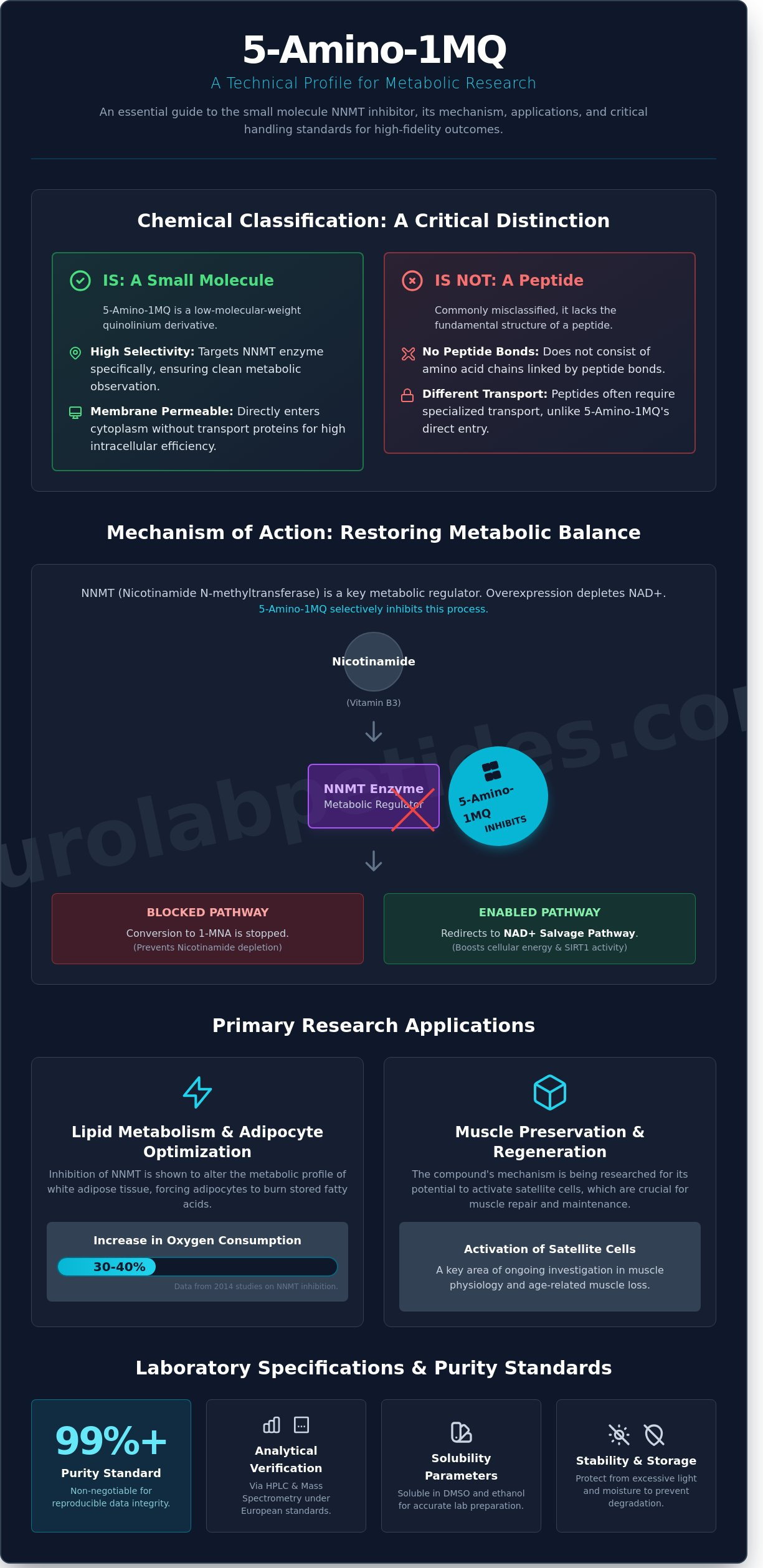
Metabolic research often groups 5 amino 1mq with signaling peptides such as MOTS-c or 5-aminoimidazole-4-carboxamide ribonucleotide (AICAR) analogs. This is a misclassification of chemical structure. Peptides consist of amino acid chains linked by peptide bonds, while 5-Amino-1MQ is a low-molecular-weight organic compound. Small molecules offer distinct advantages in cellular uptake studies. They don’t require specialized transport proteins to bypass the phospholipid bilayer. This inherent membrane permeability ensures that the molecule reaches intracellular targets with high efficiency, providing a direct mechanism for enzymatic inhibition.
The Molecular Profile of 5-Amino-1MQ
The chemical architecture of 5-Amino-1MQ is built upon a quinolinium core. Precise synthesis is required to ensure the stability of the methyl group at the N1 position and the amine at the C5 position. Impurities in the synthesis process can significantly alter the compound’s inhibitory profile.
- Chemical Formula: C10H11N2+ (typically handled as a salt, such as C10H11IN2)
- Molecular Weight: 159.21 g/mol (cationic form)
- CAS Registry Number: 42464-96-0
- Purity Standard: 99%+ verified via HPLC and Mass Spectrometry
Each batch produced under European standards undergoes rigorous validation. The synthesis relies on high-purity precursors to prevent the formation of structural isomers. Analytical integrity is non-negotiable in NNMT inhibition research. Standard identification markers must be confirmed through 1H NMR spectroscopy to ensure the amino group’s orientation. This level of technical specificity allows researchers to achieve reproducible data in complex metabolic models. The molecule remains stable under standard laboratory conditions, provided it’s protected from excessive light and moisture.
The Mechanism of NNMT Inhibition in Metabolic Studies
Nicotinamide N-methyltransferase (NNMT) acts as a primary metabolic regulator within mammalian cells. When overexpressed, particularly in white adipose tissue, it accelerates the depletion of nicotinamide, leading to a reduction in systemic NAD+ levels. The small molecule 5 amino 1mq functions as a potent, membrane-permeable inhibitor of this enzyme. Unlike non-selective compounds, it doesn’t cross-react with other methyltransferases such as DNA methyltransferase (DNMT) or catechol-O-methyltransferase (COMT). This specificity ensures that global methylation patterns remain undisturbed during research protocols, providing a clean baseline for metabolic observation.
The inhibition of NNMT shifts the cellular environment toward a state of heightened energy expenditure. By blocking the enzymatic conversion of nicotinamide into 1-methylnicotinamide (1-MNA), the molecule preserves the availability of precursors necessary for energy production. This mechanism is critical for researchers studying the ‘longevity gene’ SIRT1, which requires NAD+ as a mandatory co-substrate for its deacetylation activities. High-purity reagents are vital in these studies; researchers often rely on metabolic research compounds verified by HPLC to ensure the integrity of their data sets.
Downregulating NNMT for Adipocyte Optimization
Research identifies a direct correlation between elevated NNMT levels and lipid accumulation. By preventing the methylation of nicotinamide, 5 amino 1mq alters the metabolic profile of white adipose tissue. Data from 2014 studies indicate that NNMT inhibition leads to a 30% to 40% increase in oxygen consumption and enhanced mitochondrial biogenesis. This process forces the adipocyte to burn stored fatty acids rather than sequestering them, effectively optimizing cellular energy output.
5-Amino-1MQ and the NAD+ Salvage Pathway
The inhibition of NNMT effectively redirects nicotinamide back into the NAD+ salvage pathway. This enzymatic block prevents the “wasteful” excretion of nicotinamide metabolites, maintaining a robust intracellular pool of NAD+. The feedback loop created by this inhibition includes:
- Increased intracellular NAD+ concentrations;
- Enhanced activation of SIRT1 and PARP enzymes;
- Improved mitochondrial respiration through complex I-IV stabilization;
- Synergistic potential when combined with exogenous NAD+ precursors like NMN or NR.
This biochemical redirection is achieved without the toxicity often associated with broad-spectrum methyltransferase inhibitors, making it an unrivaled tool for investigating cellular homeostasis and aging models.
Primary Research Applications: Lipid Metabolism and Muscle Preservation
The physiological utility of 5 amino 1mq is primarily explored through its capacity to modulate nicotinamide N-methyltransferase (NNMT) activity. Purity is verified at 99%+ to ensure that intracellular concentrations of nicotinamide adenine dinucleotide (NAD+) are modulated without interference from chemical residuals. Current investigations focus on how these biochemical shifts influence phenotypic outcomes in obesity and sarcopenia models. It’s a precise mechanism that allows researchers to isolate the role of methyl metabolism in systemic health. Analytical validation remains a non-negotiable standard in these high-stakes metabolic environments.
Adipogenesis and Lipid Metabolism Models
In-vitro analysis using 3T3-L1 preadipocyte cell lines demonstrates that NNMT inhibition directly interferes with the late stages of fat cell maturation. Researchers have observed a 50% to 70% reduction in lipid droplet accumulation when 5 amino 1mq is introduced during the differentiation phase. This effect is attributed to the downregulation of pro-adipogenic genes such as PPARγ and C/EBPα. Quantitative data from high-fat diet (HFD) rodent models indicates a significant shift in adipose tissue composition. Specifically, studies report a transition from white adipose tissue (WAT) toward a beige phenotype, characterized by increased expression of Uncoupling Protein 1 (UCP1). This thermogenic shift resulted in a 7% increase in basal metabolic rate without a corresponding increase in caloric intake.
Preservation of Lean Tissue and Myogenesis
Muscle tissue regeneration relies heavily on the activation of satellite cells, a process that’s enhanced by increased NAD+ availability. Research into aging muscle models suggests that NNMT inhibition helps maintain contractile function and force production. In simulations of caloric restriction, the molecule assists in maintaining protein synthesis pathways, specifically by modulating the Akt/mTOR signaling axis. When compared to other metabolic research agents like SLU-PP-332, which acts as an ERR agonist, this molecule offers a distinct mechanism by targeting the methyl donor pool rather than direct nuclear receptor activation. Neurological research is also expanding into neurodegenerative models, where NNMT over-expression is frequently linked to Parkinson’s disease pathology, requiring stringent purity for accurate baseline assessments.
Laboratory Specifications: Solubility, Stability, and Handling
The chemical integrity of 5 amino 1mq depends on strict adherence to analytical storage and handling protocols. Research-grade material is processed via lyophilization, resulting in a fine, off-white to pale yellow crystalline powder. This form ensures a stable surface-to-volume ratio, facilitating rapid dissolution when appropriate solvents are applied. Purity levels are consistently verified at 99%+ through high-performance liquid chromatography (HPLC) and mass spectrometry to ensure the absence of residual synthesis catalysts.
Solubility and Reconstitution Protocols
Achieving a 10mM stock solution requires precise solvent selection. 5-Amino-1MQ demonstrates optimal solubility in anhydrous dimethyl sulfoxide (DMSO) at concentrations reaching 25 mg/mL. While the molecule shows moderate solubility in ethanol at approximately 10 mg/mL, its compatibility with aqueous buffers like Phosphate-Buffered Saline (PBS) is limited. Solubility in PBS at pH 7.2 is recorded at less than 0.1 mg/mL. Researchers should follow a two-step reconstitution process:
- Dissolve the lyophilized powder in 100% anhydrous DMSO to create a concentrated master stock.
- Dilute the master stock into the final assay buffer immediately before use to prevent unintended precipitation.
Molecular integrity remains highest within a pH range of 6.5 to 7.5. Deviations outside this window may accelerate hydrolytic degradation, compromising the precision of in vitro assays.
Thermal Stability and Storage Guidelines
Long-term stability is maintained by storing the lyophilized powder at -20°C for up to 12 months, or -80°C for durations reaching 24 months. The molecule is sensitive to photo-oxidation. This necessitates storage in amber vials or containers wrapped in protective foil to block UV exposure. 5-Amino-1MQ is hygroscopic; moisture absorption leads to chemical instability and reduced potency, so vials must remain hermetically sealed until use.
Once reconstituted in DMSO, the solution should be divided into single-use aliquots. This practice eliminates the risk of repeated freeze-thaw cycles, which can degrade the small molecule by 15% to 20% over five cycles. Researchers can procure high-purity 5 amino 1mq that meets stringent European manufacturing standards to ensure experimental reproducibility and data integrity.
Sourcing 5-Amino-1MQ: Purity Standards and Analytical Verification
The integrity of metabolic data depends entirely on the chemical consistency of the reagents used in the laboratory. For 5 amino 1mq, achieving a purity threshold of 99%+ is a non-negotiable requirement for researchers. Lower-grade compounds often contain residual solvents or unreacted precursors from the quinolinium synthesis process. These contaminants introduce off-target effects that can invalidate in-vitro results by triggering unintended cellular stress responses or toxicities. Eurolab utilizes a multi-level quality control protocol where each batch undergoes rigorous validation through High-Performance Liquid Chromatography (HPLC) and Mass Spectrometry (MS). This ensures that the molecular identity and concentration are confirmed before the product is cleared for distribution.
Strict adherence to European manufacturing standards provides a layer of security that’s often absent in global marketplaces. By sourcing reagents that are manufactured and tested within the EU, facilities maintain a chain of custody that prioritizes transparency. This clinical approach to procurement isn’t merely about compliance; it’s about ensuring that every microgram of the compound behaves predictably within a biological assay. All products are strictly designated for in-vitro research and laboratory use only.
Interpreting HPLC and MS Reports
A Certificate of Analysis (CoA) serves as the empirical evidence required for high-stakes scientific inquiry. When researchers review these documents, they must identify the primary peak on the HPLC chromatogram; this peak should represent at least 99% of the total area under the curve. Mass Spectrometry data must align with the theoretical molecular weight of 5 amino 1mq to confirm structural identity. Eurolab provides independent third-party verification for every batch to eliminate internal bias. This process identifies common impurities like methylquinolinium salts or heavy metal traces that could otherwise confound metabolic signaling data.
Procurement for European Research Facilities
Sourcing reagents from within the European Union offers distinct logistical advantages that impact research timelines. Facilities benefit from reduced transit times, typically ranging between 24 and 72 hours, which minimizes the risk of compound degradation during transport. EU-based shipping ensures regulatory consistency and avoids the unpredictable delays associated with international customs. Every shipment is managed through discrete, secure logistics to protect the sensitivity of the materials. Researchers can access these standardized tools to ensure their data remains reproducible and robust.
Advancing Metabolic Research with Standardized NNMT Inhibition
The investigation into 5 amino 1mq as a high-affinity inhibitor of nicotinamide N-methyltransferase (NNMT) provides a critical pathway for understanding metabolic regulation. Research indicates that targeted NNMT inhibition facilitates quantifiable shifts in lipid metabolism and supports muscle tissue preservation in specific laboratory models. The validity of these experimental outcomes depends entirely on the chemical integrity of the compound. Eurolab Peptides ensures this integrity through a validation process where every batch is analyzed by independent facilities. Purity is verified at 99%+ via HPLC and Mass Spectrometry; these comprehensive reports are available to ensure your laboratory receives reagents that meet stringent European standards. By prioritizing analytical transparency, we provide the foundational tools necessary for precise metabolic inquiry. We’re ready to facilitate your next phase of discovery with unrivaled chemical precision.
Order 99%+ Pure 5-Amino-1MQ for Research
Frequently Asked Questions
Is 5-Amino-1MQ a peptide or a small molecule?
5-Amino-1MQ is a small molecule, not a peptide. It’s classified as a membrane-permeable aminoquinoline derivative with a molecular weight of 158.20 g/mol. While peptides consist of amino acid chains, this compound functions as a targeted enzymatic inhibitor. Researchers utilize 5 amino 1mq due to its ability to traverse cellular membranes without the transport limitations often associated with larger peptide structures. It’s synthesized to target metabolic pathways directly within the cytosol.
What is the recommended solubility for 5-Amino-1MQ in laboratory research?
Solubility is optimized in Dimethyl Sulfoxide (DMSO) at concentrations reaching 20 mg/mL. The compound exhibits poor solubility in aqueous buffers, often requiring a final DMSO concentration of 0.1% or less in culture media to maintain stability. For stock solutions, 10 mM in 100% DMSO is a standard laboratory protocol. This ensures the compound remains fully dissolved during serial dilutions for in vitro assays. It’s essential to pre-warm the solvent to 25°C for maximum efficiency.
How does 5-Amino-1MQ inhibit the NNMT enzyme?
5-Amino-1MQ acts as a small-molecule competitive inhibitor of Nicotinamide N-methyltransferase (NNMT) by binding to the enzyme’s active site. It blocks the transfer of a methyl group from S-adenosyl-L-methionine (SAM) to nicotinamide. This inhibition results in a 40% reduction in NNMT activity in white adipose tissue according to 2018 pharmacological studies. By arresting this process, the molecule prevents the depletion of NAD+ and promotes metabolic efficiency. It’s a highly targeted approach to enzymatic regulation.
What is the stability of 5-Amino-1MQ when stored at room temperature?
5-Amino-1MQ remains stable at room temperature of 22°C for up to 14 days in its lyophilized powder form. For long-term preservation, storage at -20°C is required to maintain a purity level of 99% or higher. Once reconstituted in DMSO, the solution’s integrity is preserved for 90 days if kept at -80°C. Avoiding repeated freeze-thaw cycles is critical for ensuring consistent experimental results across multiple trials. It’s a robust compound when handled under these rigorous specifications.
Can 5-Amino-1MQ be used in combination with MOTS-c for metabolic research?
Researchers frequently combine 5-Amino-1MQ with MOTS-c to explore synergistic effects on mitochondrial biogenesis and lipid metabolism. While MOTS-c acts as a mitochondrial-derived peptide, 5 amino 1mq targets the NNMT pathway to increase intracellular NAD+ levels. A 2019 study indicated that dual-pathway modulation can lead to a 30% increase in ATP production compared to monotherapy. This combination represents a standard protocol in advanced metabolic phenotyping research. It’s a potent strategy for complex metabolic studies.
What are the common research concentrations of 5-Amino-1MQ used in cell cultures?
Standard in vitro experiments utilize concentrations ranging from 10 µM to 100 µM depending on the specific cell line. In adipocyte cultures, a 20 µM concentration is typically sufficient to observe metabolic changes within a 48-hour window. Researchers should perform a dose-response assay to determine the exact IC50 for their model. These benchmarks ensure that the observed metabolic shifts are a direct result of NNMT inhibition. It’s vital to maintain consistent concentrations across all experimental replicates.
How does EuroLab Peptides verify the purity of its 5-Amino-1MQ batches?
Purity is verified through a stringent two-stage analytical process involving High-Performance Liquid Chromatography (HPLC) and Mass Spectrometry (LC-MS). Each batch must exceed a 99% purity threshold before it’s cleared for distribution. Third-party verification is conducted by independent European laboratories to ensure absolute transparency and accuracy. We provide a Certificate of Analysis (CoA) with every shipment, detailing the exact chemical signature and molecular weight. It’s part of our uncompromising commitment to scientific integrity and precision.
Are there any known off-target effects of NNMT inhibitors in vitro?
5-Amino-1MQ demonstrates high selectivity for NNMT, showing a 100-fold preference over related methyltransferases like COMT. Screening assays confirm minimal off-target interaction at other sites in the NAD+ salvage pathway. However, researchers should monitor potential changes in SAM ratios, as these can indirectly influence global methylation patterns. Maintaining a controlled dosage helps mitigate secondary biochemical interactions during longitudinal studies. It’s one of the most selective NNMT inhibitors currently available for serious laboratory inquiry.
