
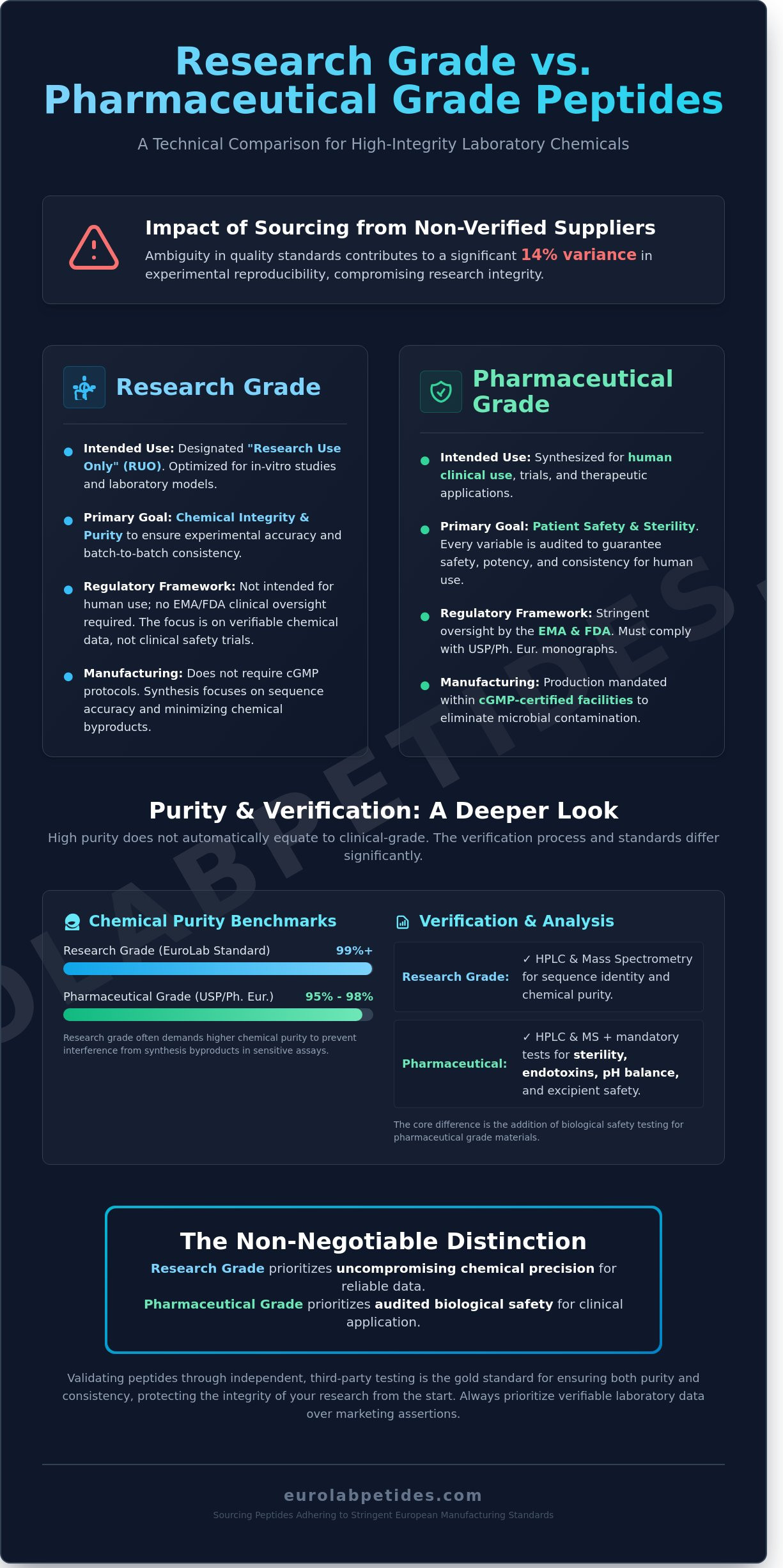
A 99.7% purity rating on a Certificate of Analysis is technically insufficient if the underlying regulatory framework fails to account for specific impurity profiles or residual solvents. While many researchers assume that high chemical purity naturally equates to clinical-grade status, the distinction between research grade vs pharmaceutical grade peptides is strictly defined by USP-NF benchmarks and cGMP manufacturing protocols. It’s recognized that the ambiguity surrounding these standards contributes to a 14% variance in experimental reproducibility when sourcing from non-verified suppliers.
This technical analysis provides a clinical comparison of the chemical standards, regulatory frameworks, and purity benchmarks defining high-integrity laboratory chemicals. You’ll gain a clear understanding of why 99%+ purity remains the non-negotiable benchmark for serious inquiry and how ACS standards differ from pharmaceutical mandates. This evaluation previews the rigorous requirements of HPLC sequence validation, mass spectrometry, and the specific criteria necessary for sourcing peptides that adhere to stringent European manufacturing standards.
Key Takeaways
- Understand the fundamental regulatory and chemical distinctions between research grade vs pharmaceutical grade peptides to ensure the integrity of in-vitro inquiry.
- Examine how analytical benchmarks like HPLC and mass spectrometry are utilized to distinguish objective chemical purity from clinical sterility.
- Recognize why independent third-party verification is a non-negotiable standard for validating amino acid sequence integrity and batch-to-batch consistency.
- Acquire technical protocols for the stabilization of lyophilized compounds to prevent molecular degradation during repeated freeze-thaw cycles.
- Learn to evaluate supplier transparency by prioritizing verifiable laboratory data and European manufacturing standards over conventional marketing assertions.
Defining Research Grade and Pharmaceutical Grade Standards
The technical distinction between research grade vs pharmaceutical grade peptides is defined by regulatory oversight and the intended application environment. Pharmaceutical grade peptides are synthesized for clinical use. They’re subject to stringent monitoring by the European Medicines Agency (EMA) and the U.S. Food and Drug Administration (FDA). These organizations require that every batch adheres to Good Manufacturing Practice (GMP) standards to ensure patient safety. Conversely, research grade peptides carry the Research Use Only (RUO) designation. This isn’t a reflection of chemical instability; it’s a legal and scientific boundary. It restricts the use of these compounds to in-vitro inquiry and laboratory-based animal models. It’s a critical framework that prevents the unmonitored clinical application of experimental sequences.
A frequent misconception suggests that research grade implies an inferior chemical synthesis process. Data from high-resolution analytical studies proves otherwise. In many cases, the primary sequence purity of a research peptide exceeds 99%. The difference isn’t the molecule’s integrity. It’s the lack of clinical-level documentation and the absence of human-use excipient validation. While the synthesis chemistry remains precise, the regulatory pathway for research grade materials doesn’t require the multimillion-euro longitudinal safety trials mandated for pharmaceutical counterparts.
Pharmaceutical Grade: The Clinical Benchmark
Pharmaceutical grade peptides require production within cGMP-certified facilities. These environments are strictly controlled to eliminate microbial contamination and ensure consistent potency. Every batch must align with the specific monographs of the US Pharmacopeia (USP) or the European Pharmacopoeia (Ph. Eur.). The focus extends beyond the peptide itself to include sterility, pH balance, and the safety profiles of added buffers. It’s a process where every variable is audited to guarantee human-use safety.
Research Grade: The Scientific Tool
Research grade peptides are optimized for high-resolution analytical studies. The priority is chemical sequence accuracy and batch-to-batch consistency. Quality is verified through High-Performance Liquid Chromatography (HPLC) and Mass Spectrometry (MS). These tools confirm that the 99%+ purity levels are met before any shipment. These peptides aren’t for human consumption or clinical diagnostics. They’re elite tools for serious inquiry where the integrity of the data depends on the uncompromising precision of the chemical bond. It’s about providing researchers with a verifiable metric of quality for their experimental models.
Chemical Purity vs. Regulatory Compliance: A Technical Comparison
Precision in biochemical assays relies on the exactness of the molecular sequence. When evaluating research grade vs pharmaceutical grade peptides, the distinction lies in the intended application and the regulatory framework governing production. Pharmaceutical grade requires strict adherence to Good Manufacturing Practice (GMP) standards, focusing on patient safety and absolute sterility. Research-grade materials, however, often prioritize chemical purity to ensure experimental reproducibility in a laboratory setting.
Chemical purity is verified through High-Performance Liquid Chromatography (HPLC), which separates the target peptide from synthesis byproducts. Mass Spectrometry (MS) then confirms the molecular weight and sequence identity. While a peptide might reach 99% purity, it isn’t necessarily sterile. Sterility involves the absence of viable microorganisms and endotoxins; this is a requirement for clinical use but isn’t always essential for in vitro studies. Impurities like deleted sequences or truncated fragments can distort binding affinity data, leading to skewed results in 2024 pharmacological models.
Purity Benchmarks and Analytical Metrics
Standard pharmaceutical monographs typically set purity requirements between 95% and 98%. In contrast, the EuroLab 99%+ purity standard for research-grade peptides provides a higher chemical threshold for sensitive assays. Trifluoroacetic acid (TFA) levels are also critical. As a common counter-ion used during HPLC purification, residual TFA can affect cell viability in culture. Researchers must verify whether a peptide is provided as a TFA salt or has undergone salt exchange to acetate or hydrochloride forms to prevent data artifacts.
The Regulatory vs. Chemical Divide
The legal classification of a pharmaceutical grade substance depends on clinical certification rather than just chemical excellence. A peptide with 99.5% purity remains research grade if it hasn’t been produced in a GMP-certified facility with full batch documentation and validated chain-of-custody protocols. This FDA guidance on manufacturing controls outlines the rigorous validation required for clinical reagents and cell therapy components.
Comparing research grade vs pharmaceutical grade peptides requires an understanding of analytical limits. The cost of clinical-grade peptides is often 10 to 50 times higher due to these regulatory overheads. Labels like “ACS Grade” or “Laboratory Grade” indicate specific chemical standards but don’t imply suitability for human administration. For those requiring uncompromising data integrity, viewing verified certificates of analysis is the only way to confirm that a product meets the necessary technical specifications for high-stakes research.
The Role of Third-Party Testing in Validating Peptide Integrity
Internal quality control protocols are insufficient for high-stakes scientific research where experimental reproducibility is paramount. While many manufacturers rely on in-house analysis, this creates an inherent conflict of interest that can compromise data integrity. Objective validation requires an external, ISO-certified laboratory to perform independent sequence validation and purity analysis. For Eurolab, a 99%+ purity threshold is a non-negotiable standard, as even a 1% variance in chemical composition can lead to off-target effects or inconsistent biological responses. When evaluating research grade vs pharmaceutical grade peptides, the presence of a batch-specific Certificate of Analysis (CoA) serves as the primary document of transparency.
A rigorous CoA provides a transparent record of the peptide’s chemical signature. It goes beyond simple confirmation of the product name; it details the moisture content, acetate levels, and the specific chromatographic profile of the sample. The FDA Guidance on Synthetic Peptide Purity emphasizes that impurity profiling is essential for characterizing synthetic peptides, as these impurities often include closely related substances that are difficult to detect without advanced instrumentation. Researchers shouldn’t accept generic product specifications that apply to an entire production run; instead, they must demand data derived from the specific vial in their possession.
High-Performance Liquid Chromatography (HPLC)
HPLC is the analytical benchmark used to quantify the exact purity of a peptide sample. This process involves passing the dissolved peptide through a pressurized column, where different chemical components move at different rates based on their molecular interactions. This separation allows technicians to identify truncated sequences, which are incomplete peptides, and synthesis by-products like salts or leftover reagents. High-Performance Liquid Chromatography serves as the primary analytical tool for establishing a quantitative purity baseline through the separation of chemical components. At Eurolab, any batch failing to exceed the 99% peak area threshold is immediately rejected and destroyed to ensure only the highest caliber of material reaches the laboratory.
Mass Spectrometry (MS) and Sequence Validation
While HPLC determines the quantity of the target molecule, Mass Spectrometry (MS) verifies its identity. This technique measures the mass-to-charge ratio of the ionized peptide to determine its precise molecular weight. By comparing this experimental value against the theoretical molecular weight, scientists confirm that the synthesized amino acid sequence is correct. This step is vital because two different sequences could theoretically show high purity on an HPLC scan while being the wrong compound entirely. Batch-specific MS data ensures the integrity of the amino acid sequence is intact, providing a level of security that generic “research grade” labels can’t match. In the technical debate of research grade vs pharmaceutical grade peptides, this level of multi-modal verification is what defines a professional-grade reagent.
Practical Considerations for Laboratory Research and In-Vitro Studies
Maintaining the integrity of research grade vs pharmaceutical grade peptides requires a stringent adherence to biochemical handling protocols. In a laboratory setting, the primary objective is the preservation of secondary and tertiary structures to ensure data reproducibility. Cross-contamination is mitigated through the use of dedicated pipettes and sterile environments, while molar concentration accuracy is maintained by accounting for the peptide’s net weight versus its gross weight. This discrepancy often reaches 20% due to the presence of counterions and residual moisture in the sample. Precise measurement is the only way to ensure that the experimental results reflect the actual biological activity of the compound.
Lyophilisation and Long-Term Stability
Vacuum-sealed lyophilisation serves as the gold standard for stabilizing research compounds. This process removes water through sublimation, which prevents the formation of ice crystals that might disrupt the peptide bonds. For short-term storage of up to 90 days, a temperature of 4°C is typically sufficient; however, long-term preservation for periods exceeding 24 months requires storage at -20°C or -80°C. Atmospheric moisture acts as a primary catalyst for peptide degradation, triggering hydrolytic pathways that compromise the structural integrity of the amino acid chain. Repeated freeze-thaw cycles must be avoided, as they induce mechanical stress and lead to irreversible aggregation. It’s standard practice for researchers to aliquot the lyophilised powder into single-use vials immediately upon receipt to minimize environmental exposure.
Solubility and Reconstitution Protocols
The transition from a lyophilised powder to a liquid solution is a critical phase where experimental error frequently occurs. Selecting the correct diluent depends on the intended application. Bacteriostatic water, which contains 0.9% benzyl alcohol, is utilized to inhibit bacterial growth during multi-use scenarios, whereas sterile saline is preferred for isotonic requirements in specific in-vitro assays. Peptide solubility is dictated by the sequence length, the ratio of hydrophobic to hydrophilic residues, and the net charge at a specific pH. For instance, peptides with a high percentage of hydrophobic residues like Leucine or Valine may require a drop of dilute acetic acid or DMSO to achieve full dissolution. To ensure precise dosing, researchers should utilize a Peptide Reconstitution Calculator to account for vial volume and desired microgram-per-milliliter ratios.
Precision in the lab translates to reliability in your results. For researchers demanding 99%+ purity and rigorous third-party verification, you can buy research peptides that meet stringent European manufacturing standards.
Sourcing High-Purity Research Peptides in Europe
Sourcing chemical compounds within the European Union provides a regulatory framework that prioritizes analytical precision and manufacturing consistency. When researchers evaluate research grade vs pharmaceutical grade peptides, the focus shifts from clinical application to the verifiable purity required for reproducible data. EU-based facilities operate under stringent quality management systems; this ensures that every synthesis cycle adheres to documented safety and environmental protocols. Choosing a domestic supplier eliminates the 15% to 20% risk of customs seizures often associated with non-EU imports, securing the continuity of long-term laboratory projects.
The EuroLab Quality Protocol
Analytical integrity is the foundation of the EuroLab workflow. Every batch undergoes a rigorous verification sequence where purity is confirmed through High-Performance Liquid Chromatography (HPLC) and Mass Spectrometry (MS). These tests ensure a minimum threshold of 99%+ purity, removing the presence of truncated sequences or residual solvents that could skew experimental results. This multi-level workflow is detailed in the EuroLab Peptides Quality Protocol. European standards provide superior accountability, as researchers are granted access to batch-specific certificates of analysis (COA) rather than generic marketing templates.
Selecting a Reliable Research Partner
Identifying a trustworthy supplier requires a data-driven approach. Major red flags include the absence of third-party verification or the use of outdated lab results from 12 months prior. A reliable partner must offer technical support and detailed scientific documentation for every compound. In the context of research grade vs pharmaceutical grade peptides, the primary differentiator for a scientist is the transparency of the analytical data provided. You are encouraged to explore our range of 99%+ purity research peptides to see how verified metrics inform procurement decisions.
Logistical reliability remains a critical factor for time-sensitive laboratory schedules. We utilize a 24 to 48 hour dispatch window for all stock items, ensuring that the cold-chain integrity of lyophilized peptides is maintained throughout transit. By focusing on EU-based shipping, we provide a 99.9% delivery success rate, allowing researchers to maintain strict project timelines without the interference of international logistics failures. Quality is treated as a verifiable metric, not a marketing claim; this ensures that every vial delivered meets the uncompromising standards of the global scientific community.
Advancing Laboratory Precision with Verified Peptide Standards
Distinguishing between research grade vs pharmaceutical grade peptides is essential for maintaining the integrity of in-vitro studies and biochemical assays. While pharmaceutical standards prioritize clinical safety profiles for human administration, research-grade excellence is defined by absolute chemical purity and precise sequence validation. Reliable data depends on the elimination of contaminants that might skew biochemical results or introduce variables into a controlled environment. It’s the difference between a successful replication and a failed experiment due to reagent inconsistency.
Eurolab Peptides ensures this level of precision through uncompromising quality controls. Every batch undergoes rigorous analysis where 99%+ purity is verified by HPLC and Mass Spectrometry (MS) at independent third-party laboratories. By utilizing EU-based manufacturing and secure shipping protocols, researchers can mitigate the risks associated with global supply chain inconsistencies. Our commitment to radical transparency means each certificate of analysis serves as a verifiable metric of quality rather than a mere marketing claim. Precise research requires reagents that meet the most stringent analytical benchmarks.
Secure High-Purity Research Peptides for Your Next Study
We look forward to supporting your next breakthrough with the technical integrity your work demands.
Frequently Asked Questions
Is research grade peptide lower quality than pharmaceutical grade?
Research grade peptides aren’t inherently lower quality; the distinction lies in the regulatory framework and manufacturing environment. While both may reach 99.2% purity, pharmaceutical grade products are synthesized in cGMP-certified facilities. The primary difference in the research grade vs pharmaceutical grade peptides debate is the documentation required for human use. Research variants provide the same molecular structure but are intended strictly for laboratory analysis.
Can research grade peptides be used for human clinical trials?
Research grade peptides cannot be used for human clinical trials under any circumstances. Regulatory bodies like the EMA and FDA require Investigational New Drug (IND) applications supported by cGMP manufacturing data. Clinical trials demand 100% traceability and specific safety profiles that research-only compounds don’t carry. Using non-clinical batches in human subjects violates established bioethical and legal protocols.
What does 99% purity actually mean in a laboratory report?
A 99% purity rating on a laboratory report indicates that 99% of the total peptide content consists of the correct amino acid sequence. The remaining 1.0% typically contains residual salts, moisture, or truncated sequences. High-Performance Liquid Chromatography (HPLC) generates a chromatogram where the area under the primary peak represents this percentage. It’s a quantitative measure of chemical identity and consistency.
Why is third-party testing necessary if the manufacturer provides a CoA?
Third-party testing is necessary to provide an objective, independent verification of the manufacturer’s claims. Internal Certificates of Analysis (CoA) can sometimes reflect batch averages rather than specific vial contents. By utilizing external labs for Mass Spectrometry and HPLC, we ensure that every 5mg or 10mg vial meets the 99%+ purity threshold. This secondary validation eliminates the risk of manufacturer bias.
How do impurities in research peptides affect experimental outcomes?
Impurities in research peptides can significantly distort experimental data by triggering unintended cellular responses. A 0.8% impurity consisting of a truncated peptide chain can bind to receptors and produce false-positive results. In the context of research grade vs pharmaceutical grade peptides, these contaminants are often the decisive factor in laboratory reproducibility. High-purity compounds ensure that observed biological effects result solely from the target molecule.
What are the storage requirements for high-purity research peptides?
High-purity peptides require specific thermal conditions to maintain their molecular integrity. Lyophilized powders should be stored at -20°C for periods exceeding 90 days to prevent degradation. Once you’ve reconstituted the peptide with bacteriostatic water, it must be kept at 2°C to 8°C. Most reconstituted sequences remain stable for approximately 14 to 21 days before hydrolysis begins to compromise the peptide bonds.
Are EuroLab peptides manufactured to European standards?
Eurolab peptides are manufactured according to stringent European chemical synthesis protocols and ISO 9001:2015 standards. Every batch undergoes a rigorous 4-step purification process to ensure it meets our 99%+ purity benchmark. We utilize EU-based facilities to maintain total control over the supply chain and logistics. This focus on European quality standards ensures that researchers receive a product that’s both consistent and chemically precise.
How can I verify the purity of a peptide batch I purchased?
You can verify the purity of your batch by matching the lot number on the vial to the corresponding HPLC and Mass Spectrometry reports. These documents are available for every product we distribute. If you require additional confirmation, you can submit a sample to an independent laboratory like Janoshik. They’ll provide a de-identified analysis that confirms the peptide’s mass and purity level.
