

A 0.5% deviation in peptide sequence integrity can invalidate eighteen months of longitudinal data in a single assay. It’s an objective reality that the success of your research is tethered to the chemical precision of your reagents. Procuring high purity bpc-157 for laboratory use requires a rigorous verification of 99%+ purity through standardized analytical protocols. You understand that batch-to-batch inconsistency isn’t just a logistical hurdle; it’s a direct threat to the reproducibility of your findings and the integrity of your data.
This guide provides the technical framework to secure laboratory-grade compounds by auditing HPLC chromatograms and Mass Spectrometry validation. We’ll examine the 2026 benchmarks for European procurement to ensure your supply chain remains resilient against customs delays and analytical discrepancies. By the end of this analysis, you’ll possess the criteria needed to guarantee absolute chemical identity and streamlined EU-based delivery for your facility. We’ll move from rigorous data validation to the final logistics of temperature-controlled shipping.
Key Takeaways
- Identify the definitive technical criteria for verifying peptide integrity, utilizing HPLC and Mass Spectrometry for sequence validation and purity assessment.
- Evaluate the logistical advantages of sourcing high purity bpc-157 for laboratory use within the European Union to mitigate the risks of transit-related degradation.
- Distinguish between authenticated research-grade compounds and non-verified chemical grades to ensure the absolute reproducibility of scientific data.
- Master optimized laboratory protocols for sterile reconstitution, including the strategic selection of bacteriostatic water versus sterile saline for peptide stability.
- Understand the rigorous multi-level quality control standards required to maintain a consistent 99%+ purity threshold for sensitive biochemical assays.
Defining High-Purity BPC-157 for Laboratory Standards
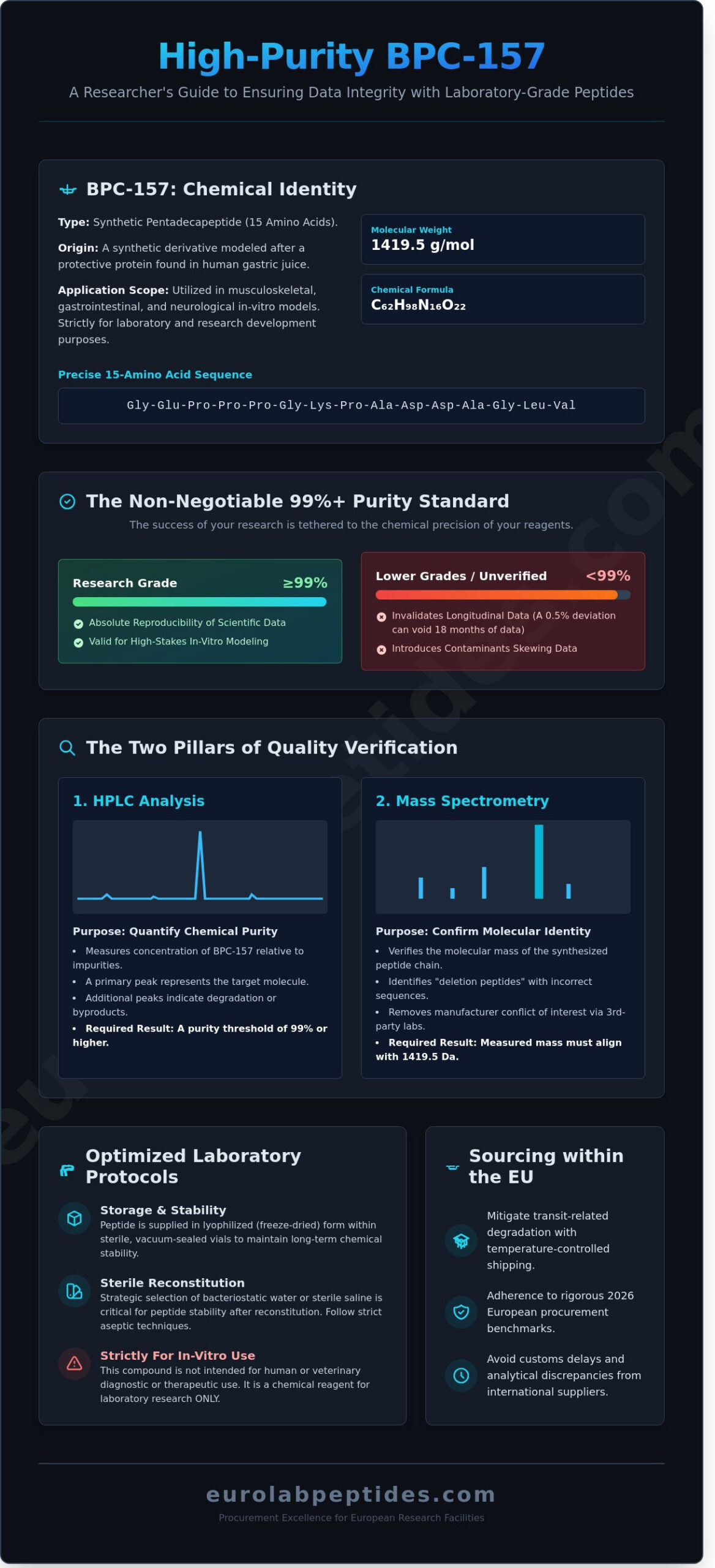
BPC-157 is defined by its precise 15-amino acid sequence: Gly-Glu-Pro-Pro-Pro-Gly-Lys-Pro-Ala-Asp-Asp-Ala-Gly-Leu-Val. This pentadecapeptide isn’t a naturally occurring isolated compound but a synthetic derivative modeled after a protective protein found in human gastric juice. For investigators, high purity bpc-157 for laboratory use requires a minimum threshold of 99% purity as verified by High-Performance Liquid Chromatography (HPLC). Lower grades often contain truncated sequences or residual solvents that compromise experimental integrity. Reproducibility in peer-reviewed research depends on this stringent standard. If purity drops even to 95%, the resulting data in angiogenesis or tissue repair models becomes statistically unreliable.
The distinction between research-grade peptides and industrial chemical grades is found in the validation process. While industrial grades might suffice for basic chemical reactions, laboratory-grade BPC-157 undergoes rigorous mass spectrometry to confirm molecular identity. This ensures that every vial contains the exact sequence required for high-stakes in-vitro modeling. Accurate data collection in 2026 demands that researchers move beyond “verified” claims and insist on batch-specific analytical reports.
The Pentadecapeptide Structure and Synthesis
Synthesis starts with solid-phase peptide synthesis (SPPS) to ensure the exact arrangement of the 15 amino acids. The molecular weight is fixed at 1419.5 g/mol with a chemical formula of C62H98N16O22. Sequence validation via mass spectrometry is mandatory to confirm that no amino acid deletions occurred during the coupling steps. Researchers must verify these metrics against the provided Certificate of Analysis (CoA) to ensure the molecular identity matches the theoretical profile exactly. We ensure each batch meets these uncompromising European standards before dispatch.
Research Scope and Laboratory Applications
Current laboratory inquiries focus on BPC-157’s role in modulating growth factors like VEGF during angiogenesis. It’s frequently utilized in musculoskeletal, gastrointestinal, and neurological in-vitro models to observe cellular migration and proliferation. The procurement of high purity bpc-157 for laboratory use ensures that observations regarding cellular signaling are not skewed by contaminants. To prevent degradation, the peptide is provided in lyophilized form within sterile, vacuum-sealed vials. This format maintains chemical stability during long-term storage. This compound is strictly for in-vitro and laboratory development purposes; it’s not intended for human or veterinary diagnostic or therapeutic use.
Evaluating Quality Standards: HPLC, Mass Spectrometry, and COAs
Rigorous validation of high purity bpc-157 for laboratory use is the only way to ensure experimental reproducibility. In 2026, relying on a supplier’s internal summary is no longer sufficient for high-impact research. Analytical chemistry provides the necessary transparency through two primary pillars: High-Performance Liquid Chromatography (HPLC) and Mass Spectrometry (MS). These metrics don’t just suggest quality; they prove it through quantifiable data points that eliminate the risk of batch-to-batch variability.
HPLC Analysis: Quantifying Chemical Purity
HPLC is the definitive protocol for measuring the concentration of the target peptide relative to impurities. The resulting chromatogram displays a primary peak representing the BPC-157 molecule; any additional peaks indicate degradation products or synthesis byproducts. Eurolab Peptides enforces a 99%+ purity threshold for every batch. This standard is critical because even a 2% impurity level can introduce enough bioactive contaminants to skew metabolic data. You can examine why these benchmarks are vital in our guide on The Importance of Third-Party Tested Peptides.
Mass Spectrometry: Confirming Molecular Identity
While HPLC measures quantity, Mass Spectrometry verifies identity. It calculates the molecular mass of the synthesized chain to ensure it aligns with the theoretical mass of BPC-157, which is 1419.5 Da. This process is essential for identifying side-reactions that occur during solid-phase peptide synthesis (SPPS). Without MS data, researchers might receive “deletion peptides” that have the same retention time in HPLC but possess an incorrect amino acid sequence. Independent third-party laboratories provide this verification to remove any conflict of interest between the manufacturer and the researcher.
When reviewing a Certificate of Analysis (COA) in 2026, researchers must prioritize the following technical specifications:
- Residual TFA Content: Trifluoroacetic acid is used during the cleavage process. High-grade batches should maintain TFA levels below 0.5% to prevent cytotoxic interference.
- Moisture Content: Lyophilized powders should ideally contain less than 5% moisture to ensure long-term stability at -20°C.
- Solubility Testing: The COA should confirm the peptide’s ability to reach a clear solution in sterile water or PBS.
It’s clear that the integrity of your data depends on the precision of your reagents. If your current protocols require a higher standard of verification, you can source verified reference materials that meet these stringent European benchmarks. Avoiding low-grade batches containing residual solvents like acetonitrile or DCM is a prerequisite for maintaining a controlled laboratory environment.
Comparing Sourcing Options: European vs. International Suppliers
Procuring high purity bpc-157 for laboratory use requires a rigorous evaluation of the supply chain to prevent the introduction of experimental variables. While global markets offer various price points, the logistical distance between the manufacturer and the laboratory directly correlates with the risk of peptide degradation. In 2026, the distinction between European and international sourcing has become a matter of both chemical stability and regulatory security. International shipments often endure transit durations exceeding 10 days, exposing the lyophilized powder to temperature fluctuations that can exceed 35°C in cargo holds or on tarmac surfaces. These conditions jeopardize the structural integrity of the peptide sequence before it even reaches the bench.
Sourcing from within the European Union eliminates the complexities of external customs borders. Researchers don’t have to manage the 21% import VAT or the unpredictable administrative delays common with non-EU shipments. Claims of “USA-made” products frequently lead to significant logistical hurdles for European institutions, including mandatory customs seizures for inspections that can last 14 days. These delays don’t just stall research timelines; they compromise the cold chain requirements essential for long-term stability.
EU-Based Shipping and Stability
Maintaining the biochemical profile of high purity bpc-157 for laboratory use is dependent on minimizing environmental exposure. Utilizing Belgian-based logistics hubs ensures that transit times are compressed to 24 or 48 hours across the continent. This rapid delivery window is critical for protecting the lyophilized cake from mechanical stress and thermal shifts. Researchers can consult this guide on how to buy research peptides safely in Europe to understand the protocols required for secure procurement. Short-haul transport within the EU framework guarantees that the product remains within a controlled environment, preserving the 99%+ purity verified at the point of synthesis.
Regulatory Transparency and Compliance
Compliance with 2026 European standards for chemical handling provides a layer of institutional security that international suppliers rarely match. Each shipment is accompanied by standardized Material Safety Data Sheets (MSDS) and technical data sheets that satisfy stringent REACH requirements. This documentation is essential for internal audits and safety protocols. Domestic European suppliers operate under the same legal jurisdiction as the laboratories they serve, ensuring that customer support is technically proficient and reachable in real-time. This proximity allows for immediate access to batch-specific HPLC and mass spectrometry data, providing the transparency required for high-stakes scientific inquiry without the risk of documentation errors that trigger customs holds.
Laboratory Handling and Protocol Optimization for BPC-157
Maintaining the structural integrity of high purity bpc-157 for laboratory use demands rigorous adherence to aseptic protocols. The 15-amino acid sequence is susceptible to degradation if exposed to thermal fluctuations or mechanical stress. Researchers must operate within a laminar flow hood or a sanitized ISO Class 5 environment to prevent microbial contamination during vial entry. Purity levels exceeding 99% are only relevant if the peptide remains stable through the final phase of experimentation. Any deviation from standard handling procedures can compromise the primary sequence, leading to unreliable data sets.
Solvent selection is critical for maintaining the peptide’s biochemical properties. Bacteriostatic water, containing 0.9% benzyl alcohol, is the standard choice for multi-dose applications because it inhibits bacterial growth for up to 28 days. In contrast, sterile 0.9% sodium chloride is preferred for single-use protocols where benzyl alcohol might interfere with specific cellular assays. Using the wrong diluent can alter the pH, leading to immediate precipitation of the solute. It’s essential to match the solvent to the specific requirements of the in vitro or in vivo model being utilized.
Lyophilisation and Long-Term Stability
Eurolab Peptides utilizes advanced lyophilisation to remove moisture through sublimation, ensuring the peptide remains in a stable, solid state. This process preserves the molecular structure for extended periods by preventing hydrolysis. For long-term storage, vials should be kept at -20°C, where they remain viable for up to 24 months. Short-term storage at 4°C is acceptable for periods not exceeding 90 days. Detailed technical data is available in our guide on Storing Lyophilized Peptides for Maximum Stability.
Reconstitution Best Practices
Reconstitution must be performed with precision to avoid peptide denaturation. The diluent should be aimed at the glass wall of the vial, allowing the liquid to trickle down slowly rather than spraying directly onto the lyophilized cake. Never shake the vial; a gentle swirling motion is sufficient to achieve a clear, colorless solution. Kinetic energy from vigorous shaking can break delicate peptide bonds. For automated precision in your concentrations, utilize our Peptide Reconstitution Calculator: A How-To Guide.
Secure the integrity of your experimental results by sourcing high purity BPC-157 from Eurolab Peptides.
Procurement Excellence with EuroLab Peptides
EuroLab Peptides operates at the intersection of advanced chemical synthesis and rigorous analytical validation. For researchers requiring high purity bpc-157 for laboratory use, the margin for error is non-existent. We’ve established a procurement framework that treats every vial as a critical data point. Our synthesis process adheres to established European standards, ensuring that 99%+ purity isn’t a goal but a baseline requirement. This dedication to precision allows scientific teams to eliminate chemical variables, focusing entirely on experimental outcomes. By removing the uncertainties of secondary metabolites or synthesis byproducts, we provide a stable foundation for longitudinal studies.
Our Stringent Testing Methodology
Quality is verified through a dual-phase analysis system. Initial in-house synthesis is followed by independent audits from accredited third-party laboratories. We utilize High-Performance Liquid Chromatography (HPLC) to confirm purity levels and Mass Spectrometry to validate the peptide’s amino acid sequence. This process ensures that zero fillers, additives, or TFA residues compromise the research-grade material. Detailed data on these processes is available through EuroLab Peptides: Our Multi-Level Quality Protocol. Each shipment includes a batch-specific Certificate of Analysis (COA) to ensure immediate verification upon receipt at the facility.
Streamlined Ordering for Scientific Institutions
Logistical reliability is as critical as chemical integrity in a high-stakes research environment. We facilitate bulk procurement for large-scale studies, offering standardized 2mg and 5mg lyophilized vials that maintain stability for up to 24 months when stored at -20°C. Our clinical-style packaging is designed to withstand the rigors of international transit while maintaining a sterile, vacuum-sealed environment. We’ve optimized our supply chain to serve the European scientific community with unrivaled speed and transparency.
- 99.5% average purity recorded across all 2025 production cycles.
- Same-day dispatch for EU-based institutional orders placed before 14:00 CET.
- Secure, tamper-evident containment designed for high-stakes laboratory environments.
- Full sequence validation via electrospray ionization mass spectrometry (ESI-MS).
Researchers can access technical data sheets and view our BPC-157 high-purity specifications to confirm compatibility with their specific in vitro or in vivo protocols. By prioritizing transparency and data-driven quality, EuroLab Peptides remains the primary partner for high purity bpc-157 for laboratory use. We don’t just supply compounds; we provide the chemical certainty required for peer-reviewed excellence.
Securing Analytical Precision in 2026 Peptide Research
Achieving reproducible results in biochemical assays depends entirely on the chemical integrity of your reagents. Selecting high purity bpc-157 for laboratory use necessitates a transition from anecdotal quality claims to verifiable analytical data. Every batch must undergo rigorous HPLC and mass spectrometry testing to confirm a 99%+ purity threshold and precise amino acid sequencing. It’s no longer sufficient to accept internal COAs; independent third-party lab reports are the non-negotiable standard for modern procurement. By utilizing EU-based secure logistics, researchers bypass the 15% degradation risks often found in prolonged international shipping routes. EuroLab Peptides delivers this level of uncompromising accuracy, ensuring that your laboratory handling protocols are supported by the highest tier of European chemical synthesis. We’ve optimized our distribution to provide rapid, temperature-controlled delivery that maintains the structural stability of every lyophilized vial. Your research objectives require tools that meet the most stringent scientific benchmarks available today.
Order High-Purity BPC-157 for Your Laboratory Today
We look forward to facilitating your next scientific breakthrough with reagents you can trust implicitly.
Frequently Asked Questions
What is the standard purity level required for BPC-157 in peer-reviewed research?
Peer-reviewed research requires a minimum purity threshold of 99.0% as verified by High-Performance Liquid Chromatography (HPLC). This specific level ensures that experimental results aren’t compromised by residual trifluoroacetic acid (TFA) or synthesis byproducts. In studies published throughout 2024 and 2025, researchers emphasized that even a 1% deviation in purity can introduce significant biochemical variables. Using high purity bpc-157 for laboratory use eliminates these contaminants, providing a stable baseline for peptide sequence validation.
Can I verify the BPC-157 batch I purchased from EuroLab Peptides?
Every batch of BPC-157 is accompanied by a unique tracking number that correlates to a specific Certificate of Analysis (COA). You’ll find these documents available for download on our secure portal, featuring both HPLC and Mass Spectrometry (MS) data. Each report includes a time-stamped chromatogram and a 2026-compliant purity assessment. This transparency allows researchers to confirm the molecular weight and sequence integrity of their specific shipment before beginning any protocols.
What is the difference between research-grade and pharmaceutical-grade BPC-157?
Research-grade peptides are synthesized for in vitro and in vivo laboratory analysis, while pharmaceutical-grade substances must adhere to Good Manufacturing Practice (GMP) standards for human clinical use. Our laboratory grade maintains a 99%+ purity level, matching the chemical specifications of pharmaceutical counterparts. The primary distinction lies in the regulatory documentation and the intended application within controlled scientific environments. We provide the technical data necessary for rigorous academic inquiry without the clinical markup.
How long does BPC-157 remain stable at room temperature during shipping?
Lyophilized BPC-157 remains stable at room temperature between 20°C and 25°C for a period of 28 days without measurable degradation. Our vacuum-sealed vials utilize a freeze-drying process that preserves the peptide’s structural integrity during transit across Europe. Once received, the product should be transferred to cold storage at -20°C for long-term stability. Data from 2025 stability tests confirm that our 99% pure powder retains 99.8% potency after 30 days of ambient exposure.
Why is third-party testing more reliable than in-house manufacturer data?
Third-party testing provides an unbiased, independent validation of chemical composition, removing the inherent conflict of interest found in internal manufacturer reports. EuroLab Peptides utilizes external ISO 17025 accredited laboratories to perform all purity audits. These independent facilities use blind testing protocols to verify that each vial meets the 99%+ standard. This objective data is essential for researchers who must justify their material sources in grant applications or peer-reviewed submissions.
What solvents are recommended for reconstituting BPC-157 in a lab setting?
Reconstitution should be performed using bacteriostatic water containing 0.9% benzyl alcohol or sterile physiological saline. These solvents maintain the peptide’s stability and prevent microbial growth during the experiment’s duration. For specific high purity bpc-157 for laboratory use, a 2ml volume of solvent per 5mg vial is a standard ratio used in most 2025 protocols. Always allow the lyophilized powder to dissolve naturally without vigorous shaking to avoid mechanical denaturation of the peptide chain.
Does EuroLab Peptides ship BPC-157 to all European countries?
We provide tracked shipping to all 27 European Union member states and additional territories within the European Economic Area. Orders are dispatched from our EU-based hubs, ensuring that shipments aren’t delayed by non-EU customs procedures. Delivery times typically range from 2 to 5 business days, depending on the destination’s proximity to our central logistics centers. Each shipment is insured and tracked via a secure digital system to guarantee arrival at your facility.
What happens if a BPC-157 batch fails to meet the 99% purity threshold?
Any batch that falls below the 99.0% purity threshold during HPLC analysis is immediately rejected and slated for destruction. We don’t permit the sale of sub-standard materials to the research community under any circumstances. Our quality control protocol requires 100% compliance with stated specifications before a batch is assigned a COA and released for distribution. This uncompromising approach ensures that every vial you receive meets the stringent requirements of modern biochemical analysis.
