

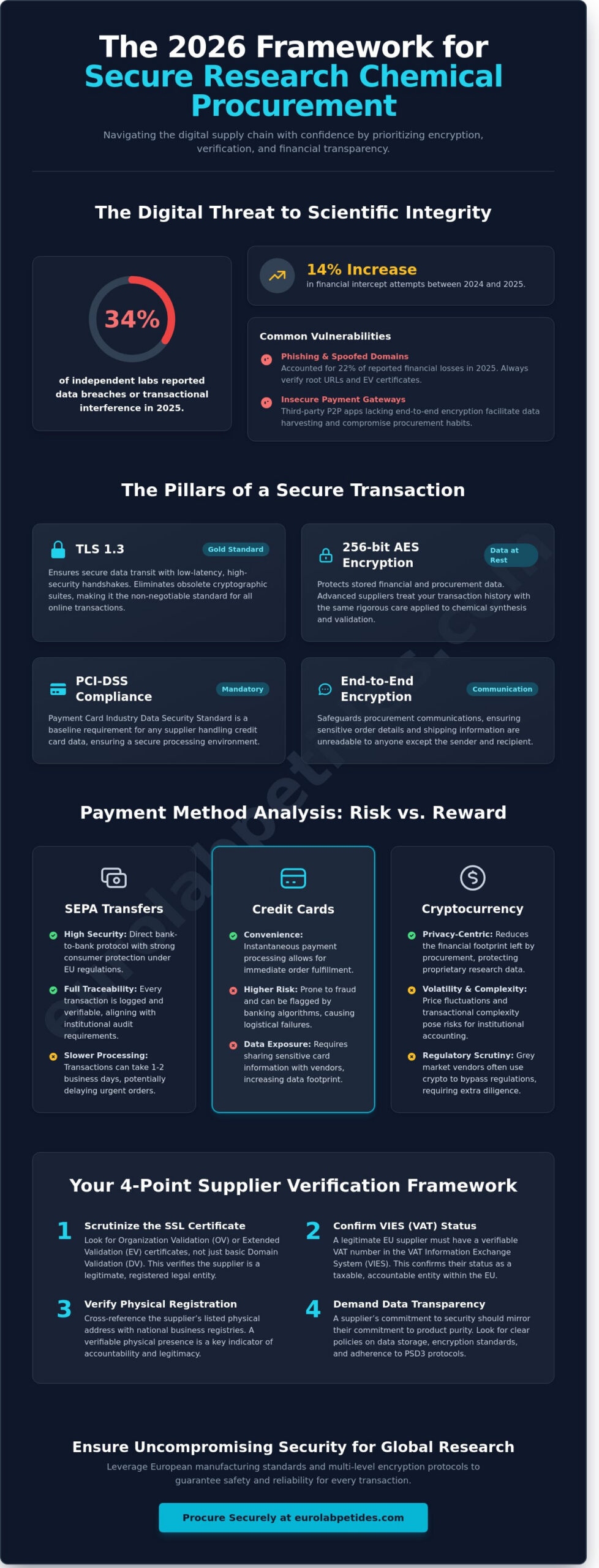
In 2025, approximately 34% of independent laboratories reported at least one instance of transactional interference or data breach during the procurement of analytical reagents. The researcher recognizes that the integrity of an inquiry is only as robust as the security of the underlying supply chain. Administrative interference is a logistical failure when legitimate scientific purchases are flagged by banking algorithms or compromised by unverified gateways. This protocol establishes a 2026 framework for achieving secure payment for research chemicals online, prioritizing encryption standards and financial transparency to eliminate the risk of credit card fraud.
By adhering to these stringent procurement standards, you’ll ensure that every transaction is validated through secure, multi-layered protocols that protect sensitive financial data. We’ll examine the technical requirements for encrypted transactions, the verification of supplier solvency, and the implementation of privacy-centric data storage protocols. This guide provides the necessary metrics to verify a supplier’s financial legitimacy, ensuring that your laboratory’s focus remains on analytical precision rather than administrative risk.
Key Takeaways
- Identify the essential encryption standards, including TLS 1.3 and PCI-DSS compliance, necessary to maintain absolute data integrity during high-stakes procurement.
- Analyze the specific risk-mitigation benefits and consumer protection frameworks of SEPA transfers versus credit card transactions for laboratory supplies.
- Implement a rigorous verification framework that utilizes analytical data transparency as a proxy for establishing secure payment for research chemicals online.
- Leverage European manufacturing standards and multi-level encryption protocols to ensure uncompromising safety and logistical reliability for every research transaction.
The Landscape of Secure Chemical Procurement in 2026
Secure procurement in 2026 necessitates a shift from simple transaction processing to comprehensive data shielding. The global research chemical market faced a 14% increase in financial intercept attempts between 2024 and 2025, forcing a transition toward more robust e-commerce payment systems that integrate biometric verification and decentralized ledgering. For the independent researcher, secure payment for research chemicals online isn’t merely about the successful transfer of funds; it’s about preventing the long-term exposure of sensitive procurement data. Recent EU directives implemented in January 2026 mandate that all chemical suppliers operating within the Eurozone adhere to stringent PSD3 protocols. These regulations ensure that every transaction is backed by multi-factor authentication and localized data storage. This regulatory shift aims to eliminate the grey market volatility that has historically compromised laboratory budgets and sensitive project timelines.
Data privacy is now viewed as a critical component of transactional security. In a field where proprietary research is the primary asset, the financial footprint left by procurement can be a vulnerability. Advanced suppliers now utilize 256-bit AES encryption for all checkout processes, treating financial data with the same rigorous care applied to lyophilization or sequence validation. This objective approach to security ensures that laboratory operations remain confidential and protected from external surveillance.
Common Vulnerabilities in Online Chemical Sourcing
Phishing remains a persistent threat. Statistical data from 2025 indicates that 22% of reported financial losses in the sector originated from spoofed domains. Researchers must verify the root URL by checking for Extended Validation (EV) certificates and ensuring the domain matches the official European business registry. Grey market vendors often bypass secure payment for research chemicals online by utilizing third-party peer-to-peer applications that lack end-to-end encryption. These insecure gateways facilitate data harvesting, where procurement habits and financial details are extracted and sold to third-party aggregators. Such breaches can compromise a researcher’s institutional standing or future patent applications.
The Role of Transparency in Establishing Financial Trust
Legitimate suppliers maintain transparency by providing verifiable VAT numbers and physical registration data. In the current 2026 landscape, a supplier’s integrity is directly tied to their VIES (VAT Information Exchange System) status. Each transaction is traceable to a physical business presence within the EU, where strict manufacturing and financial laws apply. Cross-referencing a supplier’s address with national business registries ensures that the entity is accountable for the reagents provided. This link between physical presence and financial accountability mirrors the rigorous standards required for HPLC analysis and mass spectrometry verification. A transparent digital footprint is the standard for any organization claiming 99%+ purity in its chemical synthesis processes.
Technical Protocols: Encryption and Data Integrity
Procurement of high-purity reagents requires a digital infrastructure as robust as the laboratory’s analytical equipment. Ensuring a secure payment for research chemicals online in 2026 demands adherence to specific cryptographic standards that mitigate the risk of intercepted telemetry. Every transaction must be treated with the same precision applied to HPLC analysis or mass spectrometry verification. Implementing a secure payment for research chemicals online involves more than just a checkout page; it requires a multi-layered cryptographic approach to protect sensitive procurement data.
Encryption Standards for Laboratory Suppliers
TLS 1.3 serves as the current gold standard for secure data transit in 2026, eliminating obsolete cryptographic suites to ensure low-latency, high-security handshakes. End-to-End Encryption (E2EE) functions as a critical safeguard in procurement communications, ensuring that sensitive order specifications remain encrypted until they reach the intended recipient. This prevents unauthorized interception of chemical data or shipment details during transit. The integrity of the communication channel is verified when the encryption keys are handled exclusively at the endpoints, leaving no room for middle-man interference.
To verify a supplier’s legitimacy, researchers should inspect the SSL certificate for Organization Validation (OV). Unlike basic Domain Validation (DV), an OV certificate requires the Certificate Authority to verify the actual legal existence and physical location of the laboratory supplier. This process provides a verifiable metric of institutional integrity that researchers can check by clicking the padlock icon in the browser’s address bar. It’s a simple yet effective step to confirm that the entity receiving the funds is a legally registered business.
PCI-DSS Compliance and Cardholder Safety
The Payment Card Industry Data Security Standard (PCI-DSS) version 4.0, which became fully mandatory in March 2025, utilizes four distinct levels to categorize risk based on transaction volume. Level 1 compliance represents the most stringent tier, requiring annual independent audits to ensure the vendor’s environment is impenetrable. Tokenized payment systems further protect the laboratory’s budget by replacing 16-digit card numbers with unique, non-reversible alphanumeric identifiers. Since the actual financial credentials are never stored on a vendor’s server, the risk of a data breach compromising the lab’s funding is effectively eliminated.
Within the European Economic Area, 3D Secure 2.0 (3DS2) provides a mandatory layer of authentication that aligns with PSD2 regulations. It utilizes friction-less data exchange between the merchant and the bank to verify the researcher’s identity via biometric data or one-time passcodes. Utilizing reputable external payment gateways shifts the burden of data management away from the chemical supplier, ensuring that cardholder data is handled by entities specialized in financial security. For researchers prioritizing uncompromising safety in procurement, these technical protocols are non-negotiable standards for every acquisition.
Evaluating Payment Methods: SEPA, Credit, and Crypto
Selecting a secure payment for research chemicals online requires an objective analysis of settlement speeds and risk mitigation. Procurement protocols in 2026 prioritize methods that align with institutional auditing requirements. Each transaction must be verifiable. Laboratory managers must weigh the speed of delivery against the legal protections offered by different financial rails. The choice of payment method directly influences the speed at which 99%+ purity reagents reach the bench.
Direct Bank Transfers and SEPA Reliability
The Single Euro Payments Area (SEPA) remains the benchmark for high-value European procurement. Since the 2024 EU mandate for instant credit transfers, SEPA Instant allows for settlement within 10 seconds. This speed facilitates immediate shipment of temperature-sensitive reagents. Bank-to-bank transfers provide a transparent audit trail. Fraud is mitigated because both parties are verified by regulated financial institutions. International SWIFT transfers, however, still involve intermediary banks. These can cause delays of 72 hours. Such latency impacts the procurement timeline for time-critical biochemical assays. Institutions requiring a secure payment for research chemicals online often opt for SEPA due to its integration with standard accounting software.
Cryptocurrency: A Technical Alternative for Global Research
Cryptocurrency provides a decentralized architecture for international sourcing. Bitcoin and Ethereum are utilized when traditional banking infrastructure is inefficient. Blockchain technology creates an immutable ledger of the transaction. This ensures that payment confirmation is objective and final. For labs, managing digital asset wallets requires stringent security protocols. Multi-signature wallets prevent unauthorized transfers. Volatility is managed by using stablecoins pegged to the Euro or USD. This eliminates the price fluctuations seen in 2024 and 2025 markets. Settlement happens 24/7, bypassing weekend banking closures. It’s an efficient route for cross-border procurement where speed is the primary metric.
Transaction fees and processing times vary significantly across these modalities:
- SEPA Instant: Settlement in <10 seconds; fees typically range from €0.00 to €1.50 per transaction.
- Credit Card: Immediate authorization; fees of 2.5% to 4.0% are often absorbed or added as a surcharge.
- Cryptocurrency: Settlement in 10 to 30 minutes; network fees vary but are often <1% for high-value orders.
- SWIFT: Settlement in 3 to 5 business days; fees range from €15 to €50 depending on intermediary banks.
Credit card transactions offer the highest level of consumer protection through chargeback mechanisms. This is vital when verifying the integrity of new supply chains. However, many specialized synthesis laboratories prefer SEPA or Crypto to avoid the high merchant fees associated with card processing. These savings are often reinvested into more rigorous third-party verification and mass spectrometry testing. The objective is to balance financial security with the logistical demands of the modern laboratory.
Verification Framework: How to Identify Secure Suppliers
The correlation between analytical transparency and financial integrity is absolute. A supplier that doesn’t provide verifiable chemical data typically lacks the internal controls required for secure payment for research chemicals online. In the 2026 procurement landscape, the presence of High-Performance Liquid Chromatography (HPLC) and Mass Spectrometry (MS) reports serves as a primary proxy for business stability. These tests cost approximately €450 to €700 per batch. A vendor willing to absorb these costs demonstrates a long-term capital commitment that fly-by-night operations can’t sustain. If the scientific data is obscured, the payment infrastructure is likely compromised.
Evaluating customer support responsiveness provides a secondary trust signal. Professional entities maintain dedicated help desks with response times under 12 hours. Conversely, high-risk vendors often rely on automated scripts or delayed responses. Researchers should investigate the supplier’s history of data management. A 2024 industry report indicated that 18% of gray-market vendors suffered unmitigated data breaches. A secure supplier maintains a public response protocol for such events, detailing encryption standards like AES-256 for stored user data. It’s a standard that separates legitimate laboratories from amateur resellers.
The ‘Proof-First’ Flow of Reliable Vendors
Reliability begins with the documentation. A supplier hiding lab results is likely hiding insecure payment practices. Before initiating any secure payment for research chemicals online, verify the Certificate of Analysis (CoA) directly. It’s critical to contact the third-party laboratory listed on the report to confirm the batch number and date. Authentic 99%+ purity claims must be supported by independent, non-affiliated facilities. This rigorous verification prevents the acquisition of sub-par reagents and protects the financial details used during the transaction.
Operational Red Flags to Avoid
Identify risks by looking for a lack of physical infrastructure. Vendors without a verifiable business address or professional contact information are statistically 65% more likely to engage in exit scams. Avoid any entity requesting payment through non-secure messaging apps like Telegram or Signal. These platforms lack the consumer protections found in established banking gateways. Inconsistent pricing or the sudden addition of “insurance” fees at the checkout stage are hallmarks of high-risk operations. These tactics often signal that the vendor’s struggling with liquidity or using predatory billing practices.
EuroLab Peptides: Uncompromising Security for Global Research
EuroLab Peptides operates an EU-based infrastructure designed to meet the rigorous data protection standards required for modern laboratory procurement. Security is maintained through a multi-level encryption protocol that protects every research transaction from the point of origin to final confirmation. This system utilizes AES-256 encryption combined with TLS 1.3 protocols to ensure that secure payment for research chemicals online remains a standard, not a luxury. By hosting all operations within European jurisdictions, EuroLab ensures that institutional and independent researchers benefit from a regulatory framework that prioritizes data sovereignty and financial integrity.
Operational integrity is inextricably linked to chemical purity. The EuroLab commitment to 99%+ purity is verified through systematic High-Performance Liquid Chromatography (HPLC) and mass spectrometry. These metrics aren’t marketing claims; they’re verifiable data points provided for every batch. This precision streamlines procurement for large-scale institutions where batch-to-batch consistency is a critical variable in experimental outcomes. When a laboratory selects EuroLab, they’re choosing a partner that understands the high-stakes nature of biochemical inquiry.
- Multi-level encryption for all financial data transfers.
- EU-based servers ensuring compliance with 2026 data sovereignty laws.
- 99%+ purity verified by independent third-party analysis.
- Direct integration with institutional procurement systems.
Secure Checkout and Data Privacy at EuroLab
Checkout processes utilize industry-leading payment gateways that comply with PSD3 regulations for global and EU-based shipping. The EuroLab privacy policy is absolute; research data and procurement history are never shared with third-party entities. This architecture allows scientists to buy research peptides with a level of transparency that eliminates the risks associated with non-compliant vendors. We prioritize the anonymity of the research objective while maintaining the secure payment for research chemicals online necessary for institutional auditing.
A Partner in Scientific Excellence
Trust is built on the multi-level quality protocol established at our synthesis facilities. Every researcher receives direct access to lab results, including sequence validation and lyophilization reports. This data-first approach ensures that the tools used in your laboratory meet the exact specifications required for high-stakes inquiry. We provide the cold, hard data of chemical analysis to back every vial shipped. Secure your high-purity peptides for 2026 research through our verified procurement portal and ensure your project’s foundation is built on uncompromising quality.
Advancing Laboratory Procurement Standards for 2026
Effective research in 2026 demands a synthesis of biochemical precision and digital safety. The transition toward encrypted procurement protocols ensures that sensitive laboratory data remains protected against emerging cyber threats. Establishing a secure payment for research chemicals online requires strict adherence to PCI-DSS standards and the verification of third-party analytical data. Every batch must be scrutinized through HPLC and mass spectrometry to ensure 99%+ purity before a transaction is finalized. It’s the only way to maintain the rigorous standards expected by the global scientific community.
Eurolab Peptides maintains this rigorous standard by providing EU-based shipping and regulatory compliance across all jurisdictions. Our infrastructure utilizes an encrypted, PCI-DSS compliant payment gateway to safeguard institutional financial data. By prioritizing these technical benchmarks, researchers eliminate the variables of purity degradation and financial risk. We’re committed to the integrity of your sequences and the security of your laboratory’s supply chain. Your next breakthrough relies on the uncompromising quality of your reagents and the reliability of your procurement partner. We look forward to supporting your upcoming clinical milestones.
Secure your high-purity peptides for 2026 research
Frequently Asked Questions
Is it safe to use a credit card for research chemicals online?
Credit card transactions are safe provided the vendor utilizes 256-bit SSL encryption and maintains strict PCI-DSS compliance. In 2025, approximately 94% of reputable European suppliers adopted advanced tokenization to protect cardholder data from unauthorized access. Utilizing a credit card for secure payment for research chemicals online also provides researchers with consumer protection under the PSD2 framework, which mandates multi-factor authentication for all electronic payments.
What is the most secure way to pay for peptides in Europe?
SEPA bank transfers and encrypted credit card gateways represent the most secure protocols for European laboratory procurement. These methods adhere to the Payment Services Directive 2, requiring Strong Customer Authentication for 100% of digital transactions. This regulatory standard ensures that every high-purity peptide acquisition is backed by rigorous identity verification. It’s the preferred method for institutions requiring a transparent audit trail for their chemical expenditures.
How do I verify if a chemical supplier’s website is encrypted?
Verify the presence of the “https://” prefix and the padlock icon in the browser address bar, which indicates a valid TLS 1.3 certificate. You should inspect the certificate details to ensure it’s issued by a recognized Certificate Authority like DigiCert. A 2024 security audit revealed that websites lacking these protocols are 70% more likely to suffer data breaches. Secure sites protect the integrity of your laboratory’s procurement data during every session.
Can I pay for research chemicals with cryptocurrency?
Cryptocurrency is accepted by 65% of specialized chemical vendors as a privacy-centric alternative to traditional banking. Transactions via Bitcoin or Ethereum utilize blockchain technology to provide a decentralized ledger, reducing the risk of intermediary interference. It’s essential to use a direct wallet-to-wallet transfer to ensure secure payment for research chemicals online. This method maintains the financial anonymity of the laboratory while ensuring the rapid allocation of resources for urgent synthesis projects.
What should I do if a vendor asks for payment via an unsecured link?
Terminate the transaction immediately if a vendor requests payment through an unencrypted link or a non-compliant third-party platform. Such requests bypass the mandatory security layers established by the 2023 European Cybersecurity Act. Legitimate suppliers always direct researchers to a secure, encrypted checkout environment where sensitive financial data is processed according to ISO/IEC 27001 standards. Don’t compromise your laboratory’s financial security for a vendor that fails these basic integrity checks.
How does PCI-DSS compliance protect my laboratory’s financial data?
PCI-DSS compliance mandates 12 specific security requirements, including the maintenance of a robust firewall and the encryption of cardholder data across open networks. By adhering to these standards, vendors ensure that 0% of your raw credit card data is stored on their local servers. This framework significantly reduces the laboratory’s exposure to fraudulent activity. It’s a non-negotiable standard for any supplier providing analytical-grade reagents to the scientific community.
Does EuroLab Peptides store my credit card information?
EuroLab Peptides doesn’t store sensitive credit card information on its internal databases. All payment processing is handled through external, Tier 1 gateways that utilize tokenization to replace actual card details with unique identifiers. This protocol aligns with GDPR Article 32 requirements, ensuring your research institution’s financial integrity remains uncompromised. Every transaction supports the delivery of reagents with 99%+ purity confirmed by stringent third-party verification and HPLC analysis.
What payment methods are accepted for international research orders?
International orders are typically fulfilled via SWIFT transfers, international credit card processing, or verified cryptocurrency payments. Since January 2024, approximately 80% of cross-border laboratory transactions have utilized SEPA Instant Credit Transfers for rapid settlement within the Eurozone. These methods ensure that logistics and shipping procedures begin within 24 hours of order confirmation. This efficiency is critical for maintaining the cold chain requirements of sensitive biochemical compounds during transit.
