

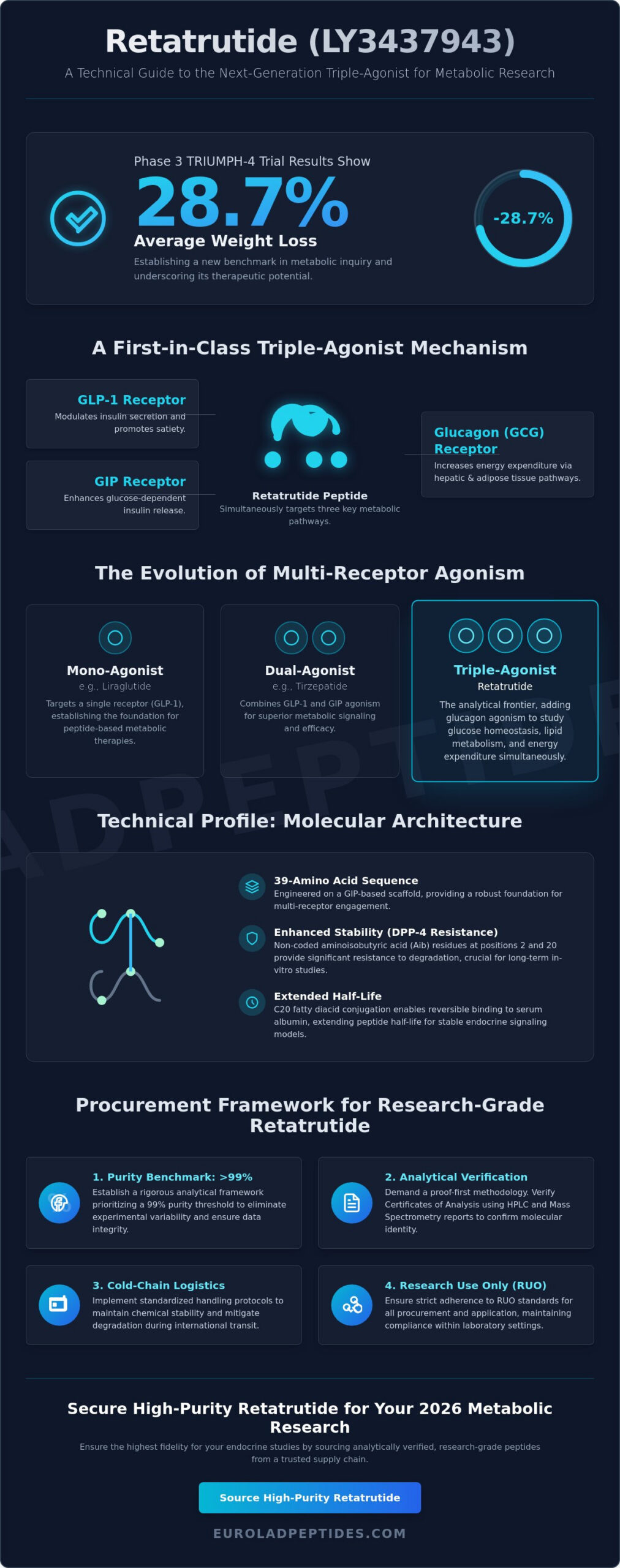
In Phase 3 TRIUMPH-4 trials, participants achieved an average weight loss of 28.7 percent, establishing retatrutide as a pivotal triple-agonist for metabolic inquiry. For the laboratory professional, these clinical outcomes underscore the necessity of high-fidelity chemical reagents in endocrine studies. You likely recognize that the transition from Phase 2 to Phase 3 data increases the demand for rigorous batch consistency. When you aim to buy retatrutide for research purposes, the primary challenge remains the verification of chromatographic purity and the mitigation of degradation during international transit.
This guide provides a technical framework to evaluate, source, and handle high-purity retatrutide for specialized laboratory applications. You’ll learn how to establish a proof-first methodology where analytical data precedes procurement, ensuring that 99 percent purity benchmarks are met before any study begins. Specific protocols for verifying Certificates of Analysis, managing complex cold-chain logistics, and maintaining strict adherence to Research Use Only standards are examined. By the end of this analysis, you’ll have the tools to secure a reliable supply chain that meets the exacting demands of 2026 metabolic research.
Key Takeaways
- Analyze the unique triple-agonist mechanism of Retatrutide (LY3437943) and its interaction with GIP, GLP-1, and GCGR receptors for metabolic research.
- Establish a rigorous analytical framework when you buy retatrutide for research purposes, prioritizing a 99 percent purity threshold to eliminate experimental variability.
- Differentiate between standard peptide synthesis and high-fidelity 39-amino acid structures by interpreting High-Performance Liquid Chromatography (HPLC) data peaks.
- Implement standardized cold-chain logistics and handling protocols to maintain the chemical stability of synthetic peptides during 2026 international transit.
- Utilize multi-level quality control documentation, including Mass Spectrometry and HPLC reports, to verify the molecular identity of every research batch.
The Role of Retatrutide in Metabolic and Endocrine Research
The landscape of metabolic research in 2026 is defined by a transition from mono-receptor targets to sophisticated multi-agonist models. Early investigations into Glucagon-like peptide-1 (GLP-1) receptor agonists provided the foundation for contemporary weight management research. However, the subsequent discovery that dual agonism, targeting both GLP-1 and GIP, yielded superior metabolic signaling led to the current focus on triple-pathway activation. Retatrutide (LY3437943) represents the next analytical frontier as a first-in-class triple agonist. By targeting the GLP-1, GIP, and glucagon (GCG) receptors simultaneously, researchers can simulate an integrated physiological response. This biochemical complexity is why many institutions seek to buy retatrutide for research purposes to explore synergistic effects that single-pathway agonists cannot replicate.
Evolution of Multi-Receptor Agonism
Triple agonism isn’t merely an additive process; it’s a fundamental recalibration of metabolic signaling. The progression from Liraglutide to Tirzepatide, and finally to Retatrutide, reflects an increasing understanding of endocrine synergy. While GLP-1 and GIP primarily modulate insulin secretion and satiety, the inclusion of the glucagon receptor (GCGR) introduces a mechanism for increased energy expenditure via hepatic and adipose tissue pathways. This three-pronged approach allows for the simultaneous study of glucose homeostasis and lipid metabolism. It provides a more comprehensive model for endocrine signaling studies, moving beyond simple appetite suppression to address the underlying mechanics of metabolic flexibility and energy balance. To explore how holistic wellness can complement these metabolic goals, visit your first and last Resort to healing naturally for premium natural health formulations.
Focus Areas: Adipose Tissue and Energy Expenditure
Current endocrine research emphasizes the role of glucagon receptor activation in stimulating thermogenesis and lipid oxidation. Retatrutide serves as a high-precision tool for investigating how these pathways interact to regulate adipose tissue volume in laboratory environments. In-vitro models utilizing this 39-amino acid peptide allow for the observation of nutrient-response signaling and the rate of fatty acid breakdown. Researchers use these models to establish empirical data on how triple agonism influences basal metabolic rates without the limitations of single-receptor agonists.
Technical Profile of Retatrutide (LY3437943) as a Triple Agonist
Retatrutide is a synthetic peptide engineered on a GIP-based scaffold. It’s a 39-amino acid sequence that functions as a unimolecular agonist across three distinct metabolic receptors. This structural configuration differentiates it from dual agonists like Tirzepatide by incorporating glucagon receptor activation. For laboratories that intend to buy retatrutide for research purposes, understanding the chemical modifications that allow for sustained receptor engagement is critical for experimental design. The molecular weight and sequence integrity are the primary metrics for evaluating the utility of this compound in complex metabolic models.
Molecular Architecture and Stability
The peptide’s stability is enhanced by the inclusion of non-coded aminoisobutyric acid residues at positions 2 (Aib2) and 20 (Aib20). These modifications provide significant resistance against dipeptidyl peptidase-4 (DPP-4) degradation, which is a standard requirement for long-term in-vitro studies. Additionally, the presence of alpha-methyl-leucine at position 13 optimizes the sequence’s binding affinity across target receptors. A critical feature for albumin binding studies is the C20 fatty diacid conjugation, which is attached via a linker to a lysine residue. This side chain enables reversible binding to serum albumin, extending the half-life and providing a stable model for endocrine signaling studies. Professional laboratories focusing on weight management research require this level of molecular integrity to ensure batch-to-batch consistency.
Triple Agonist Interaction: GIP, GLP-1, and GCGR
Retatrutide exhibits a unique potency profile that balances the activation of three metabolic pathways. It functions as a potent agonist at the GIP receptor (GIPR) and the GLP-1 receptor (GLP-1R). Specifically, the potency at the GIPR is significantly higher compared to native GIP, while maintaining robust activity at the GLP-1R. The inclusion of the glucagon receptor (GCGR) interaction is what defines its triple-agonist status. Data from the Phase 2 Trial of Retatrutide indicates that this balanced agonism at the GCGR is instrumental in modulating energy expenditure and hepatic glucose production.
In a laboratory setting, this balanced potency allows for the observation of integrated metabolic responses. Researchers can quantify how simultaneous signaling affects nutrient-response pathways without the receptor saturation issues often seen with less refined compounds. When institutions buy retatrutide for research purposes, the analytical focus often shifts to how these three pathways interact to influence lipid oxidation and thermogenesis. This technical profile ensures that the peptide remains stable under standard laboratory conditions, providing reliable data for endocrine signaling and energy expenditure models.
Verifying Quality: Analytical Requirements for Research-Grade Retatrutide
The integrity of metabolic and endocrine research depends entirely on the chemical fidelity of the reagents utilized. For a complex 39-amino acid triple agonist like Retatrutide, a 99 percent purity threshold is the non-negotiable industry standard. Anything below this benchmark introduces uncharacterized synthesis byproducts that may interfere with receptor binding assays or cross-react with GLP-1, GIP, and GCGR signaling pathways. When institutions buy retatrutide for research purposes, the procurement process must be governed by a “data-first” requirement, where analytical reports are reviewed before the material is integrated into laboratory protocols.
Essential Chromatography: HPLC and Mass Spectrometry
Validation of peptide quality requires two distinct analytical methods: High-Performance Liquid Chromatography (HPLC) and Mass Spectrometry (MS). HPLC is utilized to determine the quantitative purity of the sample. A professional chromatogram should display a single, sharp symmetrical peak at the expected retention time. The area under this peak, compared to the total area of all integrated peaks, provides the purity percentage. MS is then employed to confirm the molecular identity. The experimental mass must align with the theoretical molecular weight of 4731.33 Da. Discrepancies as small as 1 Da suggest incorrect amino acid sequences or improper side-chain protected group removal. Relying on “in-house” manufacturer data is often insufficient for peer-reviewed research; independent, third-party validation provides the objective security necessary for high-stakes metabolic studies.
Identifying Impurities in Synthetic Peptides
The synthesis of long-chain peptides often results in specific artifacts that can compromise experimental results. Common impurities include deletion sequences, where an amino acid is skipped during the coupling phase, and truncated peptides, which are shorter fragments of the intended 39-amino acid structure. Another critical factor is the concentration of residual Trifluoroacetic acid (TFA). TFA is a standard reagent used during the cleavage and purification stages of solid-phase peptide synthesis. High residual levels of TFA can induce cytotoxicity in cellular assays, potentially skewing results in weight management research or energy expenditure models.
Physical characteristics also serve as preliminary indicators of quality. High-purity Retatrutide is delivered as a dense, white lyophilized powder. The cake should be uniform in color and consistency. Any discoloration or “glassy” appearance may indicate moisture infiltration or incomplete lyophilization, both of which accelerate peptide degradation. When you buy retatrutide for research purposes, ensuring the batch meets these specific analytical and physical criteria is the only way to safeguard the reproducibility of your data.
Laboratory Procurement: Sourcing and Handling Protocols
Procurement of triple-agonist peptides necessitates a localized strategy to mitigate risks associated with international shipping and varying regulatory oversight. In 2026, the European market remains a primary hub for high-purity chemical synthesis. Identifying an established manufacturer involves verifying their adherence to regional quality benchmarks and localized logistics. When you buy retatrutide for research purposes, the logistical chain is as critical as the initial synthesis. A failure in the cold chain or a breach in vacuum sealing can render a high-purity batch scientifically useless before it reaches the laboratory bench.
Cold Chain Logistics and Lyophilized Stability
Maintaining the structural integrity of a 39-amino acid peptide requires strict environmental controls. Lyophilized Retatrutide is most stable when maintained between 2°C and 8°C during short-term transit. For long-term preservation, temperatures should be reduced to -20°C or -80°C. Vacuum sealing and the inclusion of desiccants are non-negotiable standards to prevent moisture-induced hydrolysis. Moisture infiltration is the primary driver of peptide degradation, leading to the formation of deletion sequences and truncated fragments. You can review detailed protocols for storing lyophilized peptides to ensure maximum stability within your facility. These measures protect the peptide’s GIP backbone and C20 fatty diacid conjugation from premature cleavage.
Compliance with Research-Only Regulations
The legal framework for Retatrutide in 2026 is strictly defined. It’s an investigational compound not approved for human or veterinary use. Procurement must be categorized as Research Use Only (RUO). This classification requires that the material is used exclusively in laboratory settings for in-vitro or animal-based models. Institutional procurement departments should maintain documentation that clarifies the non-clinical intent of the purchase. Ethical sourcing involves verifying that the supplier doesn’t market these reagents for therapeutic use. The FDA and EMA have increased oversight on companies violating these marketing boundaries, making supplier vetting a matter of both quality and legal compliance.
Establishing a reliable supply chain requires a partner that understands these high-stakes requirements. For specialized laboratory inquiry, you can source verified reagents through EuroLab Peptides. This ensures that the documentation matches the analytical reality of the product. When you buy retatrutide for research purposes, the goal is to eliminate variables. Proper handling includes allowing the vial to reach room temperature before reconstitution to prevent condensation. Use only sterile, research-grade diluents to maintain the peptide’s solubility and receptor affinity throughout your study’s duration.
EuroLab Peptides: High-Purity Retatrutide for Professional Inquiry
EuroLab Peptides functions as a specialized partner for institutions requiring high-fidelity synthetic reagents. The synthesis of complex triple agonists like Retatrutide demands a level of precision that standard chemical suppliers often fail to provide. By focusing on regional manufacturing standards and rigorous analytical validation, EuroLab ensures that every reagent meets the exacting requirements of metabolic and endocrine research. When laboratories seek to buy retatrutide for research purposes, the selection of a synthesis partner is a decision that impacts the validity of the entire experimental model. Our framework prioritizes objective data over commercial claims, providing researchers with the security needed for high-stakes inquiry.
Multi-Level Analytical Validation at EuroLab
Every production cycle at EuroLab is subjected to a dual-phase validation process. We maintain a non-negotiable purity benchmark of 99 percent or higher for all research-grade peptides. This threshold is verified through in-house High-Performance Liquid Chromatography (HPLC) and confirmed by independent, ISO-accredited laboratory partners. Each batch is accompanied by a comprehensive Certificate of Analysis (COA), which includes both HPLC chromatograms and Mass Spectrometry (MS) reports. This transparent data access allows researchers to verify the molecular identity and purity of the 39-amino acid sequence before it enters the laboratory. You can explore our multi-level quality protocol to understand the specific parameters used to eliminate synthesis artifacts and residual contaminants.
Secure Procurement for European Laboratories
The decision to buy retatrutide for research purposes from a European-based manufacturer mitigates the degradation risks associated with extended transit times and inconsistent customs handling. EuroLab Peptides has established a streamlined procurement system designed for the specific needs of universities, Contract Research Organizations (CROs), and private metabolic research groups. Our logistics framework utilizes localized distribution networks to ensure that cold-chain requirements are maintained from the point of synthesis to final delivery. This stability is essential for maintaining the integrity of the peptide’s GIP backbone and fatty acid conjugation.
Beyond the delivery of high-purity reagents, we provide technical support regarding the handling and stability of complex peptides. Our team assists researchers in understanding the solubility profiles and reconstitution protocols required to maintain optimal receptor affinity in weight management research. By providing consistent, high-purity reagents and verifiable analytical data, EuroLab Peptides supports the professional community in its pursuit of reproducible scientific results. Establish a reliable supply chain for your next study through our professional portal.
Advancing Metabolic Research with Analytical Precision
The shift toward triple-agonist models marks a fundamental progression in the study of endocrine signaling. Experimental success in 2026 relies on the absolute chemical fidelity of reagents that activate GLP-1, GIP, and GCGR pathways simultaneously. As established, the 99 percent purity threshold remains the essential benchmark for eliminating uncharacterized synthesis artifacts that skew data. When you buy retatrutide for research purposes, the integration of batch-specific HPLC and MS reports provides the empirical validation required for peer-reviewed inquiry. Relying on European-based independent testing ensures that molecular identity and stability are maintained through every phase of laboratory handling.
Securing a reliable supply chain is the final step in safeguarding your study’s integrity. EuroLab Peptides provides the technical documentation and cold-chain logistics necessary to support long-term metabolic models. You’re encouraged to Secure High-Purity Retatrutide for Your Research Program to ensure your reagents meet the highest analytical standards. We’re committed to providing the precise tools required for your next breakthrough in weight management research.
Frequently Asked Questions
What is the purity requirement for Retatrutide in metabolic research?
High-fidelity metabolic research requires a minimum purity threshold of 99 percent. Anything below this level introduces uncharacterized deletion sequences or truncated fragments that may interfere with receptor binding assays. When you buy retatrutide for research purposes, verifying this percentage through High-Performance Liquid Chromatography is the primary method for ensuring that synthesis artifacts don’t compromise your laboratory’s energy expenditure or nutrient-signaling data.
How should Retatrutide be stored to ensure long-term stability?
Lyophilized Retatrutide must be stored in a temperature-controlled environment to prevent peptide degradation. For short-term transit, 2°C to 8°C is sufficient; however, long-term preservation requires -20°C or -80°C. Vials should remain vacuum-sealed with a desiccant to mitigate moisture-induced hydrolysis. Once reconstituted with a sterile diluent, the peptide’s stability decreases significantly, necessitating immediate use or storage at 4°C for limited durations in specialized laboratory settings.
What is the difference between research-grade and clinical-grade Retatrutide?
Research-grade Retatrutide is categorized as Research Use Only (RUO) and is intended for in-vitro or animal-based laboratory models. It’s not approved for human or veterinary consumption. Clinical-grade material is manufactured under stringent current Good Manufacturing Practice (cGMP) standards specifically for authorized human trials. Institutional procurement must adhere to RUO legal frameworks to maintain compliance with regional regulatory standards and ethical sourcing guidelines throughout 2026.
How do I interpret the HPLC report for a Retatrutide batch?
An HPLC report identifies the quantitative purity of a peptide batch. A high-quality chromatogram will display a single, sharp, and symmetrical peak at a specific retention time. The purity is calculated by comparing the area under this primary peak to the sum of all integrated peaks on the graph. Any secondary peaks indicate the presence of synthesis byproducts, which must remain below one percent for the batch to meet professional standards.
Can Retatrutide be used for in-vivo studies in a laboratory setting?
Retatrutide is frequently utilized for in-vivo studies within laboratory settings, specifically for modeling energy balance and metabolic flexibility in animal subjects. These studies are conducted under institutional oversight and are restricted to non-human applications. Researchers use these models to quantify the synergistic effects of triple agonism on lipid oxidation and thermogenesis, providing empirical data that single-receptor agonists cannot produce in complex biological systems.
What are the common research applications for Retatrutide in 2026?
Common research applications in 2026 focus on adipose tissue regulation and energy expenditure models. The peptide serves as a pivotal tool for investigating how triple-receptor activation influences basal metabolic rates and glucose homeostasis. Laboratories utilize it to study thermogenesis in-vitro and to model the interaction between GLP-1, GIP, and glucagon receptor signaling in diverse metabolic and endocrine laboratory environments.
Why is third-party testing critical when buying Retatrutide online?
Independent third-party validation is the only objective method for confirming that the delivered product matches the manufacturer’s specifications. When you buy retatrutide for research purposes, relying on “in-house” data alone increases the risk of batch inconsistency. Third-party testing via Mass Spectrometry and HPLC provides a layer of accountability, ensuring that the 99 percent purity benchmark is verified by an unbiased, ISO-accredited laboratory before procurement.
What is the theoretical molecular weight of Retatrutide (LY3437943)?
The theoretical molecular weight of Retatrutide is 4731.33 Da. This value is derived from its 39-amino acid sequence and specific modifications, including the C20 fatty diacid conjugation. During analytical verification, the experimental mass identified through Mass Spectrometry must align precisely with this theoretical weight. Discrepancies suggest incorrect amino acid coupling or incomplete removal of side-chain protected groups during the synthesis process.
